
For most B2B revenue teams, the right choice is a unified agentic sales engine that combines CRM context, AI agents, multichannel execution, and data enrichment in one layer. Fragmented point solutions force reps to context-switch constantly, and that friction kills adoption faster than any feature gap.
Top shortlist at a glance:
- Unified agentic execution layer (Crono): Best for teams that want a single platform connecting CRM sync, AI agents, outreach automation, and sales orchestration. Fits mid-market and scaling B2B teams that need predictable pipeline without adding RevOps headcount.
- Revenue intelligence platforms (Gong, 6sense): Best for enterprise teams prioritizing conversation analysis, deal risk scoring, and forecast accuracy. High RevOps investment required; strong ROI when adoption is managed well.
- Outreach-first automation (Outreach, Reply, Regie.ai, Apollo.io, UpLead): Best for SDR-heavy teams focused on outbound volume, sequence automation, and contact data. Faster to deploy but narrower in scope.
- Coaching-centered platforms (Avoma, Dialpad): Best for teams where rep development and call quality are the primary levers. Pairs well with a separate execution layer.
- Field-first mobile apps (SPOTIO): Best for outside sales and territory teams that need route optimization, activity capture, and lead prioritization on the go.
TL;DR: If your team needs one platform that covers the full execution cycle, request a Crono demo. If you have a specific gap (coaching, field mobility, or outbound volume), match the category to that gap first, then evaluate whether a unified layer can consolidate it.
Table of Contents
- How do these AI sales platforms compare at a glance?
- What each platform category actually does in practice
- How to choose the right AI sales platform for your team
- How we evaluated these platforms
- Why agentic AI and revenue intelligence actually move the needle
- Key Takeaways
- The gap between what AI sales tools promise and what actually matters
- Crono brings execution, AI agents, and CRM context into one platform
- Useful sources and further reading
How do these AI sales platforms compare at a glance?
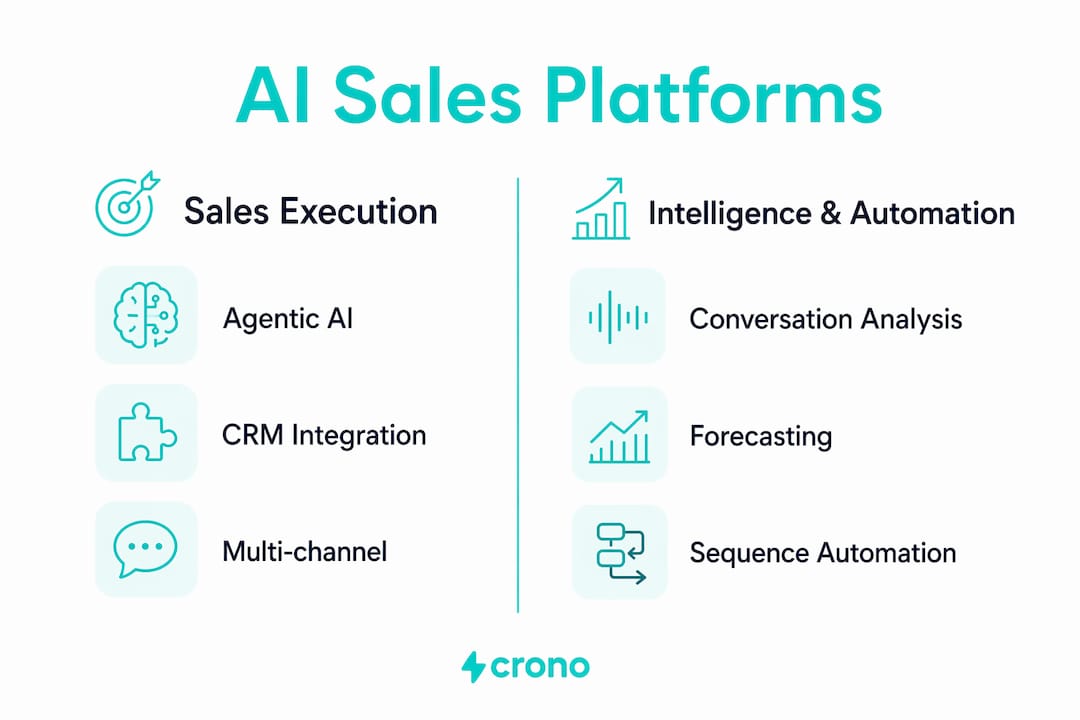
The table below maps each platform category to its core AI capability, integration footprint, and typical deployment shape. Use it to match your highest-priority GTM motion to the right category before going deeper.
| Category | Best for | Core AI capability | CRM integrations | Pricing model | Mobile/field | Security | Time-to-value |
|---|---|---|---|---|---|---|---|
| Unified agentic execution (Crono) | Mid-market B2B, full-cycle teams | AI agents, multichannel orchestration, enrichment, CRM sync | Salesforce, HubSpot, MS Dynamics | Seat-based, modular | Yes | SOC2-aligned | 2–4 weeks |
| Revenue intelligence (Gong, 6sense) | Enterprise, forecast-driven teams | Conversation AI, deal risk scoring, pipeline analytics | Salesforce, HubSpot, Dynamics | Seat + usage | Limited | SOC2, ISO | 6 weeks |
| Outreach automation (Outreach, Reply, Regie.ai, Apollo.io, UpLead) | SDR teams, high-volume outbound | Sequence automation, AI copywriting, contact enrichment | Salesforce, HubSpot | Seat or credit-based | Partial | SOC2 | 1–3 weeks |
| Coaching-centered (Avoma, Dialpad) | Enablement-focused teams | Call transcription, AI summaries, coaching scorecards | Salesforce, HubSpot, Dynamics | Seat-based | Yes (Dialpad) | SOC2 | 2–4 weeks |
| Field-first apps (SPOTIO) | Outside sales, territory teams | Route optimization, mobile activity capture, lead prioritization | Salesforce, HubSpot | Seat-based | Native mobile | SOC2 | 1–2 weeks |
Important caveats: Pricing varies significantly by seat count, contract length, and add-on modules. Vendor SLAs differ on support response time, uptime guarantees, and data residency options. Always request a written SLA before signing.
Categories that require more RevOps investment: Revenue intelligence platforms typically require several weeks of onboarding, CRM hygiene work, and ongoing model tuning. Outreach-first tools deploy faster but often require separate data enrichment subscriptions and manual sequence governance. Unified agentic layers like Crono are designed to reduce that RevOps overhead by connecting existing tools rather than replacing them.
What each platform category actually does in practice
Crono: the unified agentic execution layer
Crono is built as a sales execution layer, not a standalone point tool. It connects your existing CRM, data enrichment sources, and communication channels into one platform where AI agents and reps work together. The core capabilities include buying signal detection, automated data enrichment, multichannel sequence orchestration (email, LinkedIn, phone), AI-generated messaging, and deal prioritization. CRM sync covers Salesforce, HubSpot, and MS Dynamics with bidirectional updates, so activity data flows back without manual logging.

Pros: Single platform reduces tool sprawl; AI agents handle repetitive execution tasks; strong fit for teams running outbound and inbound motions simultaneously; faster time-to-value than enterprise-only platforms.
Cons: Teams with very large enterprise compliance requirements (strict data residency, custom SLA tiers) should verify specific configurations during a POC.
Pricing shape: Seat-based with modular add-ons. No publicly listed per-seat price; request a tailored quote based on team size and CRM stack.
Bottom line: Crono fits mid-market and scaling B2B teams that want to consolidate outreach, enrichment, and AI execution without a six-month integration project. Teams with a dedicated RevOps function will get the most from its orchestration capabilities.
Revenue intelligence platforms
These platforms (represented in the market by tools like Gong and 6sense) focus on analyzing conversation data, scoring deal health, and improving forecast accuracy. Their AI models ingest call recordings, email threads, and CRM deal data to surface risk signals and coaching opportunities.

Key features: Conversation transcription and analysis, deal risk scoring, pipeline analytics dashboards, forecast modeling, and competitive intelligence from call mentions.
Typical pros: Deep insight into why deals stall; strong forecast accuracy improvements when models are trained on sufficient deal history; AI-driven revenue forecasting can materially improve when revenue signals are unified across the CRM and call data.
Typical cons: High onboarding complexity; requires clean CRM data and consistent rep activity logging to produce reliable signals; seat costs tend to be high at enterprise scale.
Integration patterns: Native connectors for Salesforce and HubSpot; Dynamics support varies by vendor. Most require a dedicated integration setup period.
Security: SOC2 Type II and ISO 27001 certifications are common at the enterprise tier. Verify data residency options if your team handles regulated data.
Pricing shape: Seat plus usage fees; premium analytics modules often priced separately.
Outreach automation platforms
This category covers tools focused on sequence automation, AI-assisted copywriting, and contact data. Apollo.io and UpLead are strong examples of enrichment-first tools that combine a contact database with outreach sequencing. Outreach and Reply lean more toward sequence management and AI writing assistance. Regie.ai specializes in AI-generated sales content and sequence personalization.
Key features: Multi-step email and LinkedIn sequences, AI copywriting and personalization, contact database access (Apollo.io, UpLead), A/B testing, and engagement analytics.
Typical pros: Fast deployment; good for SDR teams running high-volume outbound; Apollo.io’s contact database is frequently cited by G2 reviewers for breadth of coverage.
Typical cons: Narrow scope; enrichment credits and premium connectors add cost quickly; sequence governance requires manual oversight to avoid deliverability issues.
Mobile/field readiness: Partial. Most outreach tools are desktop-first; mobile apps exist but are limited in functionality.
Pricing shape: Seat-based or credit-based depending on contact database usage. Watch for per-enrichment-credit fees that compound at scale.
Coaching-centered platforms
Avoma and Dialpad represent this category well. Avoma focuses on meeting intelligence: it records, transcribes, and summarizes calls, then surfaces coaching insights and action items. Dialpad combines a cloud phone system with AI transcription, real-time coaching prompts, and call analytics.
Key features: AI call summaries, real-time transcription, coaching scorecards, talk-time analytics, and CRM note sync.
Typical pros: Immediate value for managers reviewing call quality; Dialpad’s real-time coaching prompts help new reps handle objections without post-call debriefs.
Typical cons: Limited outreach automation; coaching insights require manager follow-through to translate into rep behavior change.
Mobile readiness: Dialpad has a strong mobile app. Avoma is primarily web-based.
Pricing shape: Seat-based. Dialpad bundles telephony with AI features; Avoma is priced as a standalone meeting intelligence tool.
Field-first mobile apps
SPOTIO is the clearest example in this category. It is built specifically for outside sales teams that need territory management, route optimization, and activity capture on a mobile device. Field teams get disproportionate value from mobile-first AI features for route optimization, lead prioritization, and activity capture, particularly when reps work in areas with inconsistent connectivity.
Key features: Territory mapping, route optimization, lead pin-dropping, offline activity capture, and Salesforce/HubSpot sync.
G2 user feedback for SPOTIO highlights ease of use for field reps and reliable CRM sync as consistent strengths.
Typical cons: Limited use for inside sales or SDR teams; AI capabilities are narrower than enterprise platforms.
Pricing shape: Seat-based. Pricing is not publicly listed; request a quote based on territory count and CRM stack.
Pro Tip: Hidden costs to watch across all categories include onboarding fees (some vendors charge $5,000–$25,000 for enterprise setup), premium CRM connector licenses, per-agent AI compute charges, and data enrichment credit overages. Always ask for a total cost of ownership estimate that covers year one and year two, not just the base seat price.
How to choose the right AI sales platform for your team
1. Map your primary GTM motion to a platform category
Start with the business outcome you need most, not the feature list. The right category follows from the motion:
- Increase pipeline conversion rate: Revenue intelligence platforms surface deal risk early and improve forecast accuracy.
- Accelerate outbound volume: Outreach automation tools with AI copywriting reduce sequence build time and personalize at scale.
- Improve rep coaching and call quality: Coaching-centered platforms give managers the data to run targeted 1:1s.
- Enable field and territory teams: Field-first apps with offline capture and route optimization drive adoption among outside reps.
- Consolidate execution across motions: A unified agentic layer like Crono handles all of the above without requiring four separate subscriptions.
2. Run a structured vendor qualification process
Ask these questions during every demo:
- How does your AI ground its outputs in our CRM and interaction data? What happens when deal data is incomplete?
- What are your hallucination safeguards for customer-facing AI-generated messages?
- What is your standard SLA for support response time, and what does the enterprise tier include?
- Are you SOC2 Type II certified? Where is customer data stored, and what are the data residency options?
- What is the typical integration latency between your platform and Salesforce/HubSpot?
- What does onboarding include, and what is the typical time-to-first-value for a team our size?
- Can you share a real case study (not a logo) with measurable outcomes from a team in our industry?
3. Design a 30/60/90-day pilot
A well-scoped pilot proves value without a large upfront integration. Outcome-driven pilots that are short (30–60 days) with narrowly scoped integrations validate grounded AI before you commit to full deployment.
- Days 1–30: Connect one CRM object (e.g., open opportunities), one data source, and one sales motion (e.g., outbound sequences for one segment). Measure open rate and reply rate.
- Days 31–60: Expand to meeting booking rate and pipeline conversion for the pilot cohort. Compare against a control group running the previous process.
- Days 61–90: Evaluate forecast accuracy improvement (if revenue intelligence is in scope), rep adoption rate, and automation acceptance rate. Decide on full rollout or scope adjustment.
4. Watch for these red flags in vendor claims
- AI outputs that cannot be traced back to a specific CRM record or interaction (ungrounded generation).
- Vague integration claims (“works with Salesforce”) without a documented connector and sync frequency.
- Pricing that changes significantly between the demo quote and the contract.
- Case studies that cite logo names but no measurable outcomes.
- No human-in-the-loop controls for customer-facing AI messages.
Pro Tip: Build your pilot around two or three measurable outcomes, not a feature checklist. A pilot that improves open rates but does not move pipeline conversion has not proven business value. Define success criteria before you start, not after.
How we evaluated these platforms
The evaluation behind this guide used the following criteria, applied consistently across all categories:
- Core AI capability: Does the platform’s AI operate on grounded, connected revenue data, or does it generate outputs without CRM context?
- Real CRM integration: Bidirectional sync with Salesforce, HubSpot, and MS Dynamics, with documented connector specs and sync latency.
- Security and compliance: SOC2 Type II certification, data residency options, and audit log availability.
- Onboarding and time-to-value: Typical weeks to first measurable outcome for a team of 10–50 reps.
- Support and SLA: Documented response time commitments and escalation paths.
- Total cost of ownership: Base seat price plus onboarding, enrichment, premium connectors, and year-two renewal patterns.
- Customer evidence: G2 reviews, Capterra ratings, and published case studies with measurable outcomes.
Sources used include vendor documentation, third-party analyses, G2 and Capterra review data, Crono’s internal benchmarks and playbooks, and the AI in B2B Revenue Teams: The 2026 Playbook for pilot design guidance.
AI readiness checks that include data lineage, integration latency, and governance checkpoints materially reduce POC failures and accelerate time-to-value. Before running any pilot, assess your CRM data quality, integration health, and change management readiness.
The strongest recommendation for any reader: run your own proof of concept focused on two or three measurable outcomes rather than evaluating features in isolation. Vendor demos are optimized for impressiveness, not fit.
Why agentic AI and revenue intelligence actually move the needle
The practical case for AI in sales is not about replacing reps. It is about removing the execution tax: the time reps spend on manual data entry, sequence building, follow-up scheduling, and CRM updates instead of selling.
Agentic AI delivers the most value when it is governed and connected to living revenue data. Leaders should prioritize platforms that support governed agents and audit trails rather than autonomous agents that act without human checkpoints. The distinction matters because customer-facing AI messages that are not grounded in deal context produce irrelevant outreach, which damages deliverability and rep credibility simultaneously.
Grounded AI practices reduce the risk of irrelevant or inaccurate messaging by tying outputs to concrete customer and deal signals. In practice, this means an AI agent drafting a follow-up email should pull from the last call transcript, the open opportunity stage, and the contact’s recent activity, not from a generic template. The same principle applies to next-best-action recommendations: a suggestion to send a pricing deck is only useful if the AI knows the deal is in late-stage negotiation.
Revenue intelligence adds a second layer of value: proactive risk surfacing. Pattern detection techniques similar to those used in transaction monitoring can be repurposed to spot deal risk signals, such as declining engagement frequency, missed follow-up windows, or competitive mentions in call transcripts. Catching these signals two weeks earlier than a manual pipeline review can be the difference between a save and a lost deal.
“Scaling agentic AI requires a governance and orchestration layer to avoid runaway agent behaviors and to keep actions auditable. Guardrails for agentic automation should include human-in-the-loop rules for customer-facing messages, an approval queue for outbound templates, and audit logs for agent actions tied back to CRM records.”
Source: Creating and Scaling AI Agents, BRDGIT
For teams evaluating coaching-first tools, the AI tools for sales coaching guide from Crono’s academy covers how conversation intelligence and AI coaching accelerate rep ramp time with concrete workflow examples. The practical steps to validate an AI model’s grounding during a POC: ask the vendor to show you a live output traced back to a specific CRM record, then deliberately feed it an incomplete deal record and observe what it generates.
Key Takeaways
The most effective approach to choosing an AI sales platform is to match the platform category to your primary GTM motion, run a short outcome-driven pilot, and prioritize grounded AI with governed agents over feature breadth.
| Point | Details |
|---|---|
| Match category to GTM motion | Revenue intelligence for forecast accuracy, outreach automation for SDR volume, coaching tools for rep development, field apps for outside sales. |
| Pilot design determines ROI | A 30–60-day pilot scoped to one CRM object and one sales motion validates grounded AI before full commitment. |
| Grounded AI prevents costly errors | AI outputs must be tied to CRM and interaction data; ungrounded generation produces irrelevant messages that damage deliverability. |
| Total cost of ownership often surprises | Onboarding fees, enrichment credits, and premium connectors can double the base seat cost in year one. |
| Crono as the unified option | Crono connects CRM, AI agents, enrichment, and multichannel execution in one layer, reducing tool sprawl for mid-market B2B teams. |
The gap between what AI sales tools promise and what actually matters
Most AI sales platform evaluations focus on the wrong thing. Sales leaders spend demo cycles comparing feature lists when the real question is simpler: will your reps actually use it, and will it connect to the data that makes the AI useful?
Adoption is where most implementations stall. A platform with sophisticated conversation intelligence is worthless if reps log calls inconsistently, because the AI has nothing to learn from. The same applies to outreach automation: sequence tools that generate AI copy without CRM context produce generic messages that prospects ignore. The technology is not the problem. The data discipline and change management around it are.
The advice I would give any sales leader starting an evaluation: before you look at a single feature, audit your CRM data quality. Check how consistently reps log activities, whether deal stages are updated in real time, and whether your contact data has enough signal for an AI model to act on. If the answer to any of those is “not really,” fix that first. A six-figure AI platform running on dirty data will underperform a well-configured sequence tool running on clean data every time.
The second thing most evaluations miss is the governance question. Governed agentic AI with human-in-the-loop checkpoints for customer-facing messages is not a nice-to-have. It is the difference between AI that builds rep confidence and AI that creates liability. Start with narrow automation, prove the outputs are accurate, then expand agent autonomy incrementally.
Crono brings execution, AI agents, and CRM context into one platform
Most teams evaluating AI sales software end up managing three or four tools that do not talk to each other: a CRM, a sequence tool, an enrichment vendor, and a coaching platform. Crono is built to replace that stack with a single execution layer where AI agents and reps work from the same data.
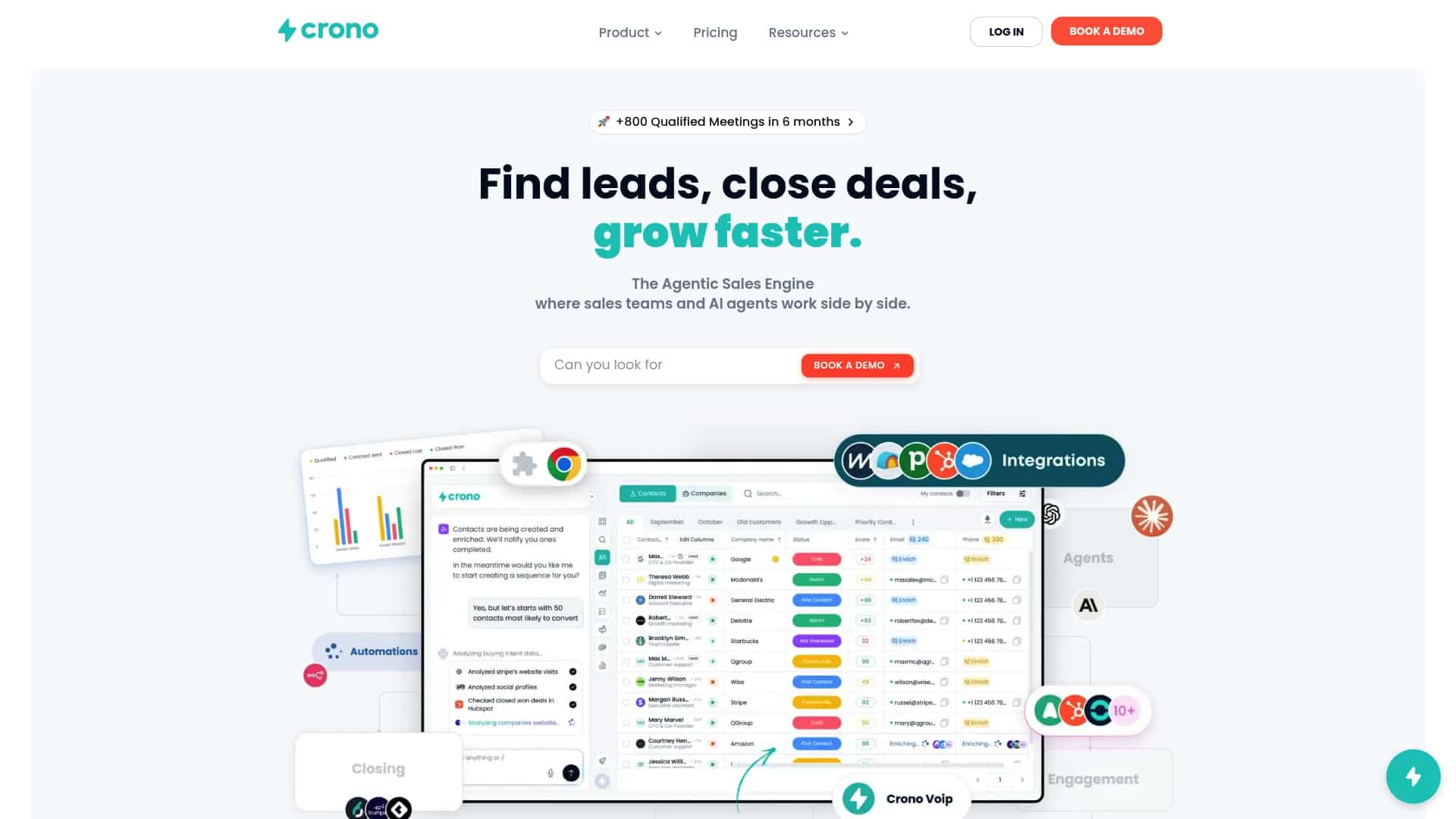
The concrete difference: Crono connects buying signals, data enrichment, multichannel outreach (email, LinkedIn, phone), AI agents, and CRM sync in one place. Reps see prioritized opportunities and AI-suggested next actions without switching tabs. Managers get pipeline visibility and orchestration playbooks without a separate RevOps build. For teams ready to move from reactive selling to proactive sales execution, Crono’s typical time-to-value is two to four weeks for a scoped pilot. Request a tailored demo at crono.one and bring your current CRM stack details so the team can scope a pilot around your specific GTM motion.
Useful sources and further reading
Use these resources to verify claims, dig deeper into specific capabilities, and prepare for vendor demos.
- Crono: The Agentic Sales Engine — Crono’s product overview; verify platform positioning, CRM integrations, and AI agent capabilities.
- AI in B2B Revenue Teams: The 2026 Playbook (Crono) — Step-by-step guidance for shifting from reactive to proactive revenue management; use as a pilot design template.
- AI Tools for Sales Coaching: 2026 Leader’s Guide (Crono) — Practical workflows for integrating AI into coaching; verify coaching platform claims here.
- AI in Revenue Forecasting Services: A 2026 Guide (BRDGIT) — Architecture and improvement patterns for AI-driven forecasting; use to validate revenue intelligence vendor claims.
- Creating and Scaling AI Agents (BRDGIT) — Governance and orchestration requirements for enterprise agentic AI; use to evaluate vendor guardrail capabilities.
- AI Automation Trends 2026: What Leaders Must Know (Bitecode) — Trend analysis and recommended leader actions for governed, outcomes-based pilots.
- Salesforce Data Readiness for AI (Resoluble) — Practical checklist for CRM data quality, integration health, and governance before a pilot.
- AI-Powered Sales Solutions, Dynamics 365 (Microsoft) — Microsoft’s agentic CRM positioning; useful for verifying Dynamics 365 integration claims from any vendor.
- SPOTIO Reviews (G2) — User reviews for field sales app capabilities and CRM sync reliability.
- Apollo.io Reviews (G2) — User reviews covering contact database quality and outreach sequencing.
Most important facts to verify in a vendor demo:
- Data lineage: can the vendor show you an AI output traced to a specific CRM record?
- SOC2 Type II and ISO certification status, plus data residency options for your region.
- SLA documentation: written response time commitments and escalation paths, not verbal assurances.
- Real case studies with named outcomes (pipeline conversion rate, ramp time, forecast accuracy) from companies in your industry.
- Hallucination safeguards: what happens when the AI generates a customer-facing message from incomplete deal data?
