The B2B buyer journey is defined as the structured process a business goes through from recognizing a problem to evaluating solutions, making a purchase decision, and managing the relationship afterward. Unlike consumer buying, this journey involves multiple stakeholders, months of independent research, and a process that rarely moves in a straight line.
Frameworks from Gartner and Harvard Business School both confirm that the buyer, not the seller, controls the pace and direction. Sales and marketing teams that understand this reality stop pushing and start facilitating. That shift is the foundation of every effective B2B engagement strategy.
What is the B2B buyer journey, and why does it matter?
The B2B buyer journey is the end-to-end path a buying organization takes to solve a business problem through a vendor relationship. The industry also refers to this as the “B2B buying process” or “customer decision journey,” and both terms describe the same reality: buyers do most of the work before a sales rep ever enters the picture.
B2B buyers complete roughly 70% of their decision process before contacting a vendor. That single fact reframes the entire role of marketing. Content, not cold calls, does the heavy lifting in the early stages.
The journey matters because misreading it costs deals. A sales team that pitches too early, or marketing that sends decision-stage content to awareness-stage buyers, creates friction instead of trust. Understanding the journey gives you a map for delivering the right message at the right moment, which is the core mechanic behind every high-performing B2B revenue team.
What are the main stages of the B2B buyer journey?
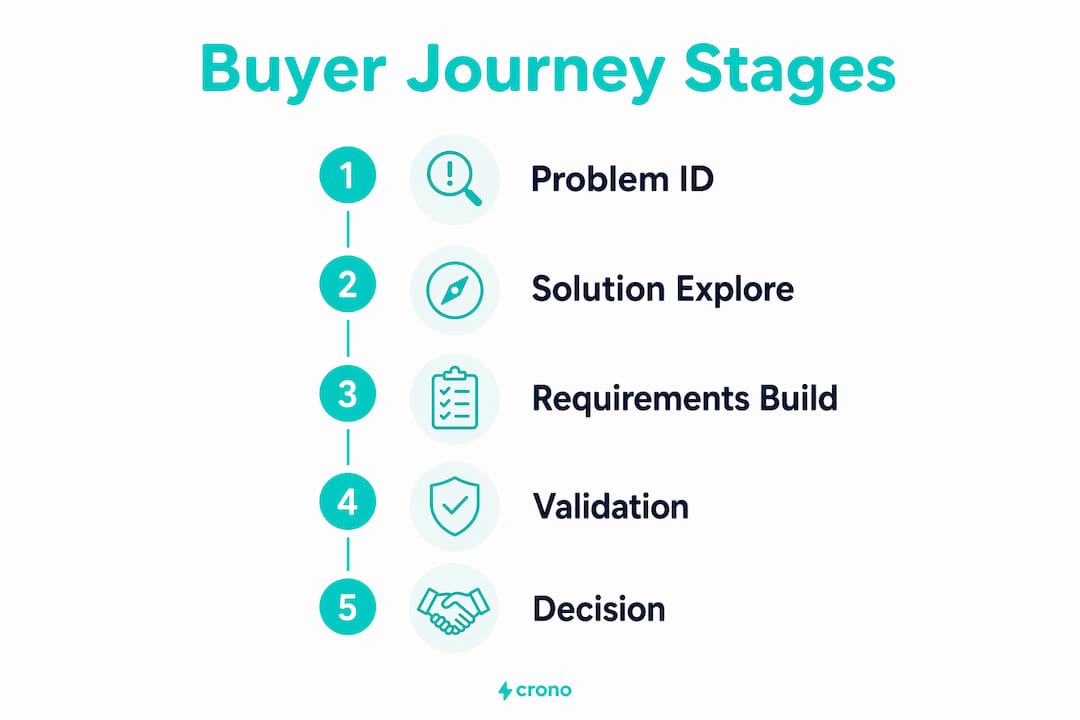
The classic three-stage model (Awareness, Consideration, Decision) is a useful starting point, but it understates the complexity of real B2B buying. Extended frameworks identify six pre-purchase stages plus post-purchase activity, giving teams a far more precise view of where buyers actually are.
| Stage | What the buyer is doing | Your job |
|---|---|---|
| Problem Identification | Recognizing a gap or pain point | Publish educational content that names the problem clearly |
| Solution Exploration | Researching categories of solutions | Provide thought leadership and category-level guides |
| Requirements Building | Defining must-have criteria | Offer RFP templates, checklists, and spec sheets |
| Supplier Selection | Comparing specific vendors | Deliver case studies, demos, and pricing transparency |
| Validation | Confirming the choice internally | Share references, security documentation, and ROI models |
| Consensus Creation | Gaining sign-off from all stakeholders | Provide persona-specific content for each decision-maker |
| Post-Purchase | Onboarding and value realization | Deliver success resources and retention touchpoints |

B2B buying decisions typically involve 6–10 decision-makers and follow a non-linear, iterative path. A buying committee might loop back from Supplier Selection to Requirements Building after an internal meeting surfaces a new concern. That looping behavior is normal, not a warning sign.
The practical implication is that your content library needs to serve multiple stages simultaneously. A CFO revisiting the Validation stage needs different material than an IT director still in Requirements Building, even though both are on the same deal.
How do buyer behaviors in 2026 influence the B2B buying process?
Buyer behavior has shifted faster in the past two years than in the previous decade. The dominant change is the role of AI in self-education.
94% of B2B buyers now use AI tools during their research, with 50% starting their evaluation in AI chatbots rather than search engines. This means your content must be structured to be cited by AI, not just ranked by Google.
- Buyers start with AI, not search. Half of all B2B research now begins in a chatbot. If your content does not appear in AI-generated answers, you are invisible at the most critical early stage.
- Two-thirds of evaluation happens online. Modern B2B buyers complete the majority of their evaluation digitally before any vendor interaction. Sales teams that wait for inbound inquiries miss most of the journey.
- Rep-free preferences are growing. Buyers increasingly prefer to self-serve through demos, pricing pages, and documentation rather than scheduling a discovery call.
- Peer validation carries more weight. Review platforms, community forums, and peer referrals now influence shortlisting more than vendor-produced content alone.
Stat to know: 94% of B2B buyers use AI tools in their research process, and half begin with an AI chatbot. Vendors whose content does not surface in AI responses are cut from consideration before a single conversation happens.
Pro Tip: Structure your key content pages with a direct definition or claim in the first sentence. AI citation engines pull from the first 30% of a page, so front-loading your core message dramatically increases the chance of being cited in buyer research.
The implication for sales and marketing alignment is direct: stage-aligned outreach must begin earlier, and it must meet buyers where they already are, which is increasingly inside AI tools and digital channels rather than at a trade show or on a cold call.
What content and engagement strategies align best with each buyer journey stage?
Content aligned with buyer stage mindset drives engagement. Content misaligned with buyer intent causes drop-off. That is the core rule of B2B content strategy, and most teams violate it regularly.
Awareness and problem identification
At this stage, buyers do not know your product exists and are not looking for it. They are searching for language to describe their problem. Educational content wins here: blog posts that name the pain, industry reports that quantify it, and short videos that frame the challenge. Avoid product mentions entirely.
Consideration and solution exploration
Buyers now understand the category and are comparing approaches. Thought leadership, comparison guides (written from a neutral perspective), and webinars work well. This is also where buyer personas become critical. A CFO evaluating financial risk needs different content than an operations manager evaluating workflow fit.
Requirements building and supplier selection
- RFP templates help buyers structure their internal evaluation and position your criteria favorably.
- Comparison checklists let buyers assess vendors against objective criteria you helped define.
- Technical documentation addresses IT and security stakeholders who block deals when their questions go unanswered.
- Case studies from similar industries or company sizes reduce perceived risk at the selection stage.
Validation and consensus creation
Effective B2B engagement at this stage means delivering the right information to facilitate the buyer committee’s internal decision, not pushing for a close. References, security audits, pilot program offers, and ROI calculators all serve this function. The goal is to make it easy for your champion to sell internally on your behalf.
Effective content addresses diverse buyer personas within the buying committee simultaneously. A CFO cares about ROI and payback period. An IT director cares about security and integration. An end user cares about usability and time-to-value. One piece of content rarely serves all three. Build a content matrix that maps each persona to each stage.
Pro Tip: Create a one-page “internal champion kit” for your primary contact. Include a summary of your value proposition, a competitive FAQ, and a simple ROI model. This gives your champion the tools to win the internal conversation you cannot attend.
How to map and analyze the B2B buyer journey for better sales alignment
Buyer journey mapping is the process of documenting every stage, stakeholder, touchpoint, and decision point a buying committee moves through from problem recognition to purchase. Journey mapping improves marketing and sales alignment by clarifying touchpoints, providing messaging consistency, and revealing where handoffs break down.
A practical mapping process follows these steps:
- Define the buying committee. Identify every role that influences or approves the purchase: economic buyer, technical buyer, end user, legal, and procurement.
- Document the stages. Use the six-stage extended framework as your baseline and adjust for your specific market.
- Map touchpoints per stage. For each stage, list every channel and content type a buyer might use: search, AI tools, peer reviews, sales calls, demos, and references.
- Identify handoff points. Mark where marketing hands off to sales, where sales hands off to customer success, and where messaging must stay consistent across the transition.
- Audit for gaps. Find stages where you have no content, no coverage, or no clear owner. Those gaps are where deals stall.
The non-linear nature of B2B buying means your map will look less like a funnel and more like a web. Buyers loop between stages, involve new stakeholders mid-process, and revisit decisions already made. A good map captures that complexity rather than forcing it into a linear diagram.
The output of a well-built journey map is a shared document that both marketing and sales use to coordinate messaging. When a sales rep knows a prospect is in the Validation stage, they pull validation content. When marketing sees engagement with requirements-building content, they trigger the right nurture sequence. That coordination is what B2B sales orchestration makes possible at scale.
What are the key challenges in managing the B2B buyer journey?
The hardest part of the B2B buying process is the stage you cannot see. The “invisible” internal stage where buyers build requirements and gain consensus internally is the primary source of lost deals. Your champion is selling on your behalf in meetings you are not invited to, using materials you may not have provided.
“The deals most often lost are not lost to a competitor. They are lost to internal inertia. Buyers who cannot build consensus internally choose the status quo, and the status quo costs you the deal.”
The recommendations that follow from this reality are specific:
- Provide objective decision aids (RFP templates, comparison checklists, ROI models) that buyers can use in internal presentations.
- Build content for every stakeholder in the committee, not just your primary contact.
- Time your outreach to match the buyer’s internal calendar, not your sales quarter.
Pro Tip: Ask your champion directly: “Who else needs to be comfortable with this decision?” Then send that person tailored content before they become a blocker. Proactive stakeholder coverage prevents late-stage surprises.
Focusing on the needs of the entire buying committee rather than a single contact is what separates winning deals from lost opportunities. This is not a soft principle. It is the operational difference between a 20% and a 40% close rate on qualified pipeline.
Key Takeaways
The B2B buyer journey is a buyer-led, multi-stakeholder process where 70% of evaluation happens before vendor contact, making stage-aligned content and journey mapping the most critical levers for revenue teams.
| Point | Details |
|---|---|
| Buyers lead, sellers facilitate | 70% of the decision process is complete before a buyer contacts a vendor. |
| Six stages beat three | Extended frameworks (Problem Identification through Consensus Creation) give teams more precise targeting than the classic funnel. |
| AI reshapes early research | 94% of B2B buyers use AI tools in research; content must surface in AI responses to stay in consideration. |
| Committee coverage closes deals | Addressing every stakeholder’s specific concern (CFO, IT, end user) is the operational difference between winning and losing. |
| Journey mapping aligns teams | Documenting touchpoints and handoffs gives marketing and sales a shared language and reduces messaging gaps. |
The buyer-led reality most sales teams still resist
I have spent years watching sales teams treat the B2B buying process as something they control. They build elaborate cadences, set aggressive follow-up schedules, and measure success by activity volume. The data tells a different story every time.
The buyer controls this process. Always has. The shift in 2026 is that buyers now have AI tools that make them even more self-sufficient before they ever talk to a rep. That is not a threat. It is a clarification. Your job is to be the most useful resource in the room the buyer is already in, which is increasingly a chatbot conversation or a peer review thread.
The teams I have seen win consistently do one thing differently: they build content for the invisible stages. They create materials for the internal consensus meeting they will never attend. They give their champion a slide deck, an ROI model, and a competitive FAQ. They treat the buying committee as the customer, not just the primary contact.
The future of B2B sales belongs to teams that understand how AI is reshaping prospecting and adjust their content and outreach accordingly. Stage-aligned content is not a marketing nice-to-have. It is the mechanism by which deals move forward when you are not in the room.
How Crono supports your B2B buyer journey strategy
Managing a multi-stage, multi-stakeholder buying process manually is where most revenue teams lose ground. Crono is built to close that gap.
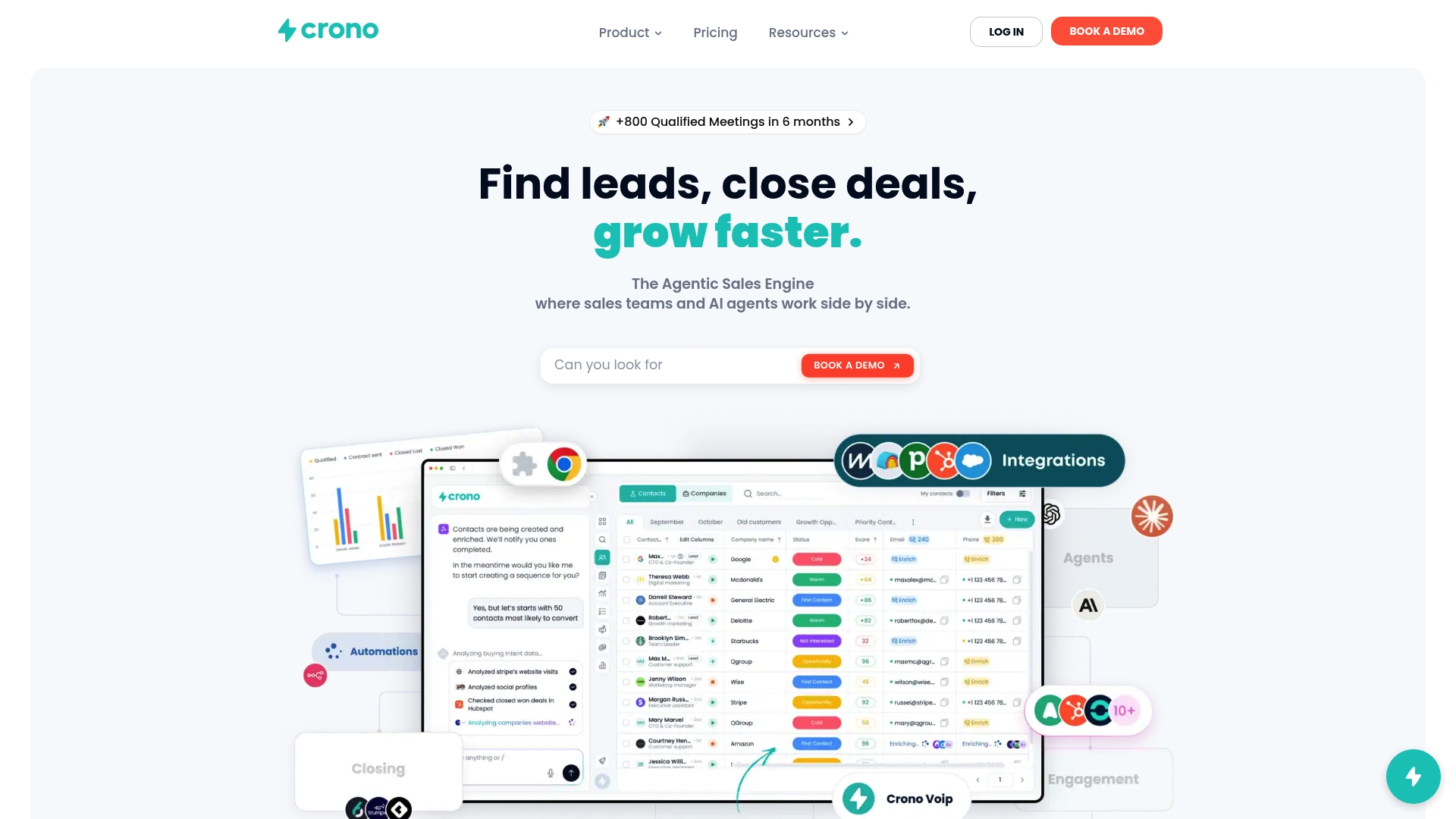
Crono’s AI agents monitor buyer signals across channels and trigger the right outreach at the right stage, without requiring a rep to manually track every touchpoint. The platform combines data enrichment, workflow automation, and multichannel engagement so your team always knows where a buying committee stands and what content to send next. For teams managing complex B2B sales orchestration, Crono acts as the execution layer between buyer signals and revenue outcomes. You can also explore AI sales agent deployment to see how AI agents work alongside your reps to cover every stage of the buyer journey at scale.
FAQ
What is the B2B buyer journey in simple terms?
The B2B buyer journey is the process a business follows from identifying a problem to selecting a vendor and completing a purchase. It typically involves multiple stakeholders, months of research, and several evaluation stages before a decision is made.
How many stages are in the B2B buyer journey?
Extended frameworks identify six pre-purchase stages: Problem Identification, Solution Exploration, Requirements Building, Supplier Selection, Validation, and Consensus Creation, plus post-purchase stages. The classic model uses three (Awareness, Consideration, Decision), but the six-stage version gives teams more precise targeting.
How many people are involved in a typical B2B buying decision?
B2B buying decisions typically involve 6–10 decision-makers, including economic buyers, technical evaluators, end users, and procurement. Each stakeholder has different priorities, which is why committee-level content coverage is critical.
Why do B2B buyers contact vendors so late in the process?
B2B buyers complete roughly 70% of their evaluation before contacting a vendor because digital channels, AI tools, and peer review platforms give them everything they need to shortlist options independently. Vendors who are not present in those early research channels are often eliminated before a conversation begins.
What is buyer journey mapping?
Buyer journey mapping is the process of documenting every stage, stakeholder, touchpoint, and decision point in the buying process. It improves marketing and sales alignment by revealing where messaging gaps exist and where handoffs between teams break down.