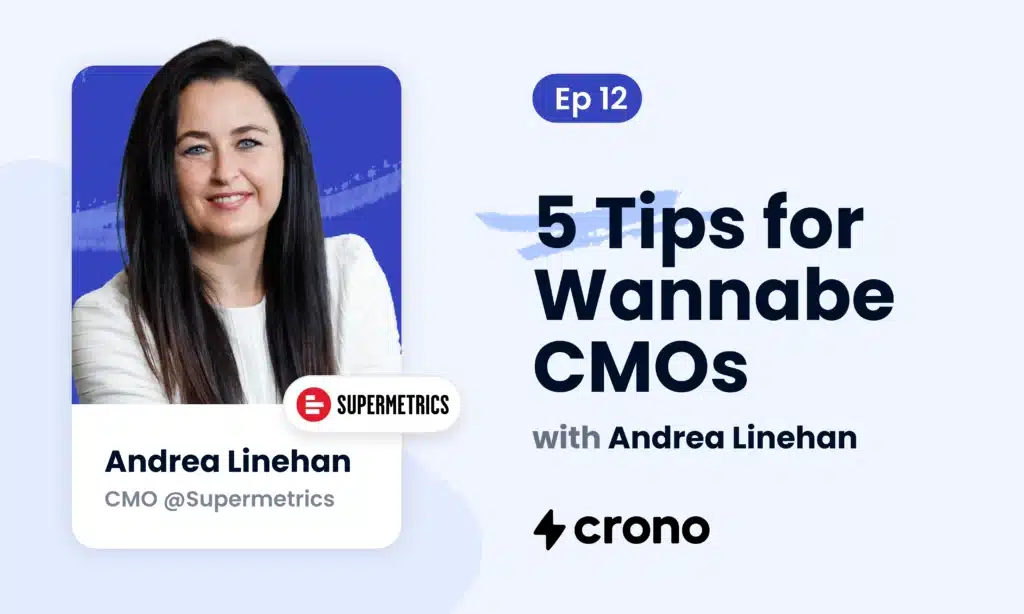
Welcome back to 5 Tips for Wannabe CMOs, our marketing column where we get to know great marketers, their stories and some inspiring tips for the next generation of CMOs.
Wondering how to become a CMO in B2B SaaS?
The honest answer is: it’s harder, messier and more financially demanding than most career guides will tell you.
Andrea Linehan has held the CMO title four times across high-growth B2B and B2C global businesses.
She’s navigated high-growth B2B and B2C markets across three continents, become a Chartered Management Accountant, and watched AI begin to expose what she calls the “dressed-up theatre” of modern SaaS marketing.
In this episode she shares the five things aspiring marketing leaders actually need to hear before they chase the title.
1. Andrea, What’s the short version of your journey to where you are today, and which moments shaped you the most as a marketing leader?
I’ve served as CMO four times across high-growth B2B and B2C global businesses – moments that shaped me most as a leader:
- Spending more than 10 years working in the Middle East, which sharpened my adaptability and global perspective
- Deliberately deepening my financial expertise and becoming a Chartered Management Accountant, which changed how I think about marketing’s role in capital allocation.
2. What’s a mistake you made early in your career that today’s aspiring CMOs should avoid?
One of the biggest mistakes I made early in my career was staying in roles too long before recognising that not only had I outgrown the role, but I had also outgrown the company.
Even the best companies can mask your true potential.
Your growth is constrained by the space that you occupy. Recognising when that is happening is critical. So change your space regularly.
Even seemingly small or sideways moves, build the breadth of perspective that marks seasoned leaders. Say yes to additional responsibility even if it doesn’t come with a title or salary increase.
The richness of experience you accumulate across functions, markets and business models gives you a reservoir of micro-situations to draw on, whether it’s navigating cross-functional tradeoffs, scaling teams or steering strategic pivots.
Push yourself into unfamiliar contexts, your future self will reap the benefits (and the titles and salary that come with that).
3. What’s a bold or unpopular opinion you have about B2B SaaS marketing?
Much of B2B SaaS marketing is still dressed-up theatre.
We’ve become very good at producing motion, campaigns, content, dashboards, that signal progress without always creating measurable commercial impact.
AI will expose this brutally fast.
When production becomes cheap and infinite, the only thing that matters is economic contribution.
The uncomfortable truth is that many marketing functions will need to be fundamentally rewired, not just optimised, to stay relevant in an AI-native world.
4. If you were mentoring an aspiring CMO, what five actionable tips would you share with them?
1. Understand your audience before you do anything else.
As a CMO, you operate at the business level first, your natural teammates are your leadership peers.
Every decision you make should be rooted in what’s best for the business, not just marketing.
That often means trade-offs that aren’t ideal for your department but are right for the company; embracing this mindset separates business building CMOs from functional leaders.
2. Become financially fluent, early.
Financial literacy isn’t optional for CMOs; it’s the price of admission to serious leadership.
To get the title, invest in formal training and get genuinely comfortable owning the numbers: P&L, CAC:LTV, payback, forecasting, unit economics and valuation impact.
The step change happens when you stop explaining marketing activity and start defending capital allocation decisions.
CMOs who can quantify growth, efficiency and ROI in financial terms earn real influence and a permanent seat at the executive table.
3. Always be recruiting, even when you’re not.
Finding great talent is rare.
Keep in touch with brilliant people you’ve worked with, across functions, not just marketing, and support their growth even if it means they move on.
Careers are long and non-linear; helping people achieve their potential builds a network you’ll want to work with again, and they’ll want to work with you.
4. Be the protagonist, not the passenger.
Great CMOs don’t protect the status quo; they challenge it.
Your role is to stretch the organization, and your team, beyond their comfort zone and often beyond what they believe they’re capable of.
Real growth rarely comes from incremental optimisation.
It comes from respectfully pushing standards higher, raising ambition, and creating the conditions for the business, the function, and the team to reach their next level of potential.
5. Build your leadership presence externally, not just internally.
A strong personal brand, through speaking, writing, networking and thought leadership, expands your influence beyond your company.
It attracts talent, builds credibility with boards and investors, and opens doors to partnerships that internal marketing alone can’t.
Doing great work is not enough. Treat your reputation as a strategic asset. And encourage your team to do the same.
5. What’s the most honest advice you’d give to someone who wants to become a CMO?
Be clear-eyed about what the CMO role truly demands.
It’s not just creative strategy and campaigns, it’s responsibility for company growth, accountability for outcomes across functions, and the relentless pressure of visibility.
You’ll work long hours and weekends and will often be firefighting problems your team doesn’t see.
Your reputation becomes public within your business, tied directly to how your teams perform, not just how you perform.
Before aiming for the title, ask yourself if you’re prepared to take on that responsibility, because there’s both tremendous upside and real downside risk when outcomes matter at the highest level.
Not sure where to start? Let's talk.
Schedule a session with one of our specialists and get our exclusive Sales Playbook 2026 for free.