Hey there Croners!
Welcome back to The Prospecting Masterclass, the original Crono column where we bring you insights and tips from the brightest minds in sales.
GTM strategies are critical for B2B companies, yet most of them fail due to misalignment between sales, marketing and RevOps.
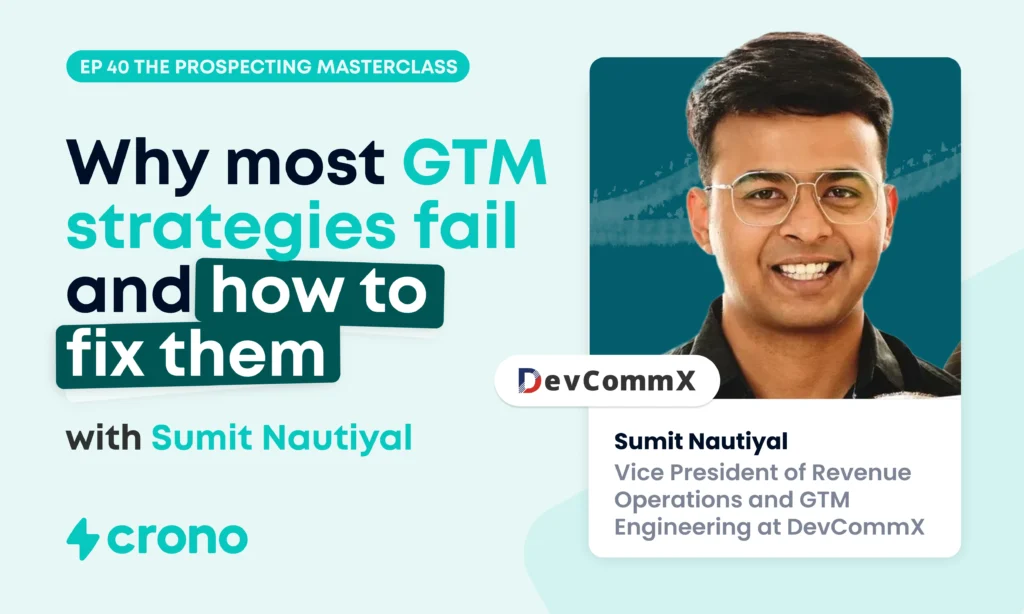
In this episode of The Prospecting Masterclass, Sumit Nautiyal, Vice President of Revenue Operations and GTM Engineering at DevCommX, shares how to fix GTM strategies, build scalable revenue engines, and leverage AI in sales to accelerate deals and drive predictable growth.
Sumit, give us the story behind your career. What brought you into the world of strategic GTM consulting?
I’ve always been obsessed with one question: how do companies actually grow predictably?
I started out in sales, moved into RevOps, and then realized most companies don’t fail because of bad products… They fail because their go-to-market system is broken. Everyone’s doing “outreach”, but very few have a true GTM engine where data, systems, and people move in sync.
That’s what pushed me into strategic GTM consulting. I wanted to build growth systems that actually compound, not campaigns that just look busy. Over time, that turned into what we now call GTM engineering where automation, RevOps, and human selling come together to drive pipeline predictably.
What makes you passionate about growth, sales and marketing?
Growth is an infinite game. You can’t win it but you can master it, iterate it, and teach it.
What keeps me hooked is the blend of psychology and systems thinking.
Sales is a human emotion. Marketing is storytelling. RevOps is structured.

When you connect all three, you don’t just scale revenue, you scale trust.
That’s what drives me every day building systems that make selling humans again while using tech to remove the manual friction.
You talk a lot about building “revenue engines that scale”. If you had to break that down, what’s the one moving part most companies get wrong when they try to scale revenue?
They treat GTM like a campaign, not a system.
Most teams over-optimize for activity, more emails, more sequences, more SDRs. But scale doesn’t come from doing more; it comes from doing what compounds.
If I had to pick one moving part that breaks most often it’s the feedback loop between marketing, sales, and RevOps. They all collect data but rarely share it in real time. So the system can’t learn.
A scalable revenue engine is one where signals flow freely when marketing knows which leads convert, sales knows which stories resonate, and RevOps turns that learning into automation. That’s the loop I build for clients every single day.
They mistake activity for architecture.
Most teams jump into outbound, content, or ads before fixing the system underneath, data, messaging hierarchy, feedback loops and automation layers.
You can’t scale chaos. If your CRM, targeting logic, and GTM workflow aren’t talking to each other, adding more leads or SDRs just multiplies inefficiency.
The companies that scale revenue predictably aren’t doing more they’re doing it in sequence, with compounding systems that make every next campaign smarter than the last.
What’s something you’ve learned about speeding up deals, that most sales teams still overlook?
Speed doesn’t come from pressure. It comes from clarity.
Most sales teams try to “push” deals forward instead of designing a journey where the prospect pulls themselves forward. The fastest way to accelerate a deal is to remove friction: unclear next steps, vague ROI, or generic proposals.
When you personalize your discovery flow, show proof early, and align every follow-up with a business outcome, deals move faster not because you chased harder, but because the buyer understood sooner.
AI is transforming the way we prospect. How do you think it’s reshaping RevOps, and where do you draw the line between automation and human intuition?
AI has turned RevOps into a thinking system.
Earlier, RevOps was about dashboards and handoffs. Now, it’s about dynamic orchestration AI signals, scoring intent, enriching context, and triggering outreach in real time.
But I always say AI should do the heavy lifting, not the heavy talking. Automation should handle research, enrichment, and timing. Humans should handle trust, empathy, and judgment.
The future of RevOps isn’t “AI replacing SDRs” it’s AI becoming the SDR’s smartest co-pilot.
Finally, if you could give one tip to sales leaders who want to future-proof their GTM strategy, what would it be?
Think in systems, not seasons.
Most GTM leaders operate quarter to quarter. But real scalability comes when you design a GTM engine that compounds where every campaign teaches the next one, and every insight improves the system.
Invest in three things:
→ Real-time data infrastructure
→ Multi-channel orchestration
→ Human brand building
The companies that win in 2026 won’t be the ones shouting the loudest. They’ll be the ones listening, learning, and adapting the fastest.