
Why B2B Sales Teams Burn Revenue Without Lead Prioritization
In B2B sales, the problem isn’t having enough leads.
The real problem is deciding where to invest human time today, calls, follow-ups, demos, negotiations, when the reality is this:
Modern buyers move through multichannel and fragmented buying journeys.
Research from McKinsey shows that B2B buyers interact with an average of ten different channels during their buying journey and are increasingly willing to switch vendors if the experience across those touchpoints is not seamless.
There is another uncomfortable truth.
Very often you are not the one creating the conversation, the buyer grants it only after they have already done most of the evaluation work.
According to 6sense, B2B buyers spend roughly 70% of the buying journey researching independently before speaking with vendors, and in many cases they initiate the contact themselves.
At the same time, tolerance for irrelevance is extremely low.
Accenture reports that many frequent B2B buyers say they have changed suppliers at least once in the last 24 months.
In this context, the strategy of “I’ll call everyone in alphabetical order” may appear neutral.
In reality, it’s a margin killer.
You’re distributing the same energy across opportunities that are not equally likely to convert.
What Is B2B Lead Scoring?
Lead scoring is not a decorative number inside your CRM.
It’s a system that transforms scattered signals, fit, engagement, and intent, into an operational hierarchy:
- Who to contact
- When to reach out
- What message to send
- What the next step should be
A practical definition comes from Bombora, which defines lead scoring as the methodology used to classify prospects or accounts based on potential value, typically combining demographic, firmographic, and behavioral data to estimate sales readiness and revenue potential.
Importantly, modern approaches do not rely solely on static rules.
More mature lead scoring models integrate dynamic signals such as:
- buying intent
- identity-resolved engagement
- historical outcomes
- account-level behavior
They often also evaluate signals at the account level, not just the individual contact level.
Example of a B2B Lead Scoring Model
Most B2B lead scoring models combine demographic, firmographic, behavioral, and intent data to prioritize the leads most likely to convert.
The example below shows how different signals can contribute to a simple lead scoring model used by many B2B sales teams.
| Category | Signal | Example Condition | Score | Why It Matters |
| Demographic | Job Title | VP, Head, Director, C-level | 20 | Senior roles typically have decision-making power in the buying process |
| Demographic | Department | Sales, Marketing, RevOps | 10 | Indicates alignment with the product’s typical user or buyer |
| Firmographic | Company Size | 50–500 employees | 15 | Companies in the target size range are more likely to fit the ideal customer profile |
| Firmographic | Industry | SaaS, Fintech, Tech | 10 | Higher probability of product-market fit within target industries |
| Firmographic | Location | Target market region (e.g., Europe, US) | 5 | Leads in supported markets are easier to convert and serve |
| Behavioral | Website Visit | Visited product or pricing page | 15 | Indicates active interest in evaluating the solution |
| Behavioral | Content Engagement | Downloaded a guide, whitepaper, or case study | 10 | Shows deeper interest in learning about the solution |
| Behavioral | Email Engagement | Clicked links in email campaigns | 10 | Suggests ongoing engagement with marketing communications |
| Intent Signal | Demo Request | Submitted demo or contact form | 30 | Strong buying signal indicating high purchase intent |
| Intent Signal | Multiple Visits | Returned to the website several times within 7 days | 15 | Repeated visits often correlate with evaluation behavior |
| Negative Signal | Unsubscribe | Unsubscribed from marketing emails | -20 | Indicates declining interest in further communication |
| Negative Signal | Inactivity | No engagement for 30+ days | -10 | Leads with no recent activity may require re-nurturing |
In many B2B lead scoring models, leads that reach a score of 50–60 points are typically considered sales-qualified and prioritized by the sales team.
Lead Scoring vs Account Scoring: What’s the Difference?
In B2B environments, this distinction is critical.
Lead scoring evaluates an individual prospect.
Account scoring evaluates an entire company by aggregating signals from multiple stakeholders.
In enterprise sales, where buying committees are involved, account scoring often becomes more predictive than lead scoring alone.
This reflects how modern B2B buying decisions actually happen:
through multiple stakeholders interacting with your brand across channels.
Manual vs Predictive Lead Scoring
Another key distinction concerns the scoring model itself.
Traditional systems rely on manual rules and weighted attributes.
More advanced platforms use predictive lead scoring, powered by machine learning.
For example, Salesforce defines predictive lead scoring as the use of AI and predictive models on historical and real-time data to estimate the probability that a lead will convert.
This enables benefits such as:
- real-time prioritization
- automatic routing of high-score leads
- faster response times
- better alignment between sales reps and opportunities
And this point is critical:
Scoring without operational action remains theory.
If the score does not trigger tasks, routing, or workflow automation, it does not accelerate revenue.
Why Most Lead Scoring Models Fail
Most lead scoring models fail for three reasons:
noise, static models, and lack of operational alignment.
Noise
Noise appears when weak or false signals are treated as real intent.
In practice, many tools must deal with events that look like engagement but are not, such as:
- email scanners
- spam filters
- bots
This is rarely discussed in generic “lead scoring guides,” but it’s a silent killer.
If your model increases scores based on false opens or clicks, it generates incorrect priorities and wastes follow-up efforts.
Static Models
The second issue is static scoring.
If your score does not reflect recency and behavioral change, your pipeline fills up with “ghost leads”, prospects that were active months ago but are cold today.
To prevent this, modern scoring systems use:
- dynamic rules
- time-based signals
- positive and negative scoring events
This ensures that a single category does not distort the overall score.
Lack of Operational Alignment
The most expensive mistake is when scoring does not influence action.
If the score lives only in a weekly report but does not affect:
- lead routing
- SDR task prioritization
- sequencing logic
- response timing
- then it is not lead scoring.
It is simply lead decoration.
How Crono Turns Buyer Signals Into Sales Priorities
The real goal is not just having a lead score.
The goal is converting:
signals → priorities → actions
inside a real sales workflow, where every minute and every task matters.
Crono explicitly positions this logic inside its value for sales leaders.
Within its AI-Powered Intelligence, the platform focuses on:
- reducing noise
- increasing signal quality
- prioritizing accounts and deals
- recommending next-best actions
This is the direct bridge between lead scoring and revenue generation.
If the score does not guide the next action, it does not accelerate the pipeline.
Signals That Matter in Modern B2B Lead Scoring
The quality of lead scoring depends on the quality of the signals behind it.
Crono highlights two key pillars.
Intent Signals
Within its pricing model, Crono includes signals such as:
- job changes
- company news
- website visits
These signals help identify high-intent prospects at the right moment.
On its Account Executive product pages, Crono describes Signals as a way to detect hot opportunities, from website visitors to career changes, enabling sales teams to act at the optimal moment.
Verified Data and CRM Synchronization
Crono also focuses on data integrity and synchronization.
Contact and company lists are synced with the CRM without duplication, while enrichment is performed through a waterfall across more than ten data providers.
The platform reports an 84% enrichment accuracy rate and tracks every action inside dashboards and analytics.
This ensures that scoring decisions rely on clean, reliable data.
The Missing Piece: Sales Orchestration
The real missing piece in most sales stacks is the transition from signal to action.
This is where orchestration matters.
Crono supports multichannel sales workflows, including:
- email
- phone calls
- social selling
- CRM tasks
These workflows rely on conditional logic triggered by signals and prospect behavior.
Crono’s AI connects priority with signals such as:
- website visits
- LinkedIn activity
- company news
- historical patterns from closed-won deals
Sequences can also adapt dynamically based on prospect actions:
- reply triggers
- open triggers
- engagement signals
This is how lead scoring becomes a revenue engine, not just a marketing metric.
How to Build a Lead Scoring Model That Drives Revenue
A revenue-driven scoring model produces repeatable decisions.
Not gut feelings.
Not daily priority lists manually rebuilt each morning.
A practical framework is to separate scoring into three dimensions.
Fit
How closely a company or contact matches your Ideal Customer Profile (ICP).
Intent
How likely the prospect is entering a buying window, based on behavioral signals.
Engagement
How the prospect responds to your outreach:
- replies
- meetings
- interaction progression
This structure aligns with modern B2B scoring approaches that combine:
- firmographic fit
- behavioral engagement
- intent signals
Using AI Fields to Improve Lead Scoring
Crono introduces additional flexibility through AI Custom Fields.
These fields generate enriched information using AI based on existing data and custom prompts.
They can be used for:
- segmentation
- filtering
- personalization
- triggering insights
Even when not directly used for scoring, these fields improve contextual prioritization and messaging.
Reliable Engagement Signals
Another critical design choice concerns true engagement detection.
Crono removes false signals through bot detection, ensuring that open and click data represent genuine engagement.
This significantly reduces the risk of false positives in lead scoring models.
Turning Lead Scores Into Daily Sales Actions
Once the three scoring dimensions are defined, the biggest operational benefit appears.
Crono links scores directly to daily SDR tasks and workflows.
With multichannel workflows and behavioral triggers, the score becomes a sales GPS.
It doesn’t just tell you who is warm.
It tells you what to do next:
- call
- LinkedIn message
- follow-up
- escalate to an AE
- schedule a demo
How to Measure the Impact of Lead Scoring on Revenue
For revenue leaders, abstract theory is not enough.
The question is simple:
What changes before and after operational lead scoring?
Crono integrates analytics into the platform.
Its pricing pages reference:
- full analytics and reports
- real-time contact insights
Sales leader dashboards provide:
- pipeline visibility
- customizable KPIs
- bottleneck analysis
- team performance reporting
Every action and outcome is tracked.
Real-World Results From Crono Customers
Finally, real-world validation matters.
Crono highlights customer examples such as:
- 5× SDR performance improvements reported by WeRoad
- +19% of prospects booking demos reported by Serenis
- +130% new customer growth and +70% revenue in the local market reported by Alibaba France
These numbers are not universal promises.
They illustrate a causal chain:
cleaner signals → better prioritization → faster action → more conversations with real buyers
And more conversations with real buyers ultimately mean more revenue.
Lead Scoring for B2B Sales Teams: How to Set It Up in Crono
Setting up lead scoring in Crono takes only a few minutes. Once configured, Crono automatically evaluates both prospects and companies, identifying the leads most likely to convert.
This allows sales teams to prioritize the right opportunities and focus their time on the prospects with the highest revenue potential.
Follow these steps to configure your lead scoring model.
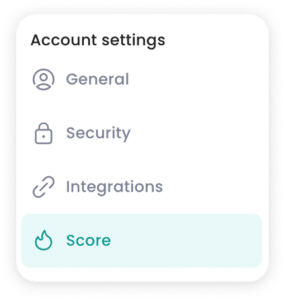
1. Open the Scoring Settings
Navigate to the Scoring section in your Account Settings.
This is where you define the rules and criteria used to calculate lead scores across your workspace.
2. Choose Your Scoring Criteria
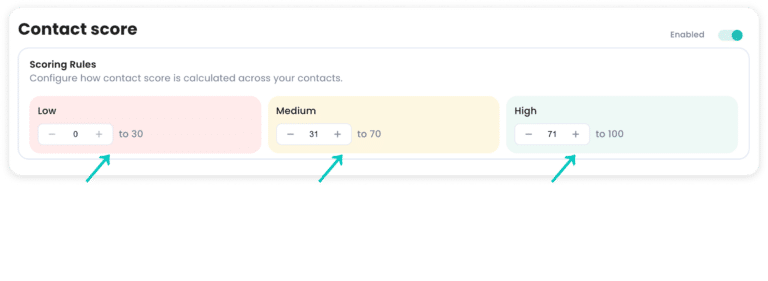
Enable the criteria you want to use for both contacts and companies.
Crono allows you to use any available field, including:
- standard contact fields
- company attributes
- custom fields you created
- AI-generated fields
- behavioral signals tracked by the platform
This flexibility allows you to build a scoring model tailored to your ideal customer profile and sales process.
3. Assign a Weight to Each Signal
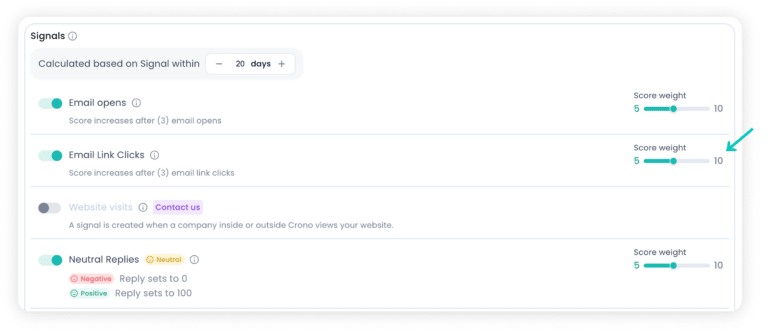
For every field you select, assign a weight that determines how much it contributes to the overall lead score.
For example, you might assign higher scores to signals such as:
- visits to high-intent pages
- job titles that match your ICP
- recent engagement with your outreach
This step ensures that your scoring model reflects the signals that matter most for conversion.
4. Save and Activate Your Scoring Model
Once you save your configuration, Crono automatically recalculates the score for all prospects and companies in your database.
From that moment on, your pipeline will continuously update based on the latest signals and engagement data.
Your team will always see which leads deserve attention first.
Not sure where to start?
Start with the Playbook.
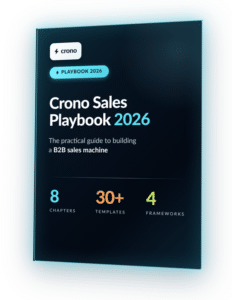
Download our free Sales Playbook 2026 and learn how top B2B teams structure their outbound process.
 BANT, SPICED & MEDDPICC frameworks
- 30+ ready-to-use sales templates
- 2026 outbound & pipeline benchmarks
Don't sell the product. Sell the change the product makes possible.
Build the process before the pipeline.
