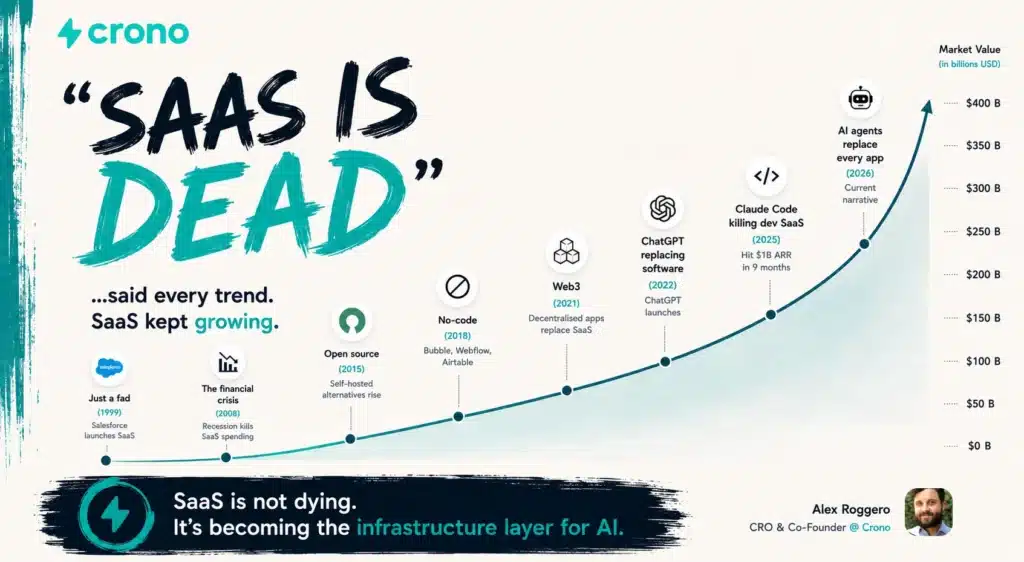
Every two years, someone declares the death of SaaS.
Every two years, the market grows by another $50 billion.
Here’s what’s actually happening and why it matters for every B2B sales team.
The "SaaSpocalypse" Narrative Is Wrong. Again.
Open Source was going to kill SaaS in 2015.
No-Code was going to kill it in 2018. Web3 was going to kill it in 2021. ChatGPT was going to kill it in 2022. And now, in 2025 and 2026, AI agents are supposedly delivering the final blow.
Here is the problem with that narrative: the market data tells a completely different story.
According to Fortune Business Insights, the global SaaS market was worth approximately $315.7 billion in 2025 and is projected to reach $375.6 billion in 2026 – a growth rate of over 18% year-over-year.
Separate research from Precedence Research places the 2025 figure at over $408 billion, with projections exceeding $1.3 trillion by 2035.
Worldwide SaaS revenue is expected to compound at roughly 19% annually through 2029.
This is not the trajectory of a dying industry. This is the trajectory of critical infrastructure.
So why does the “SaaS is dead” narrative keep resurfacing?
And more importantly, what is actually changing, and how should B2B sales and revenue teams be thinking about it?
A Short History of Things That Were Supposed to Kill SaaS
Understanding the current moment requires a bit of historical perspective. Because this is not the first rodeo.
2008 - The Financial Crisis
The Great Recession was supposed to wipe out SaaS companies as enterprise budgets collapsed. Instead, a study of 17 publicly-listed SaaS companies found that none went under, 80% continued to grow through the downturn, and nearly all returned to profitability shortly after. The subscription model proved more resilient, not less, during economic stress. Customers could scale down instead of churning entirely. The crisis stress-tested SaaS and it passed.
2015 - Open Source
The argument was that self-hosted open-source tools would make paying for SaaS unnecessary. What actually happened: most successful open-source projects either became SaaS products themselves (with hosted versions, support tiers, and enterprise licensing) or fed into the ecosystem of tools that SaaS companies were building on top of. The cloud transition accelerated, not reversed.
2018 - No-Code
Bubble, Webflow, Airtable, Notion. These platforms were going to democratize software creation to the point where dedicated SaaS tools became redundant. What actually happened: no-code became another layer of SaaS. Airtable is SaaS. Webflow is SaaS. These tools didn’t kill the model — they expanded it.
2021 - Web3 and Blockchain
Smart contracts and decentralized applications were going to replace the centralized software model entirely. The reality: the overwhelming majority of Web3 projects ran their backends on traditional cloud infrastructure. Decentralization remained a niche architectural choice for specific use cases. Enterprise software continued uninterrupted.
2022 - Generative AI
When ChatGPT launched, the immediate response was that AI would replace entire categories of SaaS tools. Why pay for a copywriting tool when GPT-4 writes? Why pay for a scheduling assistant when AI handles it natively? What actually happened: every major SaaS product began integrating AI capabilities. The category didn’t collapse — it upgraded. Salesforce launched Einstein. HubSpot launched Breeze. The SaaS market absorbed AI as a feature layer and grew faster as a result.
2024-2025 - Agentic AI
This is where we are now. The argument, articulated most dramatically by Satya Nadella, is that agentic AI will make the concept of discrete business applications obsolete. Instead of navigating a CRM, a sequencer, and an enrichment tool, an AI agent will simply handle the entire workflow autonomously — rendering the apps themselves invisible or unnecessary.
This is the most intellectually interesting version of the SaaS-is-dead argument. And it is also the one most worth examining carefully.
What Agentic AI Actually Changes (And What It Doesn't)
Gartner projects that by 2026, 40% of enterprise applications will incorporate dedicated AI agents for specific tasks.
That is a significant shift. Deloitte‘s 2026 outlook notes that agentic AI is driving “a lot of experimentation, a general augmentation of capabilities, and a slow restructuring of the SaaS market”, but explicitly stops short of predicting SaaS disappearance in any near-term horizon.
Here is the key insight that the “SaaS is dead” narrative misses: agents need infrastructure to operate on.
When an AI agent executes a sales workflow, researching a prospect, enriching contact data, drafting a personalized email, logging the interaction to CRM, it is not operating in a vacuum.
It is calling APIs. It is reading from and writing to databases. It is using the data assets, integrations, and workflow logic that SaaS platforms provide.
In this model, SaaS does not disappear. It becomes the execution layer that agents run on top of. The interface changes, fewer clicks, more commands, but the underlying infrastructure becomes more important, not less.
Microsoft’s Nadella envisions a future where AI updates multiple databases simultaneously without requiring humans to navigate separate UIs. That is a real shift in how software is used. It is not a shift that eliminates the need for software.
The analogy is electricity. When electric motors replaced steam engines in factories, people did not stop needing factories. The factories were restructured around the new power source. SaaS is being restructured around AI, not replaced by it.
Three Things That Are Genuinely Changing
While the death narrative is overblown, it would be wrong to say nothing is changing.
Three things are changing significantly:
1. The User Interface Is Evolving
raditional SaaS was built for human navigation: menus, dashboards, forms, and clicks. As agents become primary users of software, the interface layer matters less. What matters more is the quality of underlying data, the reliability of integrations, and the robustness of the API surface. SaaS companies that invested heavily in beautiful UX at the expense of data infrastructure will need to rebalance.
2. Workflows Are Becoming Orchestrated
Tasks that previously required a human to move between four different tools, checking a CRM for context, running an enrichment query, opening a sequencer, logging the result, can now be orchestrated by a single agent moving across all four.
This does not eliminate the tools. It changes who (or what) operates them. The winner in this environment is the platform that can serve as the orchestration hub, not just one node in a fragmented chain.
3. Pricing Models Are Shifting
The per-seat subscription model that defined SaaS for two decades is under real pressure. When a single AI agent can do the work of multiple users, charging per seat becomes economically irrational. Gartner predicts that by 2030, approximately 40% of enterprise SaaS spend will be oriented toward usage or value rather than per-person licensing. Outcome-based pricing, consumption-based pricing, and hybrid models will become standard. This is a business model evolution within SaaS, not a departure from it.
Why This Is Good News for B2B Sales Teams
For revenue teams specifically, the shift toward agentic, AI-integrated SaaS is a competitive advantage, if you are using the right platform.
The old model of sales technology was additive: add a tool for prospecting, add a tool for enrichment, add a tool for sequencing, add a tool for calling, add a tool for analytics. The result was fragmentation, data silos, and reps spending more time managing software than selling.
The emerging model is consolidating: a single execution hub where AI agents handle the coordination across all these functions, data flows without friction, and human reps focus on judgment and relationship calls that machines cannot replicate.
Sales teams that make this transition gain a structural efficiency advantage over teams still running on fragmented stacks. They generate more pipeline per rep. They personalize at scale without proportional headcount increases. They close faster because their agents handle follow-up and data hygiene automatically.
This is not a hypothetical future state. It is happening now, at companies that have moved to AI-native sales execution platforms.
The Data Makes the Case
Let’s ground this in numbers rather than narrative:
- The global SaaS market is growing at 18-19% annually through the end of the decade
- 73% of organizations already used cloud-based SaaS applications as of 2023, a number that continues to climb
- 88% of IT professionals consider SaaS automation essential to managing their software estate effectively
- SaaS spend globally is projected to surpass $1 trillion annually by 2027
- Gartner projects 40% of enterprise apps will embed dedicated AI agents by 2026
- By 2030, 40% of enterprise SaaS spend will shift to usage/value-based pricing
These are not the numbers of an industry in decline. These are the numbers of an industry in transformation.
What "SaaS + AI" Looks Like in Practice
The clearest way to understand where things are heading is to look at what the most effective sales teams are already doing.
They are not abandoning SaaS. They are choosing SaaS platforms that have natively integrated AI agents into the workflow, so the agent is not a bolt-on, but an intrinsic part of how the platform operates.
This means:
Signal-driven prospecting. Instead of manually researching who to contact, AI agents monitor intent signals, hiring signals, and company activity in real time, surfacing the highest-probability accounts automatically.
Automated multichannel sequences. Agents orchestrate outreach across email, LinkedIn, and phone — not just scheduling sends, but dynamically adjusting messaging based on engagement signals and pipeline stage.
Intelligent pipeline management. Rather than relying on reps to manually update CRM fields and log activities, agents handle data hygiene automatically, giving revenue leaders accurate pipeline visibility without the administrative overhead.
Outcome-based iteration. Agents analyze what is working across thousands of touchpoints simultaneously, surfacing optimization recommendations that would take a human analyst weeks to produce.
In this model, the rep’s job changes. Less time on admin, more time on the calls that move deals forward. Less time managing software, more time exercising the judgment and relationship intelligence that AI cannot replicate.
The Bottom Line
SaaS is not dying. The narrative that it is dying resurfaces every two years because technology cycles create anxiety, and anxiety generates attention. But the market data, the enterprise adoption numbers, and the trajectory of AI development all point in the same direction: SaaS is becoming more essential, not less.
What is changing is the form. The best SaaS platforms of the next decade will not be collections of forms and dashboards. They will be execution layers that AI agents operate through — orchestrating data, automating workflows, and surfacing intelligence that human teams use to make better decisions faster.
For B2B sales teams, the question is not whether to use SaaS. The question is whether you are using the version of SaaS that was built for this moment, or still running on a fragmented stack designed for a world that no longer exists.
The SaaSpocalypse is not coming. The SaaS evolution already arrived.
Crono is the AI-native Sales Execution Hub built for B2B teams that want to automate their outbound motion without stitching together ten different tools.
See how it works →

 BANT, SPICED & MEDDPICC frameworks