

A B2B market expansion strategy is a structured plan for entering new markets with existing or adapted products, with clear choices on where to compete and how to win.
Companies like Salesforce and HubSpot have built multi-billion-dollar revenue bases by systematically expanding into new geographies, verticals, and customer segments rather than relying solely on organic growth within a single market. The recognized industry term for this discipline is market development strategy, though practitioners use “market expansion” interchangeably.
The Ansoff Matrix provides the foundational framework, organizing growth options across four quadrants: market penetration, market development, product development, and diversification.
B2B expansion typically demands a 12 to 24 month ramp before meaningful traction, so understanding the full scope of commitment before you begin is not optional. It is the difference between a disciplined growth program and an expensive distraction.
What is market expansion strategy in B2B, and what are the main types?
A 5-step market entry framework covers scope definition, attractiveness assessment, right-to-win evaluation, entry mode selection, and economic quantification. Each step forces a decision, which is precisely why the framework reduces costly guesswork. The Ansoff Matrix maps these decisions onto four strategic options that every B2B executive should know by name.
| Strategy | Definition | Risk level | B2B use case |
|---|---|---|---|
| Market penetration | Sell existing products to existing markets | Low | Increase share in a current vertical |
| Market development | Sell existing products to new markets | Medium | Expand from mid-market to enterprise |
| Product development | Sell new products to existing markets | Medium-high | Add a new module for current customers |
| Diversification | New products in new markets | High | Enter an adjacent industry with a new offering |
For most B2B firms, market development is the primary expansion lever. It preserves product investment while testing new demand pools. Diversification carries the highest risk because you are simultaneously learning a new market and building a new product. Companies like Salesforce have used market development extensively, moving from SMB CRM into enterprise financial services and healthcare verticals with the same core platform.
- Market penetration works when you have pricing or distribution advantages competitors cannot match quickly.
- Market development requires deep ICP (Ideal Customer Profile) research in the target segment before committing sales resources.
- Product development suits companies with strong customer retention and clear unmet needs surfaced through account reviews.
- Diversification is rarely the right first move for B2B firms without a proven core business generating surplus capital.
Pro Tip: Before selecting a quadrant, map your current win rate by segment. If you are closing above 25% in a specific vertical, that signal often points to an adjacent market where your differentiation translates directly.
How do B2B companies assess and select new markets?
Market selection is where most B2B expansion plans fail. Teams fall in love with market size and ignore accessibility. The right sequence is TAM (Total Addressable Market), then SAM (Serviceable Addressable Market), then SOM (Serviceable Obtainable Market), with each filter removing markets you cannot realistically win in the near term.
The “right to win” concept is the most underused filter in B2B market development. It asks: given your product, brand, relationships, and cost structure, do you have a structural advantage in this market? Salesforce entering the healthcare CRM space had a right to win because of its existing compliance infrastructure and partner ecosystem. A 50-person SaaS company entering the same space without those assets does not.
Key factors to evaluate when assessing a new market:
- Profit pools: Where does money actually concentrate in this market? Not all revenue is equal.
- Regulatory and compliance barriers: Particularly relevant for fintech, healthcare, and government B2B segments.
- Competitive density: Are you entering a market with two dominant players or a fragmented one with no clear leader?
- Buyer behavior and sales cycle length: Enterprise buyers in Germany operate differently from enterprise buyers in the United States.
- Customer interview data: Qualitative signals from 10 to 15 target-market interviews often reveal blockers that no secondary research surfaces.
Set concrete, time-bound goals for each candidate market. “We want to generate $500K ARR from the DACH region within 18 months” is a decision-forcing target. “We want to explore Europe” is not a strategy.
Pro Tip: Prioritize markets where you already have one or two reference customers, even if they came in organically. A single referenceable logo in a new segment cuts your sales cycle by 30 to 40 percent compared to entering cold.
What are the key entry modes and GTM strategies for B2B expansion?
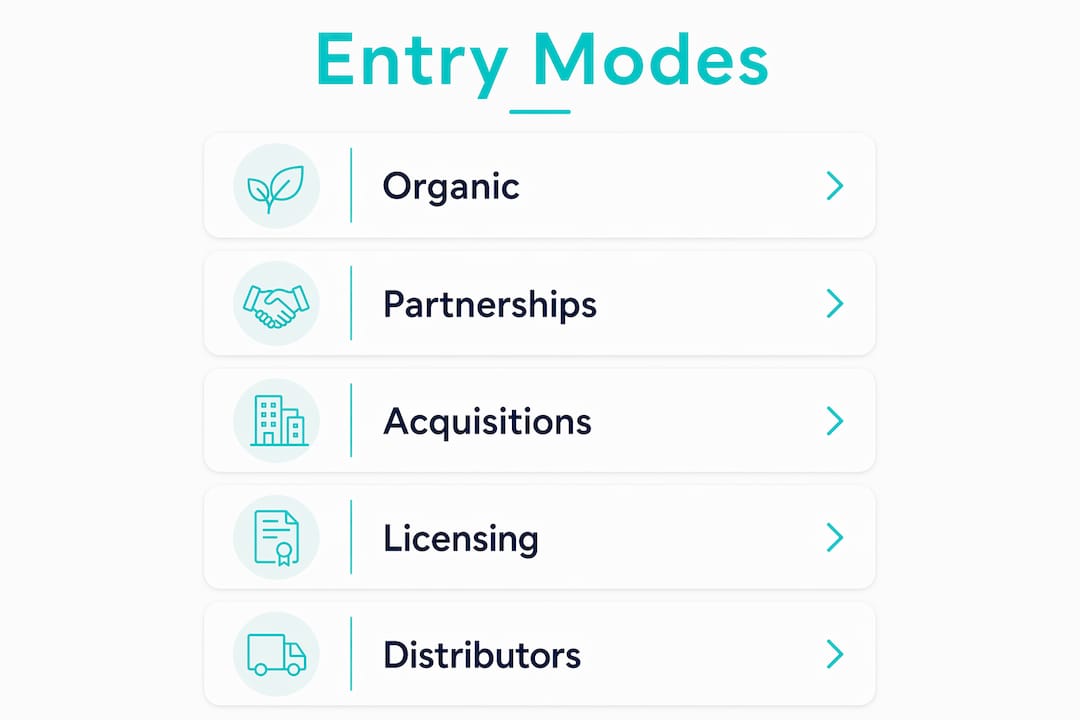
Entry modes trade off speed, control, capital, and integration complexity, and the right choice depends on how much of each you can afford to sacrifice.

| Entry mode | Speed | Control | Capital required | Best for |
|---|---|---|---|---|
| Organic/direct | Slow | High | High | Established companies with strong brand |
| Partnership/distributor | Fast | Medium | Low-medium | New geographies with local knowledge gaps |
| Acquisition | Fastest | High | Very high | Buying market share and talent simultaneously |
| Licensing/franchising | Medium | Low | Low | IP-heavy models in regulated markets |
Partnership and distributor models are the most common B2B entry mode when budget and local expertise do not justify direct entry. A SaaS company entering Southeast Asia, for example, will close deals faster through a regional value-added reseller with existing enterprise relationships than by hiring a local sales team from scratch.
GTM design for a new B2B market requires more than translating your existing playbook. Adapting sales motions to local buying behaviors is critical. Failure to do so creates “signal problems” where leads exist but do not convert, which is one of the most expensive and confusing failure modes in B2B expansion. The components of a market-specific GTM plan include:
- Positioning rebuild: Your value proposition may need reframing for a new audience’s specific pain points.
- Sales motion selection: Sales-led growth works in enterprise segments with long buying committees. Product-led growth works in markets with high self-serve adoption and lower ACV.
- Channel selection: LinkedIn outreach dominates in North America and Western Europe. WeChat and local platforms matter in Asia-Pacific.
- Pricing and packaging: What works at $30K ACV in the US may need restructuring at $15K ACV in Southern Europe.
- Pilot validation: Run a geographic or vertical pilot before committing full sales headcount.
Pro Tip: Build your GTM plan around the buyer committee, not just the economic buyer. In new markets, the influencer and champion roles often sit in different functions than you expect. Map this before your first sales call.
What practical steps and timelines should B2B firms expect?
B2B market expansion typically requires 12 to 18 months before meaningful traction, and the full project from planning to first transactions can take 6 to 9 months alone. Budget for at least 18 months before expecting ROI. Teams that underestimate this timeline cut investment too early and misread a normal ramp as a failed strategy.
A phased rollout reduces risk and preserves capital:
- Define goals and ICP. Set specific revenue, pipeline, and conversion targets for the target market. Identify the 30 to 50 accounts that best match your ICP in that segment.
- Run a qualification-first pilot. Target 30 to 50 ICP-matched accounts and use BANT qualification metrics as viability signals. A 40 to 60 percent qualification rate indicates real demand. Below 30 percent signals a product-market fit problem, not a sales execution problem.
- Validate pricing and conversion. Track pipeline velocity, average deal size, and sales cycle length against your home-market benchmarks. Significant divergence requires GTM adjustment before scaling.
- Gate AE time on prior qualification. Complete qualification before booking AE meetings in new markets. This preserves senior sales capacity for deals with real conversion probability.
- Scale based on proven pipeline quality. Only increase headcount and marketing spend once your pilot has demonstrated repeatable pipeline generation and a conversion rate within 20 percent of your baseline.
The sequential pilot then scale approach mitigates risk and avoids costly operational mistakes in the wrong markets. Pipeline quality, not pipeline volume, is the signal that guides investment decisions at each gate. For a deeper look at building scalable outreach for new markets, the outbound prospecting process Crono outlines for mid-market teams is directly applicable here.
Pro Tip: Set a 90-day decision gate at the end of your pilot. Define in advance what “good” looks like. If you hit the threshold, scale. If you do not, diagnose before spending more.
How do strategic partnerships enhance B2B market expansion success?
Strategic partnerships provide local credibility, regulatory navigation, customer relationships, and innovation acceleration in ways that direct entry simply cannot replicate at the same speed. BCG research confirms that partnerships and joint ventures are increasingly central instruments for strategic market access, not just tactical shortcuts.
The governance dimension is where most partnership-driven expansions break down. Commercial terms get negotiated carefully. Operating model alignment, decision rights, and performance accountability get handled informally. That asymmetry creates friction within 12 months.
Partnerships and joint ventures require equal rigor in governance as in commercial terms. The operating model determines whether the partnership delivers on its strategic promise.
Best practices for establishing strategic partnerships in B2B market expansion:
- Define mutual value clearly. Both parties need a specific, quantified reason to prioritize the relationship over competing demands.
- Align on ICP and qualification criteria. If your partner is passing unqualified leads, the partnership generates noise, not pipeline.
- Establish shared KPIs. Joint pipeline targets, conversion rates, and revenue milestones create accountability on both sides.
- Build governance structures early. Quarterly business reviews, escalation paths, and clear decision rights prevent the relationship from drifting.
- Pilot the partnership before exclusivity. Run a 90-day joint pilot before signing long-term exclusivity agreements. Compatibility in practice differs from compatibility on paper.
For international scaling specifically, Crono’s B2B international scaling insights cover how partnership selection decisions play out in real expansion scenarios.
Key takeaways
A B2B market expansion strategy succeeds when it combines rigorous market selection, a phased pilot approach, and a GTM motion adapted to local buying behavior rather than copied from the home market.
| Point | Details |
|---|---|
| Use the Ansoff Matrix | Market development is the lowest-risk expansion path for most B2B firms with proven products. |
| Assess right to win first | Structural advantages in product, brand, or relationships must exist before committing resources to a new market. |
| Plan for an 18-month horizon | Meaningful traction takes 12 to 18 months; budget accordingly before expecting ROI. |
| Pilot with 30 to 50 ICP accounts | A 40 to 60 percent BANT qualification rate signals real demand before you scale. |
| Adapt your GTM, do not copy it | Local buying behavior, channels, and pricing require deliberate recalibration in every new market. |
What I have learned about B2B market expansion the hard way
After working with dozens of B2B revenue teams on growth strategy, the pattern I see most often is not a bad market choice. It is premature scaling. A team gets three or four wins in a new segment, declares the market validated, and doubles headcount before the pipeline is actually repeatable. Six months later, the conversion rate collapses and the post-mortem reveals that the early wins were outliers, not signals.
The discipline of the pilot phase is harder than it sounds. There is real organizational pressure to show results quickly, especially when leadership has announced an expansion initiative publicly. That pressure is exactly when you need the 90-day decision gate most. Let the data make the call, not the narrative.
The other thing I would push back on is the assumption that your home-market GTM motion travels. It almost never does cleanly. The sales cycle length, the buying committee composition, the channel preferences, and the competitive set all shift when you cross a vertical or geographic boundary. I have seen well-funded teams waste 18 months because they refused to rebuild their outreach sequences and pricing model for a new market. Adapting your sales motion is not a nice-to-have. It is the work.
Finally, treat partnerships as a strategic asset, not a shortcut. The best partnerships I have seen were built on shared ICP definitions and joint pipeline accountability from day one. The worst ones had a signed agreement and no operating model. Governance is not paperwork. It is the mechanism that makes the partnership generate revenue.
Accelerate your B2B expansion with Crono
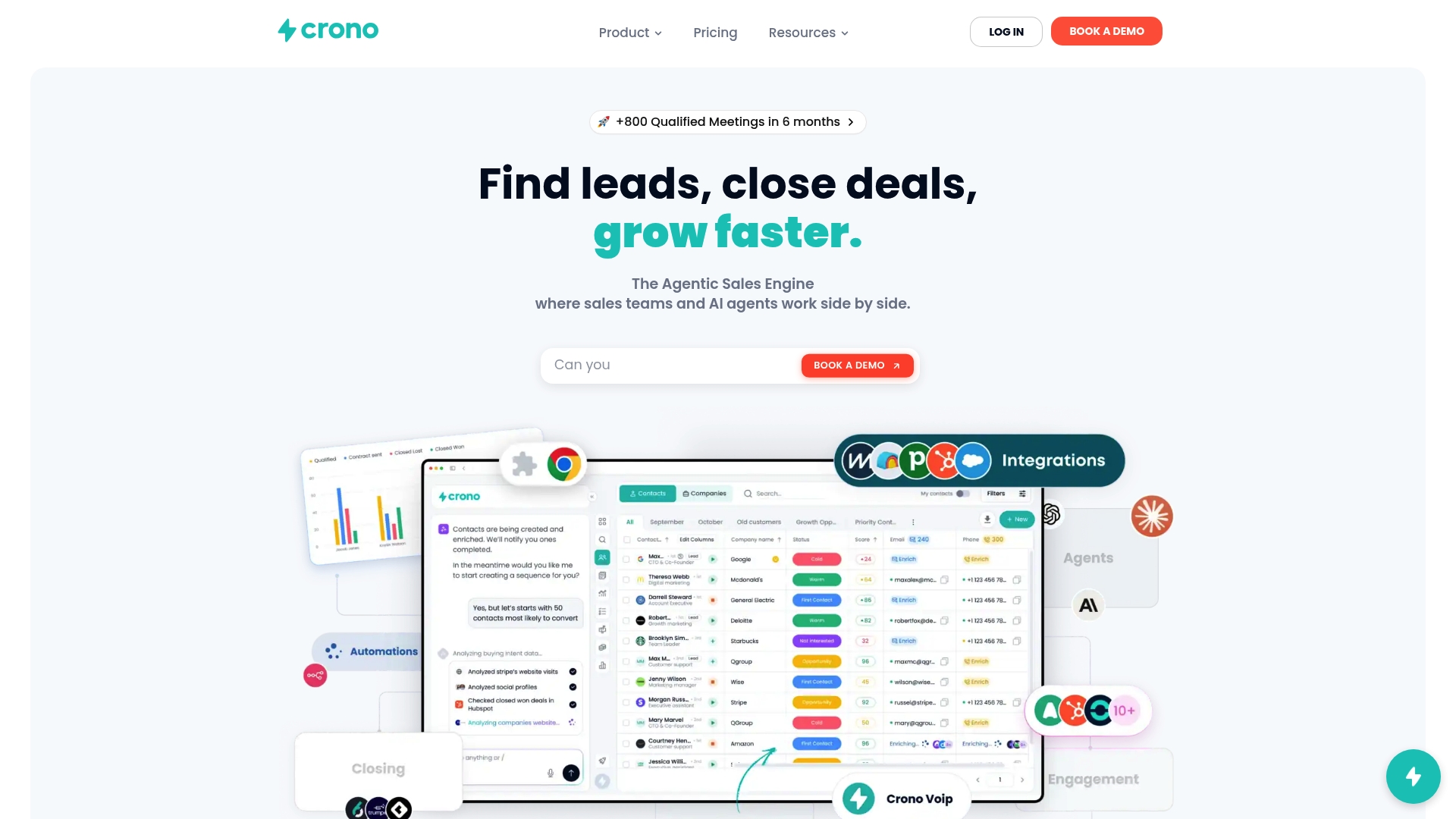
Executing a market expansion strategy means your sales team needs to qualify faster, engage more precisely, and track pipeline across new segments without losing focus on existing accounts. Crono is built for exactly that. As an Agentic Sales Engine, Crono combines AI agents, workflow automation, data enrichment, and multichannel engagement in a single platform so your team can identify opportunities and act on them without switching tools. Whether you are running a qualification-first pilot or scaling a proven GTM motion, Crono’s AI Sales Agents guide shows you how to deploy AI-driven execution alongside your sales team. You can also explore AI prospecting tools that support scalable outbound efforts as you enter new markets.
FAQ
What is a B2B market expansion strategy?
A B2B market expansion strategy is a structured plan for entering new geographic, vertical, or segment markets with existing or adapted products. It defines where to compete, how to win, and what resources and timelines are required.
How long does B2B market expansion typically take?
B2B market expansion typically requires 12 to 18 months before meaningful traction, with the full planning-to-first-transaction cycle taking 6 to 9 months. Budget for at least 18 months before expecting positive ROI.
What is the Ansoff Matrix and why does it matter for B2B growth?
The Ansoff Matrix organizes B2B growth strategies into four quadrants: market penetration, market development, product development, and diversification. It helps executives assess risk and resource requirements before committing to a specific expansion path.
What entry modes are available for B2B market expansion?
The main entry modes are organic direct entry, partnerships and distributors, acquisitions, and licensing. Partnerships are the most common choice when local knowledge gaps or capital constraints make direct entry impractical.
How do you validate a new B2B market before scaling?
Run a qualification-first pilot targeting 30 to 50 ICP-matched accounts and measure BANT qualification rates. A 40 to 60 percent qualification rate signals genuine demand and justifies scaling investment.
Recommended
Not sure where to start?
Start with the Playbook.
Download our free Sales Playbook 2026 and learn how top B2B teams structure their outbound process.
 BANT, SPICED & MEDDPICC frameworks
- 30+ ready-to-use sales templates
- 2026 outbound & pipeline benchmarks
Don't sell the product. Sell the change the product makes possible.
Build the process before the pipeline.
