
High-intent B2B accounts are defined as companies actively researching solutions in your category, exhibiting multiple correlated buying signals within a compressed time window.
The business case for targeting them is direct: intent-prioritized accounts convert at 21.3% versus 8.4% for non-prioritized accounts, a gap that compounds across every quarter of pipeline.
To identify high-intent B2B accounts with precision, you need three things working together: reliable intent signal capture, identity resolution to connect those signals to real decision-makers, and operational workflows that route accounts to sales before the buying window closes.
Platforms like Bombora, 6sense, and Leadpipe have made this possible at scale.
This guide covers exactly how to build that system.
What are the core intent signals that identify high-intent B2B accounts?
Intent signals are behavioral data points that indicate a company is actively evaluating a purchase. They fall into three distinct categories, and understanding the difference between them determines how accurately you can find qualified business leads before competitors do.
First-party signals come directly from your own digital properties. These include website visits to pricing or product pages, demo requests, content downloads (especially comparison guides or ROI calculators), and repeat visits within a short window. These are the highest-confidence signals because the prospect has already found you. The challenge is that first-party data alone covers only a fraction of the research your buyers conduct.

Third-party signals fill that gap. Platforms like Bombora and 6sense aggregate content consumption data across thousands of publisher sites, tracking which companies are researching specific topics at scale. When an account’s employees collectively read 15 articles about “sales automation” or “CRM integration” in a single week, that surge registers as a topic spike. This is where the concept of a “hot” account becomes concrete.
Contextual trigger events add a third layer. Funding announcements, executive hires in sales or revenue operations, contract renewal windows, and product launches all signal organizational readiness to buy. A company that just raised a Series B and hired a new VP of Sales is structurally primed to invest in sales technology.
The critical insight is correlation across signal types. A single website visit is noise. A demo request combined with three Bombora topic spikes and a recent funding announcement is a hot account. Correlated buying intent topics researched across 3 or more subjects within 30 days define the “hot” threshold used by high-performing intent programs. That threshold exists because it filters out casual research and surfaces genuine buying committees.
- Noise signals: Single page visit, one topic spike, generic content download
- Warm signals: Two correlated topics, pricing page visit, LinkedIn ad engagement
- Hot signals: Three or more correlated topics in 30 days, demo request, trigger event confirmed
Pro Tip: Set up a Bombora or 6sense topic cluster specific to your product category rather than tracking individual keywords. Clusters of 5 to 8 related topics catch buyers who use different vocabulary to describe the same problem.
How does identity resolution sharpen B2B account identification?
Identity resolution is the process of mapping fragmented digital identifiers, including IP addresses, cookie IDs, email addresses, and CRM records, into a unified profile of the buying committee at the account level. This is fundamentally different from basic reverse IP lookup, which tells you only which company visited your site. Identity resolution tells you who at that company is engaged and in what capacity.
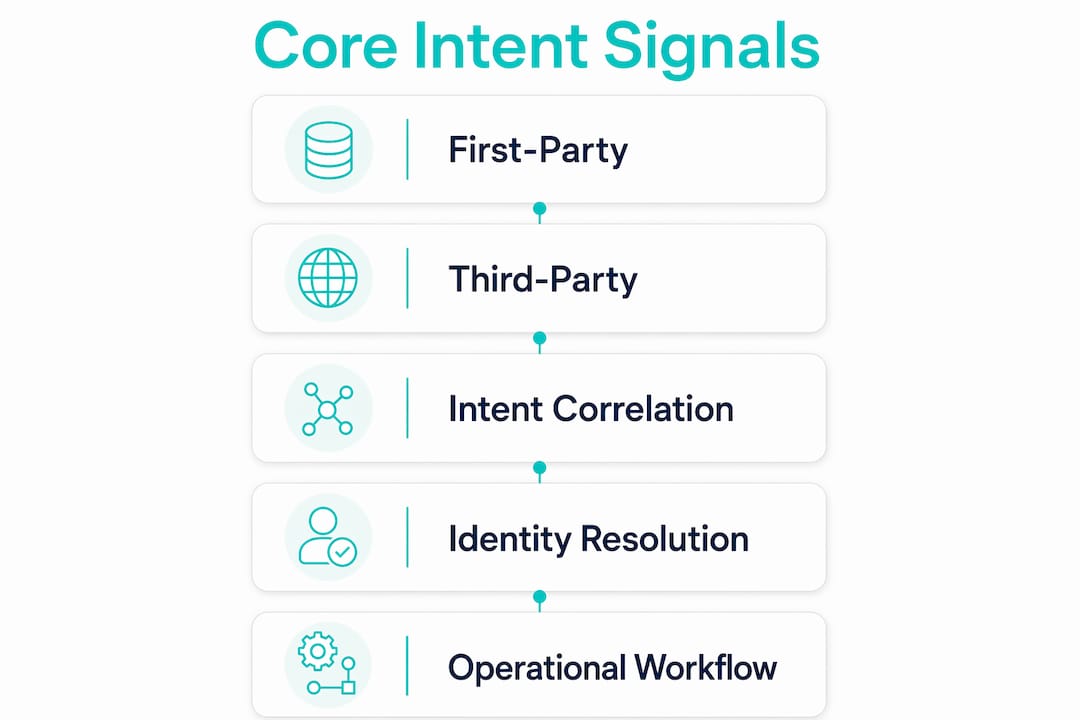
Identity resolution enriches fragmented identifiers into a unified view of the buying committee and parent account by connecting web visits, ad clicks, and CRM interactions to individual stakeholders. The output is not just a company name. It is a mapped buying committee with roles, engagement depth, and contact details attached.
Here is what a complete identity resolution output looks like in practice:
| Data Layer | Output Example | Sales Use |
|---|---|---|
| Firmographic | Company size, industry, revenue range | Qualify fit against ICP |
| Demographic | Job title, seniority, department | Route to correct sales rep |
| Contact details | Work email, direct phone, LinkedIn URL | Enable immediate outreach |
| Intent topics | Top 5 researched topics in last 30 days | Personalize messaging |
| Engagement depth | Pages visited, time on site, return visits | Prioritize within account |
Person-level identity resolution outputs decision-maker contact details including full name, work email, phone, job title, and company domain for engaged stakeholders. This means your sales team receives a pre-qualified contact list tied to a hot account, not a company name to research manually.
The practical implication is significant. Without identity resolution, your intent data tells you that “Acme Corp” is researching your category. With it, you know that Sarah Chen, VP of Revenue Operations at Acme Corp, visited your pricing page twice this week and her company has spiked on four Bombora topics. That is the difference between a lead and an opportunity.
Pro Tip: When evaluating identity resolution APIs like those from Leadpipe or Bombora, test match rates against your existing CRM data first. A platform with 60% match rate on your known accounts will perform proportionally on unknown ones.
What operational workflows optimize high-intent account engagement?
Identifying high-intent accounts is only half the equation. The other half is what happens in the 48 hours after a hot signal fires. Most intent programs fail not because of bad data, but because of slow or inconsistent execution after the signal is detected.
Here is a proven operational workflow for converting intent signals into pipeline:
Set alert thresholds. Configure your intent platform to trigger an alert when an account hits the hot threshold (3 or more correlated topics in 30 days). Alerts should fire in real time, not in a daily digest email that gets skimmed at 9 a.m.
Route immediately to the right rep. The alert should auto-assign to the account owner or territory rep via your CRM. Sales adoption of intent-flagged account lists reaches 41% within the first 90 days post-deployment, but rises to 67% when intent data is integrated directly into the CRM. Native integration removes the friction that kills adoption.
Engage within 48 hours. This is the SLA that separates high-performing intent programs from average ones. Fast routing and engagement within 48 hours is the operational standard for intent-driven outreach. Buyers researching actively today may have moved to a competitor’s demo by next week.
Execute a coordinated multichannel play. A single cold email is not a play. Combine a personalized email referencing the account’s researched topics, a LinkedIn connection request from the rep, and a targeted ad impression from your ABM platform. The median sales cycle compresses by 28 days when intent-flagged accounts receive coordinated multi-channel outreach.
Measure signal-to-conversation rate. Track the time from signal detection to first meaningful sales conversation. This single metric exposes every bottleneck in your routing and engagement process.
“Successful intent data deployment requires aligning routing rules and engagement triggers with intent scoring thresholds and measuring lag from signal to first sales touch.” – It’s Just Revenue
Apply time-decay logic to your scoring model. An intent spike from 45 days ago is not the same as one from yesterday. Use a sliding 0 to 30 day recency window so your prioritization reflects current buying activity, not historical noise. This keeps your b2b lead scoring model accurate over time.
Which platforms help you detect and activate high-intent B2B accounts?
The technology stack for high-intent account identification has matured considerably. Four platform categories now cover the full workflow from signal detection to sales activation.
| Platform | Primary Strength | Best For |
|---|---|---|
| Bombora | Third-party intent data, topic surge scoring | Identifying accounts researching your category off-site |
| 6sense | Predictive AI, buying stage modeling | Forecasting where accounts are in the buying journey |
| Leadpipe | Identity resolution API, contact enrichment | Connecting intent signals to individual decision-makers |
| ZoomInfo | Firmographic data, contact database | Enriching account profiles with company and contact details |
Each platform addresses a different layer of the problem. Bombora and 6sense excel at detecting which accounts are in-market. Leadpipe’s identity resolution API excels at telling you exactly who to call. ZoomInfo fills in the firmographic context that determines whether an account fits your ICP before you invest sales time.
The most effective deployments combine these layers rather than relying on a single platform. A practical integration workflow looks like this:
- Deploy a website pixel (via your ABM platform or Bombora tag) to capture first-party behavioral data
- Feed third-party topic surge data from Bombora or 6sense into your CRM as a custom intent score field
- Use Leadpipe’s API to enrich hot accounts with decision-maker contact details automatically
- Trigger a sales sequence in your engagement platform when an account crosses the hot threshold
AI-powered prospecting tools are increasingly embedding these integrations natively, reducing the manual configuration that slows down deployment. The goal is a system where a signal fires, an account is enriched, and a rep receives a prioritized task, all without manual intervention.
75% of B2B buyers prefer a rep-free buying experience, which means they are deep into research before they ever want to talk to sales. The only way to reach them at the right moment is to detect their research activity through these platforms and engage before they self-select out of the conversation.
Common mistakes that undermine high-intent account identification
Even well-resourced sales teams make predictable errors when deploying intent programs. Recognizing these pitfalls before they cost you pipeline is worth the investment.
Ignoring time decay. Without time-decay logic, sales teams act on stale intent data that no longer reflects current buying needs. A 45-day-old topic spike is not a buying signal. It is a historical artifact.
Targeting individuals instead of buying committees. B2B purchases involve an average of 6 to 10 stakeholders. Routing a hot account to one rep who contacts one person misses the committee. Identity resolution exists specifically to map all engaged stakeholders, not just the most visible one.
Slow first contact. Every day of delay after a hot signal fires reduces conversion probability. Teams that treat intent alerts as “nice to know” rather than immediate action items consistently underperform on pipeline contribution.
Siloed data sources. Intent data from Bombora, CRM records from Salesforce or HubSpot, and contact data from ZoomInfo sitting in separate systems creates an incomplete account profile. Unifying these into one view is a prerequisite for accurate prioritization.
No measurement framework. Intent-to-revenue effectiveness depends on confirming first-touch attribution and validating model precision. Without measuring signal-to-pipeline rates, you cannot tell whether your intent program is working or just generating activity.
Pro Tip: Run a 30-day retrospective on your last 20 closed-won deals. Check whether those accounts showed intent signals before first contact. If they did and your team did not act on them, you have a routing problem, not a data problem.
Key takeaways
Identifying high-intent B2B accounts requires combining correlated intent signals, identity resolution, and fast operational routing to reach decision-makers before the buying window closes.
| Point | Details |
|---|---|
| Intent signal correlation | Three or more correlated topics in 30 days defines a hot account worth immediate sales action. |
| Identity resolution matters | Mapping signals to individual decision-makers turns account-level data into targeted outreach. |
| Speed determines conversion | Engaging hot accounts within 48 hours is the operational standard for intent-driven programs. |
| CRM integration drives adoption | Sales adoption of intent lists rises from 41% to 67% when data is native to the CRM. |
| Measure signal-to-pipeline | Tracking time from signal to first conversation exposes every bottleneck in your routing process. |
Why intent data only works when your execution matches your ambition
I have worked with sales teams that invested heavily in Bombora and 6sense, built sophisticated scoring models, and still saw flat pipeline contribution from their intent programs. The data was good. The execution was not.
The pattern I see most often is a cultural one. Sales reps treat intent alerts as a suggestion rather than a trigger. The alert fires, it sits in a queue, and three days later someone sends a generic sequence that ignores every signal the platform surfaced. At that point, the technology is irrelevant.
What actually changes results is treating the 48-hour engagement window as a hard SLA, not a guideline. When I have seen teams enforce this, the signal-to-conversation rate doubles within 60 days. The data does not need to be perfect. The response time does.
The second lesson is about buying committees. Most reps default to the most senior title in an account. Identity resolution data consistently shows that the person doing the most research is rarely the VP. It is usually a director or manager who will brief up. Engaging that person first, with messaging that reflects their specific research topics, is what gets you into the deal before the committee has formed a vendor shortlist.
Measure everything from day one. Not because the numbers are immediately meaningful, but because the act of measuring forces the operational discipline that makes intent programs work. If you are not tracking time-to-first-contact and signal-to-pipeline rate, you are running on assumption.
How Crono helps you act on high-intent accounts faster
Identifying hot accounts is only valuable when your sales team can act on that intelligence immediately. Crono is built as an Agentic Sales Engine that connects intent signals, identity resolution data, and multichannel engagement in a single execution layer.
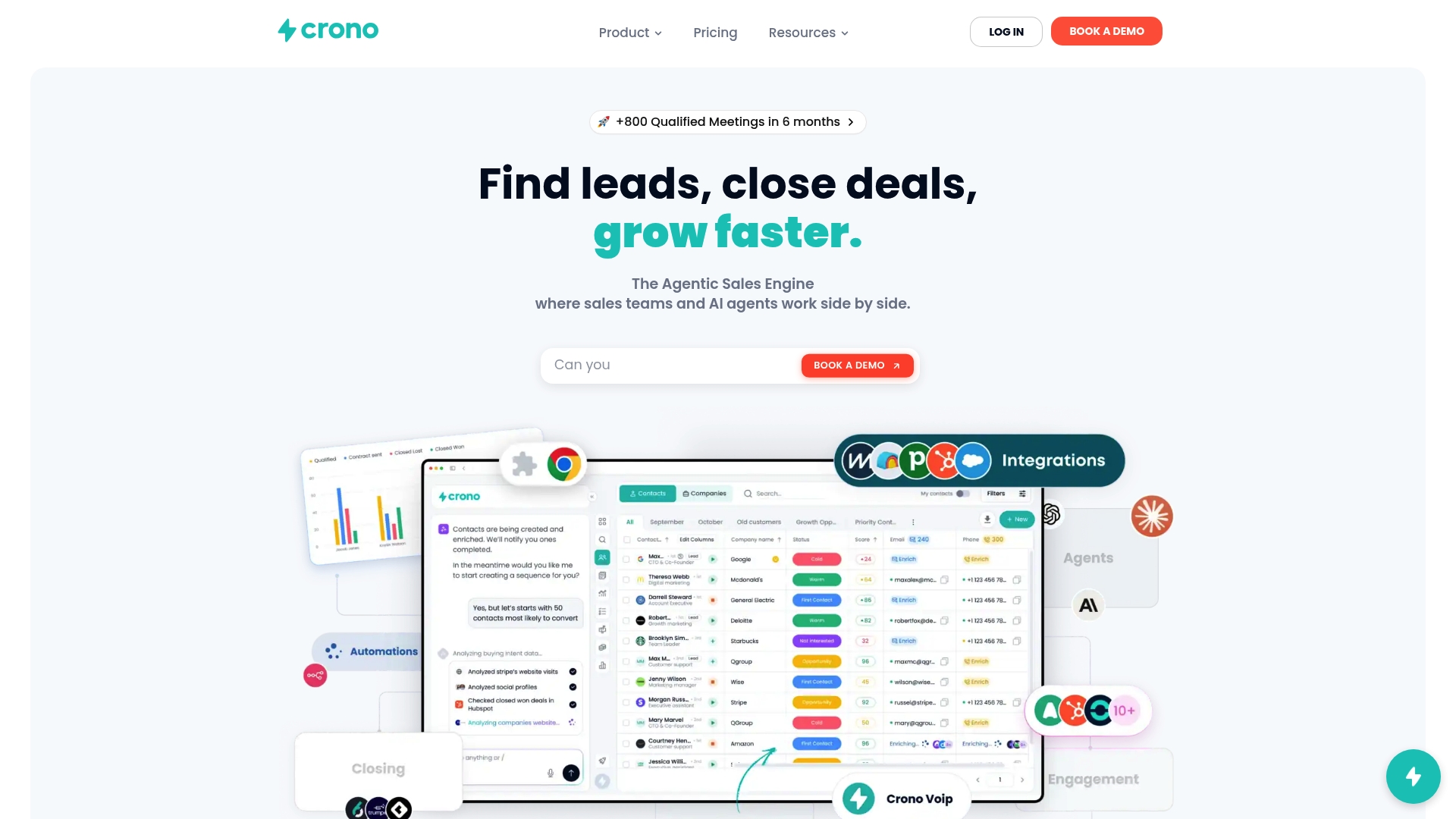
With Crono, intent data from platforms like Bombora and Leadpipe feeds directly into account scoring, triggering real-time alerts and automated routing to the right rep. AI agents handle enrichment, sequence enrollment, and first-touch personalization so your team focuses on conversations, not configuration. For teams ready to deploy AI-driven prospecting at scale, the AI Sales Agents guide for 2026 covers exactly how to build this execution layer from the ground up.
FAQ
What defines a high-intent B2B account?
A high-intent B2B account is one showing three or more correlated buying intent topics researched within a 30-day window, often combined with first-party signals like pricing page visits or demo requests. These accounts convert at 21.3% compared to 8.4% for non-prioritized accounts, according to Forrester benchmarks.
How is identity resolution different from reverse IP lookup?
Reverse IP lookup identifies which company visited your site. Identity resolution goes further by mapping individual interactions to specific decision-makers within the buying committee, providing contact details, job titles, and engagement depth for targeted outreach.
How quickly should sales engage a hot account?
Sales teams should contact hot accounts within 48 hours of a signal firing. Delays beyond this window significantly reduce conversion probability, as buyers actively researching solutions move quickly through their evaluation process.
Which platforms are best for B2B buyer intent analysis?
Bombora and 6sense lead for third-party intent data and buying stage prediction. Leadpipe specializes in identity resolution APIs that connect intent signals to individual decision-makers. ZoomInfo adds firmographic enrichment to complete the account profile.
Why do most intent programs fail to generate pipeline?
The most common failure is slow or inconsistent execution after a signal fires, not bad data. Sales adoption rises from 41% to 67% when intent data is integrated natively into the CRM, removing the friction that causes reps to ignore alerts.
Recommended
Not sure where to start?
Let's talk.
Schedule a session with one of our specialists and get our exclusive Sales Playbook 2026 for free.
 BANT, SPICED & MEDDPICC frameworks
30+ ready-to-use sales templates
2026 outbound & pipeline benchmarks
Don’t sell the product. Sell the change the product makes possible.
This playbook is step one.
