
B2B sales orchestration is defined as an AI-driven system that unifies sales engagement, revenue intelligence, and automation into a single platform, delivering prioritized next-best-action recommendations to sales teams in real time.
The term “sales orchestration” has become the recognized industry standard for this coordination layer, though you will also encounter it described as revenue action orchestration or sales motion orchestration depending on the vendor.
Platforms like Oracle Sales Orchestration and ZoomInfo Revenue Action Orchestration represent the category’s leading implementations, each connecting buyer signals, CRM data, and automated workflows to help sellers act faster and more consistently.
For B2B revenue teams, understanding how these systems work is no longer optional. It is the difference between a sales process that scales and one that stalls.
What is B2B sales orchestration and how does it work?
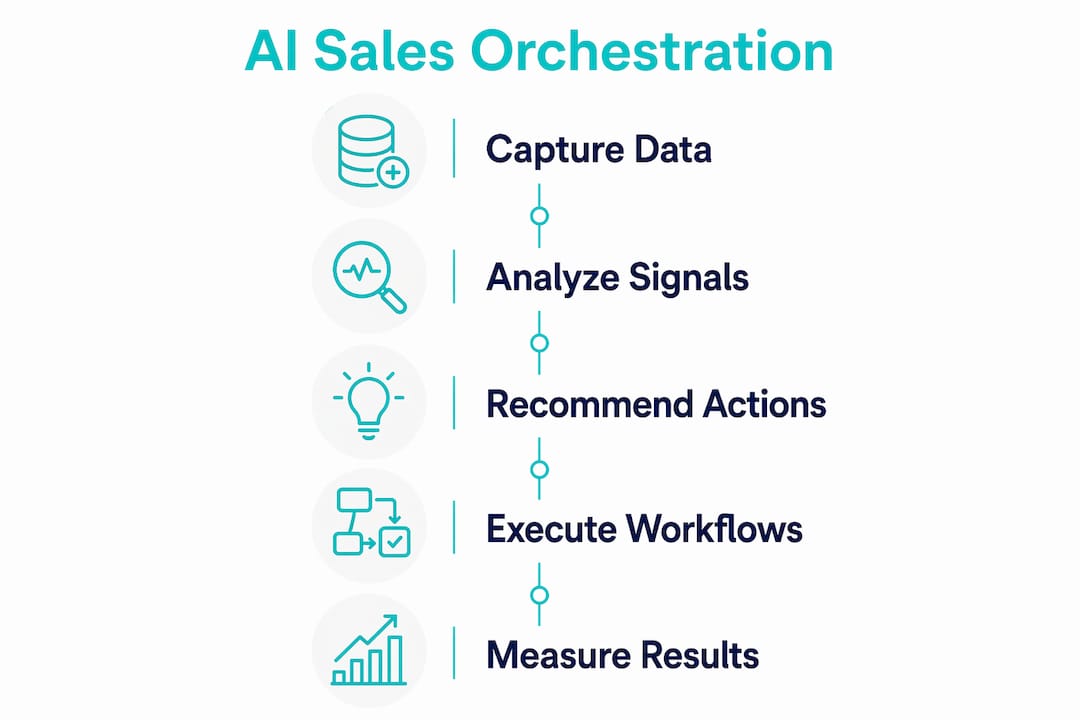
B2B sales orchestration is an AI-powered system that creates a closed loop between four connected processes: capturing engagement data, analyzing buyer signals, optimizing outreach, and guiding seller actions. Every touchpoint, from email opens to call recordings to CRM stage changes, feeds back into the system to sharpen the next recommendation. This is what separates orchestration from basic B2B sales automation. Automation executes a fixed sequence. Orchestration adapts based on what is actually happening with each deal.
The practical result is that sellers stop deciding what to do next from memory or instinct. The platform surfaces the right action, for the right account, at the right moment. ZoomInfo describes this as a system that automates outreach sequences and surfaces prioritized recommendations, freeing reps from manual follow-ups entirely. That shift in cognitive load is significant. Reps who spend less time on administrative decisions spend more time on the conversations that close deals.

Enterprise sales orchestration adds another layer of complexity because the buying committees are larger, the sales cycles are longer, and the data volumes are higher. At that scale, a system that cannot prioritize intelligently creates noise rather than clarity.
How AI recommends the next best action in real time
The AI engine inside a modern orchestration platform does not guess. It analyzes historical CRM data, buyer engagement patterns, and past outcome data to generate context-aware recommendations with confidence scores and priority levels.
Microsoft Dynamics 365’s Next Best Action feature is a concrete example: it reads deal stage, engagement recency, and historical win patterns to recommend whether a rep should send a follow-up email, schedule a call, or share a specific piece of collateral.
What makes this useful in practice is explainability. Sales reps are more likely to act on a recommendation when they understand why it was generated. A system that shows “recommend a call because similar deals at this stage closed 34% more often after a live conversation” builds trust faster than a black-box score. This transparency is a design principle in well-built AI sales orchestration systems, not an afterthought.
The AI also applies business rules on top of propensity models to manage outreach frequency. Decision engines balance short-term conversion probability against long-term relationship health, preventing reps from over-contacting accounts that are already engaged. This is the nuance that separates a well-configured orchestration system from one that simply automates spam at scale.
Key inputs that drive AI recommendation quality:
- CRM deal stage data with consistent timestamps across the team
- Engagement signals including email opens, link clicks, meeting attendance, and call sentiment
- Historical outcome data linking specific actions to closed-won or closed-lost results
- Buyer persona and account context such as company size, industry, and prior purchase history
Pro Tip: Before trusting AI recommendations, audit your CRM for stage timestamp consistency. If half your team logs “Proposal Sent” on the day of the meeting and half log it a week later, the model learns from contradictory data and its recommendations degrade accordingly.
Manual guidance vs. AI agentic orchestration: what is the difference?
This distinction matters more than most teams realize, and confusing the two is one of the most common implementation mistakes in the category.
Oracle draws a clear line between its Guidance feature and its AI Sales Orchestration capability. Guidance is a manually configured workflow where sales operations teams define each step, condition, and action explicitly. It is a best-practice playbook encoded in software.
AI Sales Orchestration, by contrast, uses agentic AI that autonomously drafts emails, suggests collateral, updates opportunity records, and monitors conversations without waiting for a human to trigger each step.
| Feature | Manual guidance (e.g., Oracle Guidance) | AI agentic orchestration (e.g., Oracle Sales Orchestration) |
|---|---|---|
| Configuration | Defined manually by sales ops | Generated dynamically by AI agents |
| Adaptability | Static until manually updated | Continuously adapts based on new signals |
| Action initiation | Triggered by predefined conditions | Autonomously initiated by AI analysis |
| Seller involvement | Seller follows prescribed steps | Seller reviews and approves AI suggestions |
| Best use case | Standardizing onboarding or compliance steps | Optimizing deal progression at scale |
| Risk | Becomes outdated without maintenance | Requires clean data and governance controls |
Mixing these two methodologies in the same workflow creates operational confusion. Sellers receive conflicting instructions: the manual playbook says to send a pricing email on day 10, while the AI agent has already sent a personalized follow-up on day 7 based on a buying signal. The result is a fragmented buyer experience and unreliable pipeline data. Teams that implement both should define clear boundaries between where each system operates.
How to implement a sales orchestration platform without common pitfalls
Deploying an orchestration platform is a data and governance project as much as it is a technology project. The system is only as good as the inputs it receives, and most B2B CRM environments have years of inconsistent data that will undermine AI performance from day one.
Follow this sequence to reduce implementation risk:
-
Define your sales plays and motions first. Before configuring any platform, document the specific sales plays your team runs. Oracle’s implementation guidance requires explicit definition of sales motions, data capture rules, and engagement sequences before the AI layer can operate correctly. Without this foundation, the system has no reference point for what “good” looks like.
-
Standardize CRM data definitions across the team. A single source of truth for deal stages and engagement timestamps is critical. Every rep must log the same event at the same point in the process. This is not a preference. It is a technical requirement for model accuracy.
-
Connect your communication channels to the platform. Oracle Sales Orchestration integrates with Microsoft Teams, Zoom, Exchange, and Outlook to automate activity documentation directly into the CRM. This removes manual entry variation and increases data reliability across the board. The fewer humans touching data entry, the more consistent the signal.
-
Set governance controls before going live. Define who can override AI recommendations, how overrides are logged, and what threshold of confidence score triggers automatic action versus human review. Without governance, the system either becomes a suggestion box that nobody uses or an autonomous agent that nobody trusts.
-
Validate AI recommendations against known outcomes. Run the model against historical closed deals before deploying it on live pipeline. If the recommendations do not align with what actually worked in the past, the model needs retraining before it touches active accounts.
Pro Tip: Treat data hygiene as an ongoing operational task, not a one-time cleanup. Continuous CRM alignment of definitions and outcome tracking is what keeps AI recommendations accurate six months after launch, not just at go-live.
How sales orchestration drives productivity, consistency, and revenue growth
The business case for orchestration is built on three measurable outcomes: seller productivity, execution consistency, and deal velocity. Each one compounds the others.
- Seller productivity increases because AI handles routine tasks like updating opportunity records, capturing meeting notes, and drafting follow-up emails. Reps reclaim hours each week that previously went to administrative work.
- Execution consistency improves because every seller follows AI-driven playbooks calibrated to what actually works, not what they remember from their last training session. New hires reach competency faster when the system guides their actions from day one.
- Deal velocity accelerates because the platform surfaces buying signals the moment they appear and recommends the right response immediately. A rep who acts on a signal within hours outperforms one who acts on it three days later after a weekly pipeline review.
- Customer engagement quality rises because personalized, context-aware outreach replaces generic sequences. The AI knows what the buyer has engaged with, what stage the deal is in, and what similar buyers responded to. That context produces better conversations.
“Sales orchestration transforms CRM from a reporting tool into an execution engine. The shift is not incremental. Teams that deploy it correctly see their pipeline data become a live decision-making asset rather than a historical record.”
The compounding effect is what makes enterprise sales orchestration particularly valuable. A 10% improvement in each of these areas does not produce a 10% revenue lift. It produces a significantly larger one because faster deals, more consistent execution, and higher engagement rates all interact with each other across a full pipeline.
Key takeaways
B2B sales orchestration works because it connects clean CRM data, AI-driven recommendations, and automated execution into a single loop that improves with every deal.
| Point | Details |
|---|---|
| Core definition | Sales orchestration unifies engagement, intelligence, and automation to deliver real-time next-best-action guidance. |
| AI recommendation quality | Model accuracy depends on consistent CRM data, outcome tracking, and defined sales plays before deployment. |
| Manual vs. AI orchestration | Keep manual guidance workflows and AI agentic orchestration in separate, clearly bounded parts of your process. |
| Implementation priority | Standardize deal stage definitions and connect communication channels before activating AI recommendations. |
| Business impact | Orchestration compounds productivity, consistency, and deal velocity to produce revenue growth beyond what each improvement delivers individually. |
Why most teams underestimate the data problem
I have seen sales teams invest in orchestration platforms and then spend six months wondering why the AI recommendations feel generic or off-target. The technology is rarely the issue. The data is. Most B2B CRM environments carry years of inconsistently logged deals, stages that mean different things to different reps, and outcome data that was never linked back to specific actions. The AI has nothing reliable to learn from.
What I find genuinely encouraging is that teams who fix this problem, even partially, see results faster than they expect. You do not need a perfect CRM. You need a consistent one. Once the model has clean signal for even a subset of your pipeline, the recommendations for that segment become noticeably sharper. That early win builds the internal credibility to extend the cleanup further.
The other thing I would push back on is the assumption that AI orchestration removes the need for sales judgment. It does not. The best implementations I have seen treat AI recommendations as a highly informed starting point, not a final answer. Sellers who engage critically with the suggestions, override them when context warrants it, and log why they deviated are actually improving the model over time. The human feedback loop is part of the system, not separate from it.
The future of this category is multichannel orchestration that adapts in real time across email, phone, LinkedIn, and in-product signals simultaneously. Teams that build the data discipline now will be positioned to take advantage of that capability as it matures. Teams that skip the foundation will keep getting mediocre results from increasingly powerful tools.
See how Crono puts sales orchestration into practice
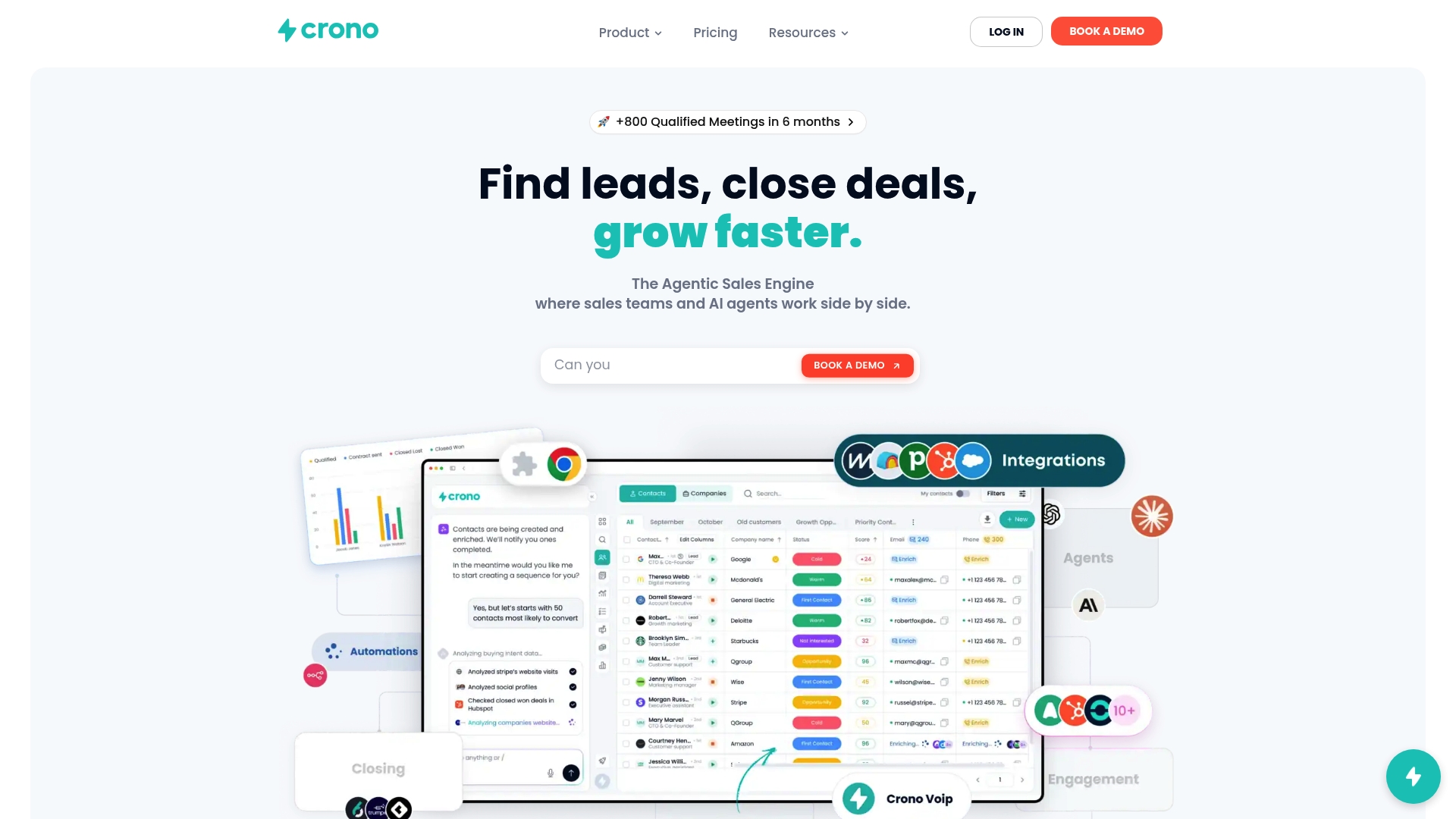
Crono is built as an Agentic Sales Engine that acts as the execution layer between signals, data, and revenue for B2B teams. It combines AI agents, sales orchestration, workflow automation, data enrichment, and multichannel engagement in one platform, so your team stops switching between tools and starts acting on the right opportunities faster.
If you want to see how AI sales agents operate inside an orchestration system, the AI sales agents guide covers deployment, configuration, and real-world use cases in detail. You can also explore how Crono handles B2B sales automation tools for lead generation and outreach if you are evaluating your current tech stack.
FAQ
What is B2B sales orchestration?
B2B sales orchestration is an AI-driven system that unifies sales engagement, revenue intelligence, and automation to deliver prioritized, context-aware next-best-action recommendations to sales teams. It connects buyer signals, CRM data, and automated workflows into a single closed-loop platform.
How does AI sales orchestration differ from basic sales automation?
Sales automation executes fixed sequences regardless of buyer behavior, while AI sales orchestration adapts recommendations in real time based on engagement signals, historical outcomes, and deal context. The key difference is that orchestration learns and adjusts; automation simply repeats.
What data does a sales orchestration platform need to work correctly?
A sales orchestration platform requires consistent CRM deal stage data with accurate timestamps, engagement signal data from email and call tools, and historical outcome data linking specific actions to won or lost deals. Without a single source of truth across these inputs, AI recommendation quality degrades significantly.
What is the difference between sales guidance and sales orchestration?
Sales guidance refers to manually configured best-practice workflows where sales ops defines each step and condition explicitly. Sales orchestration uses AI agents that autonomously generate strategies, draft communications, and update records based on continuous analysis of live deal data.
How long does it take to implement a sales orchestration platform?
Implementation timelines vary, but most B2B teams require four to twelve weeks to define sales plays, standardize CRM data, connect communication channels, and validate AI recommendations against historical outcomes before going live on active pipeline.
Recommended
Not sure where to start?
Let's talk.
Schedule a session with one of our specialists and get our exclusive Sales Playbook 2026 for free.
 BANT, SPICED & MEDDPICC frameworks
30+ ready-to-use sales templates
2026 outbound & pipeline benchmarks
Don’t sell the product. Sell the change the product makes possible.
This playbook is step one.
