
A scalable sales execution engine is an integrated system where process, data, tools, and automation work together to produce predictable revenue growth at any team size. Most B2B sales organizations fail to scale not because they lack talent, but because they lack this system. T
hey hire more reps before defining roles, add tools before fixing workflows, and confuse activity with execution. The goal of this guide is to help sales leaders and operations managers build scalable sales execution engines that compound over time.
You will learn the foundational elements, workflow design principles, AI technologies, and leadership disciplines that separate teams that scale from teams that simply grow.
What does it take to build a scalable sales execution engine?
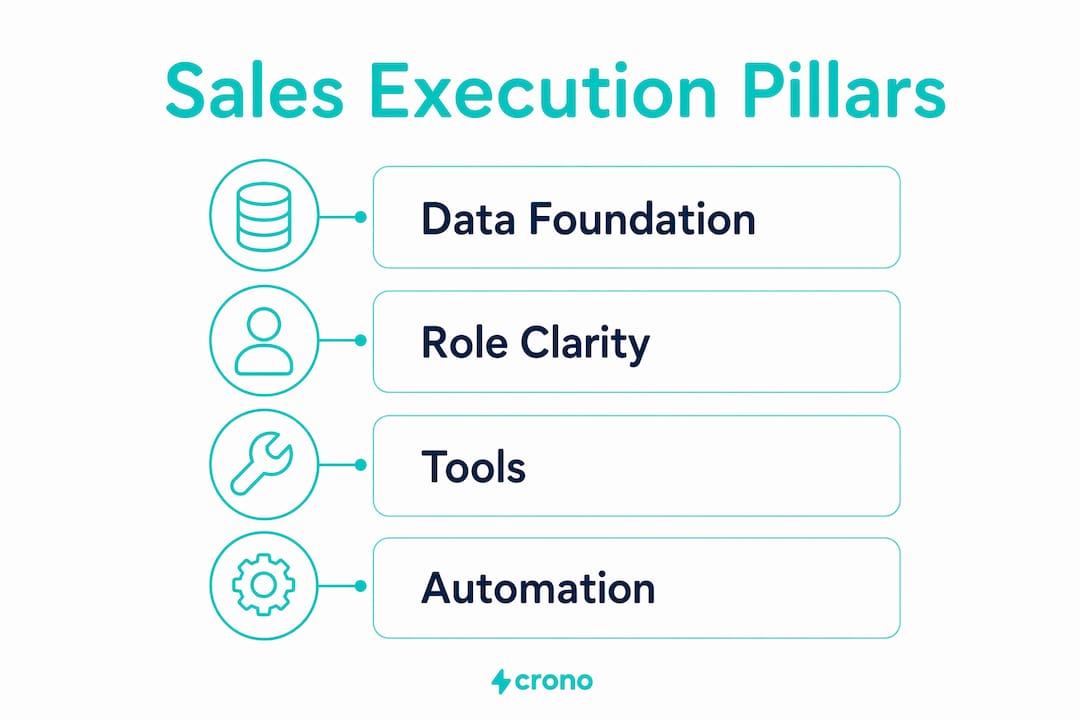
A scalable sales execution engine rests on four pillars: process, data, tools, and automation. According to GTM engineering research, all four must align for revenue systems to hold under growth pressure. Fixing only one or two creates bottlenecks that surface the moment you add headcount or enter a new market.
The first pillar is a unified data foundation. Your CRM, whether HubSpot, Pipedrive, or Salesforce, must have clean records, agreed funnel definitions, and standardized lifecycle stages. Without this, your pipeline reports lie to you. Forecasts become guesswork, and your reps waste time on leads that were never qualified.

The second pillar is role clarity. Before you hire, you need to define what each sales role owns, how success is measured, and how compensation connects to outcomes. Companies that define role clarity and compensation models before hiring achieve 23% higher per-rep revenue. That number reflects a structural advantage, not a talent advantage.
The third and fourth pillars, tools and automation, come after the first two are stable. Deploying automation on top of broken processes only accelerates the chaos.
Role types and compensation approaches
| Role | Primary Metric | Compensation Model |
|---|---|---|
| SDR / BDR | Meetings booked | Base + activity bonus |
| Account Executive | Closed revenue | Base + commission on ARR |
| Sales Engineer | Deal support quality | Base + team quota bonus |
| Customer Success | Net revenue retention | Base + expansion commission |
Pro Tip: Before writing a single job description, map your current funnel stages in your CRM and confirm every team member uses the same definitions. Misaligned funnel stages are the most common cause of inaccurate forecasting at scale.
How do you design and automate critical sales workflows?
Workflow design starts with mapping your current process from first touch to closed deal and identifying where revenue leaks. A revenue leak is any point where qualified demand exits the funnel without a clear reason. Common leak points include slow lead routing, inconsistent follow-up cadences, and unstructured handoffs between SDRs and account executives.
Once you have mapped the leaks, apply these four design principles to every workflow you build:
- SLA-driven handoffs. Every transition between roles must have a defined time limit. An SDR-to-AE handoff with no SLA creates a gap where deals go cold. Set a maximum of four business hours for any internal handoff.
- Routing rules based on data signals. Lead routing should be automatic and based on firmographic data, intent signals, or CRM ownership rules. Manual routing is a bottleneck at any volume above 50 leads per week.
- Lifecycle governance. Define who can move a deal from one stage to the next, and what evidence is required. This prevents pipeline inflation and keeps forecast data honest.
- Pilot automation in high-impact areas first. Piloting one high-impact workflow such as lead routing, prospecting, or commission calculation delivers measurable ROI before you build broader architecture. This approach reduces risk and builds internal confidence in automation.
AI agents are now practical tools for automating qualification, personalized outreach, and meeting scheduling. Waterfall enrichment, where an AI agent queries multiple data providers in sequence until a record is complete, eliminates the manual research that consumes SDR time. AI deal risk scoring flags opportunities showing early signs of slippage, such as declining email response rates or missed next steps, before they fall out of the quarter.
Pro Tip: Identify your single largest revenue leak before building any automation. Fix that one gap first. A scalable outbound prospecting process built on a patched leak compounds your results faster than any broad platform rollout.
Which AI technologies are essential for sales execution at scale?
90% of sales teams plan to use AI agents within two years to automate prospecting, CRM hygiene, and deal monitoring, with quota attainment improvements reported within six months. That adoption rate signals a structural shift, not a trend. Teams that delay AI integration are not staying neutral. They are falling behind.
The most impactful AI technologies for a scalable sales execution engine fall into three categories:
- Pipeline monitoring agents. These agents track deal health signals in real time, flagging risks before they become losses. AI deal risk identification catches pipeline slippage 2–3 weeks earlier than manual review. That lead time is the difference between saving a deal and writing a loss report.
- Prospecting and enrichment agents. AI agents handle contact research, data enrichment, and outreach sequencing. This shifts SDR time from data entry to conversation, which is where human skill actually creates value.
- Forecasting and analytics tools. AI-powered forecasting models trained on your historical win rates, deal velocity, and rep behavior produce forecasts accurate within 10%. That accuracy level supports confident resource allocation decisions.
| AI Technology | Function | Execution Impact |
|---|---|---|
| Deal risk scoring | Flags slipping opportunities early | Saves pipeline 2–3 weeks ahead |
| Waterfall enrichment | Auto-completes CRM records | Reduces SDR research time |
| AI outreach sequencing | Personalizes multichannel cadences | Increases reply rates |
| Forecast modeling | Predicts close probability | Improves resource planning |
The shift from human-only to agent-assisted models also enables coverage scalability. Anthropic’s rebuilt sales organization demonstrates this clearly: 54% of new enterprise logos now come through AI-enabled self-serve channels. You can expand market coverage without proportional headcount growth when AI handles the repeatable execution layer.
How do sales leaders maintain execution discipline as the engine scales?
A sales execution framework is a leadership system, not just a process document. It reinforces coaching, accountability, and pipeline discipline so that consistent performance survives management changes, quota increases, and market pressure. The difference between teams that sustain execution and teams that regress is whether these behaviors are institutionalized or dependent on one strong manager.
The leadership disciplines that hold execution quality at scale include:
- Weekly pipeline inspection with defined criteria. Every deal in the forecast must meet stage-entry criteria. Managers who accept verbal updates without CRM evidence create forecast inflation.
- Structured coaching cadences. Coaching sessions tied to specific deal reviews or call recordings produce measurable skill improvement. Generic one-on-ones do not. AI tools for sales coaching now make call analysis and rep feedback faster and more consistent.
- Accountability rituals that withstand pressure. When a quarter gets difficult, the first thing most managers abandon is their inspection discipline. That is exactly when it matters most. Build rituals that are simple enough to maintain under stress.
- Institutionalized onboarding. Competency frameworks and structured onboarding programs reduce ramp time. Companies that build structure before hiring achieve 3.2x faster ramp times and 47% lower turnover. Those numbers reflect the cost of skipping this step.
Strong leadership execution rhythms consistently outperform heroic management. One exceptional manager cannot carry a scaling team. Institutionalized rhythms can.
What are the most common pitfalls when scaling sales execution?
Most scaling failures follow a predictable pattern. Recognizing them early saves months of rework.
Pitfall 1: Hiring before structure is ready. Adding headcount before you have defined roles, competency frameworks, and onboarding programs creates slow ramp times and high turnover. The cost is not just financial. It erodes team culture and manager bandwidth at the worst possible time.
Pitfall 2: Replacing your tech stack instead of integrating AI. Wholesale platform replacements create months of disruption and adoption debt. Successful organizations thread AI through existing workflows instead. Using Slack or Microsoft Teams as an AI triage hub reduces cycle times without forcing reps to learn a new system. The best sales automation tools for mid-market companies integrate with what you already use.
Pitfall 3: Building broad architecture before proving value. Teams that try to automate everything at once end up automating nothing well. Pick the workflow with the largest revenue impact and build a working pilot. Measure it. Iterate. Then expand.
“Identify the largest revenue leak in your funnel and pilot smart automations there before building broad system architecture.” — GTM Engineering research
Pro Tip: When evaluating where to start your automation pilot, look at the stage with the highest drop-off rate in your CRM. That stage is your largest revenue leak and your highest-ROI starting point.
Key Takeaways
A scalable sales execution engine requires aligned process, data, tools, and automation, with leadership discipline sustaining quality as the system grows.
| Point | Details |
|---|---|
| Foundation before headcount | Define roles, CRM standards, and compensation models before hiring to achieve faster ramp and lower turnover. |
| Pilot one workflow first | Start automation with your highest-impact revenue leak to prove ROI before expanding. |
| AI agents accelerate coverage | Pipeline monitoring, enrichment, and forecasting agents extend team capacity without proportional hiring. |
| Leadership systems sustain execution | Institutionalized coaching and pipeline inspection rhythms outperform heroic individual management. |
| Integrate AI, do not replace | Thread AI into existing tools like Slack or Teams to reduce friction and accelerate adoption. |
What I have learned building sales execution systems
I have spent years watching sales organizations invest heavily in technology and still miss their numbers. The pattern is almost always the same. The technology was not the problem. The absence of a leadership system underneath it was.
The teams that scale well share one trait: they treat their sales execution framework as a living operating system, not a one-time project. They inspect it weekly, adjust it quarterly, and hold every layer of leadership accountable to it. They do not wait for a perfect architecture before starting. They pick the most painful revenue gap, build a working solution, measure it honestly, and move to the next one.
AI capabilities in 2026 are genuinely different from what existed two years ago. The agents available today can handle qualification, enrichment, outreach, and risk scoring at a level that used to require a full operations team. That changes the math on what a lean revenue team can accomplish. But the leaders who get the most from these tools are the ones who already had clean data, clear roles, and disciplined inspection habits. AI amplifies what is already working. It does not fix what is broken.
My honest advice: do not try to build everything at once. Pick one revenue gap, prove the fix, and build momentum from there. Consistent progress on a focused problem beats ambitious architecture that never ships.
How Crono helps you scale sales execution faster
If you are ready to move from manual workflows to an agent-driven execution model, Crono is built for exactly this transition.
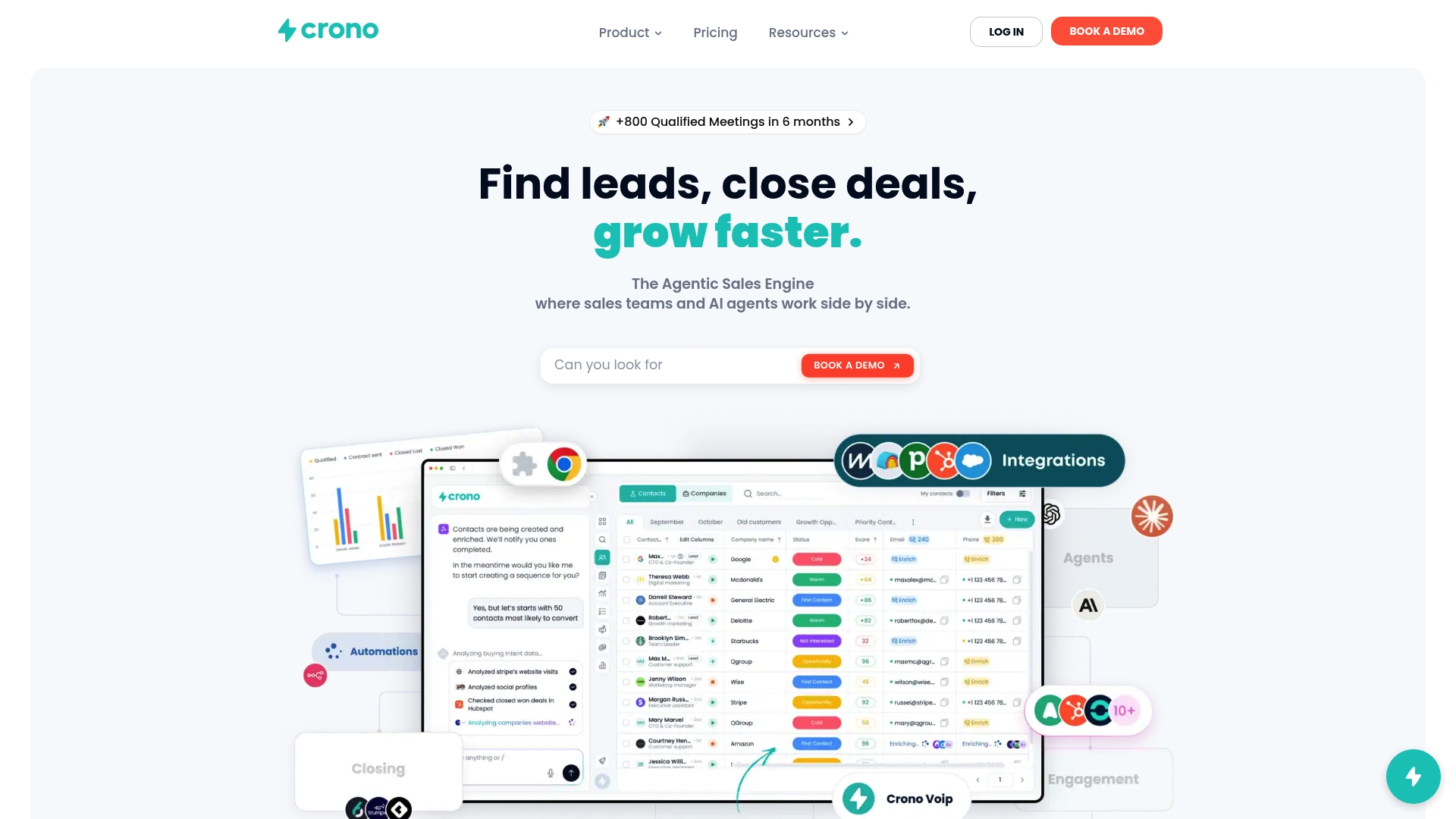
Crono is an Agentic Sales Engine that combines AI agents, workflow automation, data enrichment, and multichannel engagement in a single platform. Revenue teams use Crono to automate prospecting, monitor pipeline health, and run AI agents alongside their human reps without replacing the tools they already use. Whether you are deploying your first automation pilot or building a full AI sales agent workflow, Crono gives you the execution layer to move faster. Explore Crono’s platform to see how B2B sales teams are scaling execution without scaling headcount.
FAQ
What is a sales execution engine?
A sales execution engine is an integrated system of process, data, tools, and automation that produces predictable revenue growth. It connects every stage of the sales workflow, from lead generation to close, into a repeatable and measurable operating model.
How do you start building a scalable sales strategy?
Start by cleaning your CRM data, defining funnel stages, and clarifying role ownership before adding any automation. Companies that establish this foundation first achieve significantly faster ramp times and lower rep turnover.
How does AI improve sales execution and forecast accuracy?
AI agents monitor deal health signals, enrich contact records, and model close probabilities based on historical data. AI deal risk scoring catches pipeline slippage 2–3 weeks earlier than manual review, giving sales leaders time to intervene before deals are lost.
What is the biggest mistake when scaling a sales team?
Hiring headcount before organizational structure, competency frameworks, and compensation models are defined. This leads to slow ramp times, high turnover, and a management burden that undermines execution quality at exactly the wrong moment.
How do you maintain execution discipline as a sales team grows?
Institutionalize coaching cadences, pipeline inspection criteria, and stage-entry requirements in your CRM so that execution standards do not depend on any single manager. Consistent rhythms sustain performance where heroic management cannot.
