B2B Prospecting in the AI Era: Lessons from Nadir Businello

b2b prospecting ai era

In this article

Hey there Croners!
Welcome back to The Prospecting Masterclass, a series by Crono where we sit down with the sales leaders, BDR managers and revenue practitioners actually running the plays, to extract the mindsets, methods and metrics shaping modern B2B prospecting. We bring you insights and tips from the brightest minds in sales.

AI has rewritten half the outbound playbook in just a couple of years. Drafting emails, researching accounts, building lists: what used to take an afternoon now takes minutes. But the part that actually decides whether a deal moves forward, reading the room, earning trust, knowing when to push and when to listen, still has no shortcut.

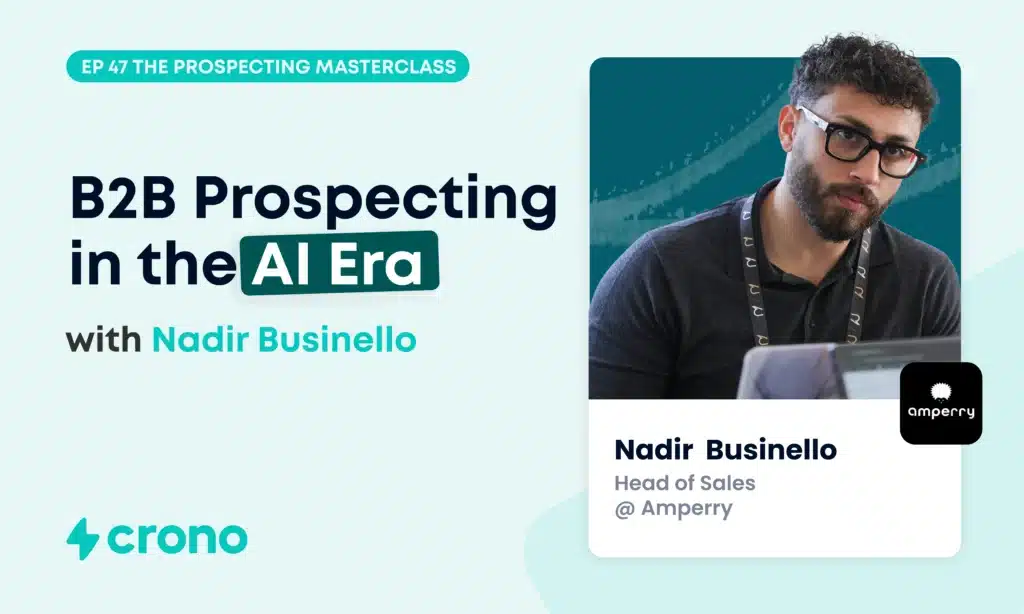
For this edition of The Prospecting Masterclass, we spoke with Nadir Businello, Head of Sales at Amperry.

Nadir’s take on prospecting is refreshingly unsentimental: it’s not about scripts or sequences, it’s about volume done with discipline, curiosity that’s actually curious, and the boredom tolerance to keep showing up when nothing seems to be working. He also plays competitive football three times a week, and as you’ll see, that discipline shows up everywhere in how he thinks about sales.

In this conversation, Nadir breaks down why AI is an accelerator and not a shortcut, what football taught him about leadership and consistency, the part of prospecting nobody talks about, and what “great prospecting” really means in 2026.

Tell us a bit more about your journey. What experiences shaped the way you approach sales today?

My path came together one piece at a time, starting from really understanding what work is. I began with junior roles abroad, on international projects, and then moved into operations and junior project management. Along the way I had my own entrepreneurial experiences: small ones, but enough to understand real risk and what someone building a company actually wants, because I’ve been on that side too.

Then I joined Doctolib, a multinational in healthcare software, a heavily regulated space. There I learned what process and structure mean at scale, how a commercial engine really runs. I was one of the first hires on the go-to-market side, so we put in a lot of work and I saw up close how you build everything from scratch.

From there came the opportunity I’d been after: working in startups at the earliest stages, where I could put all the pieces together, the entrepreneurial instinct and the rigour of a multinational, and then actually execute. That’s where I built my specialisation: sales, go-to-market, strategy, team management, and above all bringing in real volume. In a startup, part of the job is finding where the bottlenecks are, because you pivot constantly and you have to read quickly what’s working and what isn’t.

All of this left me with two convictions that still guide how I sell. The first is that fundamentals beat tricks: good research, a clear reason to reach out, and the discipline to actually do the volume. The second is that having seen both sides of the table, as an employee and as a small business owner, taught me that selling well means understanding what the person across from you actually fears and wants. At Amperry today I try to build the commercial engine I wish I’d had when I started: simple, repeatable, and human.

AI is reshaping the sales stack fast. Where does it genuinely help in prospecting, and where does it still fall short?

AI is an accelerator, not a shortcut. And like every accelerator, it multiplies what’s already there. If you’ve built the skills, if you know how to research, read an account, write a message that actually matters, AI makes you two or three times faster. Most of the grunt work in prospecting lives online now, and with the right tools you get there in seconds: account context, trigger events, a first draft, the lists, all the admin that used to eat half a day.

And that’s exactly the point, and where most people get it wrong. Give an AI tool to someone who’s done the hard work and you have a force multiplier. Give it to someone lazy who never built the fundamentals, and it doesn’t make them good: it just produces more mediocrity, faster. Worse, they never build the skill at all, because they let the tool think for them. They stay dependent, and it atrophies.

And then there’s the part no tool gives you: the conversation. AI gets you to the door incredibly fast, but once you’re inside there’s the emotion to read, the signal to catch, the trust to build, and that part has to be yours. It’s the piece you earn on the field, and today it’s worth more than ever: when everyone can mass-produce the same message, the only real difference is you.

What's one lesson you've learned outside of work that has made you a better salesperson and leader?

I play football in a proper league, training three times a week with matches on Sundays, and it’s taught me more about leadership than plenty of courses.

Some things carry over exactly. Often you don’t win on individual talent: you win on positioning, on knowing your role, and on everyone doing the unglamorous work. And matches aren’t decided in the first ten minutes, when you’re fresh. They’re decided in the last twenty, when most people fade. Prospecting is the same: consistency across the whole season beats the brilliant sprint that burns out by Wednesday.

In the end, staying fit is just this: showing up, again and again, even when you don’t feel like it. That’s the real job, in sport as in sales.

What's the hardest part of prospecting that nobody talks about?

Everyone talks about scripts, tools and sequences. Nobody talks about the grind of staying consistent when nothing’s working.

Prospecting is a lagging activity: you do the work today and for weeks you see nothing, so it’s the first thing people quietly drop when they’re busy or discouraged. The hard part isn’t knowing what to do, it’s protecting your calling time from everything that wants to eat it, and keeping your head straight through the empty stretches.

Most non-replies aren’t a rejection, they’re just noise and timing, but they feel like rejection, and handling that emotionally, for yourself and for a team, is what really makes the difference. The skill nobody mentions is boredom tolerance: doing the same unremarkable thing well, every day, long enough for the results to compound.

Not sure where to start?

Let's talk.

Schedule a session with one of our specialists and get our exclusive Sales Playbook 2026 for free.

BANT, SPICED & MEDDPICC frameworks

30+ ready-to-use sales templates

2026 outbound & pipeline benchmarks

Don’t sell the product. Sell the change the product makes possible.

This playbook is step one.

What skills will define the next generation of top sellers?

As AI takes over the mechanical parts, the skills that used to be “nice to have” become the whole game.

Real curiosity and listening: understanding the buyer’s actual problem instead of firing the pitch at them. Business acumen: being able to talk about their world, not your product. The judgement to orchestrate the tools without handing them your thinking. And resilience, because the job is still mostly hearing “no” and showing up again anyway.

The paradox is that the more AI turns the generic into a commodity, the more the human skills like trust, timing and real conversation become the actual moat. The next great sellers won’t be the ones with the most tools. They’ll be the ones who stay the most human while using them.


Finally, what does "great prospecting" mean to you today?

Great prospecting isn’t volume and it isn’t clever tricks. It’s earning the right to someone’s attention by being relevant and respectful of their time: reaching the right person, at the right moment, with something that makes them think “this person actually gets my world.”

It also means knowing how to open well and win the first thirty seconds, because that’s where you decide everything. And you do it with real curiosity and by building trust from the start, not with a script learned by heart.

The goal was never to book a meeting: it’s to start a relationship worth having. It’s a long game built on consistency and reputation, not a numbers hack you run once.

Done well, it doesn’t even feel like being sold to, it feels like someone useful showed up at the right moment. That’s the bar.


Not sure where to start?

Let's talk.

Schedule a session with one of our specialists and get our exclusive Sales Playbook 2026 for free.

BANT, SPICED & MEDDPICC frameworks

30+ ready-to-use sales templates

2026 outbound & pipeline benchmarks

Don’t sell the product. Sell the change the product makes possible.

This playbook is step one.

In this article

Start your sales revolution

Join 300+ sales teams using Crono and change your sales game.

Picture of Alessandra Bertelli
Alessandra Bertelli
Marketing Specialist

⚡️Bolt - The B2B Sales newsletter by Crono

Subscribe to our newsletter to receive monthly updates and insights on the future of B2B Sales!