
An agentic sales engine is an autonomous AI-driven system that executes complex, multi-step B2B sales workflows without waiting for human input at each stage. Unlike a CRM add-on or an AI writing assistant, it acts as the execution layer between signals, data, and revenue. Gartner projects that AI agents will intermediate more than $15 trillion in B2B commerce by 2028. That number signals a structural shift, not a feature upgrade. Sales leaders who understand what an agentic sales engine actually is, and how it differs from traditional automation, will be positioned to capture that shift.
What is an agentic sales engine and how does it work?
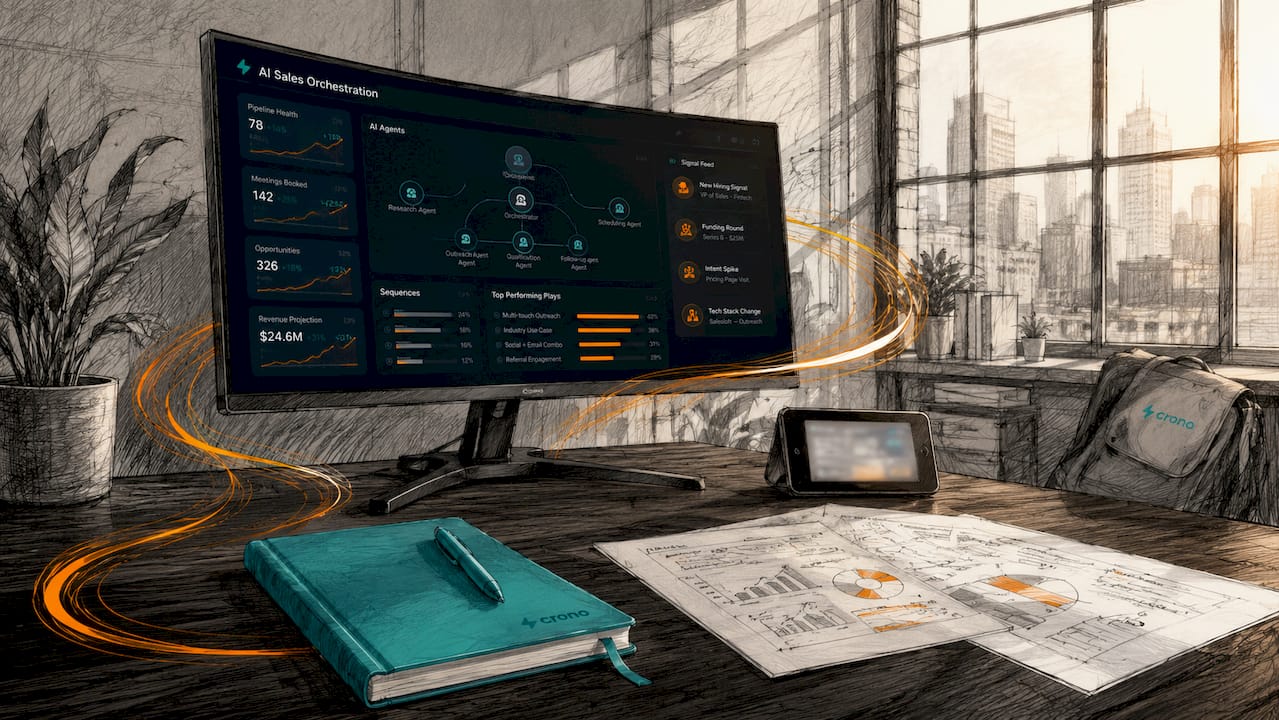
An agentic sales engine is a coordinated system of specialized AI agents, each responsible for a distinct function in the revenue process. The agents work in continuous loops rather than linear sequences. Autonomous agents handle signals, research, outreach, conversations, and orchestration as integrated, parallel phases. That compression of the traditional sales funnel is the core architectural advantage.
The five primary agent types each own a specific job:
- Signal monitoring agents scan intent data, firmographic changes, and buying triggers across data sources in real time.
- Research agents build account and contact profiles by pulling from CRM records, enrichment databases, and public signals.
- Outreach agents draft and send personalized messages across email, LinkedIn, and other channels based on research outputs.
- Conversation agents handle inbound and outbound replies autonomously, qualifying leads and booking meetings without human involvement until necessary.
- Orchestration agents act as the system’s decision layer, determining which agent acts next, sequencing tasks, and deciding when to escalate to a human seller.
The orchestration layer is the most critical component. It holds the policy rules, permission structures, and compliance boundaries that govern every agent action. Without a well-configured orchestration layer, agents can take actions that violate corporate standards or regulatory requirements.
| Feature | Traditional automation | Agentic sales engine |
|---|---|---|
| Task execution | Single-step, rule-based | Multi-step, goal-driven |
| Decision-making | Predefined scripts | Iterative planning and self-correction |
| System integration | One or two tools | CRM, CPQ, contract management, and more |
| Human involvement | Required at each step | Only at high-value or exception moments |
| Adaptability | Static | Continuously learning and adjusting |
Pro Tip: Before deploying any agent, map every action it could take to a specific policy rule. Agents that operate without explicit permission boundaries create compliance risk, not efficiency gains.
How does an agentic engine differ from AI copilots and automation?
The distinction between an AI copilot and an agentic sales engine is architectural, not cosmetic. A copilot suggests the next email subject line. An agentic engine writes the email, sends it, tracks the response, updates the CRM, and adjusts the outreach sequence, all without a rep touching the keyboard. The fundamental difference lies in full autonomy across integrated systems, not just enhanced feature sets.
Traditional automation tools follow rigid, linear scripts. If a prospect replies with an unexpected question, a standard automation sequence breaks or routes to a human. An agentic engine handles that variation. Agentic engines self-correct and adapt plans continuously, testing new subject lines, switching channels, or adjusting timing until the goal is reached. That behavior mirrors how a top-performing sales rep operates, not how a workflow tool operates.
“Agentic engines act like top-performing employees, autonomously re-jigging plans and tactics based on feedback until objectives are met. They do not wait for permission to try a different approach.”
This matters for sales leaders because it changes what you can delegate. With a copilot, you delegate a task and a human still reviews and executes. With an agentic model, you delegate an outcome. The engine figures out the path. That shift in delegation scope is what makes agentic selling techniques fundamentally different from anything that came before.
The practical implication is coverage. A single agentic engine can run personalized outreach sequences for hundreds of accounts simultaneously, something no copilot or automation script can match without degrading quality.
What benefits do agentic sales engines bring to B2B teams?
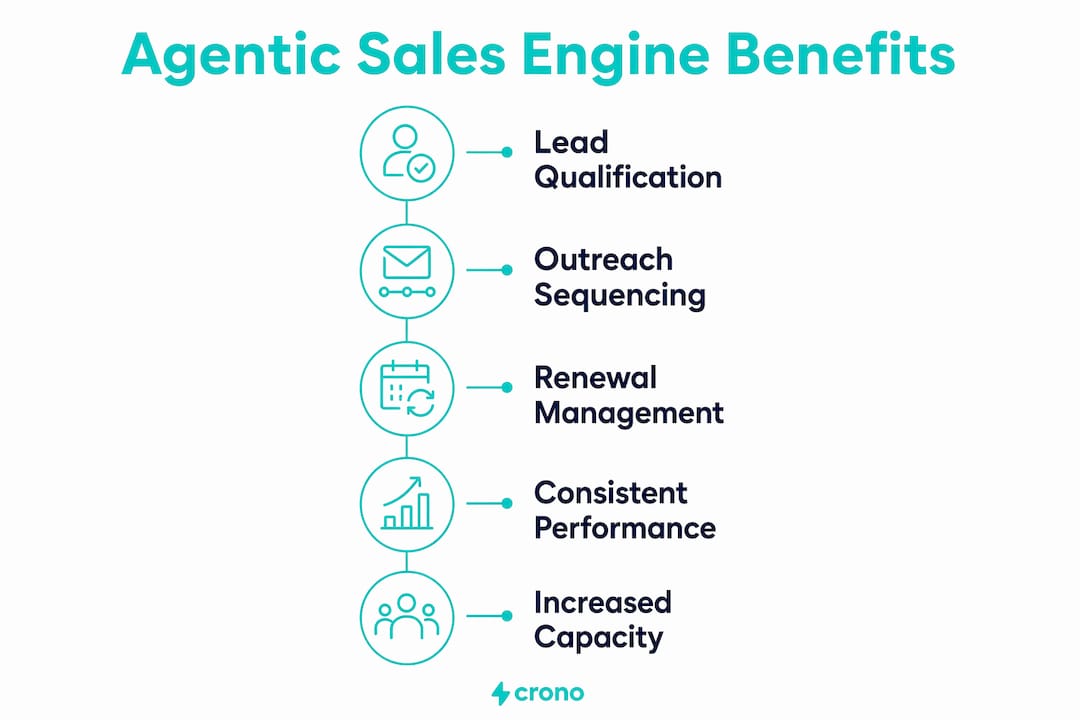
The most direct benefit is capacity. Agentic AI qualifies leads, prioritizes outreach timing, manages renewals, and handles post-call CRM updates without human involvement. Sales reps stop doing administrative work and start doing the work that actually requires human judgment.
The second benefit is consistency. Human sellers have good days and bad days. An agentic engine runs the same quality process at 2:00 AM on a Sunday as it does on a Tuesday morning. For high-volume transactional segments, that consistency compounds into measurable pipeline growth over time.
The third benefit is the hybrid model it enables. BCG research confirms that the most effective agentic selling model combines autonomous agents managing transactional tasks with human sellers focused on strategic relationships. Agents handle volume. Humans handle complexity. That division of labor is not a compromise. It is the design.
Key outcomes sales teams report from agentic sales models include:
- Faster lead qualification with no rep time spent on early-stage screening.
- Higher outreach volume without sacrificing personalization quality.
- Reduced pipeline risk through autonomous monitoring of deal health signals.
- More rep time allocated to enterprise accounts and late-stage negotiations.
Pro Tip: Start measuring rep time allocation before you deploy an agentic engine. You need a baseline to prove the shift from administrative work to strategic selling after deployment.
The AI productivity gains documented across AI-driven sales and marketing organizations consistently show that the teams who benefit most are those who redesign roles around the engine, not those who simply add it on top of existing workflows.
How can sales leaders implement an agentic sales engine effectively?
Implementation works best when it starts narrow and expands. Trying to automate every sales motion at once creates coordination problems and makes it hard to diagnose what is working. A phased approach reduces risk and builds internal confidence.
- Define your orchestration policy first. Before any agent touches a prospect, document what actions agents are permitted to take, what data they can access, and when they must escalate to a human. Orchestration intelligence must be explicitly configured with corporate policies and permission frameworks. This is not optional.
- Start with high-volume, transactional segments. SMB outreach, renewal sequences, and inbound lead qualification are ideal first deployments. These segments have clear success metrics and low relationship risk if the engine makes an error.
- Align human and agent roles explicitly. Every seller on your team needs to know which accounts and stages are agent-managed and which require human involvement. Ambiguity here creates dropped balls and duplicated effort.
- Integrate with your existing tech stack. Agentic AI completes workflows across CRM, CPQ, and contract management systems. Your engine needs clean data connections to all relevant systems to function correctly.
- Build a feedback loop from day one. Track agent actions, outcomes, and escalation rates weekly. Use that data to refine policy rules and agent configurations continuously.
Adopting a hybrid operational model that balances autonomous agent activity with deliberate human oversight is the standard recommended by practitioners who have deployed these systems at scale. The goal is not to remove humans. The goal is to put humans where they create the most value.
Pro Tip: Assign one sales operations leader as the orchestration owner. This person manages policy rules, monitors agent performance, and owns the escalation framework. Without a named owner, orchestration drift happens fast.
Key Takeaways
An agentic sales engine is the most significant structural change to B2B sales execution since CRM adoption, and teams that implement it with clear orchestration policies and hybrid role design will outpace those that treat it as a feature addition.
| Point | Details |
|---|---|
| Core definition | An agentic sales engine autonomously executes multi-step B2B workflows across CRM, outreach, and contract systems. |
| Orchestration is critical | The orchestration layer must encode policy rules and permission boundaries before any agent acts on prospects. |
| Different from copilots | Agentic engines complete outcomes independently; copilots only suggest next steps for humans to execute. |
| Hybrid model wins | Agents handle transactional volume while human sellers focus on complex accounts and late-stage deals. |
| Start narrow | Deploy first in high-volume, low-relationship-risk segments to build confidence and establish performance baselines. |
Why the “set it and forget it” mindset will cost you
The biggest mistake I see sales leaders make with agentic engines is treating deployment as a one-time project. They configure the agents, run a pilot, see good early numbers, and then stop paying attention. Six months later, the engine is running stale sequences, the orchestration policy has not been updated to reflect new compliance requirements, and reps have quietly started working around it.
An agentic sales engine is not software you install. It is a system you manage. The self-correction capability that makes it powerful also means it will adapt in directions you did not intend if you are not monitoring it. I have seen teams lose pipeline visibility because their conversation agents were qualifying leads into a stage that no longer matched the actual sales process.
The other thing I would push back on is the assumption that agentic selling techniques replace seller judgment. They do not. They free up seller judgment for the moments that actually require it. The reps who thrive in an agentic model are the ones who get genuinely good at managing complex enterprise relationships, not the ones who were good at sending 80 emails a day. That shift in what “good” looks like for a seller is something most sales leaders are not preparing their teams for yet.
My prediction: within three years, the agentic sales execution capability of a revenue team will be as foundational as CRM hygiene is today. Teams that build the operational muscle now will have a compounding advantage that is very hard to close later.
Crono: built for agentic sales execution
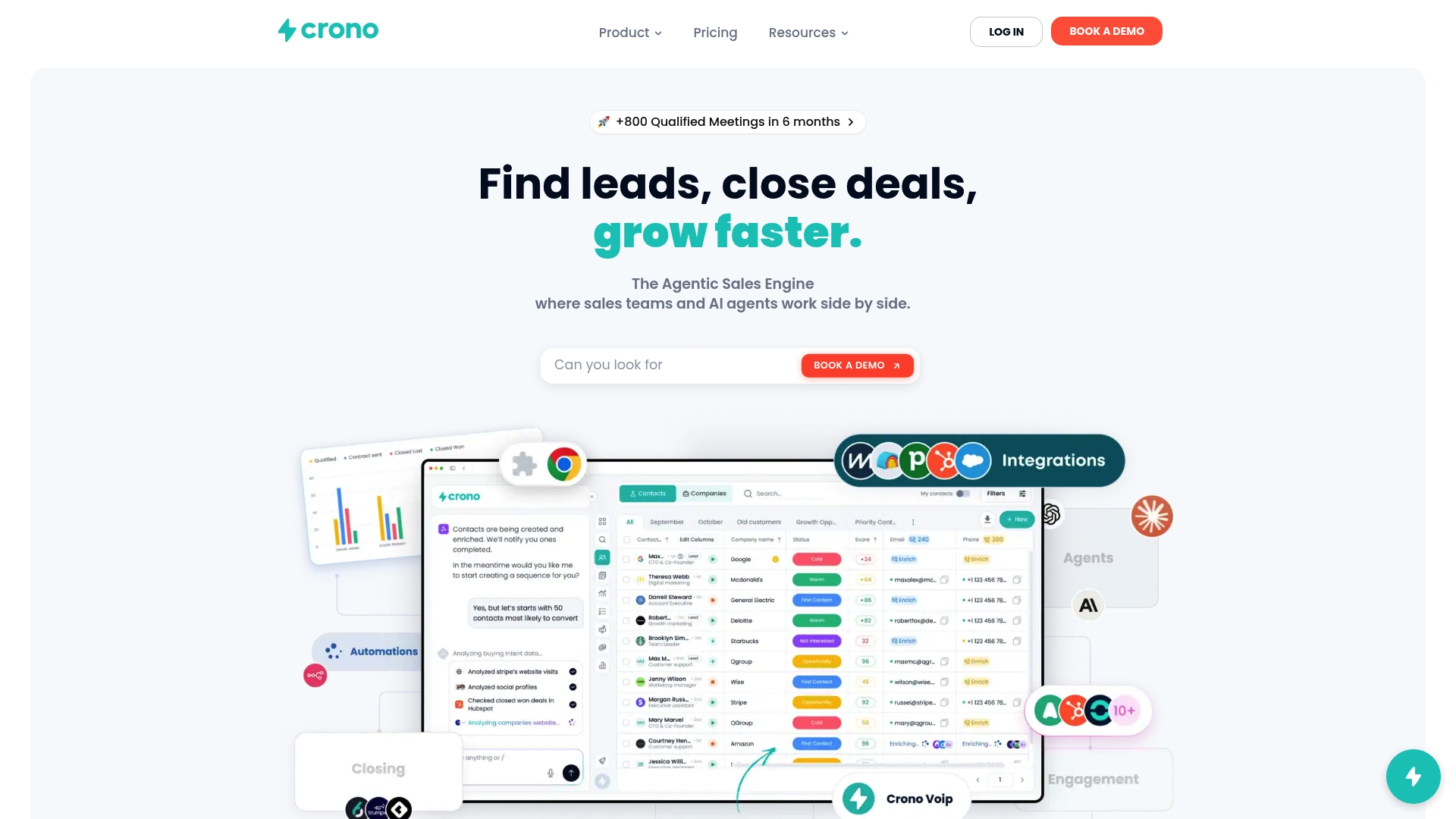
Crono is an Agentic Sales Engine designed for modern B2B revenue teams. It combines AI agents, sales orchestration, workflow automation, data enrichment, and multichannel engagement in a single platform. Sales teams use Crono to identify opportunities, automate execution, and run human and AI agents side by side.
If you are ready to move from theory to deployment, the 2026 guide to AI sales agents walks through exactly how to configure, integrate, and scale an agentic engine within your existing B2B sales operation. For teams that want to see the model in practice first, Crono’s B2B sales orchestration guide covers orchestration design with real workflow examples. The architecture is ready. The question is whether your team is.
FAQ
What is an agentic sales engine in simple terms?
An agentic sales engine is an AI system that autonomously executes multi-step sales tasks, including prospecting, outreach, qualification, and CRM updates, without requiring human input at each stage.
How does an agentic sales engine differ from a CRM or automation tool?
A CRM stores data and a standard automation tool follows fixed scripts. An agentic engine makes decisions, adapts its approach based on outcomes, and completes tasks across multiple integrated systems independently.
What is the orchestration layer in an agentic sales model?
The orchestration layer is the decision-making component that determines which specialized agent acts next, sequences tasks across systems, and enforces policy rules governing when to escalate to a human seller.
Which sales tasks are best suited for agentic automation?
Lead qualification, outbound outreach sequencing, renewal management, inbound reply handling, and post-call CRM updates are the highest-value tasks for agentic automation because they are high-volume and rule-definable.
How do I start implementing an agentic sales engine?
Start by defining orchestration policy boundaries, then deploy agents in a high-volume, low-risk segment like SMB outreach or inbound qualification before expanding to more complex sales motions.
Leave a Reply