

What does a sales engineer actually do?
A sales engineer is a technical sales professional who bridges deep product knowledge with the ability to communicate that knowledge clearly to buyers. Unlike a traditional account executive who focuses on relationship management and deal mechanics, a sales engineer validates that a product actually works for a specific customer’s environment. That distinction is what makes the role indispensable in complex B2B technology sales.
The core of the job is technical validation: conducting discovery calls to understand a prospect’s environment, delivering customized product demos, managing proof-of-concept evaluations, responding to RFPs, and handling technical objections from engineering teams and IT decision-makers. Sales engineers work alongside account executives, not instead of them. The AE owns the relationship and the deal; the SE owns the technical credibility that lets the deal close.
Here is what the day-to-day job description typically covers:
- Discovery calls: Asking targeted questions to map a prospect’s technical environment, pain points, and success criteria before any demo is built
- Customized demos: Tailoring product demonstrations to the specific use case and technical stack of each prospect, not running a generic slide deck
- Proof-of-concept management: Designing and executing POC evaluations where the product runs in a test environment against defined success criteria
- RFP responses: Translating technical capabilities into clear, business-focused answers for formal procurement processes
- Technical objection handling: Fielding hard questions from architects, CTOs, and security teams with honest, credible answers
- Cross-functional collaboration: Working with product, engineering, and customer success teams to surface prospect feedback and close knowledge gaps
The role goes by several titles across the industry. Solutions Engineer, Pre-Sales Engineer, and Technical Sales Specialist all describe the same core function. The O*NET occupational classification (SOC code 41-9031.00) uses “Sales Engineer” as the standard term, and that is the one the U.S. Bureau of Labor Statistics tracks.
What is the work environment like for sales engineers?
Sales engineers spend most of their time in an office setting, but the job is far from desk-bound. Customer meetings, product presentations, and on-site evaluations pull them into the field regularly. Some travel extensively, which can mean being away from home for several days each month, particularly when managing enterprise accounts across multiple regions.

The schedule is full-time by default, and it often stretches beyond 40 hours per week during active deal cycles. A competitive RFP deadline or a high-stakes POC can compress timelines quickly, requiring close coordination across time zones with both the internal team and the prospect’s technical staff.
Cross-functional interaction is a constant. Sales engineers regularly work with:
- Account executives: Coordinating on deal strategy, discovery prep, and objection responses
- Product management: Surfacing technical gaps and feature requests that emerge during evaluations
- Engineering and R&D: Escalating highly specific technical questions that go beyond standard product knowledge
- Customer success: Handing off technical context after a deal closes to support smooth onboarding
The pace varies by deal stage. Early pipeline work tends to be steady and planned. Late-stage evaluations, especially competitive ones involving POCs, can be intense and deadline-driven. That variability is part of what makes the role engaging for people who prefer a mix of structured preparation and live problem-solving.
How to become a sales engineer in the United States
The most direct path into sales engineering starts with a bachelor’s degree in engineering, computer science, or a related technical field. That said, a degree is not always mandatory. Candidates who demonstrate strong technical depth through hands-on experience in software development, technical support, solutions consulting, or customer success regularly qualify for the role. What matters most is the combination of genuine technical credibility and the ability to communicate clearly with non-technical buyers.

Newly hired sales engineers typically go through moderate-term on-the-job training before working independently. That training covers the employer’s specific products, sales methodology, and customer base. It often involves pairing with an experienced sales professional to observe live customer interactions before taking the lead.
Sales methodologies worth learning early include MEDDIC and MEDDPICC, which are widely used in enterprise B2B sales to qualify opportunities and align technical validation with buying criteria. Familiarity with these frameworks signals to hiring managers that a candidate understands how technical work connects to deal outcomes.
Pro Tip: Focus your discovery call preparation on the customer’s pain points, not on the product’s feature list. The most effective sales engineers build technical conviction by showing how the product solves a specific problem, not by running through every capability it has.
Steps to build a competitive profile for this career:
- Build technical depth first: Spend time in a hands-on technical role (development, support, implementation) before transitioning to pre-sales
- Develop presentation skills: Practice explaining complex systems to mixed audiences of developers and executives
- Learn a sales methodology: MEDDIC or MEDDPICC gives you a shared language with account executives and sales leadership
- Pursue certification: The Certified Sales Engineer (CSE) designation from the North American Association of Sales Engineers (NAASE) is the field’s primary professional credential and is gaining traction as a formal marker of expertise
- Build product-area expertise: Specializing in a domain (cloud infrastructure, security, data platforms, AI/ML) reduces preparation time and increases your credibility with technical buyers in that space
- Study RFP writing: The ability to translate technical capabilities into business-value statements is a skill that separates good SEs from great ones
What do sales engineers earn in the United States?
The median annual wage for sales engineers was $121,520 in May 2024, according to the U.S. Bureau of Labor Statistics. Entry-level professionals typically earn less than the median, while senior levels can achieve substantially higher total compensation, especially at leading technology companies. Compensation usually combines a base salary with a variable component tied to team performance, with bonuses and commissions varying by role and company. Career advancement offers additional earning potential, including management positions or larger territories.
What is the job outlook for sales engineers through 2034?
Employment of sales engineers is projected to grow 5% from 2024 to 2034, faster than the average for all occupations. The BLS projects approximately 5,000 openings per year over the decade, driven by a combination of new demand and the need to replace workers who retire or move to other roles.
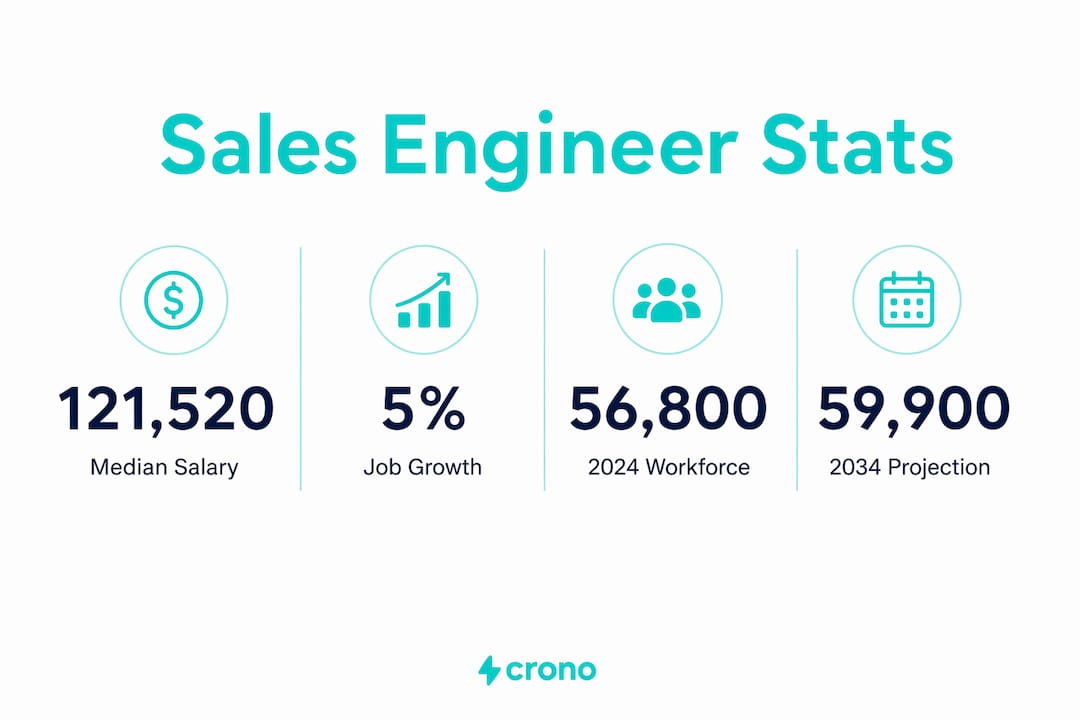
Employment growth for sales engineers is projected to increase moderately from 2024 to 2034, with thousands of annual openings expected.
The strongest growth is expected in computer software and hardware sales, with computer systems design and related services identified as a key driver. As enterprise technology products grow more complex, including AI platforms, security tools, and cloud-native infrastructure, the need for technically credible salespeople who can guide buyers through evaluations only increases.
Key trends shaping the role through the rest of the decade:
- AI as a tool, not a replacement: AI assists sales engineers with demo preparation, RFP drafting, and competitive research, but cannot substitute for the human technical advisor role during live evaluations
- AI/ML product expertise as a premium skill: Sales engineers with genuine fluency in how AI systems work, their data security implications, and their integration requirements are being recruited aggressively
- Expanding technical validation requirements: As products add compliance frameworks, security controls, and integration complexity, the scope of what buyers need validated before purchasing continues to grow
- Growth in B2B SaaS and infrastructure: These sectors consistently involve technical evaluations, making sales engineers a structural part of the go-to-market model rather than an optional resource
- Remote and hybrid deal cycles: Virtual POCs and remote demos have become standard, expanding the geographic reach of individual sales engineers while adding new demands on their digital communication skills
The 56,800 sales engineers employed in 2024 are projected to grow to 59,900 by 2034. That net addition of 3,100 roles understates the actual hiring volume, since the bulk of annual openings come from turnover rather than net new positions.
Why sales engineers are the linchpin of complex B2B deals
Sales engineers do something that marketing materials, product videos, and AI chatbots cannot: they provide technical validation that enterprise buyers can trust. When a senior architect asks a specific, probing question about how a product handles a particular edge case, the SE’s answer determines whether the deal progresses or stalls. That moment of credibility is the core value of the role.
Effective sales engineers focus on building technical conviction rather than just showcasing features. Discovery calls tailored to customer pain points are consistently more effective than generic demos, because they let the SE frame every capability in terms of a problem the prospect is already trying to solve. That framing is what moves a skeptical engineering team from “interesting product” to “this actually works for us.”
Sales engineers also serve a critical internal function. By acting as the technical encyclopedia for the sales team, they free product managers from repeated involvement in individual sales calls. That separation lets product management focus on roadmap and development while the sales team scales without creating a bottleneck at the product layer.
Pro Tip: When a prospect asks a question you cannot answer confidently, say so and commit to a specific follow-up timeline. Intellectual honesty builds more trust than a confident-sounding bluff, and a bluff caught during a POC can end a deal that was otherwise on track.
What separates high-performing sales engineers from average ones:
- They run discovery before every demo, not after
- They design POCs around the prospect’s success criteria, not the product’s strongest features
- They maintain relationships with R&D and product specialists to handle questions beyond their own knowledge
- They translate technical findings into business-value language for executive stakeholders
- They specialize in a product domain rather than trying to cover everything, which reduces preparation time and increases depth
- They treat every technical objection as a discovery opportunity, not a threat to manage
For anyone exploring B2B SaaS sales specifically, the SE role is where technical depth and commercial impact converge most directly. The ability to run a credible evaluation in a SaaS environment, including API integrations, SSO configuration, and data security reviews, is what separates a solutions engineer from a product demonstrator.
Key Takeaways
Sales engineers combine technical depth with sales ability to close complex B2B deals that no other role can advance alone, making them one of the most valuable and well-compensated positions in enterprise technology.
| Point | Details |
|---|---|
| Median salary | BLS reports $121,520 annual median wage as of May 2024. |
| Job growth | Employment projected to grow 5% from 2024 to 2034, faster than the average for all occupations. |
| Entry path | A bachelor’s degree is typical but not required; technical experience in development or support is often sufficient. |
| Certification | NAASE’s Certified Sales Engineer (CSE) designation is the field’s primary professional credential for formal recognition. |
| Crono’s role | Crono helps sales engineering teams scale by automating repetitive execution and connecting CRM data with AI-driven sales workflows. |
The sales engineer role in 2026 is more specialized than most people realize
The conventional view of sales engineering treats it as a support function: the technical person who shows up to the demo and answers hard questions. That framing undersells the role and, more practically, it leads people to underinvest in the skills that actually drive results.
The most effective sales engineers in 2026 are not generalists who know a little about everything their product does. They are specialists who know a great deal about the problems their best customers face, and they use that depth to run evaluations that feel less like vendor pitches and more like collaborative problem-solving sessions. That shift in posture is what builds the kind of trust that survives a competitive evaluation.
Certification through NAASE is becoming a meaningful differentiator, not because a credential changes what you know, but because it signals that you take the profession seriously enough to formalize your expertise. In a field where the role is still frequently misunderstood by hiring managers and buyers alike, that signal carries weight.
AI tools are genuinely useful for preparation, RFP drafting, and competitive research. But the moment a prospect’s engineering team starts asking real questions about architecture, data handling, or edge-case behavior, no AI tool can substitute for a person who has actually worked with the product and can answer honestly. The human technical advisor role is not at risk from AI. If anything, AI-powered products have made the SE’s job more important, because buyers need someone who can explain how the AI actually works, not just what it claims to do.
The career path for sales engineers who specialize and build credibility is genuinely strong. Senior SEs move into management, into product roles, into field CTO positions, or into independent consulting. The skills developed in the role, technical depth, executive communication, and the ability to run a structured evaluation, transfer across industries and company stages.
Crono gives your sales engineering team an execution edge
Sales engineers do their best work when the surrounding sales process is tight: the right accounts prioritized, the right context surfaced before a call, and the repetitive coordination tasks handled automatically. That is exactly what Crono is built for.
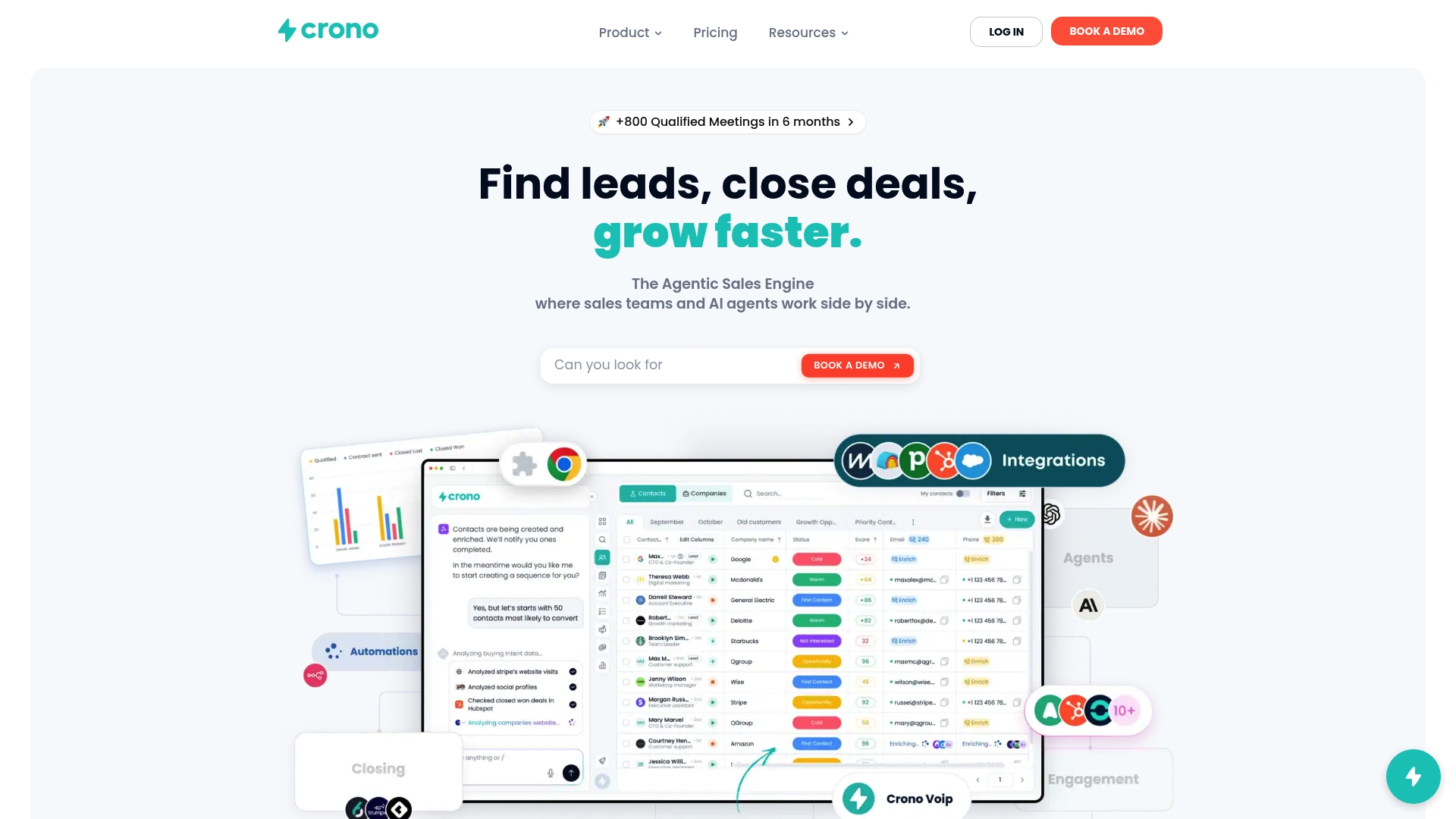
Crono is the sales execution layer for modern B2B revenue teams. It connects your CRM and existing tools into a unified platform where AI agents and people work together, handling buying signal detection, data enrichment, workflow automation, and multichannel engagement in one place. For teams with sales engineers, that means less time chasing account context and more time running evaluations that actually move deals forward. Crono helps you refine your B2B sales techniques and build the kind of repeatable process that scales with your team. If you want to see how AI-driven sales engagement fits into a technical sales motion, Crono is worth a close look.
