
A sales call follow up email is a targeted message sent promptly after a sales call to reinforce what was discussed, personalize key points, and move the deal forward with one clear next step. It is not a courtesy note. It is one of the most decisive touchpoints in your entire sales process, where momentum is either locked in or quietly lost.
The best follow-up emails share four traits:
- Personalization grounded in the call itself — referencing the prospect’s exact words, not a generic template with their name swapped in
- Timing that capitalizes on fresh memory — sent within hours, not days
- A single, specific next step — not a vague “let me know what you think”
- Brevity — focused enough to read in under a minute
Consistent, structured follow-up processes correlate strongly with sales success and reduced deal leakage. The emails that actually get replies treat the call as raw material, not background noise.
Table of Contents
- How to write a sales call follow up email that actually gets a reply
- 16 proven follow-up email templates organized by sales scenario
- When to send follow-up emails and how often to reach out
- How Crono helps you write better follow-ups with AI and personalization
- Common mistakes that kill follow-up success and how to fix them
- Crono turns your follow-up process into a competitive advantage
- Key Takeaways
How to write a sales call follow up email that actually gets a reply
Writing an effective follow-up after a sales call comes down to a clear structure and disciplined personalization. Here is how to build one that works.
Start with a subject line that earns the open
Your subject line is the gate. If it reads as generic, the email never gets seen. Subject lines under 50 characters that directly reference the prior conversation tend to outperform everything else. Avoid “Just checking in” or “Following up” as standalone subjects — they signal low effort immediately.
Strong subject line patterns:
- “[Prospect’s Name], next steps from today’s call”
- “Quick recap + the case study I mentioned”
- “Follow-up on [specific topic from the call]”
- “One idea from our conversation on [date]”
Open with a specific reference to the call
Your first sentence should orient the prospect instantly. One or two sentences that name what you discussed — not a generic “great speaking with you” opener — reconnects the conversation before they have to think about it.

Bridge their pain points to outcomes, not features
Using the buyer’s exact words from the call prevents generic messaging and increases engagement. The follow-up’s job is to link what the prospect told you they struggle with to a concrete outcome your solution delivers. You are not recapping product features. You are positioning yourself as the person who actually listened.
Add one piece of new value
A resource, a relevant case study, a quick answer to a question they raised — something that gives them a reason to respond beyond the fact that you reached out.
Close with one clear next step
Vague asks produce vague responses. Propose something specific: a time to meet, a yes-or-no question, or a concrete action. “Would Thursday at 2 PM work to walk through the proposal?” beats “Let me know your thoughts” every time.
Pro Tip: Write your follow-up email immediately after the call, while the conversation is still fresh. Even a rough draft captures the specific phrases and details that make personalization feel real rather than manufactured.
16 proven follow-up email templates organized by sales scenario
These templates are starting points. The goal is to adapt each one to the actual conversation you had — the specific challenge the prospect named, the outcome they described, the objection they raised. A template used verbatim is a template the prospect has already seen.
Templates for discovery call follow-ups
Template 1: After a strong discovery call with clear next steps
Subject: [Name], next steps from today’s call
Hi [Name],
Thanks for walking me through [specific challenge] today. Based on what you shared about [key detail], I think [brief recommendation] could help your team [desired outcome].
I’ve attached [resource discussed]. Would [day and time] work to [next step]?
[Your name]
Template 2: After a discovery call with no clear next step
Subject: One idea from our conversation on [date]
Hi [Name],
Something you said about [specific challenge] stuck with me. I put together [resource or summary] that might help as you think through [their goal].
Would a 15-minute call next week make sense to walk through it?
[Your name]
Template 3: After a discovery call where the prospect raised a specific objection
Subject: Quick follow-up on [objection topic]
Hi [Name],
You raised a fair point about [objection] during our call. I wanted to share [specific answer or data point] that addresses it directly.
Happy to discuss further — does [day] work for a quick call?
[Your name]
Templates for demo call follow-ups
Template 4: After a demo with strong engagement
Subject: [Name] — what we covered today
Hi [Name],
Really appreciated the questions you asked about [specific feature or use case] during the demo. It’s clear [Company] is focused on [goal discussed].
I’ve attached [relevant resource]. Next step: would [day/time] work to loop in [decision-maker or team]?
[Your name]
Template 5: After a demo where the prospect needs internal buy-in
Subject: Summary for your team
Hi [Name],
To make it easy to share with your colleagues, here is a quick summary of what we covered:
- [Key point 1 from the demo]
- [Key point 2 from the demo]
- [Relevant outcome or ROI point]
Happy to join a call with your team to answer questions directly. Would [day] work?
[Your name]
Template 6: After a demo with no clear next step
Subject: Following up on our demo — [specific topic]

Hi [Name],
Wanted to check in after our demo. Based on what you shared about [challenge], I think the [specific feature] we walked through could have a real impact on [outcome].
What would be most helpful as a next step — a deeper dive on [topic] or a conversation with your team?
[Your name]
Templates for pricing discussions
Template 7: After sharing a proposal
Subject: Quick question on the proposal
Hi [Name],
Following up on the proposal I sent. Given what you told me about [budget constraint or priority], I wanted to flag [specific option or adjustment] that might be a better fit.
Does [day/time] work to talk through it?
[Your name]
Template 8: After a pricing call where the prospect needs time
Subject: [Name] — a few things to consider
Hi [Name],
Totally understand you need time to review. While you do, I thought [case study or data point] might be useful context — it shows how [similar company] handled [similar challenge] with [outcome].
No rush. Happy to answer any questions whenever it’s convenient.
[Your name]
Templates for no-shows or missed calls
Template 9: After a prospect misses a scheduled call
Subject: Missed you today — easy to reschedule
Hi [Name],
We had [time] blocked for a call today. No worries — happy to find another time that works better.
Here are a few options: [Day 1 at time], [Day 2 at time], or [Day 3 at time]. Just reply with what works and I’ll send a new invite.
[Your name]
Template 10: After a no-show with no prior response
Subject: Still worth a conversation?
Hi [Name],
We missed each other on [date]. I know schedules get complicated.
If [challenge you discussed] is still a priority, I’d love to reconnect. A 15-minute call is all we’d need. Does [day] work?
[Your name]
Templates for re-engagement and late-stage follow-ups
Template 11: After no response to previous follow-ups
Subject: Following up on [specific topic]
Hi [Name],
I’ve reached out a couple of times and haven’t heard back. I want to be respectful of your time.
If [challenge] is still on your radar, I’m here. If priorities have shifted, just let me know and I’ll stop following up.
[Your name]
Template 12: Final outreach before closing the file
Subject: Closing the loop on [topic]
Hi [Name],
I’ve tried to connect a few times without luck. I’ll assume the timing isn’t right and won’t reach out again.
If things change and [challenge] becomes a priority, feel free to reach back out. The offer stands.
[Your name]
Templates for networking and event follow-ups
Template 13: After meeting at a networking event
Subject: Great meeting you at [event name]
Hi [Name],
Really enjoyed our conversation about [specific topic] at [event]. You made a great point about [detail from conversation] — it’s something I’ve been thinking about since.
Would love to continue the conversation. Are you open to a quick call this week?
[Your name]
Template 14: After a networking event with a specific resource to share
Subject: The [resource] I mentioned at [event]
Hi [Name],
As promised — here is [resource]. Given what you shared about [challenge], I think [specific section] will be particularly relevant.
Happy to walk through it together if that would be useful.
[Your name]
Templates for multi-stakeholder and complex deals
Template 15: When looping in a new decision-maker
Subject: Connecting you with [colleague name]
Hi [Name],
Based on our conversation, I think it would be worth looping in [colleague] from our team. They work closely with companies navigating [specific challenge] and can speak to [technical or strategic detail] in more depth.
Would a brief three-way call work? Happy to set it up.
[Your name]
Template 16: After a call that surfaces a new priority
Subject: Something you mentioned today
Hi [Name],
When you mentioned [new priority or challenge that came up], it made me think of [specific resource or approach]. It’s a bit different from what we originally discussed, but I think it’s worth a look given where your team is focused.
Would it make sense to revisit our conversation with this in mind?
[Your name]
Key customization tips for all templates:
- Replace every bracketed placeholder with the prospect’s actual words from the call
- Match the tone to the deal stage: exploratory early on, more direct and decision-focused later
- Keep the total email under 200 words — brevity signals respect for the prospect’s time
- One call to action per email, always
When to send follow-up emails and how often to reach out
Timing is where most follow-up strategies quietly fall apart. Sending too late means the conversation has gone cold. Sending too frequently without new value means you become noise.
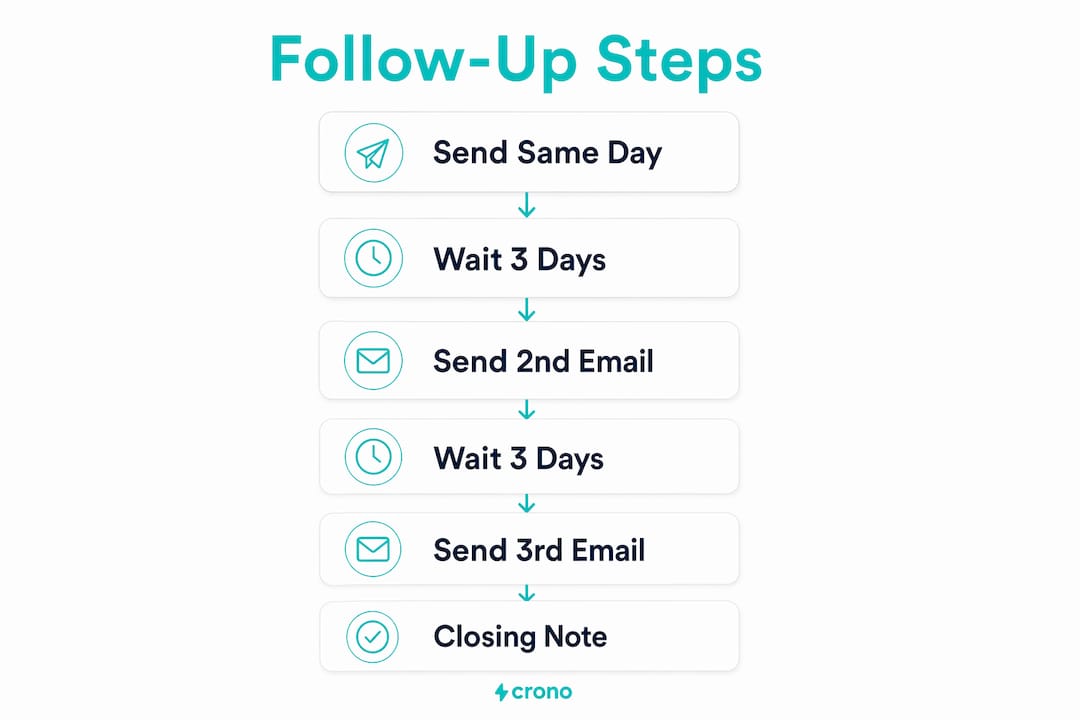
The first follow-up: send it the same day
Send your first follow-up email within two hours of ending the call. This is when the prospect’s memory of the conversation is sharpest and their motivation is highest. Waiting until the next morning is a missed opportunity. If the call ends late in the day, send it before you close your laptop.
A practical follow-up cadence
- Day 0 (same day): First follow-up sent within two hours of the call. Recap, value, clear next step.
- Day 2–3: If no reply, send a second message with a new insight, relevant resource, or a different angle on the challenge they described.
- Day 5–7: A brief check-in that references the original conversation and proposes a specific next step.
- Day 10–14: Final outreach. Keep it short, low-pressure, and leave the door open.
The 3-3-3 rule offers a useful framework: three emails spaced three days apart over three weeks, followed by a closing note. Treat it as a starting point, not a rigid formula. The right cadence depends on the deal stage and how engaged the prospect has been.
Recognizing when to stop
If a prospect has not responded after four to five well-spaced, value-driven touches, a graceful exit is the right move. A final “closing the loop” email often prompts a response when nothing else has. It also protects the relationship for future outreach.
Timing insight: Follow-up emails sent soon after a sales call have significantly higher open and reply rates than those sent later. The window right after the call is your highest-leverage moment.
For a deeper look at how timing interacts with channel selection, Crono’s guide on multichannel timing strategies breaks down how to sequence email alongside other outreach for maximum impact.
How Crono helps you write better follow-ups with AI and personalization
The biggest obstacle to great follow-up emails is not effort. It is memory. By the time you finish a call, open your CRM, and start drafting, the specific phrases the prospect used — the exact language that makes personalization feel real — are already fading. This is where AI-powered tools change the equation.
Crono’s platform addresses this directly. Here is how it works in practice:
- AI-assisted transcription and note capture: Crono captures key moments from your calls, so the prospect’s exact words are available when you sit down to write. You are not reconstructing the conversation from memory — you are working from the actual record.
- Draft generation grounded in the call: AI tools for transcription and follow-up email drafts can overcome memory limitations and improve accuracy. Crono takes this further by connecting call data directly to your outreach workflow, so the draft reflects what was actually said.
- CRM integration for consistency and tracking: Every follow-up is logged, timed, and tracked within your existing CRM. No manual data entry, no missed touchpoints, no deals falling through because a follow-up slipped through the cracks.
- Workflow automation for cadence management: Crono automates the spacing and sequencing of follow-up touches, so your cadence stays consistent without requiring manual scheduling for every prospect.
- Tailored templates tied to deal stage: Rather than one-size-fits-all templates, Crono surfaces the right template structure based on where the deal sits in the pipeline.
Pro Tip: Co-create the next step during the call itself. When the prospect agrees to a specific action before you hang up, your follow-up email becomes a confirmation rather than a cold ask. That shift in framing dramatically improves response rates.
The practical result: sales reps spend less time on administrative reconstruction and more time on the conversations that actually move deals. For teams managing high volumes of outreach, Crono’s AI-driven sales engagement approach means follow-up quality stays high even as volume scales.
Effective follow-up is also part of a broader lead nurturing strategy — keeping prospects engaged across multiple touches until they are ready to decide.
Common mistakes that kill follow-up success and how to fix them
Even experienced reps make the same follow-up mistakes repeatedly. The good news: each one has a straightforward fix.
Mistake 1: Sending a generic template without personalizing it The prospect can tell. A follow-up that could have been sent to anyone signals that you were not really listening. Fix: reference at least one specific thing the prospect said — their words, their challenge, their goal.
Mistake 2: Recapping the entire call A long summary of everything discussed buries the actual point of the email. Fix: keep the recap to two or three sentences focused on what matters most to the deal, then move directly to the next step.
Mistake 3: Including multiple calls to action When you ask the prospect to do three things, they do none of them. Fix: one CTA per email, always. Make it specific and easy to respond to.
Mistake 4: Waiting too long to send A follow-up sent 48 hours after the call is competing with a prospect’s new priorities, new conversations, and a fading memory of what you discussed. Fix: send the first follow-up the same day, ideally within two hours.
Mistake 5: Vague ownership of next steps “I’ll send something over” or “let me know when you’re ready” leaves the deal in limbo. Fix: name who owns what and by when. “I’ll send the proposal by Thursday. Can you confirm receipt by Friday?” is a next step with teeth.
Mistake 6: Never tracking what works If you are not looking at open rates, reply rates, and conversion by template or subject line, you are flying blind. Fix: use your CRM or sales engagement platform to track outcomes and iterate. The templates that consistently get replies are the ones worth refining further.
Mistake 7: Giving up too early Most deals require multiple touches. Stopping after one or two follow-ups because you haven’t heard back is one of the most common reasons pipeline stalls. Fix: commit to a structured cadence with a defined endpoint, and make each touch add something new.
A well-structured follow-up email template library, combined with disciplined tracking, is what separates reps who close consistently from those who rely on luck.
Crono turns your follow-up process into a competitive advantage
Most sales teams treat follow-up emails as an afterthought. Crono is built for teams who know that follow-up is where deals are actually won.
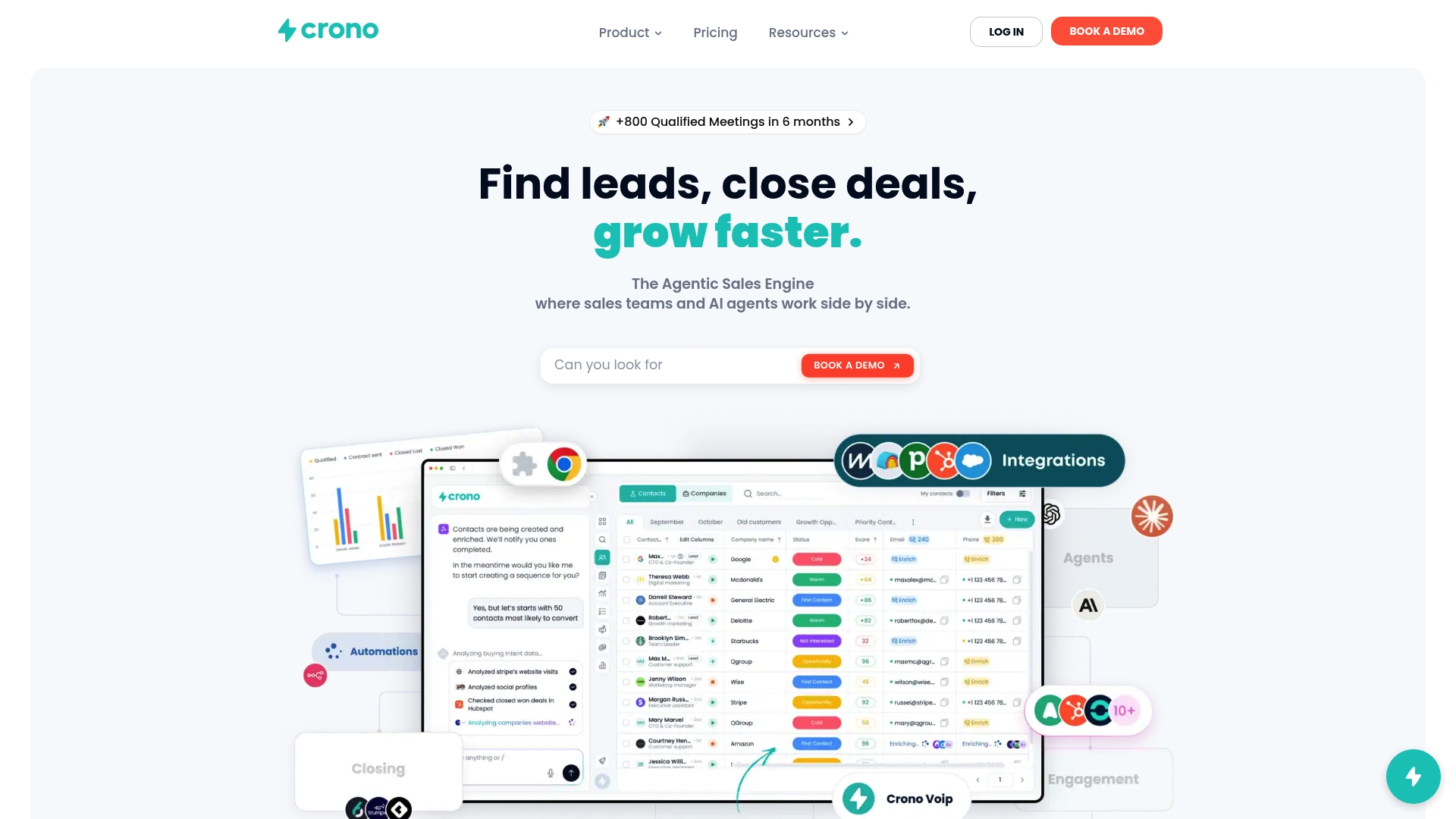
Crono connects your CRM, call data, and outreach workflows into a single execution layer where AI agents and your reps work together. The result: follow-up emails that are grounded in real call details, sent at the right time, and tracked for continuous improvement — without adding hours of manual work to your team’s day. For B2B revenue teams managing complex pipelines, that consistency compounds. Every rep follows up faster, with better personalization, and with full visibility into what is working.
If you are ready to move beyond copy-paste templates and build a follow-up process that actually converts, Crono’s B2B sales techniques resource is the place to start. You can also explore how AI sales agents fit into a modern follow-up workflow. See what Crono can do for your team at crono.one.
Key Takeaways
A sales call follow up email sent within hours of the call, personalized with the prospect’s exact words, and closed with one specific next step is the single most reliable way to keep deals moving forward.
| Point | Details |
|---|---|
| Send the same day | The first follow-up should go out within two hours of the call while memory and motivation are highest. |
| Personalize with real words | Reference the prospect’s exact language from the call — not just their name — to make the email feel relevant and earned. |
| One CTA per email | A single, specific call to action outperforms multiple asks every time; vague requests produce vague responses. |
| Follow a structured cadence | Space follow-ups across days 0, 2–3, 5–7, and 10–14, adding new value with each touch rather than repeating the same ask. |
| Crono automates and elevates | Crono connects call data, CRM, and outreach workflows so every follow-up is timely, personalized, and tracked for improvement. |
