Product marketing is the discipline that connects what a product does to why buyers should care, driving three measurable outcomes: clear positioning and differentiation, product adoption and activation, and revenue enablement across sales and customer success. According to HubSpot, it owns positioning, buyer understanding, launch, and sales enablement from first release through the full customer lifecycle. The Product Marketing Alliance recognizes it as one of the fastest-growing strategic functions in B2B, and Pragmatic Institute frames it as the practice of grounding every go-to-market decision in real market and buyer intelligence.
Three outcomes product marketing drives directly:
- Positioning and differentiation: Articulates why your product wins in a specific segment against specific alternatives.
- Adoption and activation: Moves buyers from awareness to first value, then from first value to habit.
- Revenue enablement: Arms sales, customer success, and partners with the messaging, tools, and evidence they need to close and expand.
Key Takeaways
Product marketing is most effective when it operates as a continuous feedback loop connecting buyer intelligence, positioning, and revenue execution, not as a series of discrete launch events.
| Point | Details |
|---|---|
| Definition and scope | Product marketing owns positioning, GTM, launch, sales enablement, and post-launch lifecycle work end to end. |
| AI adoption is accelerating | AI agent use in GTM workflows has significantly increased recently, and organizations integrating product and marketing functions tend to outperform their peers substantially in market-cap growth. |
| Metrics that matter | Track leading indicators (activation rate, positioning resonance, TTV) alongside lagging ones (win rate, PQL conversion, expansion ARR). |
| Positioning is a living system | Update your positioning document when win/loss data or activation signals shift, not on an annual planning schedule. |
| First 90 days | Interview customers and reps, write a positioning doc, build one battlecard, and execute one launch with a formal checklist before day 90. |
Table of Contents
- What product and marketing actually covers end-to-end
- How product marketing differs from product management and general marketing
- Core responsibilities and what product marketers do every week
- A practical product-marketing strategy you can execute step by step
- How product marketing collaborates with product, sales, and brand teams
- Key metrics and KPIs product marketers should track
- Skills, hiring, and career path in product marketing
- Concrete examples and templates you can copy right now
- Research-led trends reshaping product marketing right now
- How to build product marketing in your company: a 90- to 180-day plan
- A practitioner’s perspective on what most teams get wrong
- Ready to put product marketing into practice?
- Sources
What product and marketing actually covers end-to-end
Product marketing spans the full arc from market intelligence to post-launch lifecycle work. Most people picture it as launch planning, but that is only one phase. The function owns seven interconnected domains:
- Positioning and messaging: Defining the market category, the differentiators, and the language that makes both land with buyers.
- Buyer research: Continuous interviews, win/loss analysis, and behavioral data synthesis to keep personas current.
- Go-to-market (GTM) planning: Channel selection, sequencing, and launch readiness across internal and external audiences.
- Pricing and packaging: Translating value into tiers, bundles, and price points that match buyer willingness to pay.
- Launch execution: Coordinating product, marketing, sales, and support for a coordinated release.
- Sales enablement: Battlecards, objection guides, demo scripts, and competitive intelligence that help reps close.
- Post-launch lifecycle work: Adoption programs, feature announcements, churn signals, and expansion messaging.
In B2B SaaS, this looks like a product marketer running a win/loss program, rewriting onboarding sequences based on activation data, and briefing sales on a new pricing tier before it goes live. In consumer goods, the same function shows up as category management, retail channel strategy, and packaging copy that converts at the shelf. The scope is the same; the execution surfaces differ.
Pro Tip: Build a one-page “product marketing charter” in your first 30 days that lists which domains you own, which you influence, and which belong to adjacent teams. Shared clarity on scope prevents the most common friction.
How product marketing differs from product management and general marketing
These three roles share overlapping vocabulary but own fundamentally different problems.
| Dimension | Product Management | Product Marketing | General / Brand Marketing |
|---|---|---|---|
| Core focus | What to build and why | How to position and sell what was built | Awareness, brand equity, demand generation |
| Primary KPIs | Feature adoption, retention, NPS | Win rate, pipeline influenced, activation rate | Impressions, MQLs, brand recall |
| Typical deliverables | Roadmap, PRD, sprint backlog | Positioning doc, launch plan, battlecard | Campaign brief, media plan, creative assets |
| Timeline ownership | Quarterly to annual roadmap | Launch cycle plus ongoing lifecycle | Campaign calendar, always-on programs |
As Acquia explains, product managers decide what to build; product marketers decide how to position and sell it. The distinction sounds clean in theory but creates real friction in practice.
Common handoff friction points:
- Product ships a feature without looping in product marketing until two weeks before launch, leaving no time for buyer research or enablement.
- Product marketing writes positioning based on last quarter’s persona work, not the latest customer interviews the product team ran.
- General marketing runs a campaign using messaging that product marketing has already retired after a win/loss analysis.
- Sales uses an old battlecard because no one owns the update cycle.
A RACI-style launch handoff clarifies who does what. For a typical B2B SaaS feature launch: product management is Responsible for the feature spec and acceptance criteria; product marketing is Responsible for positioning, messaging, and enablement assets; demand generation is Consulted on channel execution; sales leadership is Informed with a briefing at least two weeks before GA. Without that structure, launches default to whoever shouts loudest.
Core responsibilities and what product marketers do every week
Product marketers carry a broader task set than most job descriptions suggest. The recurring responsibilities break into four clusters:
Research and intelligence
- Conduct buyer interviews and synthesize findings into updated personas.
- Run win/loss analysis on closed deals, at least monthly for high-velocity pipelines.
- Monitor competitive positioning and update battlecards when rivals change pricing or messaging.
Positioning and messaging
- Own the master positioning document and version-control it.
- Write and test messaging variants by segment, channel, and buyer stage.
- Translate technical features into buyer-relevant outcomes.
Launch and GTM execution
- Build and manage the launch checklist (internal and external tracks).
- Coordinate cross-functional readiness: support trained, docs published, sales briefed.
- Write launch copy: press release, email, in-app announcement, social posts.
Sales enablement
- Produce battlecards, objection-handling guides, and demo scripts.
- Run sales training sessions before major launches.
- Maintain a content library that stays current, not a graveyard of outdated decks.
Launch checklist (internal track):
- Positioning document reviewed and signed off by product and sales leadership.
- Pricing and packaging confirmed with finance.
- Sales briefing scheduled (at least 14 days before GA).
- Battlecard and objection guide distributed.
- Support team trained with FAQ document.
- Documentation and help center articles published.
- Internal announcement sent to all customer-facing teams.
Launch checklist (external track):
- Email announcement drafted and approved.
- In-app or product notification configured.
- Landing page or feature page updated.
- Social posts scheduled across active channels.
- Press release or analyst briefing (if warranted by launch tier).
- Customer success team briefed for proactive outreach to existing accounts.
Sales enablement template outline:
- Battlecard: Product overview (two sentences), top three differentiators, top three competitor weaknesses, five common objections with responses, proof points (case studies, G2 ratings, ROI data).
- Objection guide: Objection statement, root cause, recommended response, supporting evidence.
- Demo script: Discovery questions by persona, feature walkthrough tied to buyer pain, closing question.
Pro Tip: Treat your sales enablement library like a product. Version it, deprecate old assets explicitly, and run a quarterly audit. Reps using outdated battlecards is a positioning problem, not a sales problem.
A practical product-marketing strategy you can execute step by step
A repeatable product-marketing strategy connects six interdependent layers, as GTM Verse’s framework outlines: market and customer intelligence, positioning, messaging architecture, channel execution, enablement, and measurement. Here is how to run each one.

Step 1: Market and customer intelligence
Interview at least five buyers per persona segment per quarter. Supplement with win/loss data, support tickets, and product usage analytics. The goal is a current ICP definition, not a persona slide from 18 months ago.
Step 2: Positioning
Use this template:
For [target buyer] who [has this problem], [Product Name] is a [category] that [delivers this outcome]. Unlike [alternative], we [key differentiator].
Example for a B2B SaaS product: For revenue operations leaders who struggle to connect CRM data with outreach execution, [Product] is a sales execution platform that converts pipeline signals into booked meetings. Unlike point tools that require manual coordination, it automates sequencing across email, LinkedIn, and calls in one workflow.
Step 3: Messaging architecture
Translate the positioning statement into channel-specific language. The core claim stays constant; the format and proof points shift by channel.
| Channel | Message format | Proof point type |
|---|---|---|
| Sales outreach | One-sentence value prop + pain hook | Customer outcome stat |
| Website hero | Benefit headline + three supporting bullets | Social proof / G2 badge |
| Email campaign | Problem-first subject line + solution body | Case study snippet |
| In-app onboarding | Action-oriented instruction + outcome preview | Feature adoption tip |
Step 4: Channel execution
Prioritize two or three channels where your ICP actually spends time. Effective GTM execution concentrates on trusted channels and converts positioning into channel-specific campaigns, with social proof and user advocacy outranking high-production press announcements for most B2B products.
Step 5: Enablement
Distribute assets before launch, not during. Run a live briefing, not just a Slack message.
Step 6: Measurement and iteration
Track leading indicators (win rate by segment, activation rate, sales cycle length) and lagging indicators (revenue influenced, churn rate, expansion ARR). Review monthly and update positioning when the data shifts.
First 90 days post-launch priorities:
- Weeks 1–2: Monitor activation data and flag drop-off points.
- Weeks 3–4: Run five customer interviews on the new feature or product.
- Month 2: Update battlecard based on early competitive objections from sales.
- Month 3: Publish a case study or proof point from an early adopter.
How product marketing collaborates with product, sales, and brand teams
Org structure shapes how well product marketing functions. Three common archetypes each carry trade-offs.
Engineering-led org: Product marketing reports into product or engineering. Pros: tight feedback loop with the roadmap. Cons: messaging often skews technical, and sales enablement gets deprioritized.
Marketing-research-led org: Product marketing sits inside the marketing function. Pros: strong channel coordination and campaign integration. Cons: product roadmap influence is weak, and launches can become campaigns without substance.
Product-and-marketing-led org: Product marketing operates as a bridge function with dual reporting or a dedicated PMM team. Pros: balanced influence on roadmap and GTM. Cons: requires strong cross-functional operating norms to avoid role ambiguity.
Collaboration checklist for pre-launch:
- Product marketing attends sprint reviews and roadmap planning sessions.
- Positioning document shared with product leadership for accuracy review.
- Sales leadership previews messaging at least 30 days before GA.
- Demand generation receives campaign brief with ICP, messaging, and channel priorities.
Post-launch collaboration:
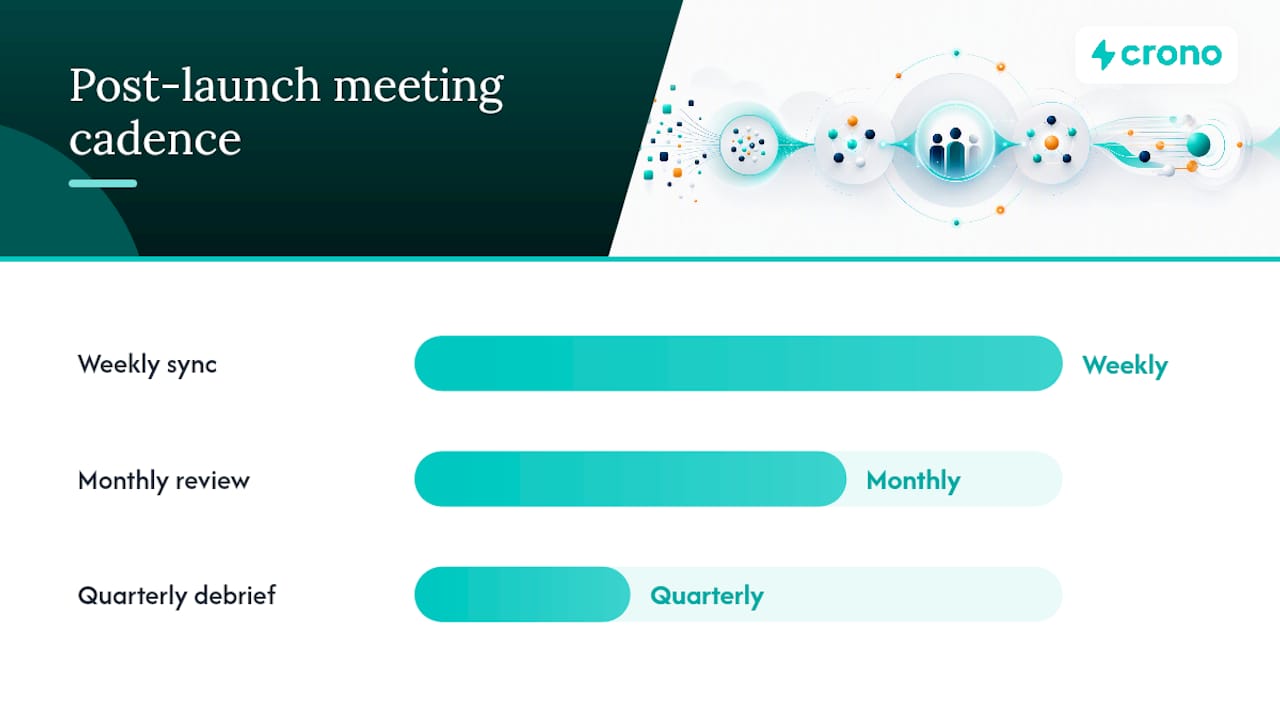
- Weekly sync between product marketing and sales to surface objection patterns.
- Monthly review of activation and adoption data with product.
- Quarterly win/loss debrief shared with product, sales, and leadership.
Red flags that alignment is failing:
- Sales is writing their own one-pagers because the official ones “don’t work.”
- Product ships features that product marketing hears about in the release notes.
- Demand generation runs campaigns using messaging that product marketing has not reviewed.
- Customer success is handling objections that sales enablement should have addressed.
When you see these signals, the fix is almost always structural: formalize the touchpoints, assign ownership, and make the feedback loop explicit rather than assumed.
Pro Tip: A shared Slack channel between product marketing, product management, and sales leadership, with a weekly async update cadence, catches misalignment before it becomes a launch problem.
Key metrics and KPIs product marketers should track
Product marketing owns both leading and lagging indicators. Tracking only revenue attribution is a mistake; by the time revenue moves, the positioning problem is already six months old.
Deloitte Digital’s research found that organizations integrating product and marketing functions can outperform their peers by up to 50% in market-cap growth, which supports the importance of tracking these KPIs at executive levels
Avoid vanity metrics: page views on a launch blog post, total impressions on a press release, and raw email open rates tell you almost nothing about whether positioning is working. Revenue attribution matters, but it requires a clear model. The most practical approach is pipeline influenced: track which deals had product marketing touchpoints (a battlecard used, a case study shared, a demo script followed) and measure win rate for that cohort versus deals without those touchpoints.
- Leading indicators (adjust positioning and messaging): positioning resonance, activation rate, TTV, feature adoption.
- Lagging indicators (validate strategy): win rate, PQL conversion, expansion ARR, churn rate.
AI-enabled behavioral analytics and in-app signals now allow product marketers to update personas and messaging in near real time, rather than waiting for quarterly research cycles.
Userpilot, Product Marketing Strategy: What Actually Changed
Skills, hiring, and career path in product marketing
Product marketing sits at the intersection of research, storytelling, and commercial execution. The skill set is genuinely broad, which is why strong product marketers are harder to hire than most teams expect.
Core skills checklist:
- Buyer research: Qualitative interviews, survey design, win/loss analysis, and synthesis into actionable personas.
- Storytelling and writing: Translating technical features into buyer outcomes; writing positioning docs, launch copy, and enablement assets.
- Sales enablement: Understanding the sales process well enough to build tools reps actually use.
- Analytical thinking: Reading activation data, win rate trends, and cohort analysis without needing a data team to interpret everything.
- Pricing and packaging: Structuring tiers and bundles that reflect buyer value, not engineering cost.
- Cross-functional influence: Moving product, sales, and marketing teams toward a shared narrative without direct authority.
Career ladder:
- Associate / Junior PMM: Executes research, writes copy, supports launches under senior direction.
- Product Marketing Manager: Owns a product line or segment; runs launches and enablement independently.
- Senior PMM: Leads positioning strategy, manages competitive intelligence, influences roadmap.
- Head of Product Marketing / Director: Builds and manages the PMM team; owns GTM strategy across the portfolio.
- VP of Marketing / CMO path: Many CMOs at B2B companies come from product marketing backgrounds because the role builds both commercial and analytical fluency.
On compensation, the U.S. Bureau of Labor Statistics tracks advertising, promotions, and marketing managers as a high-paying management category, with strong demand across technology and B2B sectors. Product marketing specifically skews toward the upper end of marketing compensation because the role requires both technical product fluency and commercial storytelling.
Concrete examples and templates you can copy right now
Positioning statement template
For [target buyer role] at [company type] who [specific pain or goal], [Product Name] is a [category] that [primary outcome]. Unlike [alternative approach], [Product Name] [key differentiator].
Filled example (B2B SaaS):
For sales operations managers at mid-market B2B companies who lose pipeline to manual CRM updates and disconnected outreach tools, [Product] is a sales execution platform that automates prospecting, sequencing, and pipeline tracking in one place. Unlike point solutions that require switching between five tabs, [Product] connects your CRM, email, LinkedIn, and call tools into a single workflow.
Launch checklist template
Internal (T-30 to T-0):
- Positioning doc finalized and approved (T-30).
- Pricing confirmed with finance (T-28).
- Sales briefing delivered (T-14).
- Battlecard and objection guide distributed to all AEs and SDRs (T-14).
- Support team trained; FAQ doc published internally (T-7).
- Help center articles live (T-3).
- Internal launch announcement sent (T-1).
External (T-0 and post-launch):
- Email announcement sent to prospect and customer lists (T-0).
- In-app notification or product tour activated (T-0).
- Website and landing page updated (T-0).
- Social posts published (T-0).
- First customer interview scheduled for feedback (T+7).
- Case study or proof point published (T+30).
Battlecard sample: one objection filled
Objection: “We already use [generic CRM] for this.”
Root cause: Buyer conflates CRM data storage with sales execution. They don’t see the gap between having data and acting on it.
Response: “Most teams use their CRM as a record system, not an execution layer. The gap is between knowing who to contact and actually running coordinated outreach across email, LinkedIn, and calls without switching tools. That’s the problem [Product] solves on top of your existing CRM, not instead of it.”
Supporting evidence: Reference a case study where a similar company reduced time-to-first-contact by a measurable amount after adding an execution layer.
Pro Tip: Keep battlecards to one page. If a rep can’t scan it in 60 seconds before a call, they won’t use it. Depth belongs in the objection guide; the battlecard is the quick-reference layer.
Research-led trends reshaping product marketing right now
The practice is changing faster than most job descriptions reflect. Two shifts are structural, not cyclical.
Deloitte Digital’s analysis reports that AI agent adoption in GTM workflows has significantly increased over recent years. That gap is not a rounding error.
Implications for product marketing teams:
- Staffing: Hire for analytical fluency alongside storytelling. PMMs who can read product telemetry and behavioral cohorts are more valuable than those who can only write.
- Tooling: Behavioral analytics platforms, in-app survey tools, and AI-assisted research synthesis are now table stakes, not nice-to-haves. Understanding AI’s role in marketing strategies helps PMMs choose the right stack.
- Measurement: Move from quarterly research cycles to continuous signal monitoring. Win/loss interviews, in-app behavioral data, and sales call transcripts can now be synthesized weekly, not quarterly.
- Positioning cadence: Userpilot’s research documents the shift from discrete launch models to continuous lifecycle ownership, with product signals and behavioral analytics shortening persona and messaging update cycles significantly.
The second structural shift: product marketing is absorbing customer lifecycle ownership that used to sit in customer success. Expansion messaging, feature adoption programs, and churn prevention narratives are increasingly product marketing’s responsibility, not just CS’s.
Pro Tip: Connect your product analytics platform (Mixpanel, Amplitude, or similar) to your positioning review cadence. When a feature’s adoption drops below target, that’s a positioning signal, not just a product signal. Review both together.
How to build product marketing in your company: a 90- to 180-day plan
Whether you’re the first PMM hire or standing up a function from scratch, the first six months follow a predictable pattern of intelligence gathering, foundation building, and operational execution.
Days 1–30: Intelligence and orientation
- Interview at least ten customers, five lost deals, and five active sales reps.
- Audit all existing positioning documents, sales decks, and enablement assets.
- Map the current GTM motion: who owns what, where handoffs break, what’s missing.
- Identify the one launch or initiative already in motion that needs immediate support.
Acceptance criteria: You can articulate the top three buyer pain points, the current positioning gaps, and the most urgent enablement need by day 30.
Days 31–60: Foundation
- Write the first version of the positioning document and get it reviewed by product and sales leadership.
- Build or update the core battlecard for the primary product or segment.
- Establish a win/loss interview cadence (biweekly or monthly).
- Run the first sales enablement session: a live briefing on positioning and objection handling.
Acceptance criteria: Sales leadership has reviewed and approved the positioning doc. At least one battlecard is in active use by the sales team.
Days 61–90: First launch or major deliverable
- Execute a launch or major update using the checklist framework from Section 4.
- Measure activation rate and win rate for the launch cohort.
- Debrief with product, sales, and demand generation within two weeks of launch.
- Publish the first version of your metrics dashboard.
Acceptance criteria: Launch executed on time with all internal and external tracks complete. First metrics review completed with stakeholders.
Days 91–180: Operationalize and scale
- Establish quarterly buyer research cycles with a defined interview guide.
- Build a content calendar for ongoing enablement assets (one new battlecard or guide per month).
- Introduce a competitive intelligence update cadence (monthly summary to sales and product).
- Define the PMM team’s OKRs for the next two quarters, tied to win rate, activation, and pipeline influenced.
Key stakeholders to involve early: Head of Sales (for enablement buy-in), Head of Product (for roadmap access), and a customer success lead (for lifecycle signal access). Early wins that build credibility fastest: a battlecard that reps actually use, a launch that goes out on time, and a win/loss insight that changes how the product team prioritizes a feature.
A practitioner’s perspective on what most teams get wrong
The most common failure in product marketing is treating positioning as a document rather than an operating system. Teams spend weeks crafting a positioning statement, get it approved, and then file it somewhere it never gets read again. Sales keeps using the pitch they invented themselves. Product ships features without a messaging update. The positioning document becomes archaeology.
What actually works is making positioning a continuous feedback loop. Sales call transcripts, support tickets, and activation drop-off data are all positioning signals. When a rep consistently loses to a specific competitor on a specific objection, that’s not a sales problem. It’s a messaging gap that product marketing owns. The teams that scale well treat their positioning document the way a product team treats a roadmap: a living artifact that gets updated when the evidence changes, not when someone schedules an annual review.
The second thing most teams underestimate is the importance of product marketing’s relationship with sales. Product marketers who sit close to the sales floor, listen to calls, and run regular enablement sessions build credibility that no amount of documentation can replace. Reps use tools they trust. They trust tools built by people who understand what they’re actually selling against.
For B2B revenue teams specifically, platforms like Crono that connect CRM data, buying signals, and multichannel outreach give product marketers a direct window into how messaging performs in the field. When you can see which sequences convert and which stall, you have real positioning feedback, not just anecdote.
Ready to put product marketing into practice?
If your team is building out GTM execution and wants to connect product positioning directly to outreach performance, Crono’s AI-powered sales execution platform gives revenue teams the infrastructure to run coordinated multichannel campaigns, track pipeline signals, and measure how messaging converts across every touchpoint.
For sales leaders looking to align enablement with execution, the B2B sales techniques masterclass covers the commercial skills that complement strong product marketing. And if you’re thinking about how AI agents fit into your GTM motion, the AI GTM platform guide walks through practical deployment patterns for revenue teams.