
Inside sales is remote selling via phone, email, video, and social channels; outside sales is in-person, territory-based field selling. The short verdict: inside sales wins on cost, speed, and scalability for deals under roughly $50K ACV, while outside sales earns its keep on large, complex, multi-stakeholder opportunities where trust and physical presence close the gap. For most modern B2B teams, the right answer is a hybrid of both.
- Inside sales strengths: lower customer acquisition cost (CAC), high contact volume, easy to scale, data-driven coaching, and strong fit for SaaS, SMB, and mid-market deals.
- Outside sales strengths: relationship depth, executive access, physical demos, and a decisive edge on enterprise deals with buying committees of five or more stakeholders.
- Rule of thumb: if your average contract value (ACV) exceeds $100K, your buyer requires an on-site demo, or your deal involves C-suite sign-off from multiple departments, outside sales is worth the investment. Below that threshold, inside sales typically delivers a better return.
Gartner’s research on the B2B buying journey confirms that buyers now move through much of the purchase process independently before engaging a rep at all, which shifts the advantage toward inside teams that can meet buyers digitally at every stage.
Key Takeaways
Inside sales delivers lower CAC and higher scalability for deals under $100K ACV; outside sales earns its premium on large, complex, multi-stakeholder deals; and hybrid orchestration with shared CRM discipline outperforms either model alone for most B2B teams.
| Point | Details |
|---|---|
| Use ACV as your primary decision rule | Inside sales fits deals under $50K ACV; outside sales justifies its cost above $100K. |
| Inside sales is 40%–90% cheaper per customer | That cost gap means the burden of proof is on field sales to show deal-size outcomes that justify travel spend. |
| Hybrid models outperform single-motion teams | Pairing inside qualification with selective field visits reduces CAC while maintaining relationship depth on strategic accounts. |
| Instrument every handoff in CRM | Document stage, owner, next step, and visit rationale at every transfer to prevent deal slip between motions. |
| Audit your pipeline before restructuring | Segment closed-won deals by ACV and stakeholder count to find where field investment actually pays back. |
Table of Contents
- What is inside sales, and how does it work today?
- What does an outside sales rep actually do?
- How do inside and outside sales compare across core dimensions?
- When should you choose inside, outside, or a hybrid model?
- How do inside and outside teams work together?
- Skills, compensation, and career paths in U.S. sales
- Which tools enable each model?
- What do the trends say about inside vs. outside sales in 2026?
- What I’d do as a sales leader building this in 2026
- Sources
What is inside sales, and how does it work today?
Inside sales is not telemarketing. The modern inside rep is a consultative seller who works entirely remotely, using a coordinated mix of phone, email, video calls, LinkedIn, and automated sequences to move prospects through a pipeline. Coursera’s definition draws the line clearly: inside sales relies on digital channels rather than physical presence, and today’s practitioners are expected to interpret verbal and written cues with the same precision a field rep reads body language.
Daily duties and role variations
A typical inside sales team runs three distinct roles:
- SDR/BDR (Sales Development Rep): Prospecting, cold outreach, qualifying inbound leads, and booking meetings. SDRs own the top of the funnel and hand off to AEs once a prospect meets qualification criteria.
- AE (Account Executive): Running discovery calls, delivering demos via video, negotiating terms, and closing. Inside AEs manage a full pipeline digitally without travel.
- Account Manager: Post-close relationship management, expansion revenue, and renewal conversations, all conducted remotely.
Channels and tools
Inside reps depend on a tight tech stack: a CRM (Salesforce, HubSpot) as the system of record, a sales engagement platform for sequenced outreach, video conferencing for demos, call recording and analysis tools for coaching, and data enrichment to keep contact records accurate. Shopify’s 2026 inside sales guide highlights active listening and consultative questioning as the skills that separate high performers from average reps, because digital channels strip away the visual context that in-person sellers rely on.
Pros of inside sales:
- Significantly lower CAC. HubSpot reports that many teams find inside sales 40%–90% cheaper than field sales on a per-customer basis.
- High contact volume and easy pipeline visibility.
- Faster ramp time for new hires and simpler performance coaching through call recordings.
- Scales without proportional headcount increases when automation handles routine touchpoints.
Cons of inside sales:
- Relationship ceiling on very large or politically complex deals.
- Harder to build executive trust without face-to-face interaction.
- Digital fatigue can reduce response rates in saturated channels.
Pro Tip: Record every discovery call and review the first two minutes weekly. The opening question pattern is the single biggest driver of conversion rate variance inside remote teams, and it is the easiest thing to coach at scale.
What does an outside sales rep actually do?
Outside (field) sales means the rep travels to the buyer. Meetings happen in the prospect’s office, at trade shows, over executive dinners, or during on-site product demonstrations. The model is built for situations where trust, physical presence, or a hands-on product experience is a genuine requirement, not a preference.

Daily workflows and responsibilities
Field reps structure their weeks around geography and account priority. A typical week includes:
- Pre-trip research and remote qualification of accounts before any travel is scheduled.
- On-site meetings with economic buyers, technical evaluators, and end users, often in a single visit.
- Trade show attendance and executive briefing center presentations for high-value prospects.
- Post-visit follow-up, proposal delivery, and negotiation, which often happens remotely.
- Territory planning to maximize the number of high-value contacts per travel day.
The practical challenge is “windshield time.” SyncGTM’s field sales playbook recommends anchoring every field day around at least one confirmed high-value meeting rather than filling a calendar with speculative visits. Remote prep using data enrichment before travel consistently improves in-person conversion rates.
Tools that support field selling
Field reps rely on mobile CRM access, calendar and route optimization, expense management software, demo kits or product samples, and video conferencing for follow-up. For a full view of the tech stack that supports field and mid-market teams, the outbound sales tech stack guide covers both inside and field tool categories in detail.
Pros of outside sales:
- Deeper relationship development with executive buyers.
- Higher close rates on large, complex deals with multiple stakeholders.
- Physical demos and on-site presence remove doubt that digital channels cannot.
- Stronger competitive differentiation when the product requires hands-on evaluation.
Cons of outside sales:
- High CAC due to travel, lodging, and time-per-contact costs.
- Difficult to scale without proportional headcount and expense growth.
- Long sales cycles reduce pipeline velocity.
- Productivity loss from unproductive travel days.
Pro Tip: Before any field visit, run a stakeholder map in your CRM. Knowing who attends, their role in the decision, and their known objections before you walk in the door is worth more than any presentation slide.
How do inside and outside sales compare across core dimensions?
The most consequential trade-offs for managers are CAC, deal size fit, and scalability. Inside sales wins decisively on cost and volume; outside sales wins on relationship depth and deal size ceiling. Hybrid models, which pair inside qualification with selective field visits, often outperform either model alone for mid-market and enterprise segments.
| Dimension | Inside Sales | Outside Sales |
|---|---|---|
| Location / channel | Remote: phone, email, video, social | In-person: office visits, demos, events |
| CAC | 40%–90% lower than field (per HubSpot) | High: travel, lodging, time per contact |
| Typical deal size | SMB to mid-market; generally under $100K ACV | Mid-market to enterprise; $100K+ ACV |
| Sales cycle length | Shorter (days to weeks) | Longer (weeks to months) |
| Scalability | High: automation and sequencing multiply rep output | Low: headcount and travel costs scale linearly |
| Best for | SaaS, subscription, SMB, high-volume pipelines | Enterprise software, hardware, professional services requiring demos |
| Core tools | CRM, sales engagement platform, video, call analytics, enrichment | Mobile CRM, route optimization, expense tools, demo kits |
| Compensation structure | Lower base, moderate OTE; performance bonuses tied to volume metrics | Higher base, higher OTE; travel allowances and territory bonuses |
The single most important number to watch is ACV. Below $50K, inside sales almost always delivers a better unit economics story. Above $100K, the relationship investment of field selling typically pays back. The $50K–$100K band is where hybrid models earn their keep.
When should you choose inside, outside, or a hybrid model?
The decision is not about preference. It follows from your product, your buyer, and your deal economics.
Decision rules
Use these criteria to map your situation:
- Deal value: ACV under $50K points to inside. ACV over $100K points to outside or hybrid. The $50K–$100K band warrants a pilot to measure close rates by channel.
- Buying committee size: One to two decision-makers favor inside. Three or more stakeholders, especially at VP or C-suite level, favor outside.
- Physical demo requirement: If the product must be touched, installed, or seen in context, outside sales is not optional.
- Sales cycle length: Cycles under 30 days are almost always inside. Cycles over 90 days usually justify field investment.
- Buyer preference signals: If prospects consistently ask for on-site visits or decline video calls, follow their lead.
Use-case mapping
- SaaS SMB: Inside sales, full cycle. High volume, short cycle, self-serve trial reduces field need entirely.
- Mid-market SaaS ($30K–$80K ACV): Inside-led with selective field visits for final-stage executive alignment.
- Enterprise software ($150K+ ACV): Outside-led with inside SDRs handling qualification and pipeline nurture.
- Hardware or physical products: Outside sales for initial evaluation; inside for renewals and expansion.
- Professional services: Hybrid. Inside for qualification and proposal; outside for relationship-building and contract close.
SyncGTM’s research confirms that outside sales outperforms inside for very large ACV deals and multi-stakeholder buying committees, while hybrid models pair virtual qualification with selective field visits for final-stage trust building.
Pro Tip: Set a measurable handoff threshold in your CRM. A practical starting point: any opportunity with ACV above your defined threshold, a confirmed economic buyer, and two or more stakeholders in the buying committee triggers automatic assignment to a field rep. Instrument this as a workflow rule, not a judgment call.
How do inside and outside teams work together?
The most effective B2B revenue teams do not run inside and outside as separate silos. They design explicit handoffs, shared playbooks, and CRM discipline that keep both motions aligned.
Common team structures
- Inside-first model: SDRs qualify all inbound and outbound leads; AEs close remotely. Field reps handle only strategic accounts above a defined ACV threshold. Works well for SaaS companies scaling from SMB to mid-market.
- Outside-first model: Field reps own territory relationships; inside reps provide pipeline support, follow-up, and renewal management. Common in enterprise software and hardware.
- Paired hybrid (1:1): One inside rep and one field rep share a named account list. The inside rep handles qualification, nurture, and digital touchpoints; the field rep owns executive relationships and final-stage meetings. Vengreso’s inside sales guide identifies this pairing as a proven structure for reducing CAC while maintaining relationship depth on strategic accounts.
- Center-of-excellence overlay: A centralized inside team supports multiple field territories with content, data enrichment, and outreach, while field reps focus exclusively on high-value in-person moments.
Role handoffs and operational requirements
A disciplined handoff is not a conversation. It is a CRM record with a defined stage, a named owner, an expected next step, and a documented visit rationale. Without that structure, deals slip between inside and outside motions and accountability disappears.
Effective handoffs require:
- Shared CRM view: Both inside and outside reps see the same account history, contact map, and deal stage.
- SLAs for handoffs: Define response time expectations when a lead crosses the ACV threshold or a field visit is triggered.
- Ride-alongs and joint calls: Inside reps join field calls periodically to understand buyer context; field reps listen to inside discovery calls to calibrate qualification standards.
- Metrics to prevent deal slip: Track time-in-stage, next-step completion rate, and win rate by handoff type to identify where deals stall.
For a detailed framework on building these handoffs into a repeatable playbook, B2B sales orchestration covers the operational mechanics in depth.
Pro Tip: Run a monthly “deal slip” audit. Pull every opportunity that changed owner in the last 30 days and check whether the CRM record had a documented next step at the time of transfer. The gap between “yes” and “no” tells you exactly where your handoff process is breaking down.
Skills, compensation, and career paths in U.S. sales
The skills that make someone excellent in inside sales are meaningfully different from what field selling demands. Hiring managers who conflate the two end up with reps who underperform in both contexts.
Core skills by model
Inside sales:
- Remote consultative selling and structured discovery questioning.
- Digital-native prospecting across email, LinkedIn, and phone sequences.
- Active listening and verbal cue interpretation without visual context, a skill Shopify’s inside sales research identifies as the defining competency of the modern inside rep.
- Call analysis and self-coaching using recorded conversations.
- CRM hygiene and data discipline to maintain pipeline accuracy at volume.
Outside sales:
- Executive relationship-building and long-cycle account management.
- In-person negotiation, presentation, and objection handling.
- Territory planning and travel efficiency.
- Stakeholder mapping and multi-threaded account strategy.
- Demo delivery and technical credibility in front of mixed buying committees.
U.S. compensation ranges
Compensation structures differ significantly between the two models. Inside reps typically carry a lower base with moderate on-target earnings (OTE), while field reps command higher bases to offset travel demands and longer ramp periods.
- Inside SDR (U.S.): Base salary typically in the $45,000–$65,000 range; OTE with commission around $70,000–$90,000 depending on market and company stage.
- Inside AE (U.S.): Base in the $70,000–$95,000 range; OTE commonly reaching $130,000–$180,000 for mid-market roles.
- Outside/Field AE (U.S.): Base in the $85,000–$120,000 range; OTE often $180,000–$250,000+ for enterprise roles, plus travel and expense allowances.
These ranges reflect general market conditions; actual figures vary by industry, company size, and geography. The Bureau of Labor Statistics and Glassdoor both publish current benchmarks that are worth checking before setting compensation bands.
Career progression
The most common path in inside sales runs SDR to AE to Senior AE or team lead, with a branch point toward either field sales or sales management. Moving from inside to outside is common and generally welcomed, since inside reps arrive with strong pipeline discipline and CRM habits that field teams often lack. The reverse, moving from outside to inside, requires adjustment to higher contact volume and less relationship-based selling. Cross-training through paired hybrid assignments is the fastest way to develop reps who can operate effectively in both motions.
Which tools enable each model?
The tool categories are largely shared, but the capabilities that matter most differ by motion.
Inside sales tool priorities:
- CRM: Salesforce or HubSpot as the system of record for all pipeline activity.
- Sales engagement platform: Sequence automation, multichannel cadences, and A/B testing for outreach. Sales automation tools vary significantly in how well they handle volume at scale.
- Call recording and analysis: Tools that transcribe, score, and surface coaching moments from every conversation. AI-powered call analysis has made this category far more accessible for teams of all sizes.
- Data enrichment: Keeping contact and account data accurate so sequences reach real people.
- Video conferencing: Zoom, Google Meet, or Microsoft Teams for demos and discovery.
- AI agents: Automated prospecting, message personalization, and signal-based prioritization.
Outside sales tool priorities:
- Mobile CRM: Field reps need full pipeline access and note-taking from any location.
- Calendar and route optimization: Reducing windshield time by clustering visits geographically.
- Expense management: Concur or similar tools to track and report travel costs.
- Demo logistics: Physical demo kits, product samples, or pre-configured demo environments.
- Pre-visit enrichment: Account and contact intelligence pulled before travel to maximize meeting quality.
Crono operates as the sales execution layer that connects CRM, enrichment, multichannel engagement, and AI agents into a single orchestration platform. For inside teams, that means automated sequences and AI-driven prioritization. For hybrid teams, it means shared pipeline visibility and instrumented handoffs that keep inside and field motions synchronized. The G2 Winter 2026 report confirms continued category growth in sales engagement and CRM automation, validating the investment case for teams building out this stack.
What do the trends say about inside vs. outside sales in 2026?
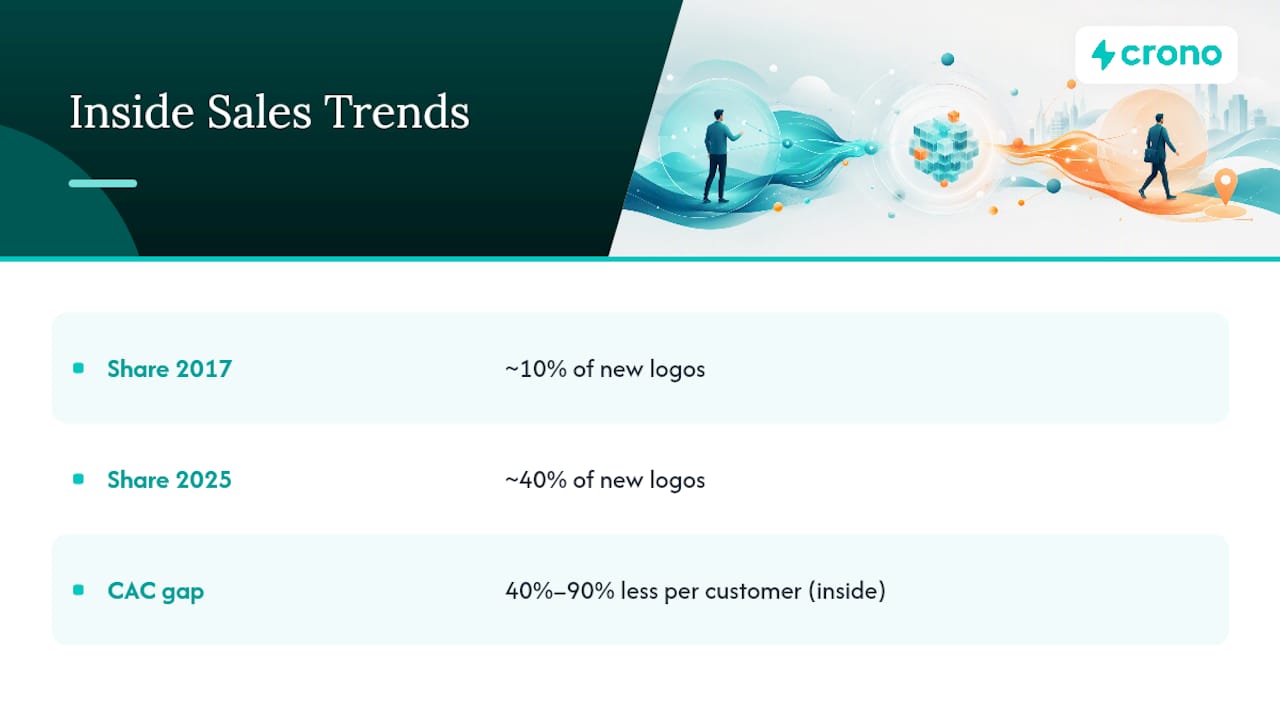
The data points in one direction: inside sales has grown from a supporting role to the primary new-logo engine for most B2B companies. Vengreso’s research tracks inside-sales share of new-logo acquisition rising from roughly 10% to approximately 40% among high-growth B2B teams between 2017 and 2025. That shift did not happen because outside sales stopped working. It happened because inside sales got dramatically better at handling deals that once required field presence.
Stat to know: Inside sales can cost 40%–90% less per customer acquired than field sales. At that cost differential, the burden of proof is on outside sales to demonstrate deal-size or relationship outcomes that justify the premium.
Buyer behavior is reinforcing this trend. Gartner’s B2B buying journey research shows that buyers now complete a significant portion of their evaluation independently, often preferring digital self-serve or remote interactions over scheduled field visits. Successful teams follow buyer preference rather than defaulting to a single motion.
The practitioner implication is clear: hybrid orchestration is the operating model, not a compromise. Teams that instrument their handoffs, share CRM data across inside and field reps, and use AI agents to prioritize which accounts warrant field investment consistently outperform single-motion teams on both win rate and CAC.
Pro Tip: Before scheduling any field visit, run a buying signal check in your CRM. If the account has had three or more digital touchpoints, opened a proposal, or engaged with pricing content, the visit has a documented rationale. If it has not, the visit is speculative and the travel budget is better spent on inside outreach. Effective lead nurturing before field visits consistently improves conversion rates on in-person meetings.
What I’d do as a sales leader building this in 2026
If I were structuring a B2B revenue team today, I would start with inside sales as the default motion and add outside capacity only where the data demands it. Here is the practical sequence:
Step 1: Audit your current pipeline by ACV and buyer type. Pull every closed-won deal from the last 12 months and segment by ACV band and number of stakeholders. The distribution tells you exactly where field investment pays back and where it is overhead.
Step 2: Run a 90-day hybrid pilot. Pair one inside AE with one field rep on your top 20 named accounts. Instrument every handoff in CRM with stage, owner, next step, and visit rationale. Measure win rate, sales cycle length, and CAC against your baseline.
Step 3: Set ACV thresholds as workflow rules, not guidelines. Any opportunity crossing your defined ACV threshold with a confirmed economic buyer triggers automatic field assignment. Remove the judgment call. Judgment calls create inconsistency; workflow rules create data.
Step 4: Align compensation to the motion. Inside reps should be rewarded for pipeline velocity and volume metrics. Field reps should be rewarded for deal size and relationship outcomes. Mixing the incentive structures creates the wrong behavior in both roles.
The teams that win in 2026 are not choosing between inside and outside. They are building the orchestration layer that makes both motions work together, with shared data, clear handoffs, and AI agents handling the execution work that used to consume rep time.
Sources
- Inside Sales vs. Outside Sales: How Are They Different? – Coursera
- Outside sales strategies and where in-person still wins – HubSpot
- Inside Sales: 7 Strategies for Effective Inside Sales (2026) – Shopify
- Mastering Inside Sales: Top Strategies for Today’s Sales Landscape – Vengreso
- Gartner research on the B2B buying journey
