
Personalization at scale means using unified data, automated decisioning, and cross-channel orchestration to deliver individually relevant experiences to every customer or prospect, not just your top accounts. Done well, it lifts engagement, conversion, and revenue simultaneously. The first move isn’t a platform purchase. It’s picking one segment and one use case to pilot before you touch anything else.
TL;DR:
- Personalization at scale relies on a unified customer view, decisioning layers, and orchestration across channels to adapt messages dynamically for every prospect.
- High-growth companies are more likely to have the necessary infrastructure, making personalization a key driver of faster revenue growth compared to slower peers.
- Building a successful program requires starting small with one segment and use case, establishing clear ownership, and ensuring content and data quality from the outset.
- Overcoming data silos, privacy concerns, and content bottlenecks are common challenges that demand targeted, phased solutions rather than sweeping automation.
- Measuring success involves tracking both rapid engagement metrics and longer-term revenue impacts, using rigorous A/B testing and multi-touch attribution models.
Table of Contents
- What Does Personalization at Scale Actually Mean?
- What Is the Business Case for Personalization at Scale?
- What Are the Building Blocks of Scaled Personalization?
- How Do You Build a Personalization Program Without Overcommitting?
- How Does Sales Personalization at Scale Work in Practice?
- How Do You Measure Personalization at Scale?
- What Are the Biggest Challenges in Scaling Personalization?
- What Should Leaders Prioritize First?
- How Crono Fits Into Your Personalization at Scale Playbook
- Sources
- FAQ
What Does Personalization at Scale Actually Mean?
Most teams think they’re already doing personalization at scale because their email tool inserts a first name and their CRM shows a company logo in a landing page banner. That’s not scale. That’s a token. Personalization at scale is a different discipline: it means every customer or prospect gets a message, offer, timing, and channel chosen dynamically from their own data, and that choice gets remade every time new data arrives.
Think about the difference in practice. A basic approach sends the same welcome email to every new sign-up, with a merge field for the name. A scaled approach evaluates the sign-up’s industry, the page they converted from, their company size, and their behavior in the first session, then routes them into one of a dozen possible journeys, each with its own content, cadence, and channel mix. The first is a mail merge. The second is a decision engine.
The same gap shows up in B2B sales outreach. A rep who swaps in “{{FirstName}}” and “{{CompanyName}}” on a template is personalizing at the token level. A rep whose sequence tool pulls in a prospect’s recent funding round, a job change, or a technology they just adopted, and adjusts the message and the send time accordingly, is personalizing at scale, even if they’re only touching a few hundred accounts a month. Scale isn’t about volume alone. It’s about whether the system adapts per profile, automatically, without a human rewriting each message from scratch.
Three things separate real scale from cosmetic personalization:
- A unified view of the customer or prospect. You can’t personalize on data that lives in five disconnected tools.
- A decisioning layer that picks the next best message, offer, or channel based on that unified data, in something close to real time.
- Orchestration that actually delivers the decision across whatever channel the customer is in, whether that’s email, web, in-app, a LinkedIn message, or a phone call.
Enterprise personalization requires exactly this kind of orchestration across data, decisioning, and distribution rather than one clever email campaign. Skip any one of the three legs and you get personalization theater: it looks tailored on the surface, but it can’t hold up when the customer’s situation changes or when you try to apply it to your next ten thousand contacts instead of your favorite fifty.
What Is the Business Case for Personalization at Scale?
The evidence for investing here is stronger than most marketing initiatives get. Companies that grow faster than their peers are far more likely to say they have the personalization technology to back it up.
The technology gap is the growth gap. Half of high-growth companies report having the necessary personalization technology in place, compared with a smaller share of their slower-growing peers, according to research on hyper-personalization from AWS and Braze.
That’s not a small edge. It suggests the companies pulling ahead in their markets have already built the data and decisioning infrastructure that makes personalization possible at volume, while everyone else is still running manual campaigns dressed up with merge tags.
The revenue case holds up beyond that one data point. Consulting research indicates personalization can unlock substantial revenue and retention gains when it’s paired with real organizational change and system integration, not bolted on as a marketing tactic. The uplift doesn’t come from the personalization alone. It comes from rebuilding how teams plan, approve, and ship content so the organization can actually act on what the data reveals.
Where the payoff shows up across the customer relationship:
- Acquisition: better-targeted offers and messaging raise conversion on paid and organic traffic alike.
- Onboarding and activation: journeys tailored to a user’s actual behavior shorten time to first value.
- Retention: proactive, relevant outreach at renewal and usage-decline points reduces churn.
- Expansion: decisioning that flags upsell-ready accounts turns account management into a revenue channel instead of a support function.
The obstacle isn’t usually ambition. It’s execution. Personalization at scale improves engagement and conversion in study after study, but it’s routinely blocked by content and data silos that keep teams from acting on what they already know about a customer. You can have the insight and still miss the outcome if your content team can’t produce enough variants or your data lives in three systems that don’t talk to each other. The Statista dataset on CX personalization tracking consumer expectations globally shows this gap has only widened as buyers get more accustomed to relevant experiences and less patient with generic ones.
What Are the Building Blocks of Scaled Personalization?
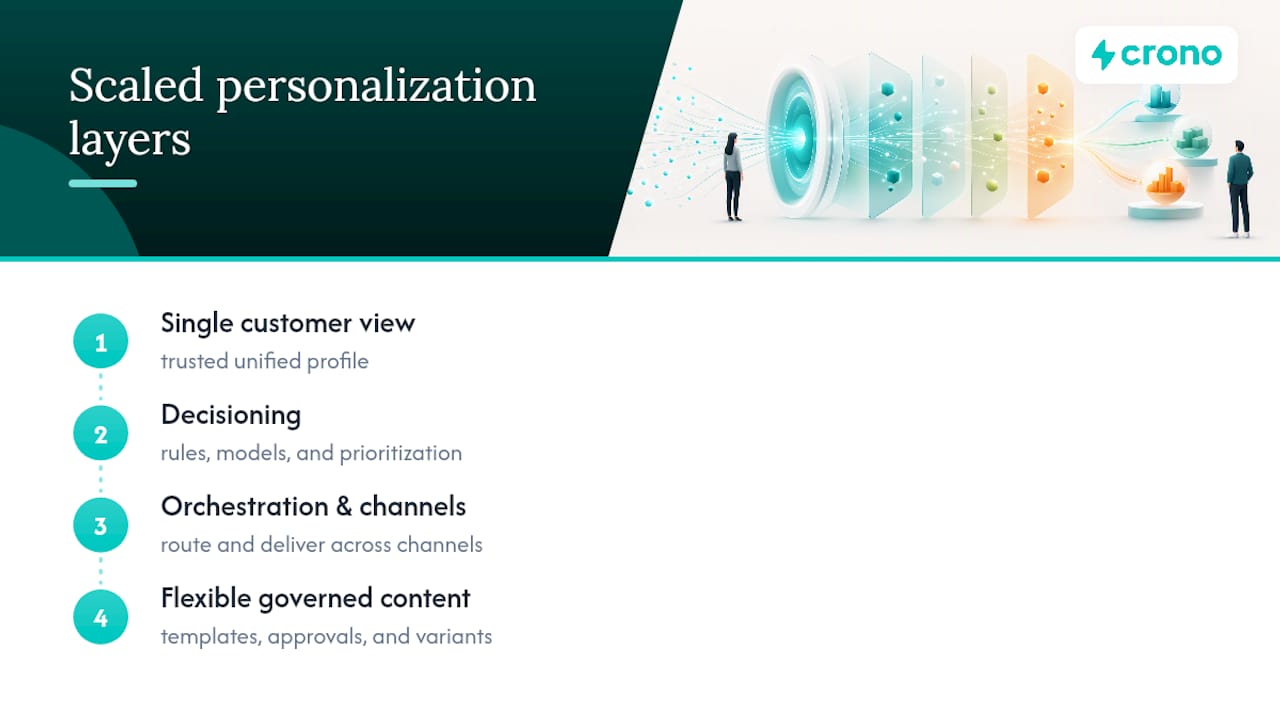
Every mature personalization program rests on four layers. Skip one and the others underperform, no matter how much you invest in the rest.
A single customer view worth trusting
Your unified data layer, whether it lives in a customer data platform or a well-governed data warehouse, needs to combine identity resolution, behavioral events, transactional history, and firmographic or demographic attributes into one profile per customer or account. For B2B teams, that profile should also absorb CRM activity and conversation history, since combining CRM data, behavioral signals, and conversation data into a single source of truth is what actually makes sales personalization effective rather than cosmetic.
The trap here is scope creep. Teams try to ingest every available field before launching anything, and the project stalls for a year while data engineering builds the perfect schema. Start with the ten to fifteen attributes that actually drive your first use case, then expand.
Decisioning: rules, machine learning, or both
Not every decision needs a model. A simple rules engine, “if cart value exceeds $200, show free shipping,” works fine for high-confidence, low-complexity decisions. Machine learning earns its cost when you’re predicting something genuinely uncertain, like which of forty possible subject lines will perform best for a given segment, or which accounts are likeliest to convert this quarter. Reinforcement learning, where the system keeps testing and updating its own choices, fits mature programs with enough volume to let the model learn continuously. Most teams should start with rules, layer in ML for the highest-value decisions, and treat reinforcement learning as a year-two problem, not a launch requirement. Frameworks from vendors like Adobe and Forrester describe how AI-enabled decisioning changes both the ROI and the governance burden of a personalization program as it matures.
Orchestration and channel architecture
Orchestration is the layer that takes a decision and actually delivers it, in the right channel, at the right moment. That means real-time triggers (a cart abandonment, a pricing page visit, a job change on LinkedIn) connected to channel APIs for email, web, in-app messaging, push, and outbound sales tools. Omnichannel orchestration done right keeps the experience consistent even as the customer moves between channels, an idea covered well in this breakdown of unifying customer experience across channels.
Content that can flex without breaking
Decisioning is useless without enough content variants to act on its recommendations. Dynamic content blocks, modular templates, and live API-driven content (product recommendations pulled at send time rather than baked in weeks earlier) let one campaign structure serve hundreds of micro-variants. Governance matters just as much here: a content approval workflow and a data-quality check should sit upstream of every personalized send, or you’ll eventually ship something wrong to a customer at volume instead of by accident to one.
Pro Tip: Audit your current stack against these four layers before buying anything new. The gap is usually in decisioning and content flexibility, not raw data collection.
How Do You Build a Personalization Program Without Overcommitting?
The programs that work start narrow. McKinsey’s research on scaling personalization is blunt about this: one well-executed segment beats many shallow ones. Here’s the sequence that gets you from idea to a program that survives contact with your organization’s actual constraints.
-
Pick one segment, one use case, one channel. Choose based on where you already have decent data and where a win would matter to leadership, not where it’s technically easiest. A common starting point: your highest-intent trial users, personalizing the onboarding email sequence based on their first-session behavior.
-
Define your baseline before you launch anything. Write down current conversion, engagement, and revenue numbers for that segment. Without a baseline, you can’t prove the pilot worked, and you’ll spend more time arguing about whether it did than building the next one.
-
Assign clear ownership across four roles. Someone owns the data (is it clean, is it current), someone owns decisioning logic (what triggers what), someone owns content supply (can you produce enough variants fast enough), and someone owns activation (does it actually reach the customer through the right channel). Splitting these across four different people who don’t talk weekly is the single most common reason pilots quietly die.
-
Set a review cadence, not a launch-and-forget date. Weekly for the first month, biweekly after that. Look at engagement metrics first, since they move fastest, and treat revenue metrics as lagging confirmation.
-
Build the approval workflow before you need it. Decide who signs off on new content variants and how fast that approval can happen. If legal or brand review takes two weeks, your personalization program will never keep pace with the decisioning layer generating new combinations daily.
-
Watch for scaling signals, not just performance numbers. A pilot is ready to scale when the workflow runs without daily firefighting, when content production keeps pace with decisioning output, and when a second team wants to borrow your approach for their own segment. That last signal matters more than people expect: organic internal demand is a stronger scale-readiness indicator than a good pilot report nobody outside your team reads.
-
Hand off with documentation, not tribal knowledge. Write down what triggered what, why, and what you learned from the misses. The programs that scale smoothly are the ones where the second team doesn’t have to reverse-engineer the first team’s Slack history.
Pro Tip: Resist the urge to add a second use case before the first one hits its second full review cycle. Parallel pilots split attention and make it harder to tell which changes actually caused which results.
How Does Sales Personalization at Scale Work in Practice?
Marketing teams have had years to build muscle around personalization. B2B sales teams are catching up fast, and the underlying logic is identical: a single source of truth, a decisioning step, and orchestrated delivery, just applied to outbound sequences instead of email campaigns.
The single source of truth problem is often worse in sales than in marketing. CRM data lives in one place, intent signals in another, and the rep’s actual conversation history in a third tool nobody else checks. Sales personalization only becomes reliable when CRM data, behavioral signals, and conversation data combine into one profile that every touchpoint can draw from. That’s the same unified-data requirement marketing needs, just scoped to accounts and contacts instead of consumer segments.
The recommended workflow from practitioner guidance follows a consistent pattern: AI generates a first draft using the unified profile, a human rep reviews and adjusts the tone, then the message goes into an active sequence. This “AI first, human second” approach is explicitly what sales personalization research recommends for preserving authenticity while covering enough volume to matter. A rep who tries to write two hundred genuinely researched cold emails a week by hand will burn out or cut corners. A rep who reviews and humanizes two hundred AI-drafted emails, each built from real signals, can move faster without sounding like a template.
AI drafting combined with human review lets reps preserve their own voice while covering the volume that scaled outreach demands, rather than forcing a choice between authenticity and reach.
Where this shows up concretely:
- Prospecting: a first-touch message references a specific trigger, a recent funding round, a new hire in a relevant role, a technology adoption, rather than a generic value proposition.
- Follow-up: a rep’s second and third touches reference what the prospect actually engaged with (a case study click, a pricing page visit) instead of repeating the same pitch.
- Retention and expansion: account managers get flagged usage patterns that suggest an upsell or renewal risk conversation, timed before the account goes quiet.
Tools built for this workflow connect the CRM and enrichment data into one place so reps aren’t manually stitching together five browser tabs before writing a single message. Understanding how AI and human outreach are changing SDR success is a useful starting point if your team is still deciding where the line between automation and rep judgment should sit. The same logic extends naturally to LinkedIn outreach, where a personalized connection request built on a real signal converts at a meaningfully different rate than a copy-pasted template ever will.
How Do You Measure Personalization at Scale?
Measurement has to work at two speeds. Engagement metrics tell you if a change is working within days. Revenue metrics confirm it weeks or quarters later. Track both, or you’ll either declare victory too early or wait so long for proof that you kill a program that was actually working.
Fast-moving engagement signals to instrument from day one:
- Open rate and click-through rate, segmented by which decisioning path a contact went through, not just in aggregate.
- Reply rate for outbound sales sequences, broken out by personalization depth (token-only versus signal-based).
- Meeting or demo booking rate as the first true intent signal in a sales motion.
- In-app engagement or feature adoption rate for personalized onboarding flows.
Slower, revenue-connected metrics that confirm the engagement gains actually matter:
- Deal velocity: does personalized outreach shorten time from first touch to closed deal?
- Win rate by segment, comparing personalized versus non-personalized cohorts where you can isolate the variable.
- Customer lifetime value, tracked over multiple quarters since personalization’s retention effect takes time to show up.
- Retention and renewal rate for accounts that received proactive, data-driven outreach versus those that didn’t.
On the statistics side, treat every personalization experiment like a real A/B test: predefine your sample size, run it long enough to cover a full weekly cycle (B2B buying behavior varies by day of week more than most teams account for), and resist peeking at results daily and calling it early. For multi-touch personalization, where a contact might get three or four personalized touches across channels before converting, a simple last-touch attribution model will overcredit whichever channel happens to close the deal. A multi-touch or time-decay model gives a fairer read on which parts of the sequence actually moved the needle.
The Statista research on CX personalization and revenue outcomes is a useful external benchmark when you’re building the business case for a bigger measurement investment, since internal numbers alone can be a hard sell to a CFO who’s never seen an industry comparison.
What Are the Biggest Challenges in Scaling Personalization?
Every team that gets serious about this runs into the same four obstacles, usually in the same order.
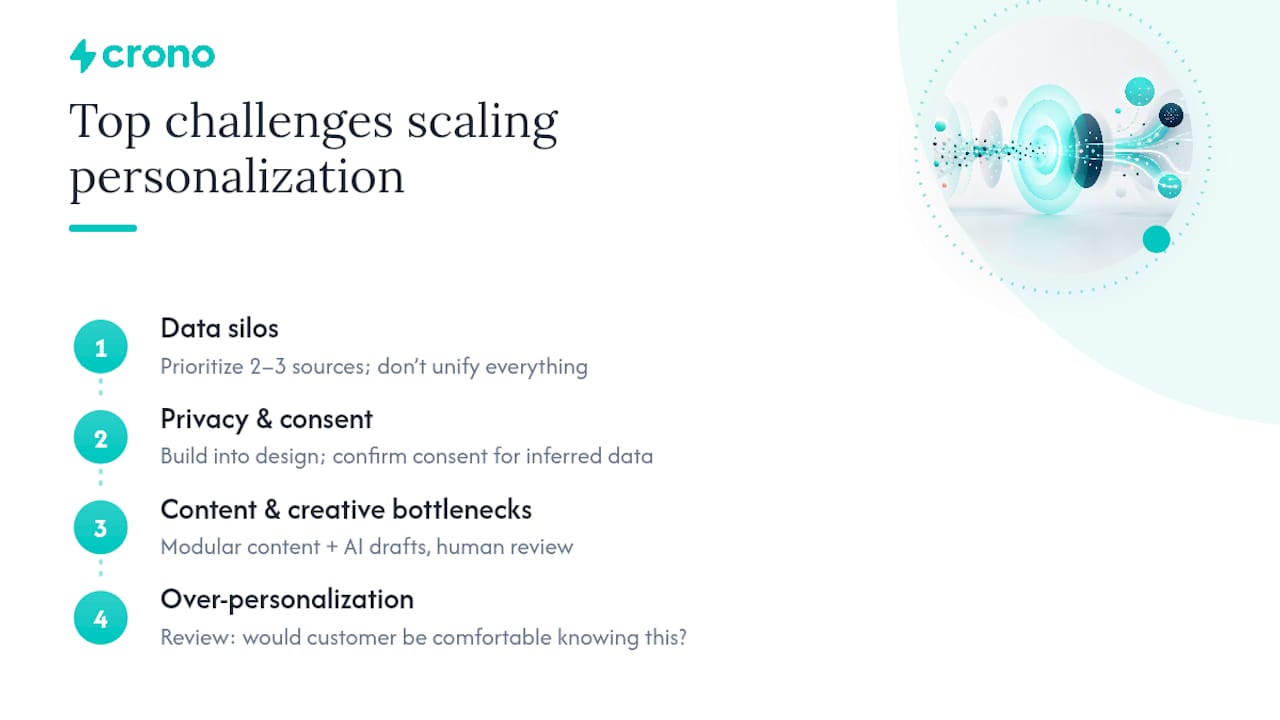
Data silos top the list. Marketing automation, CRM, product analytics, and support tickets rarely share a schema, let alone a real-time sync. Fixing this doesn’t require a full data warehouse migration on day one. Prioritize the two or three data sources your first use case actually needs, connect those cleanly, and expand from there. Trying to unify everything before launching anything is the most common way pilots never ship.
Privacy and consent need to be built into the experiment design, not bolted on after legal review flags something. Before any personalized send goes live, confirm the customer actually consented to the data use behind that personalization, particularly for inferred attributes (predicted income, inferred life stage) that customers never explicitly shared.
Content and creative bottlenecks stall more programs than bad data does. Decisioning systems can generate dozens of valid audience-message combinations; content teams working in a traditional campaign-by-campaign model can’t keep pace. Modular content and AI-assisted drafting, reviewed by a human before it ships, close that gap without sacrificing brand consistency. Tools that support this kind of AI-assisted rewriting or broader AI planning across marketing workflows are worth evaluating specifically for this bottleneck rather than for personalization in the abstract.
Over-personalization is the failure mode nobody warns you about until it happens. Referencing data a customer never knowingly shared, or making an inference that turns out wrong (assuming a life event, misreading a job title), erodes trust faster than generic messaging ever would. Build a review step that asks, “would this customer be comfortable knowing we know this?” before any new personalized field goes live.
What Should Leaders Prioritize First?
The biggest mistake I see in personalization planning is sequencing the investment backward: buying a decisioning platform before the data underneath it is trustworthy, or hiring for AI expertise before anyone owns data quality. Fix the foundation first. A messy customer profile makes even a good model produce personalized nonsense at scale, which is worse for trust than no personalization at all.
If you’re prioritizing three things this quarter, make them data, a single pilot, and measurement discipline, in that order. Get one segment’s data clean and unified before touching decisioning logic. Run one pilot long enough to trust the result before starting a second. Define your metrics before launch, not after someone in a leadership meeting asks whether it worked.
The cross-functional part matters more than the technology part. Personalization programs fail more often from misaligned ownership between marketing, sales, data, and legal than from a weak model or a clunky content pipeline. Get an executive sponsor who can break ties between teams early, because you will need one, usually around week three when content approval collides with the decisioning team’s launch timeline.
Treat this as a continuous improvement discipline, not a project with an end date. The programs that keep compounding value are the ones that review, adjust, and expand quarter over quarter instead of shipping once and moving on.
How Crono Fits Into Your Personalization at Scale Playbook
If your team is still stitching together CRM records, enrichment tools, and outreach sequences by hand, you’re solving the unified-data problem the slow way. Crono connects those pieces into one execution layer, so the profile a rep sees and the message an AI agent drafts both pull from the same source of truth rather than three disconnected tabs.
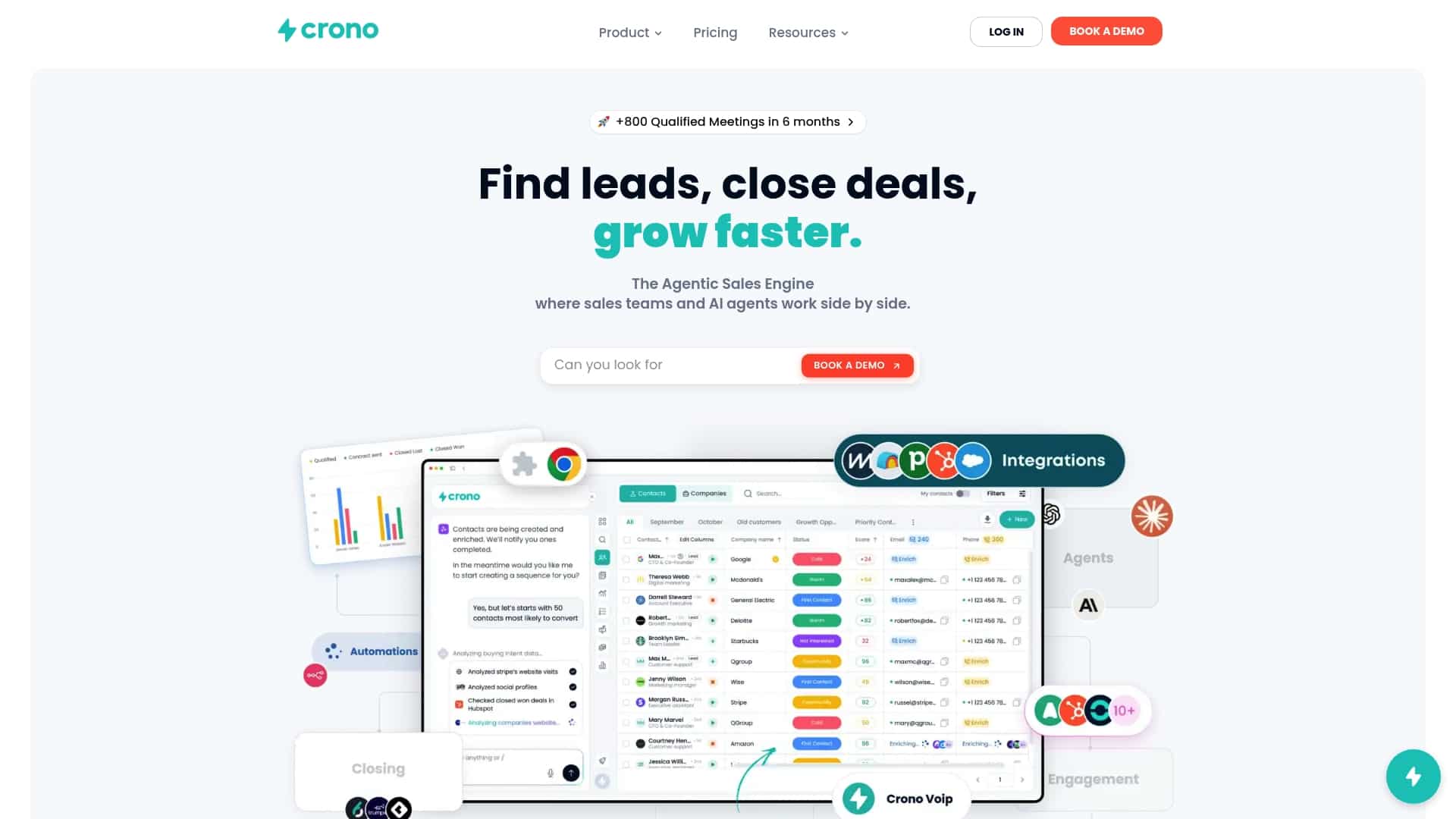
That maps directly to the building blocks covered in this guide: unified prospect and account data, an AI-assisted decisioning and drafting layer that generates first-pass messages from real signals, and orchestration across email, LinkedIn, and calls so a rep isn’t manually rebuilding a sequence for every channel. The AI-first-draft, human-second-pass workflow this article recommends for sales personalization is built into how Crono’s AI outreach automation and sales engagement tools work together.
A trial gives you a practical way to test the pilot approach from this playbook on your own pipeline: one segment, one sequence, measured against a real baseline. Start by exploring Crono’s platform to see how unified data and AI-assisted messaging come together for your team’s next outbound push.
Sources
- The future of hyper-personalization, powered by Braze and AWS generative AI
- Personalization at scale (Braze guide)
- Personalization at scale: First steps in a profitable journey to growth (McKinsey)
- Everything you need to know about personalization at scale (Contentful)
FAQ
What does personalization at scale mean?
It means using unified customer data, automated decisioning, and cross-channel orchestration to deliver individually relevant messages, offers, and experiences to large numbers of customers or accounts, not just a handful of top-priority ones.
What are the four building blocks of personalization at scale?
The core layers are a unified customer data view, a decisioning layer (rules, machine learning, or both), orchestration across channels, and content infrastructure flexible enough to produce many variants without breaking brand governance.
How is personalization at scale different from basic personalization?
Basic personalization inserts a name or company into a template; personalization at scale adapts the message, timing, and channel dynamically based on real-time data, and it does this consistently across thousands or millions of profiles rather than one campaign at a time.
How do you measure personalization at scale?
Track fast-moving engagement metrics like open rate, click-through rate, and reply or meeting rate first, then confirm impact with revenue-connected metrics like deal velocity, win rate, and customer lifetime value over a longer window.
How does Crono support personalization at scale for sales teams?
Crono unifies CRM, enrichment, and behavioral data into one profile, then uses that data to power AI-drafted, human-reviewed outreach delivered across email, LinkedIn, and calls, following the same data-decisioning-orchestration model covered throughout this guide.
