
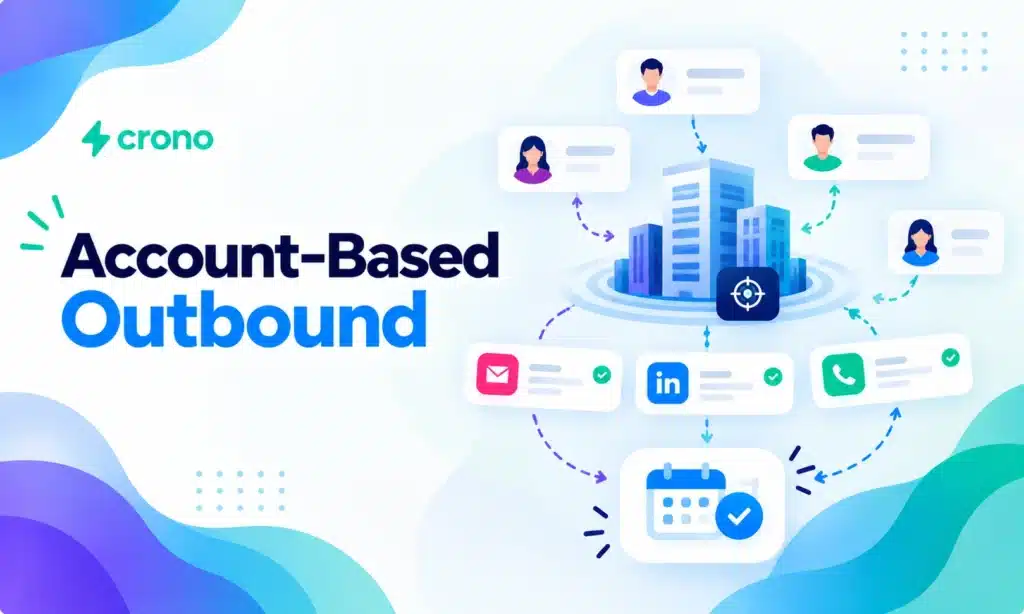
Account based outbound is a coordinated, multi-channel outreach motion built around a tight list of named target accounts rather than a broad lead pool. It pays off once your average contract value clears roughly $30,000, you can name 200 to 500 accounts worth pursuing, and sales and marketing are ready to work the same list together. Done well, it produces fewer but higher-quality opportunities.
TL;DR:
- Build the target list from your 5 to 10 best customers, rank lookalikes using firmographics and intent signals, and refresh it monthly.
- Allocate roughly 10% to Tier 1, 40% to Tier 2, and 50% to Tier 3, matching research and personalization to each tier.
- For priority accounts, map and contact multiple stakeholders, including a champion, economic buyer, technical evaluator, and end user; track penetration, not just replies or meetings.
- Target meetings within 90 days from 15% to 25% of Tier 1 accounts and 8% to 15% of Tier 2 accounts.
- When accounts go quiet, pause outreach rather than increasing frequency, and coordinate every channel through a shared timeline visible to sales and marketing.
Table of Contents
- What Account Based Outbound Is and How It Differs From Broad Outbound and ABM
- When to Use ABO: The Business Signals That Justify the Investment
- Build the Target Account List (TAL) and Ideal Account Profile (IAP)
- Tiering and Resourcing: What To Do for Tier 1, 2, and 3 Accounts
- Account Research and Stakeholder Mapping for Multi-Stakeholder Outreach
- Multi-Channel Sequences and Orchestration for Enterprise Accounts
- Orchestration and Tech Stack Guidance for Sales and Marketing Coordination
- Account-Level Metrics and Benchmarks to Track ABO Performance
- Getting Started: A 90-Day Plan to Launch Account Based Outbound
- A Practitioner’s View on Running ABO at Scale
- How a Sales Execution Layer Like Crono Helps Execute Account Based Outbound
- FAQ
- Sources
What Account Based Outbound Is and How It Differs From Broad Outbound and ABM
Account based outbound, often shortened to ABO, rests on three pillars: a tight target account list (TAL), an account map that identifies multiple stakeholders per company, and a coordinated sequence of touches across channels rather than touches fired off in isolation. Every email, call, and ad impression ties back to a named account, not a generic persona.
That distinguishes it from broad outbound, which runs volume sequences against a wide contact list filtered by title and industry, optimizing for reply rate across thousands of contacts instead of depth on a few hundred accounts. It also differs from how account-based marketing is usually framed: ABM treats specific companies as markets and leans on campaigns and content, while ABO is the sales-side execution layer that turns that targeting into direct, personalized outreach.
A few signs tell you whether a planned program is genuine ABO:
- Every account on the list has a named champion and economic buyer you are actively researching.
- Outreach cadence and messaging change by tier, not just by persona.
- Marketing and sales share the same account list and can see each other’s touches.
When to Use ABO: The Business Signals That Justify the Investment
ABO takes more hours per account than broad outbound, so it only makes sense under specific conditions. Average contract value above roughly $30,000 is the most common threshold, because that deal size supports the research and personalization time each account demands.
Beyond ACV, a few organizational signals matter:
- You can name a bounded universe of 200 to 500 accounts and describe what a strong lookalike looks like.
- Sales and marketing can agree on a shared account list and commit resourcing to it.
- You have at least one person who can own account research without stealing time from active pipeline.
- Deal cycles involve multiple stakeholders, not a single buyer who signs alone.
When your ACV is lower, your buyer list is undefined, or your team is stretched thin, broad outbound or demand generation is the better first move. Running ABO without these conditions in place usually produces a smaller, slower pipeline with no quality gain to show for it.
Build the Target Account List (TAL) and Ideal Account Profile (IAP)
Start with your 5 to 10 best existing customers, the ones with the fastest ramp, the highest expansion, or the lowest churn. Pull out what they share: industry, size, tech stack, and the business trigger that made them buy. That pattern becomes your ideal account profile (IAP), the filter every new account has to pass.
- List your top 5 to 10 customers and document shared firmographics and the trigger event that preceded their purchase.
- Apply firmographic filters, industry, headcount, revenue band, growth stage, and tech stack, to generate a long list of lookalikes.
- Layer intent signals and proxies, recent funding, leadership hires, job postings for roles tied to your product, and news mentions, to rank accounts by how “in-market” they appear.
- Trim the long list down to a working TAL of 200 to 500 accounts, sized to what your team can actually research and tier.
- Review the list monthly, pruning accounts that go cold and adding new ones that match fresh intent signals.
Pro Tip: Treat your TAL as a living document, not a one-time export. A list reviewed quarterly decays fast, while one reviewed monthly stays worth the effort you put into researching it.
A TAL of this size keeps research manageable while giving sales enough accounts to work without diluting focus. Teams building this process for the first time often benefit from a scalable outbound prospecting process built for mid-market structures, which maps closely to how TAL construction should work in practice.
Tiering and Resourcing: What To Do for Tier 1, 2, and 3 Accounts
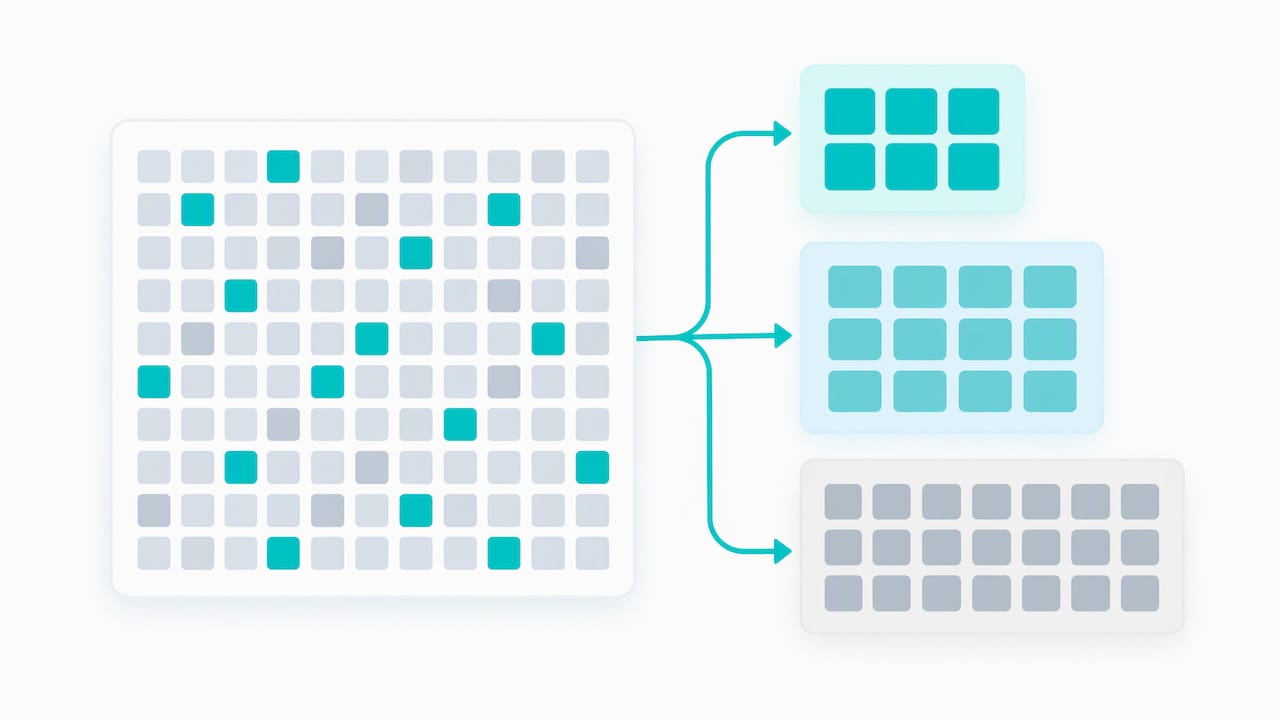
Not every account on your TAL deserves the same hours. A tiered structure, with roughly the top 10% as Tier 1, the next 40% as Tier 2, and the remaining 50% as Tier 3, lets you match effort to deal potential.
- Tier 1 accounts get heavy research, a dedicated account map, a named SDR or AE owner, and marketing support through custom ad creative.
- Tier 2 accounts get persona-level personalization, meaning messaging tailored to the role rather than the individual, with lighter research and shared ad creative across the segment.
- Tier 3 accounts run on ICP-level sequences, essentially your best broad outbound messaging applied to a known, qualified list.
Personalization depth should mirror this structure: full account maps for Tier 1, role-based messaging for Tier 2, and segment-level messaging for Tier 3. An account can move tiers when the signals change, a Tier 2 account that shows strong intent or a new executive hire gets promoted, while a Tier 1 account that goes unresponsive after 90 days of effort gets demoted or pulled from active work entirely.
Account Research and Stakeholder Mapping for Multi-Stakeholder Outreach
Single-threading, working one contact per account, is one of the most common reasons ABO stalls. Larger buying groups require engaging multiple stakeholders and equipping an internal champion to sell the change inside their own organization, not just agreeing to a meeting themselves. For Tier 1 accounts, aim to engage multiple stakeholders, such as a champion, an economic buyer, a technical evaluator, and an end user.
- Identify the roles typically involved in a deal of this size and map them to named individuals using LinkedIn, the company site, and recent press.
- Collect context on each stakeholder, their recent initiatives, what they have publicly said, and how their role likely intersects with the buying decision.
- Note the political dynamics where visible, who reports to whom, and which stakeholder is likely to champion versus gatekeep.
- Write persona-focused messaging for each role so a technical evaluator and an economic buyer receive different angles on the same offer.
- Space outreach to stakeholders so the account does not feel like it is being flooded at once.
Pro Tip: Track account penetration, the share of mapped stakeholders you have actually engaged, as its own KPI. Replies and meetings can look healthy while you are still talking to only one person at a large account.
Multi-Channel Sequences and Orchestration for Enterprise Accounts
Channels can reinforce one another. Email paired with LinkedIn, display advertising, or a well-timed call may work better than any channel used alone. The logic is simple: each touch raises the odds the next one gets noticed instead of filtered out.
A sample sequence for a Tier 1 account might look like this:
- Begin account-awareness display ads for the stakeholder list.
- Send a personalized email to the champion referencing a specific trigger event.
- Send the economic buyer a LinkedIn connection request with a role-specific note.
- Follow up with the champion by email and a relevant case point.
- Engage with the technical evaluator’s recent LinkedIn post.
- Call the champion.
- Email the technical evaluator about implementation concerns.
- Send direct mail to the economic buyer’s office.
- Follow up by phone, referencing the direct mail.
- Email multiple stakeholders to request a joint conversation.
Running awareness ads before sales activation on Tier 1 accounts can warm the account before the first cold touch, which may help response compared with leading with outreach alone. Keep cadence tight enough to stay visible without tipping into fatigue. If an account goes quiet, pause rather than escalating frequency.
Orchestration and Tech Stack Guidance for Sales and Marketing Coordination
Running ABO well depends less on which tools you buy and more on whether they share data cleanly. Three outcomes matter most: a single shared TAL that both teams see the same version of, a unified timeline of every touch an account has received across channels, and sequences that stay thread-safe when a stakeholder needs more context than a template provides.
To get there, most teams need capability across a few categories:
- Data enrichment to keep account and contact records current.
- Intent feeds to surface which accounts are actively showing buying signals.
- Sequence orchestration that coordinates email, LinkedIn, and calls without manual handoffs.
- Ad targeting tied to the same account list sales is working.
- Direct mail operations for Tier 1 accounts where physical touches matter.
- Unified reporting that rolls touches up to the account level, not just the contact level.
Pro Tip: Assign one owner for trigger logic, who decides when an account moves from marketing-led to sales-led, and agree on a matching key (domain, not company name) so records never fork between systems.
Clean integration work here prevents the quiet failure mode of ABO: two teams working the same account with no visibility into what the other has already sent.
Account-Level Metrics and Benchmarks to Track ABO Performance
ABO succeeds or fails at the account level, so your dashboard should focus on accounts and tiers, not just contacts. Core KPIs include accounts worked, accounts engaged (any positive response from any stakeholder), meetings booked per account, pipeline value by tier, and time from first touch to first meeting.
- Track accounts worked versus accounts engaged weekly to catch stalled tiers early.
- Review pipeline value by tier monthly to confirm Tier 1 effort is producing Tier 1 results.
- Watch time to first meeting as a leading indicator, longer times often signal weak personalization or the wrong stakeholder.
One benchmark worth targeting: a well-run program should see roughly 15 to 25% of Tier 1 accounts convert to a meeting within 90 days, and 8 to 15% of Tier 2 accounts do the same, giving you a concrete bar to measure your own numbers against.
When conversion lags, work through a short diagnostic: is the TAL itself weak, is research too shallow to personalize well, or is the account single-threaded with only one stakeholder engaged? A dedicated outbound metrics guide can help you build out a fuller dashboard once these core numbers are in place.
Getting Started: A 90-Day Plan to Launch Account Based Outbound
The fastest path to a working ABO program follows a predictable sequence rather than trying to do everything at once.
- Define your IAP from existing best customers and assemble a TAL of 200 to 500 accounts.
- Tier the list and build full account maps for priority accounts.
- Launch a pre-activation ad push against Tier 1 and Tier 2 accounts.
- Activate Tier 1 sequences, then layer in Tier 2 and Tier 3 as capacity allows.
In the first 30 days, track three quick wins: accounts uploaded to your working list, account maps completed for the top 20, and first ad impressions delivered against the TAL. Set a regular cadence between sales and marketing leads, with a clear owner for following up on engagement signals promptly.
A Practitioner’s View on Running ABO at Scale
The programs that hold up over time are not the ones with the cleverest sequence copy. They are the ones with disciplined TAL hygiene, clear tier definitions nobody argues about every quarter, and a leadership team that reviews account-level numbers weekly instead of waiting for a monthly rollup. Execution discipline beats the specific tools underneath it, though the right orchestration layer makes that discipline far easier to sustain.
— Alex
How a Sales Execution Layer Like Crono Helps Execute Account Based Outbound
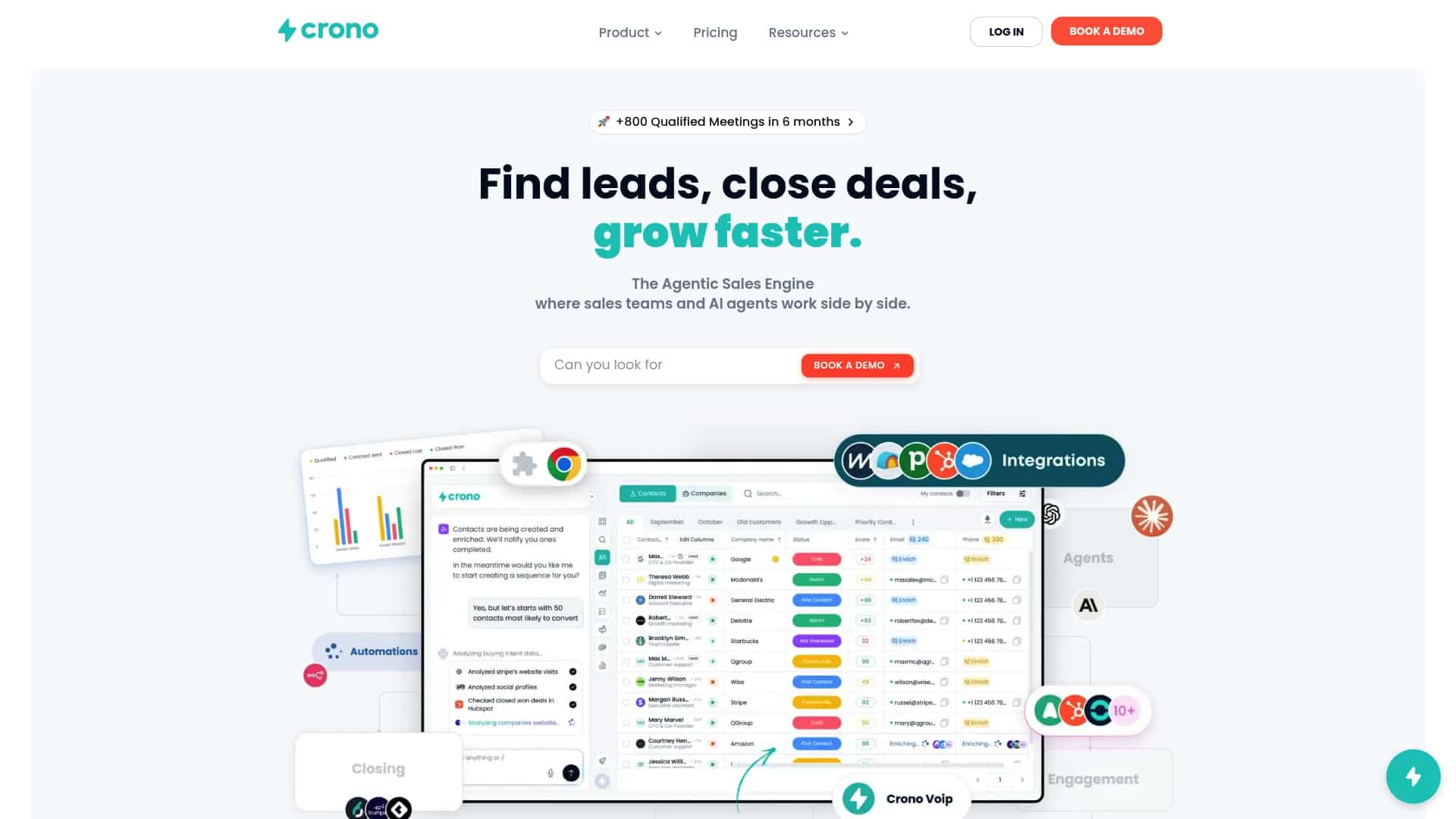
Everything covered here, TAL hygiene, tiered personalization, multi-stakeholder sequencing, and account-level reporting, depends on tools that share data cleanly. That is the problem we built Crono to solve: a sales execution layer that connects your CRM and existing sales tools into one place where enrichment, multichannel outreach, AI-driven personalization, and pipeline visibility work from the same account list instead of five disconnected ones.
For teams ready to put this playbook into practice, we would point you toward a few starting points:
- Review our pricing page to compare the Pro and Ultra plans against your team size.
- Explore the Agentic Sales Engine tiers if AI-driven research and personalization at scale is the gap you are trying to close.
- Read how outbound sales is changing with AI to see how orchestration fits into a broader execution strategy.
If building the RevOps architecture behind this is the bigger lift, Quick To Impress works on the CRM and revenue operations implementation side that often has to exist before ABO can run smoothly.
FAQ
What is an example of account-based marketing?
A common example is a marketing team running a custom ad campaign and personalized landing page aimed at a single named enterprise account, timed to run before sales outreach begins. The goal is to make that account recognize the brand before a rep ever makes contact, which ABM frameworks describe as treating one company as its own market.
What does outbound mean in business?
Outbound refers to sales or marketing activity initiated by a company toward a prospect, rather than activity the prospect starts on their own, such as filling out a form. It typically includes cold email, cold calls, LinkedIn outreach, and direct mail aimed at people who have not yet expressed interest.
What are examples of outbound activities?
Common outbound activities include cold email sequences, cold calling, LinkedIn connection requests and messages, direct mail sent to a named contact, and targeted display ads aimed at a specific account or persona list. In account based outbound, these activities are coordinated across channels against the same named accounts rather than run independently.
What is outbound vs. inbound?
Outbound means your team initiates contact with a prospect who has not yet engaged with you, while inbound means the prospect finds you first, through content, search, or a referral, and reaches out. Most mature B2B sales motions run both simultaneously, using inbound signals to help prioritize which outbound accounts to pursue first.
