
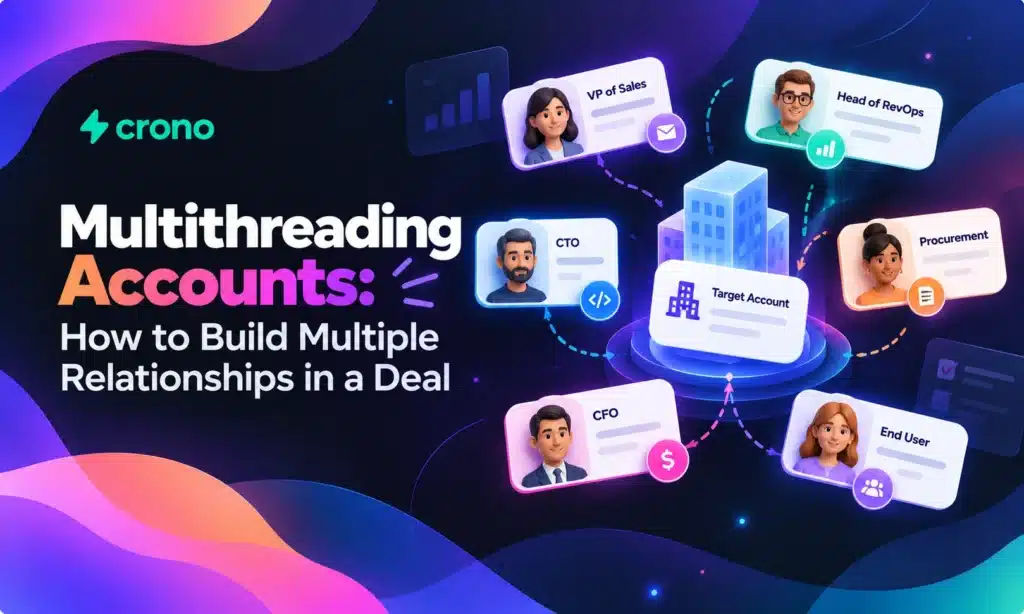
Multithreading an account means building real working relationships with several people inside the buyer’s company, instead of depending on one contact to carry your deal. You do it by mapping the buying committee, giving each stakeholder a reason to engage that fits their role, coordinating who talks to whom and on which channel, and tracking coverage as closely as you track activity. This guide walks through each step, with a stakeholder map you can copy, a sequencing model, the metrics that tell you whether it is working, and the mistakes that cost teams their champion.
TL;DR
- Multithreading is deliberate coverage of the buying committee, not a longer contact list. Each thread needs a role, a reason to engage and an owner.
- Single-threaded deals fail quietly: when your one contact changes jobs, loses budget or goes silent, you start from zero.
- Map roles first (economic buyer, champion, technical, security, finance, procurement, legal, executive sponsor), then mark the gaps as “unknown” so they stay visible.
- Ask your champion to open doors rather than going around them, and tailor every message to the stakeholder’s priorities.
- Measure role coverage, threads per opportunity and multi-stakeholder meetings, not just emails sent.
Table of Contents
- What multithreading accounts really means
- Why single-threaded deals break
- Step 1: Map the buying committee
- Step 2: Engage each stakeholder with a reason to care
- Step 3: Multithread without burning your champion
- Step 4: Coordinate the team behind the threads
- Step 5: Measure whether you are really multithreading
- Common mistakes
- Perspective: what we see in multithreading
- How Crono supports multithreaded selling
- FAQ
- Sources
What multithreading accounts really means
In B2B sales, multithreading is the deliberate effort to build conversations with the key decision makers at a prospect at the same time, rather than running a one-on-one relationship with a single contact. The point is a fuller view of the account and protection if one person leaves the picture, as Walnut’s explainer puts it. We cite it for the definition only.
Gartner frames it from the buyer’s side. In its view, multithreaded engagement means coordinating concurrent connections with multiple stakeholders while adapting support to each person’s self-directed buying journey and the task they are working on right now. That is a useful correction to the common reading. Multithreading is not “send more emails to more people.” It is orchestration: the right information reaching the right person at the moment they need it.
Three practical consequences follow:
- Every thread has a purpose. The CFO gets a conversation about payback and risk. The admin who will run the tool gets a conversation about workload and setup.
- Threads are coordinated. Nobody on the buyer’s side should receive three unrelated asks from your team in the same week.
- Coverage is visible. If it lives in one rep’s head, it is not a process. It has to be in the CRM where a manager can inspect it.
Why single-threaded deals break
A single-threaded deal looks healthy until it doesn’t. Your contact loves the product, answers within the hour and promises to “take it upstairs.” Then one of these happens:
- They change roles or leave the company.
- A reorganization removes their budget or their authority.
- They are enthusiastic but have no power to sign, and you never meet the person who does.
- Security, legal or procurement enters late and nobody on your side knows them.
In each case the seller must start over or lose the deal. Multiple relationships soften that loss because someone else already knows your value and can pick up the conversation.
The larger the deal, the more this matters. Enterprise purchases involve committees, and each member can say no even if none can say yes alone. Your champion cannot answer a security questionnaire on your behalf, and cannot know how procurement will push back on terms. You need people on your side of the table who have actually spoken with those stakeholders.
Step 1: Map the buying committee
Before you contact anyone new, write down who should be in the deal. A stakeholder map does not need software. It needs a consistent list of roles per opportunity. The Pedowitz Group suggests starting with roles such as economic buyer, technical evaluator, champion, user, security, finance, procurement, legal and executive sponsor, and adding “unknown” placeholders so gaps are visible instead of ignored.
Here is a simple template:
| Role | What they care about | Status | Owner on our side |
|---|---|---|---|
| Champion | Solving their team’s problem, looking good internally | Engaged | AE |
| Economic buyer | Return, budget fit, risk | Unknown | AE + sales leader |
| Technical evaluator | Integration, data flows, maintenance | Contacted | Solutions engineer |
| End users | Daily workflow, time saved | Not contacted | SDR / CSM |
| Security | Data handling, compliance | Unknown | Solutions engineer |
| Finance | Cost, payback period | Unknown | AE |
| Procurement and legal | Terms, vendor requirements | Unknown | Sales ops |
| Executive sponsor | Strategic fit | Not contacted | Sales leader |
The “unknown” rows matter most. A deal with six unknowns at the proposal stage is a single-threaded deal in disguise, whatever the forecast says.
Decide when each thread opens
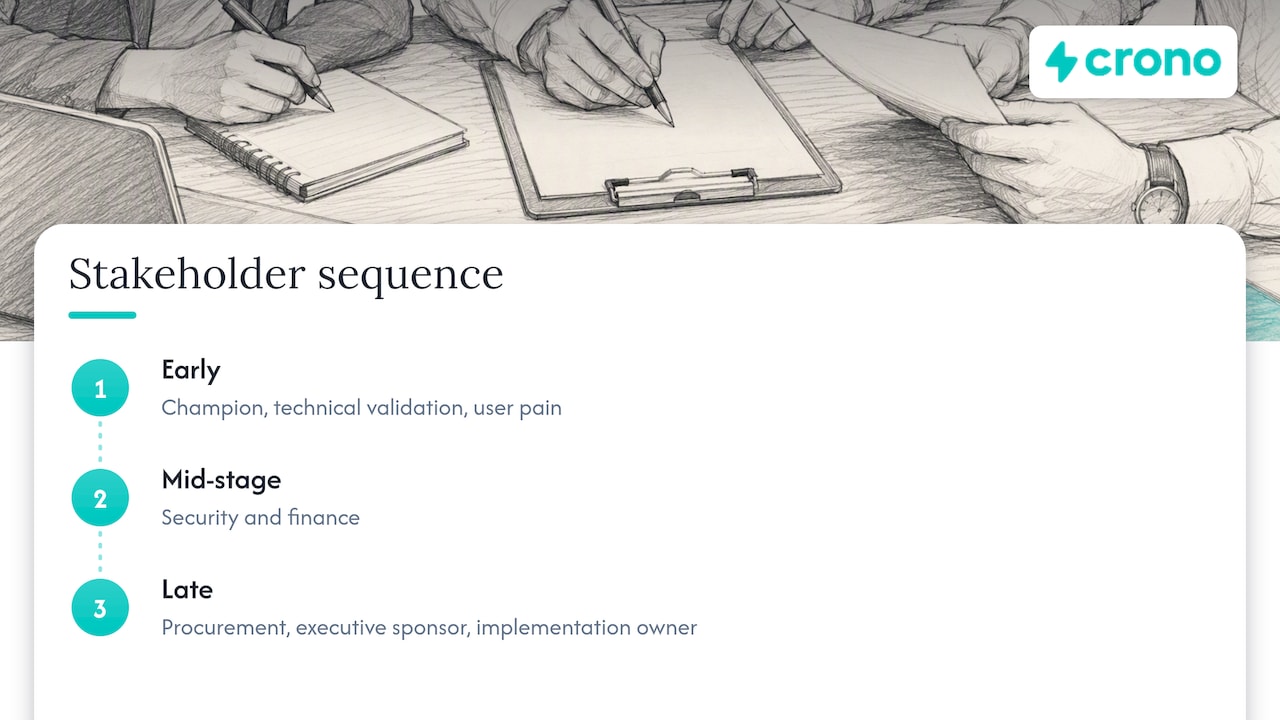
Not every role belongs in the first week. The same Pedowitz guidance prioritizes the champion, technical validation and user pain early, security and finance mid-stage, and procurement, the executive sponsor and the implementation owner late. Treat that as a sensible default and adjust for your own sales cycle. A short cycle may compress the stages, but the order usually holds: understand the problem, prove it can work, then clear the approvals.
Find the people you don’t know yet
Mapping exposes gaps, and filling them takes research. Look at the champion’s org chart, the job titles in the department that will own the outcome, and recent hires that signal priorities. Buying signals such as leadership changes or new hiring in a function help you decide whom to reach and when. Enrich the account with verified contact data so that outreach reaches real inboxes and numbers. If you are building the list from scratch, our guide to multichannel outreach across two to four channels covers the mechanics.
Step 2: Engage each stakeholder with a reason to care
A common mistake is to copy the same pitch to every name on the map. A finance leader reading a feature tour feels no pull. A user reading an ROI model feels none either. Good multithreading connects each person’s role, goals and pain points to a tailored proposition, rather than widening the audience for one generic message.
Some examples of how the same deal reads from different seats:
- Economic buyer: cost of the current process, expected payback, risk of doing nothing.
- Technical evaluator: how it connects to existing systems, who maintains it, what data moves where.
- User: hours saved each week, how the day-to-day changes, how long onboarding takes.
- Security and legal: data handling, documentation, standard terms, answers they can forward without a call.
- Executive sponsor: how the project ties to a goal they already own.
Keep the story consistent while changing the emphasis. If the user hears “saves time” and the CFO hears “reduces headcount,” the stakeholders will compare notes and trust will drop.
Use channels deliberately
Stakeholders prefer different channels. A senior executive may ignore a cold email but accept a short note through a mutual connection or a LinkedIn message. A technical lead may want documentation and a sandbox. A user may respond to a call. Madison Logic describes effective multithreading as covering relationship, channel and content threads, with role-tailored messaging and coordinated campaigns. That framing is a good check: are you reaching people through the channel they use, with content that fits their job?
This is also where cross-channel strategies help, because the principle is the same as in marketing: adapt support to each person’s role, task and preferred path, and keep the touchpoints connected. Timing matters too. Our pieces on the power of timing in multichannel strategies explain how to space touches so that outreach feels coordinated rather than relentless.
Step 3: Multithread without burning your champion
The biggest fear reps raise is simple: “If I contact other people, my champion will feel bypassed.” The fear is reasonable. Done badly, multithreading can end the relationship you most need. Done well, it makes the champion look good.
The approach that works:
- Frame it as help for them. Say that decisions like this usually involve finance, security and IT, and you want to prepare answers so they don’t have to.
- Ask them to broker access. “Could you introduce me to whoever owns the budget?” works better than a cold email to that person. 30MPC’s advice on this is to frame the request in the buyer’s interest and avoid going over the champion’s head when they are the only path to close.
- Offer them materials. Give them a short summary, a one-page business case or a technical brief they can forward. It lowers the effort of introducing you.
- Report back. Tell the champion what you discussed with others. Surprises are what make champions feel bypassed.
- Separate bottom-up from top-down. Users and managers can be engaged through normal outreach. Executives are usually best reached through an introduction, from the champion or from your own leadership.
If the champion resists every introduction, treat that as information. A contact who will not let you meet anyone else may lack influence, or may be unsure about the deal. Either way, you need to know before the forecast call, not after.
Step 4: Coordinate the team behind the threads
Multithreading becomes chaos when five people from your company contact the same account without talking to each other. Assign one owner per account, then give other roles defined jobs: the SDR works user-level and manager-level contacts, the solutions engineer handles technical validation, the sales leader opens executive doors, and sales ops prepares procurement and legal paperwork.
The Pedowitz Group recommends standardizing CRM fields, rules and service-level agreements so every thread is visible and coordinated. In practice, that means:
- A contact-role field on every opportunity, required before the proposal stage.
- A rule that logs activity from all channels against the account, not only against the owner.
- A shared next step for each stakeholder, with a date.
- Alignment with marketing, so that content and campaigns support the same personas your reps are approaching.
When those fields are accurate, a manager can open an opportunity and see in seconds who is engaged and who is missing. Our walkthrough of the pipeline inspection process shows how to build that check into your weekly review, and the pipeline hygiene audit covers the fields that keep forecasts honest.
Where AI fits
The coordination work is repetitive and easy to drop: finding additional contacts, enriching them, drafting role-specific first touches, logging replies and prompting follow-up. That is the kind of execution AI agents can take on while the rep handles the conversations that need judgment. If you are evaluating that path, start with our guide to deploying AI sales agents in B2B sales, and keep a human approving anything that goes to an executive.
Step 5: Measure whether you are really multithreading
Activity numbers lie. A rep can send 200 emails to one person and still be single-threaded. The better questions are about coverage and outcomes. The metrics recommended by the Pedowitz Group include:
| Metric | What it tells you |
|---|---|
| Role coverage | How many of the key roles on the map have an engaged contact |
| Threads per opportunity | Number of active, two-way relationships, not names in the CRM |
| Multi-stakeholder meeting rate | Share of meetings with more than one buyer-side role |
| Time in stage | Whether deals with more threads move faster or slower |
| Late-stage stall rate | Deals that freeze at security, finance or procurement |
| Win and no-decision rate | The result that matters, compared by thread count |
Two cautions. First, count a thread only when the person has engaged, replied or attended something. A name found on LinkedIn is not a relationship. Second, compare your own win and no-decision rates by number of threads before you set targets. Benchmarks from other companies reflect their deal size and sales cycle, not yours, so your CRM history is the better yardstick.
For a weekly routine, review these for every open opportunity above your size threshold:
- Which roles are covered and which are still unknown?
- Who engaged in the last two weeks?
- Did the last meeting include more than one stakeholder?
- Which stakeholder poses the biggest risk?
- What is the next step, and who owns it?
Flag any late-stage deal with only one engaged contact. That flag alone changes behavior, because reps start building coverage earlier to avoid it.
Common mistakes
- Treating a bigger list as multithreading. Ten names with no engagement is a single thread with extra rows.
- Starting too late. Reaching finance and security at the proposal stage is a recipe for a stall. Open them at the point your map suggests.
- Sending the same message to everyone. Role-specific value is the whole point.
- Going over the champion’s head. Ask for introductions first. Bypass only with a clear reason and a plan to repair trust.
- Leaving it to individual style. If it is not in the process, it will happen only for the reps who already do it well.
- Ignoring the post-sale. The same logic protects renewals. If your only contact leaves a customer account, you face the same restart.
Perspective: what we see in multithreading
Most teams we talk to already believe in multithreading. The trouble is execution. The information needed to multithread sits in different places: the CRM holds contacts and stages, a data tool holds enrichment, an engagement tool holds sequences, and the signals telling you who just joined the account arrive somewhere else entirely. Reps do not skip multithreading because they disagree with it. They skip it because assembling the picture takes more time than they have.
That is why we built Crono as an execution layer over the stack you already own, not another system to replace it. Signals show which accounts and which roles deserve attention now. Enrichment fills in the contacts. Workflows and AI agents handle the repetitive preparation, and the rep keeps the relationship. Our view is that the goal is not more activity but visible, coordinated coverage: every opportunity showing who is engaged, who is missing and what happens next.
We also think multithreading should stay human where it counts. An AI agent can find the finance lead and draft a relevant first note. It should not decide how to approach an executive through your champion. Use automation for the legwork and your people for trust.
— Alex
How Crono supports multithreaded selling
If your team wants coverage that is easy to see and repeat, Crono brings signals, data enrichment, multichannel outreach and workflow automation into one place on top of your CRM. Seat plans start at €79 per month per seat for Pro and €119 for Ultra, and the Agentic Sales Engine adds credit-based AI and enrichment capacity, starting at €99 per month for 10,000 credits on the Agents Hub. Enterprise pricing is available on request. See the pricing page for what each plan includes.
FAQ
What is the difference between single-threading and multithreading in sales?
Single-threading relies on one contact to carry the deal. Multithreading builds relationships with several stakeholders, each tied to a role in the buying decision. The second protects you when a contact leaves, loses influence or cannot get approval alone.
How many contacts should I engage per deal?
There is no universal number. It depends on deal size, product complexity and how many functions must approve. Use your stakeholder map as the guide: cover each role that can block the deal, and compare win rates by thread count in your own CRM to set a target.
How do I multithread without upsetting my champion?
Present it as support for them. Explain that finance, security and IT will have questions, ask for introductions, share materials they can forward and keep them informed about every conversation. Avoid contacting senior stakeholders behind their back unless the deal is clearly stalled.
Does multithreading work for small deals?
Yes, in lighter form. A short-cycle deal may involve only a user and a manager, but the same risk applies if your one contact leaves. Add at least one second contact, ideally the person with budget authority, before the proposal.
Sources
- Gartner: Why Multithreaded Engagements Are the Secret to Accelerating Revenue Growth
- The Pedowitz Group: How do you enable sales for multi-threading accounts?
- Madison Logic: Sales Multithreading: What It Is, KPIs, and Takeaways
- Walnut: What Is Sales Multi-Threading and How to Do It Right
- 30MPC: How to Multithread and Get to Power in Sales
