
How to Deploy AI Sales Agents in B2B: A Practical Guide for Mid-Market Teams
Below, you’ll find a practical breakdown of the five AI sales agents that Mid-Market B2B teams are deploying right now to generate pipeline, qualify leads, and book more meetings, without adding headcount.
- Signal-Based Sequence Agent
- AI Personalization Agent
- Intelligence Agent
- Qualification Agent
- Meeting Prep Agent
Already know which agent you need? Jump straight to the section. If you’re still figuring out where to start, or want to understand what AI sales agents actually are, keep reading. Deploying the wrong agent for the wrong problem is the most common reason Mid-Market teams don’t see results.
1. Signal-Based Sequence Agent
What it does
- Monitors for key external events: job changes, new funding rounds, hiring surges, relevant social mentions
- Upon detecting a signal, analyzes context to determine the best outreach strategy and explains its reasoning
- Automatically builds the full end-to-end sequence of touchpoints from that signal
- Lets sales teams define the degree of autonomy: “Draft only” to review before sending, or “Auto-send” for full automation
Buying signals expire fast. A prospect who just changed jobs is most receptive in the first two weeks, after that, they’re heads-down in their new role and harder to reach. Manual monitoring of hundreds of accounts at once is impossible for most Mid-Market SDR teams. This agent closes that gap: it catches the signal the moment it appears, builds the sequence, and gets a message out while the window is still open. The ROI is clearest when your team covers large account lists with signals spread across multiple sources.
Common mistake to avoid
Starting on “Auto-send” before the agent is calibrated. In the first 30 days, set it to “Draft only” so your reps review and approve the sequences it generates. Use that period to calibrate signal types, message tone, and sequence structure. Only then graduate to higher autonomy.
How Crono handles this natively
Crono’s Signal-Based Sequence Agent detects buying triggers across your entire account list in real time and fires personalized sequences automatically. Job change. Funding round. Pricing page visit. Zero lag between signal and the right action.
2. AI Personalization Agent
What it does
- Leverages internal CRM data: past notes, deal history, previous interaction patterns with the contact
- Enriches messages with real-time external context: company news, the prospect’s specific role responsibilities, current tech stack
- Generates hyper-personalized messages that move beyond simple templates to demonstrate true business relevance
- Works at scale, personalizing hundreds of contacts without the manual research time per message
Common mistake to avoid
Treating the agent’s output as always final. AI-generated personalization can occasionally miss context or reference outdated information. Build a quick human review step for high-value accounts and VP-level contacts, especially for the first few batches while you’re calibrating the quality threshold.
Crono’s AI Personalization Agent combines your CRM history with live external data to generate messages that read as handcrafted. Integrated directly into your sequences—one click to approve and send, or configure auto-send for high-volume outreach.
3. Intelligence Agent
- Proactively monitors contacts, deals, and companies already stored in your CRM—including inactive and lost opportunities
- Cross-references internal CRM status with external signals: prospect changing companies, competitor mentions, funding events
- When timing is optimal, automatically triggers a reconnection sequence or assigns a personalized task to the rep
- Runs as a continuous background process, no manual check required, no signal ever missed
Most Mid-Market teams have a large “not now” graveyard in their CRM—contacts who were interested six months ago but went quiet. Manually checking in on hundreds of those contacts is impossible, so most of that pipeline just sits untouched. The Intelligence Agent turns that dead weight into a live source of re-engaged pipeline by watching for the external trigger that changes the equation: a new job that means a new budget, a competitor contract ending, a funding round that unlocks spending. It’s one of the highest-ROI agents for teams with an existing CRM history to mine.
Not defining what “good timing” means before deploying. Configure specific trigger criteria—which signal types should activate re-engagement, what CRM statuses qualify, and what minimum time gap is required between contact attempts. Without these guardrails, the agent can over-contact or surface false positives.
Crono’s Intelligence Agent monitors your entire CRM for re-engagement signals continuously. When a cold contact hits the right trigger, it either fires a sequence automatically or alerts the rep with a personalized task—so they reach out while the signal is still fresh.
4. Qualification Agent
What it does
- Sits between lead discovery and CRM creation as a critical intermediate filtering step
- Evaluates each lead based on predefined criteria: ICP fit, intent signals, firmographic thresholds
- Routes only high-fit or high-intent prospects into the active pipeline for rep follow-up
- Keeps CRM clean by preventing low-quality leads from cluttering pipeline and skewing metrics
Growing Mid-Market teams often hit a specific problem: as top-of-funnel volume increases, rep capacity becomes the bottleneck. The Qualification Agent addresses this by acting as an intelligent pre-filter, ensuring that the leads entering the active pipeline have already cleared a quality bar. The result is reps working fewer, better leads rather than more leads of mixed quality. This is particularly high-leverage when you run high-volume inbound or outbound campaigns where lead quality varies significantly.
Common mistake to avoid
Setting qualification criteria too tight in the beginning and over-filtering genuinely good leads. Calibrate the agent iteratively: start with moderate criteria, review what it passes and rejects for the first two weeks, then tighten. An agent that’s too aggressive filters out real pipeline alongside the noise.
How Crono handles this natively
Crono’s Qualification Agent filters every lead before it enters your CRM, evaluating fit against your ICP and intent signals automatically. Your pipeline stays clean, your reps stay focused, and your conversion rates reflect actual quality, not volume.
5. Meeting Prep Agent
What it does
- Automatically generates a comprehensive pre-call brief: interaction history, recent company news, latest deal updates
- Provides a stakeholder map of the decision-making org chart to identify key influencers and blockers
- Suggests specific talking points tailored to the current stage of the deal and the prospect’s role
- Integrates with Google Calendar to deliver briefs automatically at the right time before each meeting
The pre-call research problem is universal: reps either spend 30–45 minutes preparing for each meeting, time that doesn’t scale across a full calendar, or they walk in underprepared and miss the nuance that closes deals. The Meeting Prep Agent solves both problems. It’s highest-value for AEs managing multiple active opportunities across complex accounts with multiple stakeholders, where walking in with the right context and the right talking point can meaningfully change the outcome of a call.
Reps treating the brief as the full picture. The Meeting Prep Agent surfaces structured data efficiently, but the rep’s own relationship knowledge—tone, history, personal details—doesn’t live in the CRM and won’t appear in the brief. Encourage reps to use it as a foundation to build on, not a script to read from.
How Crono handles this natively
Crono’s Meeting Prep Agent delivers a full pre-call briefing automatically, interaction history, org chart, talking points tailored to the deal stage, integrated with your calendar so it’s ready exactly when your rep needs it. Zero manual research required.
What Is an AI Sales Agent? A Clear Definition for B2B Teams
Before deploying any agent, it’s worth being precise about what the term actually means, because vendors use it loosely, and the gap between “AI-powered automation” and “a real AI agent” has significant implications for how you evaluate tools and set expectations with your team.
AI automation executes a fixed sequence of actions based on predefined rules. It’s deterministic: if X, then Y. Most sales tools marketed as “AI” are sophisticated automation. They’re valuable, but they don’t reason, adapt, or make independent decisions.
An AI sales agent perceives inputs, buying signals, CRM data, emails, web research, reasons about the best next action, executes it autonomously, and learns from outcomes to improve future decisions. It can handle ambiguity. It can switch strategies mid-sequence if the data warrants it.
The practical difference: an automation tool runs your sequence on a schedule. An AI agent decides whether this is the right moment, builds the right sequence for this specific signal, and tells you when a human should step in.
The human + agent model: why Mid-Market wins with augmentation
Most Mid-Market teams don’t replace their reps with AI. They augment them. Agents handle the volume-heavy, repetitive tasks—signal monitoring, sequence building, lead filtering, meeting prep—while human reps focus on the conversations and relationships that actually close deals.
The teams winning in 2026 are not the ones who went fully autonomous. They’re the ones who found the right division of labor: agents handling everything that can be systematized, reps owning everything that requires judgment and trust.
Which Agent Should You Deploy First?
- Missing buying signals in real time? → Start with the Signal-Based Sequence Agent
- Low reply rates despite high send volume? → Start with the AI Personalization Agent
- Large “not now” CRM backlog going untouched? → Start with the Intelligence Agent
- Reps buried in low-quality leads? → Start with the Qualification Agent
- Reps going into calls underprepared? → Start with the Meeting Prep Agent
Before deploying: three non-negotiables
1. Clean CRM data.
Every agent reasons from what’s in your CRM. If deal stages are stale, contact data is outdated, or activity isn’t logged, agents produce bad outputs. Fix data quality first.
2. Defined autonomy level.
Each agent in Crono’s Agents Hub lets you configure the degree of automation, from “Draft only” (rep reviews everything) to full auto-send. Start conservative. Graduate autonomy as you validate output quality.
3. Human review at high-stakes touchpoints.
Always keep humans in the loop for first messages to strategic accounts, VP-level or above contacts, and late-stage deal communications. Agents are optimized for volume; humans are optimized for nuance.
What "Humans + Agents" Looks Like in Practice
Here’s what a week looks like for a Mid-Market B2B sales team running all five agents, not a theoretical scenario, but what the best teams are actually operating with right now.
Monday morning: The Signal-Based Sequence Agent detected 12 buying signals over the weekend: 4 job changes at target accounts, 2 funding rounds, 6 relevant social mentions. It drafted sequences for each. The SDR reviews and approves in 15 minutes.
Throughout the week: The AI Personalization Agent generates first lines and message variants for 60 new contacts entering sequences. Each one references real context—recent company news, role-specific pain points, CRM interaction history. The SDR reviews 20% and approves the rest. Total weekly time on personalization: 20 minutes.
Midweek: The Intelligence Agent flags a contact who went cold in February: they just changed jobs and joined a company that fits the ICP perfectly. It alerts the SDR with a suggested reconnection message already written. The SDR sends it. The contact replies the same day.
Thursday: 30 inbound leads came in from a campaign. The Qualification Agent filters them: 8 pass the ICP and intent threshold and enter the active pipeline. The other 22 go to a nurture track. Reps never see the noise.
Friday: The AE has three discovery calls. The Meeting Prep Agent delivered a brief for each before 8am: interaction history, org chart, deal stage context, and two talking points tailored to each conversation. Each call takes 40% less prep time.
How Crono's Agents Hub Brings This Together
Most teams trying to deploy AI sales agents end up stitching together 4–6 separate tools: a signal monitoring platform, a sequence tool, an AI writing layer, a lead scoring system, a meeting prep tool, and a CRM.
Each requires its own integration, its own data sync, its own maintenance overhead. For Mid-Market teams without a dedicated RevOps function, this complexity kills adoption before it starts.
Crono’s Agents Hub gives you all five agents—Signal-Based Sequence, AI Personalization, Intelligence, Qualification, and Meeting Prep—natively inside the same platform where your reps run sequences, manage pipeline, and log activity.
Your data doesn’t need to sync across systems. Every agent action is visible and controllable. And everything stays in sync with Salesforce, Pipedrive, and HubSpot automatically.
Frequently Asked Questions About AI Sales Agents
What is an AI sales agent?
An AI sales agent is a software system that autonomously performs sales tasks, signal detection, outreach, lead qualification, meeting preparation, by perceiving data inputs, reasoning about the best action, and executing it without requiring a human to initiate each step. Unlike traditional automation, AI agents adapt their behavior based on context and outcomes, and can operate across multiple data sources simultaneously.
Do AI sales agents replace SDRs?
Not in most Mid-Market contexts. The most effective implementations use agents to handle high-volume, repetitive tasks—signal monitoring, sequence building, lead filtering, pre-call research—while human SDRs and AEs focus on qualification conversations, relationship-building, and closing. The winning model in 2026 is augmentation: agents bring the speed, reps bring the relationships.
What buying signals do AI sales agents detect?
The most common signals include: job changes at target accounts, new funding rounds, hiring surges in specific departments, relevant social mentions, competitor mentions, and behavioral intent signals like website visits to pricing or feature pages. Crono’s Signal-Based Sequence Agent monitors for all of these across your account list and fires the appropriate outreach the moment a signal appears.
How do AI sales agents integrate with CRM?
The best platforms, including Crono, log all agent activity directly to your CRM in real time, with no manual input required. Every sequence fired, every message sent, every qualification decision made by the agent appears in Salesforce, Pipedrive, or HubSpot automatically. The CRM stays current without rep involvement, which also means agents always have accurate data to reason from.
Are AI sales agents worth it for Mid-Market teams?
Yes, when deployed correctly. The key is starting with the bottleneck that most limits your pipeline—missing signals, low personalization, dead CRM backlog, poor lead quality, or underprepared reps—rather than trying to deploy everything at once. Mid-Market teams that deploy agents strategically see meaningful improvements in the number of signals acted on, reply rates, time-to-first-contact on new leads, and the percentage of rep time spent on conversations versus research and admin work.
What’s the difference between “Draft only” and “Auto-send”?
In Crono’s Agents Hub, each agent lets you configure its degree of autonomy. In “Draft only” mode, the agent prepares the sequence or message but holds it for rep review and approval before anything is sent. In “Auto-send” mode, the agent executes autonomously without human review. Most teams start on “Draft only” to validate quality, then graduate to higher autonomy for specific agent types and contact tiers as confidence builds.
Not sure where to start?
Let's talk.
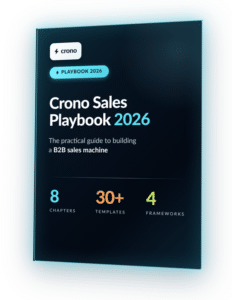
Schedule a session with one of our specialists and get our exclusive Sales Playbook 2026 for free.
 BANT, SPICED & MEDDPICC frameworks
30+ ready-to-use sales templates
2026 outbound & pipeline benchmarks
Don’t sell the product. Sell the change the product makes possible.
This playbook is step one.
Not sure where to start?
Let's talk.
Schedule a session with one of our specialists and get our exclusive Sales Playbook 2026 for free.
BANT, SPICED & MEDDPICC frameworks
30+ ready-to-use sales templates
2026 outbound & pipeline benchmarks
Don’t sell the product. Sell the change the product makes possible.
This playbook is step one.
