
An account prioritization framework is a repeatable way to rank the companies you could sell to, so your team spends its limited hours on the ones most likely to buy, grow and stay. The version that works in practice has four parts: a shared ideal customer profile (ICP), a score that combines fit and timing, three or four tiers with different levels of effort, and a review rhythm that keeps the ranking current. This guide walks through each part, gives you a matrix you can copy, and shows how to turn the ranking into daily work.
TL;DR
- Start with a written ICP that sales and marketing agree on, covering firmographics plus traits such as the technologies an account already uses.
- Score every account on two axes: fit (should we sell here?) and timing (is there a reason to act now?).
- Plot accounts on a fit-and-timing matrix, then assign each tier a specific motion, channel mix and weekly effort budget.
- Review the model every quarter. A static score drifts away from the market within months.
- A ranking only pays off when it drives action: connect it to your CRM, outreach and task queues so priorities show up in reps’ daily work.
Table of Contents
- Why prioritization is a revenue decision, not a list-cleaning exercise
- The four building blocks of an account prioritization framework
- The fit-and-timing matrix
- How to build the framework in six steps
- Common account prioritization models and when to use them
- Prioritizing existing accounts, not only new ones
- Turning the ranking into territories and capacity
- Where AI helps, and where humans still decide
- Our perspective: a framework is only as good as the execution behind it
- Putting the framework to work with Crono
- Measuring whether your framework works
- FAQ
- Sources
Why prioritization is a revenue decision, not a list-cleaning exercise
Every team has more accounts than hours. Without a shared method, reps rank accounts by whatever is loudest: the logo they recognize, the last deal they won, the contact who answered an email. HubSpot’s ABM product manager describes the stall that follows: teams lack a common definition of value, so selection turns into opinion. That is how recency bias creeps in.
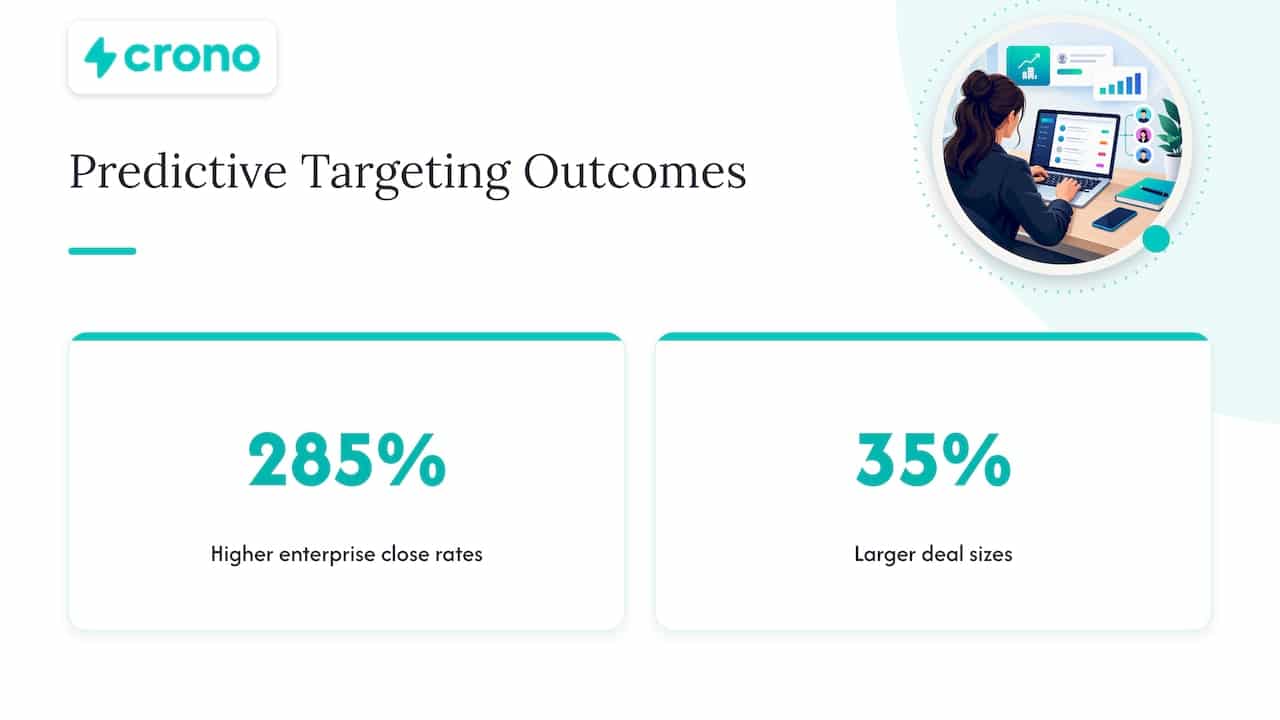
The upside of getting it right is large. Gartner’s ICP research reports that companies using predictive targeting saw 285% higher enterprise close rates and 35% larger deal sizes. Treat those figures as a ceiling from a specific benchmark, not a promise. Your own gain depends on data quality and how consistently reps follow the ranking. Still, the direction is clear: teams that target on evidence beat teams that target on instinct.
Prioritization also protects your existing base. Forrester notes that in some B2B organizations a handful of customers have an outsized impact on the bottom line and the company’s future. A good framework ranks customers for expansion as well as prospects for new business.
The four building blocks of an account prioritization framework
1. A shared ICP
Everything downstream depends on this. Gartner defines the ICP as the firmographic, environmental and behavioral attributes of the accounts expected to become your most valuable customers, developed through both qualitative and quantitative analysis. In plain terms: look at your best customers, find what they share, and write it down.
A workable ICP has three layers:
- Firmographics: industry, employee count, revenue band, geography, funding stage.
- Environment: the tech stack, the tools they replace, the regulations that shape their buying.
- Behavior: how they buy, how fast they close, how often they expand.
HubSpot’s guidance is to include non-obvious traits such as a specific technology in the stack, because those ground the model in facts instead of rep intuition. If your personas are still fuzzy, it helps to build buyer personas before you assign weights, since the person you sell to shapes which signals matter.
2. A score with two dimensions
Most frameworks fail by collapsing everything into a single number. A 78 could mean a perfect-fit account that is silent, or a poor-fit account that is clicking everything. Keep two scores separate:
| Dimension | Question it answers | Typical inputs |
|---|---|---|
| Fit | Would this account succeed with us? | Industry, size, tech stack, region, past win rates in similar accounts |
| Timing | Is there a reason to engage now? | Hiring in relevant roles, funding events, website or content engagement, intent data, champion job changes, contract renewal windows |
Gartner’s guidance on purchase intent data frames scoring as a shared sales and marketing method that ranks prospects on several factors, including the interest they show. Our own piece on how to identify high-intent B2B accounts goes deeper on which timing signals deserve weight.
3. Tiers tied to effort
A score that does not change behavior is decoration. Convert it into tiers, and give each tier a defined motion.
4. A review cadence
Gartner’s view, as summarized in the research we reviewed, is that ICP development and account scoring are living processes that need a quarterly check so quotas and territory coverage reflect current market potential, not old results. Put the review on the calendar before you launch.
The fit-and-timing matrix
This is the account prioritization matrix most teams end up using, because it is simple enough to explain in one meeting. Score fit and timing as high or low, then place each account in a quadrant.
| High timing | Low timing | |
|---|---|---|
| High fit | Tier 1: Act now. Personalized multichannel outreach, senior sponsor involvement, same-week follow-up | Tier 2: Build. Light-touch nurturing, social engagement, signal monitoring so you move the moment timing changes |
| Low fit | Tier 3: Qualify carefully. Short, low-cost outreach. Check for hidden fit before investing | Tier 4: Park. Automated nurture at most, or remove from active lists |
The matrix prevents two common mistakes. The first is chasing a hot but poor-fit account, which burns cycles and often produces churn. The second is ignoring a perfect-fit account because it has not raised a hand yet.
How to build the framework in six steps
- Pull your closed-won and closed-lost data. Look at the last 12 to 24 months. Find the attributes that separate fast, large, retained deals from slow or lost ones.
- Write the ICP with sales and marketing in the same room. Agree on three to six attributes that you can actually observe in your data. If you cannot measure an attribute, drop it.
- Assign fit weights. Give heavier weight to attributes that predict retention and expansion, not just a signed contract. A simple 1 to 5 scale per attribute is enough to begin.
- Choose your timing signals. Pick five to eight, such as a relevant hire, a funding round, a pricing-page visit by multiple contacts, or a champion moving to a new company. More signals add noise.
- Set tier thresholds and motions. Decide the cutoffs, then write what each tier receives: channels, cadence, who owns it, and how many accounts one rep can hold.
- Pilot with one segment. Run it on one team or territory for a quarter. Compare reply rates, meetings booked and pipeline created against a control group before you roll it out.
A worked example
Say you sell to mid-market SaaS companies. Your ICP: 100 to 1,000 employees, a CRM already in place, a sales team of 10 or more, and a North American headquarters.
- Account A matches all four traits. The VP of Sales just joined last month and three employees visited your pricing page. Fit is high, timing is high: Tier 1.
- Account B matches all four, but there has been no activity in six months. Fit high, timing low: Tier 2. You monitor it.
- Account C has 40 employees and no CRM, but its CEO has engaged with your posts. Fit low, timing high: Tier 3. A short qualifying conversation is justified, nothing more.
- Account D is a 5,000-person manufacturer outside your target region with no signals. Tier 4.
The numbers here are illustrative, not benchmarks. Your own weights should come from your own win data.
Common account prioritization models and when to use them
Readers often ask which model to choose. They are variations on the same idea, differing in how much math they need.
| Model | How it works | Best for | Watch out for |
|---|---|---|---|
| Tiered (manual) | Reps or managers sort accounts into A, B and C using agreed criteria | Small teams, early-stage ICP | Subjectivity and inconsistency |
| Point-based scoring | Each attribute earns points; totals set the rank | Teams with a clean CRM | Weights set by guesswork |
| Weighted fit-and-timing | Two separate scores plotted on a matrix | Most mid-market teams | Needs a regular signal feed |
| Predictive | A model trained on past wins ranks accounts | Large datasets and many closed deals | Opaque logic if you cannot inspect inputs |
| Strategic 1:1 selection | Leaders hand-pick a few high-impact accounts | Enterprise and key-account programs | Bias toward familiar names |
There is no need to jump to predictive scoring. A weighted fit-and-timing model, reviewed quarterly, beats an elaborate model nobody trusts. If you grow into predictive, keep the matrix as a sanity check.
Prioritizing existing accounts, not only new ones
The same logic applies to your installed base. Rank customers by upside (expansion potential), risk (renewal date, usage drop, champion turnover) and urgency. Gartner’s research on growing accounts, not just retaining them points to “customer improvement,” meaning teams that bring new business perspectives to a customer. The figures cited in the research we reviewed: a 45% higher likelihood of account growth and 94% higher retention, according to Gartner.
In practice, add an expansion lens to your matrix: replace “fit” with “expansion potential” and “timing” with “risk and renewal proximity.” Accounts that are high on both deserve an executive-level plan.
Turning the ranking into territories and capacity
A ranking only helps if it shapes how you divide work. Two decisions follow:
- Territory design. Distribute Tier 1 and Tier 2 accounts evenly so no rep inherits all the best opportunities. Our guide to territory planning in B2B sales covers how to balance coverage.
- Capacity limits. Decide how many Tier 1 accounts one rep can work well. A common failure is giving each rep 200 “priority” accounts, which is the same as having none.
When scoring shows that your best-fit accounts sit in a new segment or region, that is a signal for expansion. Our B2B market expansion guide shows how to test a new market without abandoning the core.
Where AI helps, and where humans still decide
AI is useful in three places: gathering and enriching data so scores stay current, spotting timing signals across thousands of accounts, and drafting first-touch messages for Tier 1 and Tier 2. It is weaker at the judgment calls: whether a strategic logo is worth a slower deal, or whether a champion’s departure kills an opportunity.
A sensible split: let automation maintain the data and surface the signals, and let people set the weights, review the Tier 1 list and own the conversations. Our overview of how to deploy AI sales agents lays out that division of labor in more detail.
Our perspective: a framework is only as good as the execution behind it
We see the same pattern in revenue teams. The scoring model is thoughtful, the slide is beautiful, and three weeks later reps are back to working whichever accounts they like. The cause is rarely the math. It is that the ranking lives in a spreadsheet while the work happens in the CRM, the inbox and LinkedIn.
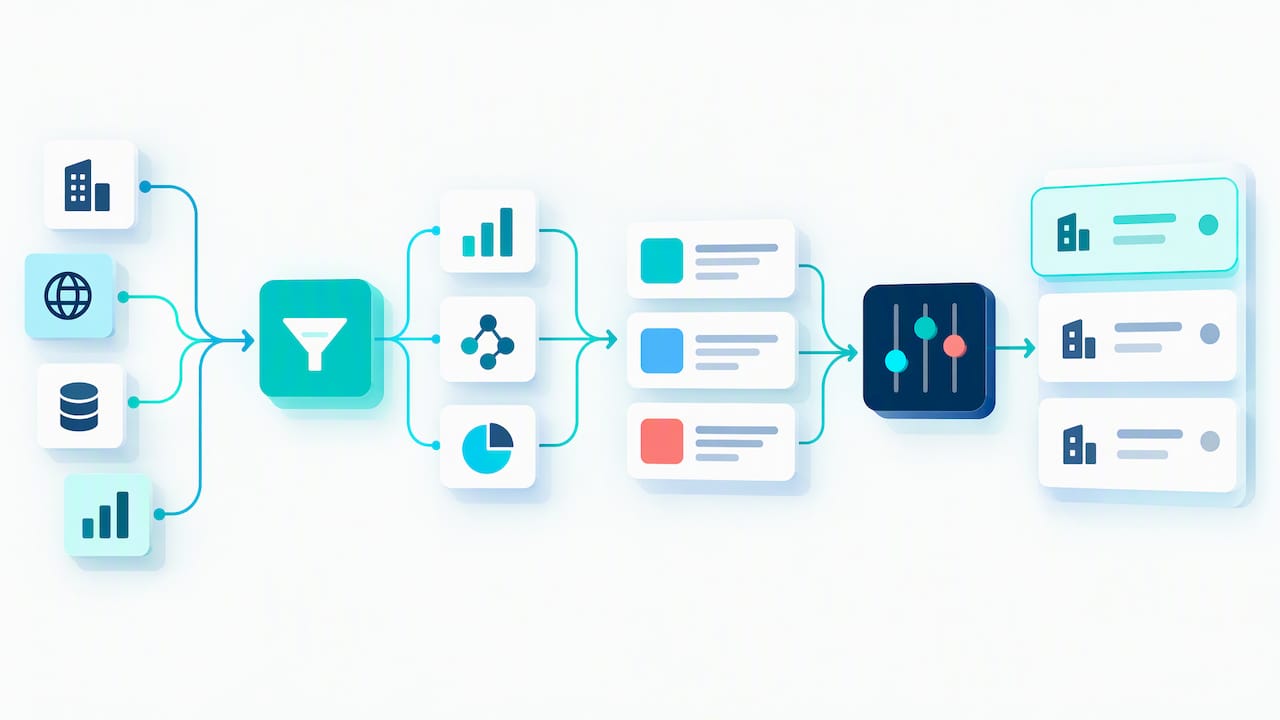
That is why we built Crono as a sales execution layer rather than another system of record. It connects your CRM and sales tools so buying signals, enrichment, workflow automation, AI agents and multichannel outreach sit in one place, and so people and agents work from the same priorities. Our view is that a framework should answer three questions every morning for every rep: which accounts, which contacts, which next action.
Three principles guide how we advise teams:
- Separate fit from timing. A blended score hides the reason an account is ranked where it is, and reps stop trusting what they cannot explain.
- Make tiers change behavior. If Tier 1 and Tier 3 get the same sequence, you have a label, not a framework.
- Keep the loop short. Feed outcomes back into the weights every quarter. The accounts that actually became pipeline are your best teacher.
— Alex
Putting the framework to work with Crono
If you want the ranking to drive daily execution, Crono combines signals, enrichment, outreach across LinkedIn, email and calls, and AI-driven personalization on top of the CRM you already use. Plans are priced per user: Pro starts at €79 per seat per month and Ultra at €119 per seat per month, with Enterprise available on request. Usage-based AI and enrichment work runs on credits, and the Agentic Sales Engine starts at €99 per month for 10,000 credits. See current details on the pricing page or explore the Agents Hub.
For a deeper look at what a connected outbound setup looks like, read our guide to the outbound sales tech stack for mid-market teams.
Measuring whether your framework works
Track outcomes by tier, not just overall. These five metrics tell you if the ranking is predictive:
- Meeting rate by tier. Tier 1 should convert to meetings at a clearly higher rate than Tier 3. If not, your timing signals are weak.
- Win rate and cycle length by tier. High-fit accounts should close more often and faster.
- Average deal size by tier. Confirms whether fit weights reflect value.
- Retention and expansion by original tier. The best test of whether fit predicts long-term success.
- Rep adherence. Share of outreach time spent on Tier 1 and 2. A great model that reps ignore delivers nothing.
When the numbers disagree with the model, change the model. Our guide on a pipeline coverage formula helps you check whether the tiers give you enough pipeline for the target.
FAQ
How do you prioritize accounts in sales?
Define an ICP, score each account for fit and timing separately, and place accounts into tiers with a different level of effort per tier. Give your best-fit, high-signal accounts the most personalized, multichannel attention. Review the ranking every quarter.
What is an account prioritization matrix?
It is a grid that plots accounts by two dimensions, usually fit on one axis and timing or intent on the other. The four quadrants map to four motions: act now, build, qualify carefully and park. It is popular because it is easy to explain and easy to audit.
How many tiers should I use?
Three or four is enough for most teams. More tiers create debates over edge cases without changing what reps do. If two tiers receive the same treatment, merge them.
How often should I update account scores?
Refresh timing signals continuously or weekly, and review the fit model and weights quarterly. That matches the guidance that ICP and scoring work as living processes tied to current market potential.
Sources
- The Framework for Ideal Customer Profile Development, Gartner
- How to Choose the Right Accounts for ABM, HubSpot
- ABM Won, But It’s Not Done Changing The Game, Forrester
- How to Use Purchase Intent Data to Score Leads, Gartner
- Position Sales Teams to Grow Accounts, Not Just Retain Them, Gartner
