
An AI GTM platform is a unified system that uses artificial intelligence to automate and orchestrate the entire go-to-market process for B2B companies.
The industry term for this category is “AI-powered GTM orchestration,” and it covers everything from pipeline intelligence to multichannel sales execution.
These platforms solve GTM bloat by replacing disconnected sales, marketing, ops, and finance tools with one intelligent operating layer. For sales leaders and revenue strategists, the result is faster execution, tighter cross-functional alignment, and measurable revenue impact.
What does an AI GTM platform actually do?
An AI GTM platform replaces fragmented point solutions with a single system that connects every function involved in revenue generation. Sales, marketing, operations, and finance all operate from the same data layer, the same workflows, and the same performance signals. This is not a CRM add-on or a reporting dashboard. It is the execution layer that sits above your existing tools and coordinates them.
The core problem these platforms address is well documented. GTM bloat occurs when teams stack too many disconnected tools, each with its own data model and workflow logic. The result is slow execution, misaligned teams, and revenue leakage at every handoff. An AI GTM platform eliminates those handoffs by making the entire motion continuous and AI-coordinated.
Crono is built on this principle. Rather than replacing your CRM, Crono connects your existing tools into a unified execution platform where AI agents and sales reps work together. Buying signals, data enrichment, workflow automation, and multichannel engagement all run through one system, giving revenue teams a single source of truth for every decision.

How AI GTM platforms unify and automate go-to-market workflows
The functional core of any go-to-market AI solution is its multi-agent architecture. Multi-agent AI systems assign specialized AI agents to distinct tasks: audience research, campaign planning, creative writing, compliance review, A/B testing, and attribution analysis. Each agent handles its domain autonomously, then passes outputs to the next agent in the sequence. The result is a fully coordinated campaign motion that runs without manual handoffs.
Workflow automation in these platforms goes beyond simple triggers and sequences. The best systems codify your best practices into reusable playbooks that execute across every rep and every account. AI-driven CRM enrichment keeps contact and account data current without manual updates. Deal coaching surfaces the right talk tracks and objection responses at the right moment in each opportunity.
Key capabilities you should expect from a mature AI GTM platform:
- Multi-agent AI crews that handle research, planning, writing, review, and analytics in parallel
- Workflow builders that encode sales and marketing best practices into automated sequences
- CRM enrichment that updates records automatically based on engagement signals and external data
- Deal coaching that delivers real-time guidance based on deal stage, persona, and conversation history
- Forecasting that uses pipeline signals to project revenue with greater accuracy than spreadsheet models
- Multichannel execution across email, LinkedIn, phone, and in-app channels from a single interface
Pro Tip: Avoid stacking a workflow automation tool on top of a separate AI writing tool on top of a separate analytics platform. Each integration point is a failure point. Evaluate platforms on whether their AI agents share a common data model natively, not through third-party connectors.
For a practical look at how these agent frameworks operate in real sales environments, the agentic sales execution examples from Crono’s academy show how B2B teams structure multi-agent workflows end to end.
What technology separates AI-native GTM platforms from legacy tools?
The architectural difference between a true AI GTM platform and a legacy BI tool with AI features added on top comes down to how data moves through the system. Legacy tools batch-process data on a schedule. AI-native platforms use event-driven data models that update instantly when CRM records change, deals move stages, or engagement signals fire.
Bi-temporal data architectures capture both the “value” of a data point and the “as-of date” when it was recorded. This means you can analyze pipeline health as it stands today and as it stood at any point in the past, without latency or data drift. That capability is foundational for accurate weekly Demand Council reviews and retrospective win/loss analysis.
Event-driven models enable real-time Account Quality Index scores and pipeline coverage updates. Cross-functional teams stop arguing about whose numbers are right because every function reads from the same live data layer. Decision speed increases because the data is always current.
| Capability | Legacy BI + AI Add-On | AI-Native GTM Platform |
|---|---|---|
| Data refresh | Batch (daily or weekly) | Event-driven (real-time) |
| Workflow logic | Rule-based, manually maintained | Goal-based, autonomously managed |
| Agent coordination | None or single-model | Multi-agent crews with specialized roles |
| CRM enrichment | Manual or scheduled sync | Continuous, signal-triggered updates |
| Retrospective analytics | Limited by data snapshots | Bi-temporal, full historical accuracy |
| Integration layer | Point-to-point connectors | Unified API layer across the full stack |
Pro Tip: When evaluating platforms, ask vendors specifically whether their data model is bi-temporal and whether workflow logic is goal-based or rule-based. Rule-based systems require constant manual maintenance as your GTM motion evolves. Goal-based systems adapt automatically.
Continuous experimentation is another differentiator. AI-native platforms run ongoing tests across workflow variants, creative elements, and audience segments simultaneously. Winning paths surface weekly rather than quarterly. That cadence compounds over time into a significant performance advantage.
For teams building an AI-driven brand strategy alongside their GTM motion, the same event-driven architecture that powers pipeline intelligence also maintains brand consistency across every AI-generated touchpoint.
How do AI GTM platforms improve sales execution and revenue outcomes?
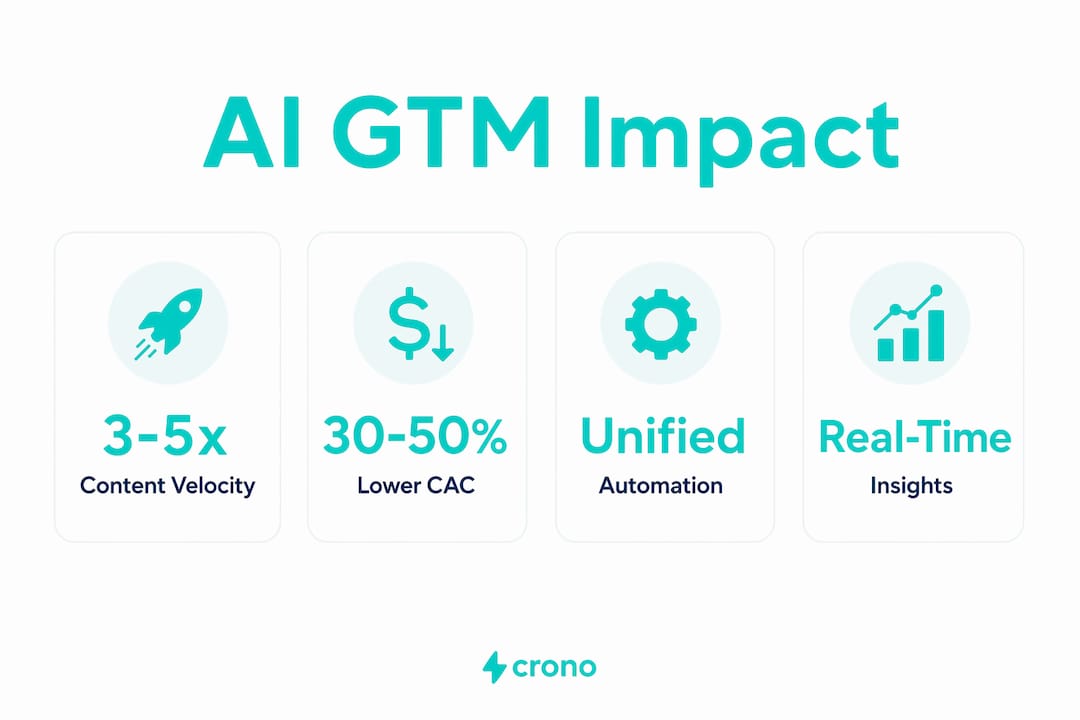
The performance impact of AI-powered GTM orchestration is measurable and fast. Multi-agent AI marketing systems increase content velocity by 3–5× and reduce Customer Acquisition Cost by 30–50% within 6–12 weeks of implementation. That is not a long-term projection. It is an outcome that shows up in the first quarter after deployment.
Content velocity matters because modern B2B buying involves multiple stakeholders across long cycles. Your team needs personalized assets for every persona, every stage, and every channel. AI agents produce that volume without proportional headcount increases. CAC reduction follows because AI-optimized campaigns waste less spend on the wrong audiences and the wrong messages.
Most marketing teams spend 60–70% of their time on execution tasks that AI platforms can handle. Freeing that capacity shifts your team’s focus from manual execution to growth strategy and creative direction. That shift compounds: better strategy produces better campaigns, which produce better data, which trains better AI models.
The revenue impact extends across every function:
- CMOs get real-time campaign performance data tied directly to pipeline contribution, not vanity metrics
- CROs get accurate forecasts based on live pipeline signals rather than rep-reported estimates
- CFOs get budget allocation recommendations driven by attribution data, not gut feel
- Sales reps get AI-coached deal guidance that surfaces the right move at the right moment
For teams running account-based marketing programs, AI GTM platforms automate the research, personalization, and sequencing that ABM requires at scale. Paid media optimization runs continuously rather than in monthly review cycles. Lifecycle marketing triggers fire based on behavioral signals rather than calendar schedules.
The shift from manual to AI-driven outbound is already reshaping how B2B revenue teams structure their sales engagement. Teams that adopt AI GTM orchestration now build a compounding execution advantage over those still running manual sequences.
What are the best practices for adopting an AI GTM platform in B2B?
Adoption success depends on architecture alignment before you configure a single workflow. Your AI GTM platform must connect cleanly to your existing CRM and data ecosystem. If your CRM data is inconsistent or incomplete, the AI agents will amplify those problems rather than solve them. Data hygiene is a prerequisite, not an afterthought.
Goal-based automation outperforms rule-based automation in every dimension that matters for GTM teams. Rule-based systems break when your process changes. Goal-based systems adapt because they optimize toward outcomes, not steps. When evaluating platforms, prioritize those that let you define growth objectives and let the AI map the execution path.
Organizational readiness is the factor most teams underestimate. AI GTM platforms require sales, marketing, and ops to share data and agree on definitions. Pipeline stage definitions, lead scoring criteria, and attribution models must be standardized before the platform can produce reliable outputs. Cross-team alignment on these definitions is the real implementation work.
In-flow AI operation is a practical adoption accelerator. Platforms that execute AI tasks inside tools your team already uses, such as Slack, email, or your CRM interface, see faster adoption than those requiring reps to log into a separate dashboard. Reduce friction at every touchpoint.
Follow these steps to accelerate Time to Value:
- Audit your current tool stack and identify the three highest-friction handoffs between sales and marketing
- Standardize your data definitions across CRM stages, lead scoring, and attribution before onboarding
- Start with one high-volume workflow such as outbound sequencing or content personalization, and measure results before expanding
- Configure goal-based logic rather than replicating your existing rule-based sequences inside the new platform
- Embed AI agents in existing channels so reps interact with AI inside their current workflow, not a new one
- Review performance weekly using the platform’s event-driven data to catch issues before they compound
For a detailed deployment framework, Crono’s guide on deploying AI sales agents covers the sequencing decisions that determine whether adoption accelerates or stalls.
Pairing your GTM platform adoption with a strategic AI marketing plan helps align organic growth initiatives with the automated execution your new platform enables.
Key Takeaways
An AI GTM platform delivers measurable revenue impact only when it operates as a unified execution layer, not as another point solution added to an already fragmented stack.
| Point | Details |
|---|---|
| Unified operating layer | AI GTM platforms replace fragmented tools by connecting sales, marketing, ops, and finance into one system. |
| Multi-agent architecture | Specialized AI agents handle research, planning, writing, review, and analytics autonomously and in parallel. |
| Event-driven data models | Real-time data updates eliminate batch-refresh delays and give every function a single source of truth. |
| Measurable performance gains | Multi-agent systems deliver 3–5× content velocity and 30–50% CAC reduction within 6–12 weeks. |
| Goal-based logic wins | Platforms using goal-based automation adapt to process changes; rule-based systems require constant manual updates. |
The part most B2B leaders get wrong about AI GTM
The most common mistake I see revenue leaders make is treating an AI GTM platform as a faster version of what they already have. They migrate their existing rule-based sequences into the new platform, configure the same manual approval gates, and then wonder why results are marginal. The platform is not the problem. The logic they imported is.
The real shift is from orchestrating tasks to defining outcomes. When you tell an AI system “generate $2M in pipeline from mid-market SaaS accounts this quarter,” and give it access to your CRM, your content library, and your channel integrations, it maps the execution path autonomously. That is categorically different from building a 12-step email sequence and calling it automation.
The second thing leaders underestimate is the data readiness requirement. I have seen implementations stall for months because the CRM had three different definitions of “qualified lead” across three sales regions. The AI cannot optimize toward a goal it cannot measure consistently. Fixing data definitions is not glamorous work, but it is the work that determines whether your AI GTM investment pays off in one quarter or one year.
The teams winning with AI GTM orchestration right now are not the ones with the most sophisticated tech stacks. They are the ones who standardized their data, defined clear revenue goals, and let the AI own the execution path. That combination produces compounding returns that manual GTM motions simply cannot match.
— Alex
How Crono fits into your AI GTM strategy
Crono is built for sales leaders who need AI-driven execution without replacing the tools their teams already use.
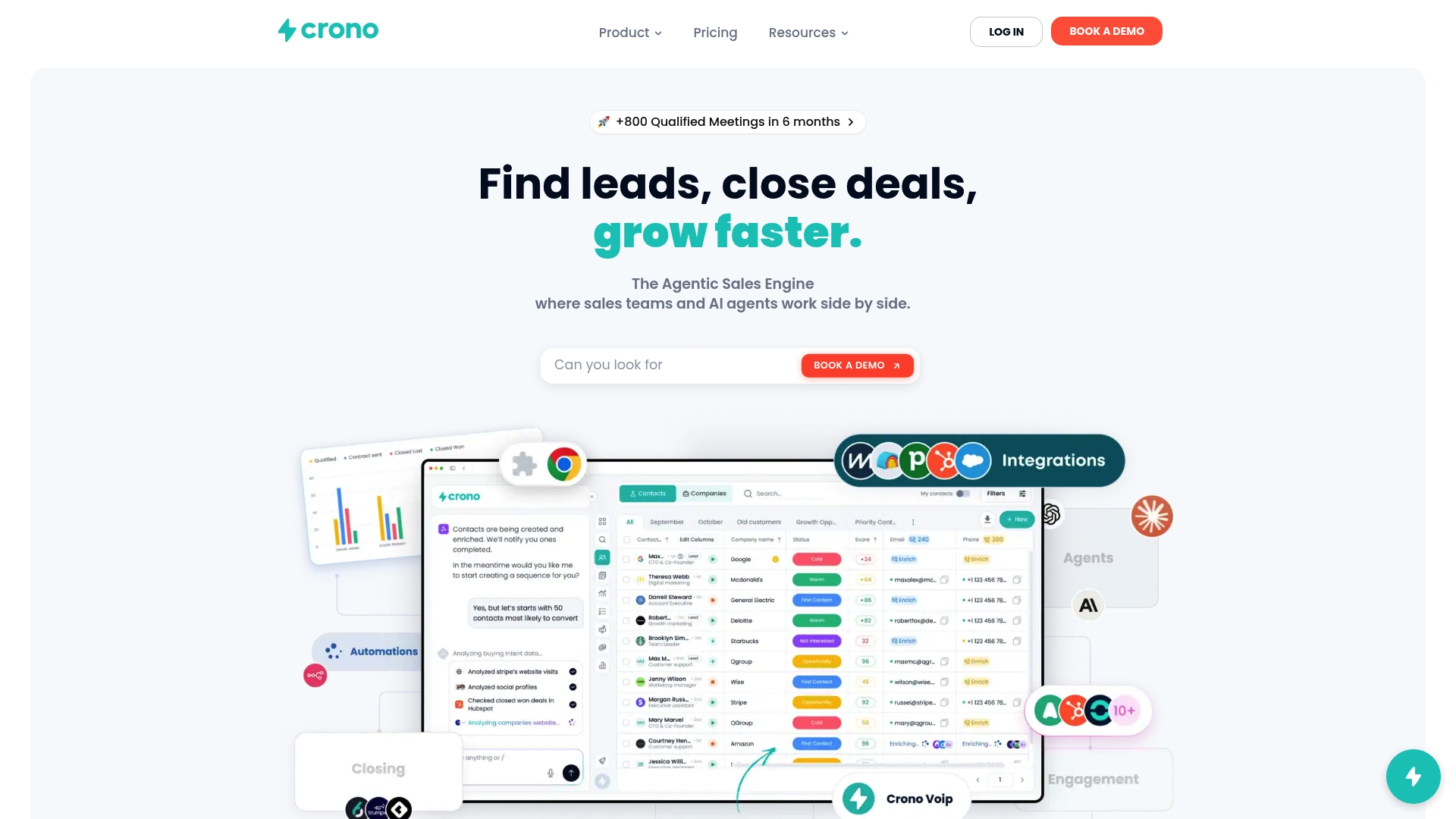
Crono connects your CRM, enrichment sources, and engagement channels into one platform where AI agents and reps work together. Buying signals trigger automated sequences. Data enrichment keeps every record current. Multichannel outreach runs across email, LinkedIn, and phone from a single workflow. For revenue teams ready to move from fragmented execution to coordinated GTM motion, Crono’s B2B sales techniques masterclass and the Crono for Sales Leaders page show exactly how the platform supports every stage of your revenue motion.
FAQ
What is an AI GTM platform?
An AI GTM platform is a unified system that uses artificial intelligence to automate and coordinate the entire go-to-market process, connecting sales, marketing, operations, and finance into one execution layer.
How is an AI GTM platform different from a CRM?
A CRM stores and tracks customer data. An AI GTM platform uses that data to autonomously execute workflows, coach deals, enrich records, and optimize campaigns across every revenue function.
What results can B2B teams expect from AI GTM adoption?
Multi-agent AI marketing systems deliver 3–5× content velocity and 30–50% lower Customer Acquisition Cost within 6–12 weeks, according to documented implementation outcomes.
What is the biggest risk when implementing an AI GTM platform?
Inconsistent CRM data and rule-based workflow logic are the two most common failure points. Standardizing data definitions and switching to goal-based automation before full deployment reduces both risks significantly.
How does AI GTM orchestration improve cross-functional alignment?
Event-driven data models give sales, marketing, and finance a shared real-time view of pipeline health and campaign performance, eliminating the data discrepancies that cause cross-functional friction.
