
AI in B2B revenue teams is defined as the systematic use of artificial intelligence to automate sales workflows, enrich pipeline data, and coordinate cross-functional go-to-market execution. 87% of sales organizations now use AI, and daily AI users are twice as likely to exceed their targets. That gap between adopters and non-adopters is widening fast.
The industry term for the most advanced form of this integration is AI-driven revenue acceleration, and it goes well beyond chatbots or auto-generated email copy. It means AI working as an execution layer across your entire revenue motion.
What is the role of AI in b2b revenue teams?
The core role of AI in B2B revenue teams is to reclaim selling time and redirect it toward high-value human activities. 64% of sales professionals save 1–5 hours weekly on manual tasks like meeting summaries and CRM updates using AI. Those recovered hours compound quickly across a team of 20 or 50 reps.
The operational applications break down into three distinct categories:
- Task automation: AI handles meeting notes, CRM data entry, follow-up scheduling, and activity logging. Reps stop doing administrative work and start selling.
- Predictive intelligence: AI-driven predictive lead scoring analyzes hundreds of variables to surface the accounts most likely to convert. RevOps teams use this to reduce forecast bias and catch at-risk deals before they slip.
- Personalized outreach at scale: AI pulls intent signals, firmographic data, and engagement history to generate context-aware outreach. The result is messaging that feels researched, not templated.
The business impact is measurable. One B2B SaaS case documented through Fullcast showed a 215% rise in qualified leads after deploying agentic AI across their revenue operations. That is not a marginal efficiency gain. It is a structural shift in pipeline capacity.
Pro Tip: Track where your reps spend the hours AI recovers. Without intentional reallocation, those hours drift toward internal meetings and admin, not selling.
How does agentic AI orchestration redefine revenue operations?
Agentic AI is defined as a system of autonomous AI agents that take actions, make decisions, and coordinate workflows without requiring human input at every step. This is the concept behind what practitioners now call agentic GTM. Agentic GTM involves autonomous AI agents coordinating real-time workflows across sales, marketing, customer success, and RevOps simultaneously.

The practical difference between standard AI tools and agentic AI orchestration is significant. Here is how they compare:
| Capability | Disconnected AI Tools | Agentic AI Orchestration |
|---|---|---|
| Data sharing | Siloed by function | Real-time signal sharing across GTM |
| Workflow coordination | Manual handoffs between teams | Automated, cross-functional execution |
| Account prioritization | Each team uses its own scoring | Unified prioritization across all functions |
| Pipeline accuracy | Dependent on rep input | Continuously updated by AI agents |
| Response to intent signals | Delayed, often missed | Immediate, triggered automatically |
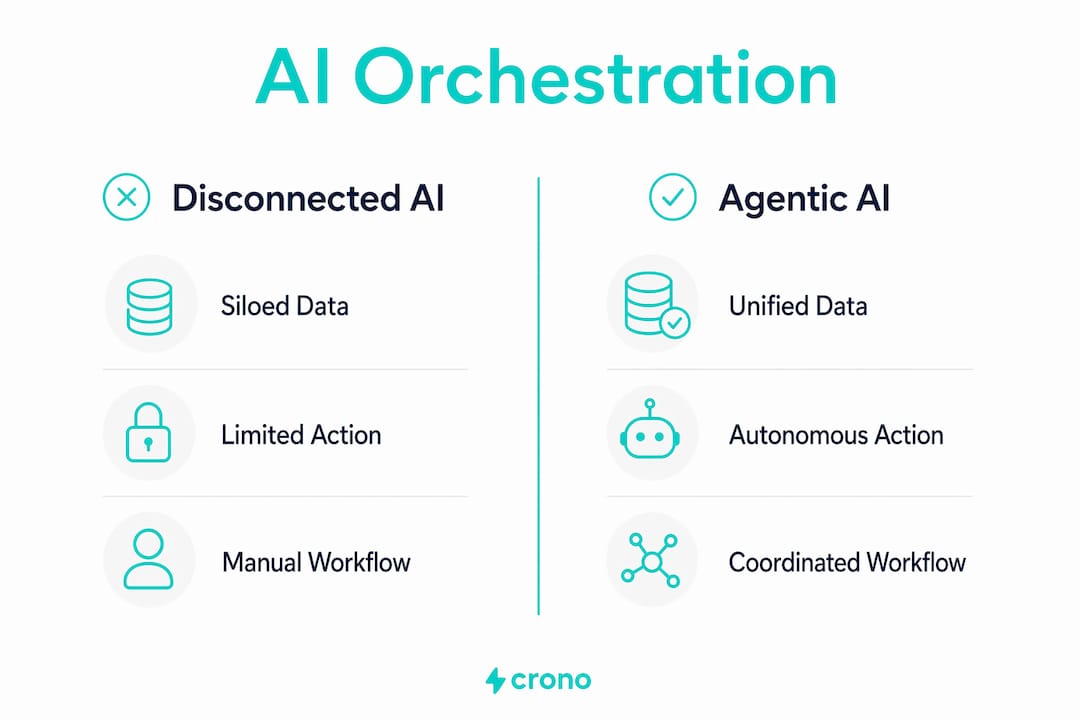
The distinction matters because most B2B organizations have already deployed AI in some form. The problem is that those tools operate in isolation. Marketing automation does not talk to the CRM. The CRM does not feed the outbound sequencer. RevOps builds reports from stale data. Agentic orchestration solves this by treating AI as integrated infrastructure rather than disconnected tools, which is the foundation for sustained compound growth.
75% of B2B sales organizations will use AI-guided selling solutions by 2026, shifting from volume-based to insight-based sales motions. That shift improves customer acquisition cost and forecast accuracy at the same time. Organizations that deploy agentic AI now are building a structural advantage that will be very difficult for late adopters to close.
How is revenue leadership changing because of AI?
Revenue leadership is evolving from functional management toward what researchers at The AI Hat describe as architecting autonomous AI-driven revenue engines. The title shift from Chief AI Officer to Chief AI Agent Officer reflects a real change in responsibility. Leaders are no longer just buying tools. They are governing fleets of AI agents.
Governance-by-design is now essential for maintaining trust and compliance in AI-powered decision-making. The three principles every revenue leader should build into their AI programs are:
- Explainability: Your team and your customers need to understand why AI made a recommendation. Black-box scoring models create compliance risk and erode rep trust.
- Responsibility: Someone on your leadership team must own each AI deployment. Diffuse ownership leads to fragmented, experimental rollouts that never scale.
- Transparency: Buyers increasingly ask how their data is used. Revenue leaders who cannot answer that question clearly will lose deals to competitors who can.
The risk of ignoring governance is not theoretical. Organizations that treat AI as a series of disconnected experiments end up with tool sprawl, inconsistent data quality, and reps who distrust the outputs. Coordinated AI agents require modular architectures and interoperability standards to function as a coherent fleet. Without that foundation, you are not running an AI-powered revenue team. You are running a team with a lot of AI subscriptions.
Pro Tip: Assign a named owner to every AI deployment in your stack. If no one is accountable for the output quality of a specific agent or tool, the output quality will degrade.
The human element does not disappear in this model. AI does not replace top sales talent. It amplifies existing good habits. Human judgment remains critical for complex negotiations and building trust with multi-stakeholder buying committees. The best revenue leaders understand this distinction and design their AI programs around it.
How can b2b organizations embed AI to maximize revenue impact?
Embedding AI effectively requires a measurement framework, not just a technology purchase. Here is a practical sequence for getting it right:
- Measure reclaimed time first. Identify which tasks AI is automating and calculate the hours recovered per rep per week. This is your baseline for everything else.
- Redirect those hours explicitly. Assign the recovered time to specific activities: more discovery calls, deeper account research, or relationship-building with key stakeholders. The most successful teams redirect AI-recovered hours to relationship-building, which is the activity most critical for complex B2B sales.
- Track revenue per rep as your primary KPI. Cost savings are a secondary benefit. The primary measure of AI success is whether your reps are generating more revenue per head. If that number is not moving, your AI deployment is not working.
- Avoid the cost-cutting trap. Organizations that deploy AI primarily to reduce headcount miss the compounding upside. AI used as a force multiplier on a strong team produces far better returns than AI used to justify smaller teams.
- Align your culture before your technology. Reps who distrust AI outputs will ignore them. Run enablement sessions that show reps how AI recommendations are generated. Transparency builds adoption.
AI-driven predictive lead scoring and hyper-personalization lower customer acquisition cost and improve conversion by focusing outreach on the highest-propensity accounts. That is the force-multiplier effect in practice. You are not asking reps to work harder. You are giving them a shorter list of better targets and better context for every conversation. Explore how AI tools for prospecting can sharpen that targeting further.
Key takeaways
AI in B2B revenue teams delivers its greatest impact when deployed as integrated infrastructure, not as isolated tools, with clear governance and explicit measurement of how recovered time is reallocated.
| Point | Details |
|---|---|
| AI recovers selling time | 64% of sales professionals save 1–5 hours weekly on manual tasks using AI. |
| Agentic AI multiplies pipeline | Coordinated AI agents across GTM functions drove a 215% rise in qualified leads in documented B2B SaaS cases. |
| Governance is non-negotiable | Revenue leaders must build explainability, responsibility, and transparency into every AI deployment. |
| Measure revenue per rep | Track revenue per rep, not just cost savings, to confirm AI is functioning as a force multiplier. |
| Human judgment stays central | AI amplifies strong sales habits but cannot replace human trust-building in complex, multi-stakeholder deals. |
Where i think most revenue teams get this wrong
The organizations I see struggling with AI adoption share one common pattern: they buy tools before they define outcomes. They deploy an AI sequencer, an AI scoring model, and an AI meeting assistant, and then six months later they cannot tell you whether any of it moved the revenue number. That is not an AI problem. It is a measurement problem.
The teams that get it right start with a single question: what would we do with five more hours per rep per week? If you cannot answer that question specifically, you are not ready to deploy AI at scale. The technology will give you the time. You have to know what to do with it.
The other thing I have seen consistently is that the best AI deployments are invisible to the buyer. The rep shows up more prepared. The follow-up arrives faster. The proposal is more relevant. The buyer never knows AI was involved. That is the standard worth aiming for. AI should make your reps look better, not make your process feel automated.
The future of AI in B2B sales belongs to teams that treat it as infrastructure, not as a feature. The companies building that infrastructure now will have compounding advantages in pipeline quality, rep productivity, and forecast accuracy that will be very hard to replicate in two or three years.
How Crono puts this into practice for b2b revenue teams
Crono is built specifically for the model described in this article. It acts as the execution layer between signals, data, context, and revenue, combining AI agents, sales orchestration, workflow automation, data enrichment, and multichannel engagement in a single platform.
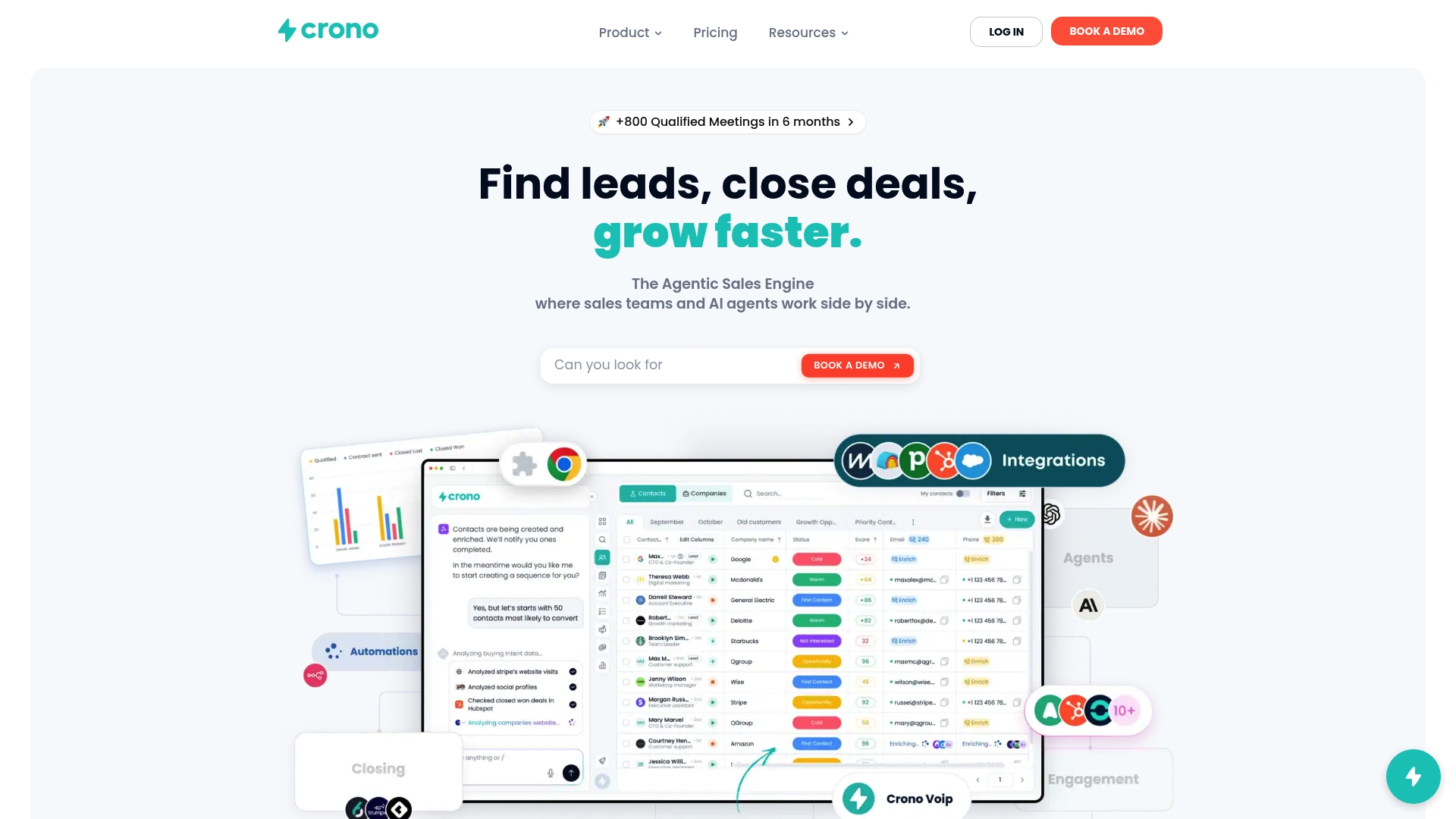
Crono’s AI Sales Agents handle the operational work that slows your reps down, from CRM updates to outreach sequencing, so your team focuses on conversations that close deals. AI Custom Fields automatically enrich contact and account records with the context reps need before every call. If you are ready to move from disconnected AI tools to a coordinated revenue engine, Crono is where that build starts.
FAQ
What is the role of AI in b2b revenue teams?
AI in B2B revenue teams automates manual tasks, scores and prioritizes leads, and coordinates cross-functional workflows to increase selling time and conversion rates. The most advanced form is agentic AI, where autonomous agents execute and coordinate across sales, marketing, and RevOps simultaneously.
What is agentic AI for revenue teams?
Agentic AI for revenue teams refers to autonomous AI agents that take actions and coordinate workflows across GTM functions without requiring human input at every step. This enables real-time signal sharing, unified account prioritization, and continuous pipeline updates.
Why do b2b revenue teams need AI automation?
B2B revenue teams need automation because manual tasks consume hours that should go toward selling. 64% of sales professionals save 1–5 hours weekly using AI for summaries and CRM updates, and daily AI users are twice as likely to exceed their targets.
How should revenue leaders govern AI deployments?
Revenue leaders should govern AI deployments around three principles: explainability, responsibility, and transparency. Each deployment needs a named owner, a clear logic for how recommendations are generated, and documented policies on how buyer data is used.
How do you measure AI success in a b2b sales team?
The primary measure of AI success is revenue per rep, not cost savings. Track how many hours AI recovers weekly, confirm those hours are redirected to selling activities, and monitor whether pipeline conversion rates and quota attainment improve over time.
Recommended
Not sure where to start?
Start with the Playbook.
Download our free Sales Playbook 2026 and learn how top B2B teams structure their outbound process.
 BANT, SPICED & MEDDPICC frameworks
- 30+ ready-to-use sales templates
- 2026 outbound & pipeline benchmarks
Don't sell the product. Sell the change the product makes possible.
Build the process before the pipeline.
