
AI meaningfully improves 30 to 90 day sales forecast accuracy, and it does so by producing revenue estimates and per-deal win probabilities that update as pipeline data changes.
That improvement only shows up if your CRM data is clean and someone owns the operational rollout. The fastest way to find out if it works for your team is a focused pilot, not a company-wide rollout.
Table of Contents
- What Is AI Sales Forecasting and What Should You Expect From It?
- How Do the Main AI Forecasting Methods Actually Work?
- Where Does AI Sales Forecasting Deliver the Most Value First?
- What Should You Fix Before You Build a Model?
- How Do You Know If Your Forecasting Model Actually Works?
- What Trips Up Most AI Forecasting Rollouts?
- What Are the Data Privacy and Compliance Considerations?
- How Do External Market Factors Affect Forecast Accuracy?
- How Should Rep Judgment Factor Into an AI Forecast?
- A Pilotable Path: The Six Step Fix and 90 Day Pilot
- Your Next 90 Days, Mapped Out
- Turn Forecasting Signals Into Action With specialized platforms
- Sources
What Is AI Sales Forecasting and What Should You Expect From It?
AI sales forecasting combines your CRM’s pipeline data, rep activity signals, and sometimes external market data to generate probabilistic predictions instead of a single gut-check number. AI models look at hundreds of similar deals and calculate that probability from patterns your team can’t manually track, then recalculate it every time new data lands.
That recalculation is the real advantage. Manual forecasts get updated once a week during pipeline review. AI models can pull live CRM data and update predictions continuously, which matters most on short horizons where a single lost champion or a stalled email thread changes the outlook fast.
Revenue teams running AI forecasting typically get three outputs:
- Expected revenue for a rolling 30, 60, or 90 day window, broken out by segment or rep.
- Win probability scores per deal, updated as new activity or CRM fields change.
- Pipeline health signals that flag deals with slowing activity, missing next steps, or unusual stage duration.
None of that replaces a forecast call. It gives the person running that call a sharper starting point.
How Do the Main AI Forecasting Methods Actually Work?
Most AI sales forecasting systems lean on one of four model families, and picking the wrong one for your data is the single most common reason pilots underperform.
Time-series models (ARIMA, exponential smoothing, seasonal naive) work off historical revenue or booking patterns alone. They’re fast to build and still competitive at the aggregate level, especially for quarter-over-quarter revenue trends with clear seasonality. They struggle the moment you need deal-level detail.
Supervised tabular models, especially gradient-boosted tree ensembles like XGBoost and LightGBM, are the workhorse for B2B pipeline forecasting. They handle the messy mix of CRM fields, engineered features, and categorical data that pipeline forecasting actually involves. Practitioner guidance is direct on this point: tree ensembles built on engineered lag and rolling features outperform deep learning for most B2B use cases, because deep learning only earns its complexity with very large, rich datasets and strong exogenous signals.
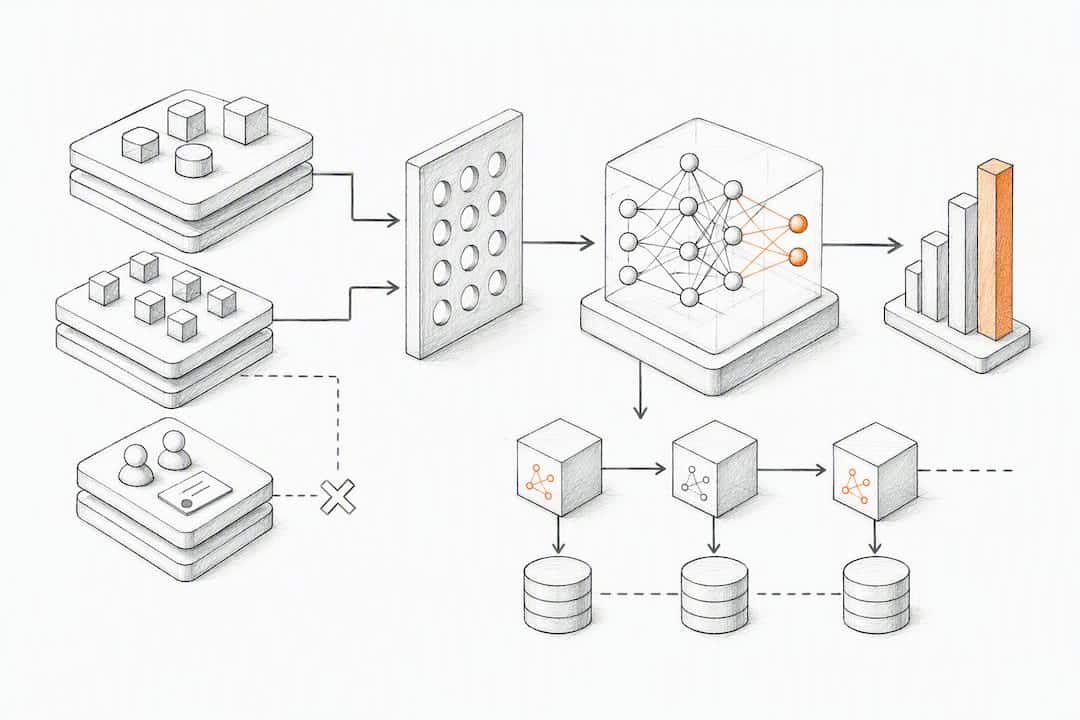
Propensity and classification models predict per-deal win likelihood rather than aggregate revenue. A generalized machine-learning workflow for B2B forecasting uses feature enhancement plus ensemble classifiers to output a win-likelihood score and a decision threshold, run through a training pipeline and a separate live prediction pipeline.
Hybrid architectures combine decomposition, sequence models, and exponential smoothing. One study found a hybrid STL-DCSInformer-ETS model cut forecasting error substantially on FMCG data, but only because that dataset had rich exogenous variables available at prediction time.
Benchmark to know: most B2B pipeline forecasts land in the 10 to 20% MAPE range once tuned. Retail and CPG forecasts can go lower when richer external data is available. If a vendor promises single-digit error on your first pipeline model, be skeptical.
Exogenous signals (market indices, hiring data, funding announcements) can sharpen a model, but they also add fragility. If a feature isn’t reliably available at prediction time, it breaks the model in production even if it tested well historically.
Where Does AI Sales Forecasting Deliver the Most Value First?
Not every use case deserves equal attention in year one. Prioritize based on where bad forecasts currently cost you the most.
- Forecast accuracy and bias correction. Sales teams chronically over-forecast, especially late in the quarter when optimism creeps in. AI models trained on historical close rates correct that bias mechanically, because they don’t care how confident a rep sounds in a pipeline review.
- Pipeline prioritization. Win-probability scores let managers sort a 200-deal pipeline by which 15 deals actually need attention this week, instead of reviewing everything equally.
- Quota attainment forecasting. Aggregating deal-level probabilities up to the rep level gives you an early read on who’s tracking to quota and who needs pipeline help before the quarter ends, not after.
- Churn and renewal risk flags. The same activity-decay signals that flag a stalling new-logo deal also flag an at-risk renewal, often weeks before a rep notices the account has gone quiet.
- Territory and resource planning. Aggregated forecasts by segment or region inform where to add headcount or shift enablement spend before the next planning cycle, not during it.
A manager who sees a deal’s win probability drop 20 points after a champion goes quiet for two weeks can intervene immediately, rather than discovering the loss during a Friday pipeline call. That’s the practical difference between a forecast number and a forecast signal.
What Should You Fix Before You Build a Model?
Model quality is capped by data quality, and most pilots fail here, not at the modeling stage. Work through this sequence before you touch an algorithm.
- Audit your CRM fields. Confirm close dates, deal stages, deal amounts, and activity logs are populated consistently across reps. Inconsistent stage definitions between teams are one of the most common reasons a model underperforms, because contact decay and missing fields quietly corrupt training data.
- Set your minimum required fields. At a minimum you need deal stage, deal age, deal amount, close date, activity count, and a way to identify won versus lost outcomes.
- Decide your historical depth. You want at least 12 to 18 months of clean historical data to capture a full seasonal cycle, ideally 24 months if your sales cycle runs long.
- Start aggregated, not granular. Begin forecasting at a 30 to 90 day aggregated horizon across a segment or team, rather than jumping straight to rep-level or SKU-level predictions. Aggregation reduces variance and builds trust in the model before you add granularity.
- Connect live sync and enrichment. The model needs a live CRM feed, not a quarterly export, and enriched contact or firmographic data if you’re using exogenous features.
- Define your pilot scope and success metric up front. Pick one segment, one horizon, and one accuracy target before you start, so you know when the pilot succeeded.
Pro Tip: Run your CRM audit before you shop for a modeling approach. A clean dataset with a simple model beats a sophisticated model built on a messy one, every time.
How Do You Know If Your Forecasting Model Actually Works?
Every model needs a baseline before it earns a place in your workflow. Skipping this step is how teams end up trusting a model that isn’t actually better than what they had.
- Start with seasonal naive. Forecast next quarter using last year’s same quarter, adjusted for trend. It costs nothing to build and it’s the bar every model must clear.
- Set a real improvement threshold. If a more complex model can’t beat the seasonal naive baseline by at least 10%, the problem is usually your data, not your model choice. Fix the data before adding complexity.
- Use walk-forward validation. Train on data up to a point in time, test on the period immediately after, then roll the window forward. Random cross-validation leaks future information into training for any temporal dataset and will make your model look better than it is.
- Track MAE, MAPE or WAPE, and bias together. MAPE alone hides whether your model consistently over- or under-forecasts. Bias (average signed error) tells you which direction to correct.
- Check calibration, not just accuracy. If your model says a group of deals has a 70% win rate, roughly 70% of them should actually close. Calibration failures are common and easy to miss if you only look at aggregate error.
- Watch for drift. Retrain on a fixed cadence (monthly or quarterly, depending on deal velocity) and monitor for performance decay between retraining cycles.
What Trips Up Most AI Forecasting Rollouts?
Three failure modes account for most disappointing pilots, and all three are avoidable with the right guardrails.
- Garbage in, garbage out. A model trained on inconsistent stage definitions or sparse activity logs will confidently produce wrong numbers. No algorithm fixes bad inputs.
- Overfitting to a narrow window. A model tuned tightly on one quarter’s data often falls apart the moment market conditions shift, because it learned noise instead of pattern.
- Scope creep. Teams that try to forecast every segment, every rep, and every product line in the first pilot rarely finish any of it well.
The fix isn’t more modeling sophistication. It’s designing a workflow where AI probability scores support human decisions rather than replace them. Set a clear escalation rule: any deal where win probability drops more than a defined threshold in a week gets flagged for manager review, not silently adjusted in the forecast. Assign one owner for the forecast number itself, whether that’s RevOps or a sales ops lead, so accountability doesn’t disappear into “the model said so.” Roll out in stages, one segment at a time, and communicate to reps early that the model is a prioritization tool, not a performance scorecard. Teams that skip that communication step often see reps game the inputs the moment they realize activity counts feed a model.
What Are the Data Privacy and Compliance Considerations?
AI forecasting models run on customer and prospect data, which means privacy obligations follow the data wherever it goes, including into a machine-learning pipeline. If your CRM includes personal contact information for prospects in the EU or California, your forecasting model inherits the same handling obligations your CRM already carries under GDPR or the CCPA. Moving data into a third-party AI platform doesn’t reset that responsibility.
Three practical steps matter most. First, confirm your AI vendor’s data processing agreement covers the specific use case of predictive modeling, not just storage or enrichment. Second, limit the personal fields that actually flow into the model. A win-probability model rarely needs a prospect’s home address or personal email; deal-level and activity-level fields are usually sufficient. Third, keep an audit trail of what data trained which model version, since regulators and customers alike are increasingly asking companies to explain how automated predictions are generated.
There’s also an internal compliance angle leaders overlook: forecast data often includes commission-relevant information. If a model’s win-probability score influences quota credit disputes or compensation decisions, treat that model output with the same governance rigor as any other compensation input, including documentation of how it’s calculated and who can override it. Build this into your pilot scope from day one rather than retrofitting it after a dispute forces the question.
How Do External Market Factors Affect Forecast Accuracy?
No model, however well built, is immune to a shift in the market it was trained on. A forecasting model trained on 2024 and 2025 deal cycles reflects buying behavior from that period. If your average sales cycle lengthens because budget approval processes tighten across your buyer base, a model trained on faster cycles will systematically over-predict near-term close rates until it’s retrained on the new pattern.
This is exactly why walk-forward validation and a defined retraining cadence matter more for sales forecasting than for many other predictive use cases. Interest rate shifts, sector-specific budget freezes, and even a single major competitor’s pricing move can change close rates fast enough that a quarterly retrain cycle isn’t aggressive enough during volatile periods.
The practical response isn’t to build a model that predicts macro conditions. It’s to monitor forecast bias continuously so you catch drift early. If your model’s bias metric starts trending negative or positive for two consecutive cycles, that’s usually the market shifting under the model, not a modeling error. Treat it as a signal to retrain sooner and to loop in sales leadership on what’s changed in the buying environment, rather than assuming the algorithm needs a bigger dataset.
Seasonal and calendar effects deserve their own attention here too. Quarter-end closing spikes, fiscal-year-end budget flushes, and holiday-period slowdowns are predictable enough to encode as features, but they still need to be checked against the current year’s actual calendar, since fiscal year-ends and public holidays don’t always land on the same dates every year.
How Should Rep Judgment Factor Into an AI Forecast?
The best forecasting programs treat AI output as one input among several, not the final word. A rep who knows a champion just left the company, or that a signed order is stuck in procurement for reasons that have nothing to do with deal health, has information no model can see. Cutting that judgment out of the process to chase a purely automated number is a mistake most teams eventually walk back.
The practical structure that works is a weighted blend with a documented override process. Let the model set the default win probability for every deal. Give reps and managers a defined, logged mechanism to override that number, with a required reason field, whenever they have information the model doesn’t have access to. That override history becomes valuable training data over time, since it tells you exactly where the model’s blind spots are.
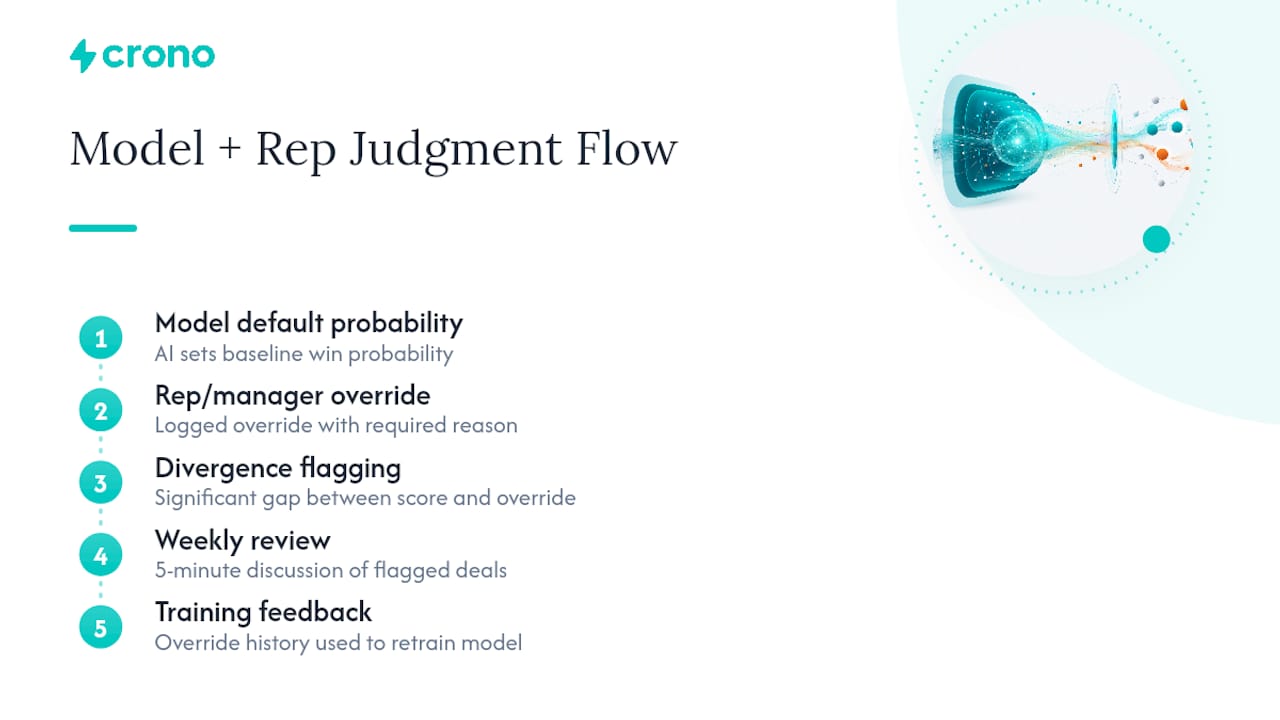
This also solves an adoption problem. Reps who feel a model is replacing their input tend to either ignore it or, worse, manipulate the activity data that feeds it. Reps who see their qualitative knowledge captured and weighted alongside the model’s output are far more likely to trust the combined number and act on it. Build a lightweight weekly ritual where flagged deals (those where rep judgment and model score diverge significantly) get a five-minute discussion in pipeline review. That single habit catches more forecast errors than any amount of additional model tuning.
A Pilotable Path: The Six Step Fix and 90 Day Pilot
The framework that holds together everything in this guide is simple: fix the data first, validate against a real baseline, then run a scoped 90-day pilot before committing further. Crono’s Six Step Fix and 90 Day Pilot structure walks CROs through exactly that sequence, with defined KPIs like MAPE reduction, bias correction, and the percentage of flagged deals actually reviewed by a manager.
What makes this workable in practice is that forecasting doesn’t happen in isolation from execution. Some platforms connect CRM data, enrichment, and workflow automation so that once a model flags a deal or a rep falls short of pace, the next action, whether that’s a follow-up sequence or a manager alert, happens automatically instead of getting lost in a spreadsheet. That’s the gap between a forecast number and forecast-driven action.
Your Next 90 Days, Mapped Out
Three actions matter more than anything else this quarter: audit your CRM fields for consistency, run a seasonal naive baseline before building anything fancier, and launch a scoped 90-day pilot in one segment. Track MAPE improvement against that baseline, forecast bias direction, and the share of flagged deals your managers actually review. Expect the first cycle to surface data problems you didn’t know you had. Fix those, retrain, and measure again.
Turn Forecasting Signals Into Action With specialized platforms
A forecast is only useful if it changes what your team does next. Some platforms are built to connect CRM, enrichment data, and outreach tools so that a flagged deal or a slipping quota pace triggers a prioritized action automatically, instead of sitting in a dashboard nobody checks between pipeline reviews.
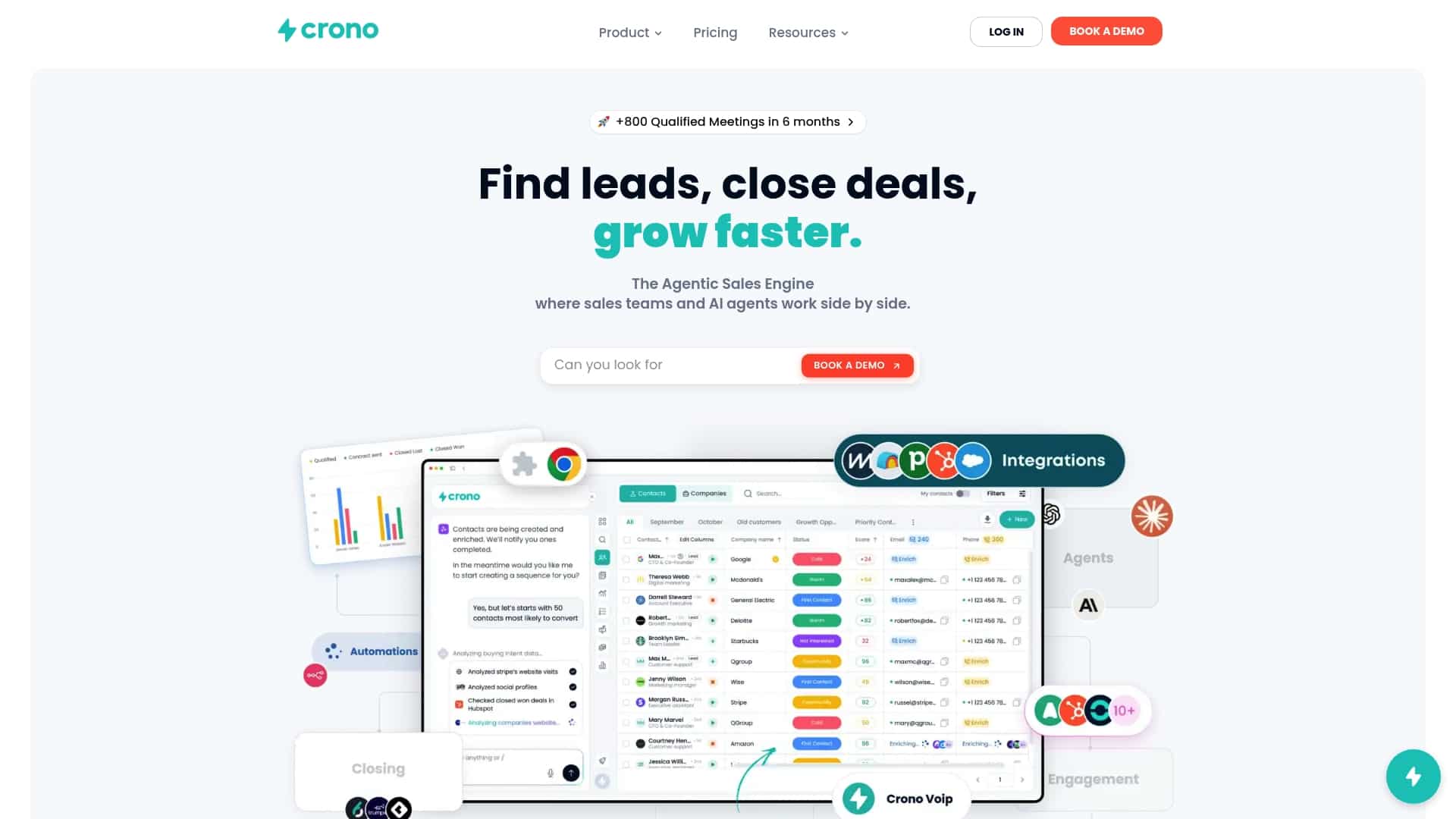
Where a standalone forecasting model tells you which deals are at risk, Crono’s sales orchestration layer routes that signal to the rep or manager who needs to act on it, using the same CRM data your forecast already depends on. If you’re running the CRM audit and pilot described here, pairing it with a platform that operationalizes those signals, rather than just displaying them, is how the accuracy gains actually show up in closed revenue. You can also work through Crono’s prospecting techniques resources to tighten the upstream activity data your forecast depends on, or explore how other teams have structured agentic sales execution around similar signals. For teams exploring adjacent AI applications, examples of AI driving measurable sales lift in eCommerce show the same signal-to-action principle at work in a different channel.
Start with a demo of the platform to see how your own CRM data would flow through it before you commit to a full rollout.
Sources
- Machine Learning sales forecasting: Practitioner’s Guide 2026 — Prospeo
- A Generalized Flow for B2B Sales Predictive Modeling: An Azure Machine-Learning Approach — MDPI
