
AI tools for sales coaching are defined as software platforms that combine conversation intelligence, automated call scoring, and rep workflow integration to deliver personalized, scalable performance development.
The top platforms in this category, including Nimitai, Salesforce Agentforce, Rafiki, AcePitch, and Degreed Maestro, move coaching from monthly manager reviews to continuous, data-driven feedback loops.
For sales leaders managing distributed teams, these tools are the difference between guessing why win rates stall and knowing exactly which skills to fix.
What makes the best AI tools for sales coaching work
The best AI sales coaching platforms share three foundational capabilities: conversation intelligence, hybrid call scoring, and deep CRM integration. Each one is necessary. None alone is sufficient.
Conversation intelligence covers call recording, transcription, and real-time analysis. The system listens to every rep call, not just the ones a manager happens to review. That shift from sampling to full coverage is what makes AI-driven sales performance possible at scale.

Hybrid call scoring is where most platforms differentiate. Stage-aware rubrics assign different evaluation criteria depending on whether a rep is in discovery, demo, or negotiation. Nimitai’s approach uses multiple rubric variants per sales stage, which prevents the systematic mis-scoring that happens when a single rubric judges every call the same way. Maintaining multiple rubric variants also reduces manager overrides, which is a strong signal of scoring accuracy.
Explainability is the feature sales managers undervalue until they need it. When a rep scores 62 out of 100, they need to know why. Evidence-backed feedback with direct transcript quotes builds trust in the system and makes coaching conversations specific rather than vague.
- Real-time streaming analysis during the call
- Post-call scoring delivered within minutes of completion
- Evidence quotes tied to each score dimension
- Audit sampling to detect and prevent model drift
- CRM-embedded score delivery to reduce context switching
Pro Tip: Before evaluating any AI coaching platform, map your current sales stages in your CRM. Tools that cannot read your stage definitions will produce noisy scores that managers ignore.
CRM integration determines adoption. AI reducing CRM update time from 30 to 10 minutes daily saves 100 minutes per rep each week. That time savings alone justifies the investment for most sales teams, before you count the coaching impact.
1. nimitai: hybrid call scoring with stage-aware rubrics
Nimitai is built specifically for sales quality assurance and coaching at scale. Its two-pass scoring design runs a streaming model during the call and a full post-call evaluation, with scores delivered within 5 minutes of call completion. That speed matters because feedback that arrives the next morning competes with the next day’s pipeline. Feedback that arrives in five minutes can change the next call.
The platform’s stage-aware rubric system is its clearest technical advantage. Discovery calls are scored on different dimensions than closing calls, which reflects how actual sales conversations work. Each score includes evidence quotes pulled directly from the transcript, so reps see exactly which moment drove a lower score. Audit sampling runs continuously to catch model drift before it corrupts coaching data.
Nimitai fits teams that prioritize scoring accuracy and explainability over breadth of features. It is a strong choice for sales operations leaders who want to build a defensible, auditable coaching program.
2. rafiki: AI role-play with simulated buyer personas
Rafiki centers its coaching platform on AI role-play with difficulty levels and five scoring dimensions, giving reps a practice environment that mirrors real buyer conversations. The AI buyer personas can be configured to match your actual ICP, which makes practice sessions directly transferable to live calls.
Scoring covers behavioral dimensions including tone, pacing, objection handling, and discovery quality. Each session produces a transcript-based feedback report, so reps can review exactly where they lost momentum. Managers can assign specific scenarios to individual reps or the full team and track progress through team scorecards.
The platform’s scalability is its strongest argument for growing teams. A manager with 20 reps cannot personally run 20 role-play sessions per week. Rafiki runs them automatically, scores them consistently, and surfaces the reps who need direct manager attention.
Pro Tip: Align your Rafiki buyer personas with your internal buyer research and coaching rubrics. Scenario-aligned practice produces measurably better skill transfer than generic AI buyer simulations.
3. degreed maestro: hyper-personalized learning paths
Degreed Maestro approaches sales coaching as a learning and development problem. The platform combines AI role-plays, quizzes, skill reviews, and engagement measurement to build personalized learning paths for each rep. It identifies skill gaps and friction points at the individual level, then delivers targeted practice rather than generic training content.
Dynamic Practice AI role-plays adapt to each rep’s current skill level, which means a new hire and a senior rep receive different scenarios and different feedback. The platform tracks confidence and retention alongside skill scores, giving managers a fuller picture of rep readiness. Team scorecards and assignment features let managers direct resources toward the reps and skills with the highest impact on pipeline.
Degreed Maestro fits organizations that already invest in learning and development infrastructure and want to extend that investment into sales-specific skill building.
4. salesforce agentforce: low-code custom coaching agents
Salesforce Agentforce takes a different approach. Instead of a fixed coaching product, it provides a low-code agent builder and a prebuilt skills library that lets sales teams create custom AI coaching agents tailored to their specific sales process. You define the coaching objectives in natural language, and the agent executes autonomously.
| Capability | Agentforce Approach |
|---|---|
| Agent creation | Low-code builder with natural language prompts |
| Skills library | Prebuilt modules for objections, tone, negotiation |
| Data source | Salesforce Data 360 for personalized context |
| Execution | Autonomous real-time feedback during and after calls |
| Compliance | Configurable operational controls and guardrails |
The prebuilt skills library accelerates deployment significantly. Teams can configure objection-handling agents, tone coaching agents, and negotiation practice agents without writing code. Data from Salesforce Data 360 personalizes feedback based on each rep’s deal history and performance trends.
Agentforce is the right choice for organizations already running Salesforce as their CRM. The integration depth is unmatched in that ecosystem, and the low-code builder means sales enablement teams can iterate on coaching agents without waiting for engineering resources.
5. AcePitch: consistent evaluation with compliance controls
AcePitch delivers consistent call evaluation through dashboards, personalized coaching plans, and targeted role-play. Its differentiator for enterprise teams is compliance infrastructure. The platform includes recording consent management, policy retention settings, and full audit trails, which matter for financial services, healthcare, and other regulated industries.
CRM integrations cover Salesforce, HubSpot, and major call recording platforms. Coaching plans are generated from call evaluation data and tied to specific skill gaps, not generic best practices. The dashboard gives managers a clear view of team performance trends without requiring manual data aggregation.
AcePitch fits regulated industries and enterprise teams where compliance documentation is a non-negotiable requirement alongside coaching quality.
6. platform comparison: features, pricing, and integration
Choosing among the top AI sales coaching platforms requires matching capabilities to your team’s actual needs.
| Platform | Best For | CRM Integration | Unique Strength | Pricing Tier |
|---|---|---|---|---|
| Nimitai | Scoring accuracy and QA | API-based | Stage-aware rubrics, 5-min scoring | Mid-market |
| Rafiki | Role-play at scale | Native integrations | AI buyer personas, team scorecards | SMB to mid-market |
| Degreed Maestro | L&D-driven coaching | LMS and CRM | Personalized learning paths | Enterprise |
| Salesforce Agentforce | Salesforce-native teams | Native Salesforce | Low-code agent builder | Enterprise |
| AcePitch | Regulated industries | Salesforce, HubSpot | Compliance controls, audit trails | Mid-market to enterprise |
Real-time scoring speed separates Nimitai from most competitors. The two-pass scoring design creates a tight feedback loop that influences the next call, not the next quarter. For teams where deal velocity is high and rep skill development needs to keep pace, that speed is a material advantage.
Pricing across these platforms ranges from per-seat monthly subscriptions for SMB-focused tools to custom enterprise contracts for Salesforce Agentforce and Degreed Maestro. Most vendors offer a pilot program, which you should use to validate scoring accuracy against your own call data before committing.
7. how to choose the right platform for your team
Selecting the right automated sales coaching platform depends on four factors: team size, sales methodology, CRM readiness, and budget.
- Startups and SMBs should prioritize tools with fast setup and transparent pricing. Rafiki and Nimitai both offer strong core capabilities without enterprise-level implementation complexity.
- Mid-market teams benefit from platforms that combine role-play practice with live call scoring. A hybrid approach, using Rafiki for practice and Nimitai for live call QA, covers both skill development and performance monitoring.
- Enterprise teams on Salesforce should evaluate Agentforce first. The native integration and low-code agent builder reduce deployment time and increase adoption by keeping coaching inside the tools reps already use.
- Regulated industries need AcePitch or a platform with equivalent compliance infrastructure. Audit trails and consent management are not optional features in those environments.
CRM readiness is the gating factor most teams overlook. Auditing data fidelity before rollout, including stage definitions, required fields, and activity capture completeness, prevents the noisy AI outputs that kill adoption. Fix your CRM data first. Then deploy your coaching platform.
For teams building a broader outbound sales tech stack, AI coaching tools work best when they sit alongside engagement platforms and data enrichment tools rather than operating in isolation.
Key takeaways
The most effective AI sales coaching platforms combine real-time conversation intelligence, stage-aware call scoring, and CRM-embedded workflows to deliver coaching that reps actually use.
| Point | Details |
|---|---|
| Speed of feedback matters | Platforms scoring calls within 5 minutes create feedback loops that change the next call, not the next quarter. |
| Stage-aware rubrics prevent mis-scoring | Different sales stages require different evaluation criteria to produce accurate, trustworthy scores. |
| CRM readiness is a prerequisite | Audit stage definitions and data completeness before deploying any AI coaching platform. |
| Role-play scales manager bandwidth | AI buyer persona simulations let managers coach 20 reps without running 20 sessions manually. |
| Compliance features are non-negotiable in regulated industries | Audit trails, consent management, and policy retention separate enterprise-grade tools from SMB platforms. |
Why most AI coaching rollouts fail in the first 90 days
I have watched sales teams invest in strong AI coaching platforms and see almost no behavior change six months later. The failure mode is almost never the technology. It is the data plumbing underneath it.
When stage definitions in the CRM are inconsistent, when required fields are empty, when duplicate records inflate activity counts, the AI produces scores that managers cannot trust. Reps notice when scores feel wrong. They stop engaging with the feedback. The platform becomes shelfware.
The teams that get real ROI from AI sales training tools do one thing differently. They treat CRM cleanup as part of the coaching deployment, not a separate IT project. They run a data audit before the first call is scored. They define what “discovery” means in their process before asking an AI to evaluate it.
The other pattern I find underrated is the shift from episodic to continuous coaching. Most sales organizations still run monthly or quarterly coaching sessions. AI role-play and automated call scoring make daily feedback possible without adding to manager workload. The teams that adopt that cadence see skill development accelerate in ways that episodic coaching simply cannot match.
My prediction for the next two years: the platforms that win will be the ones that embed coaching directly into the outbound sales workflow rather than requiring reps to visit a separate coaching tool. The friction of switching contexts is still the biggest adoption barrier, and the platforms solving that problem will pull ahead.
Build your AI coaching stack with Crono
If you are ready to move beyond standalone coaching tools and build a connected AI sales system, Crono is designed for exactly that. Crono’s Agentic Sales Engine combines AI agents, workflow automation, data enrichment, and multichannel engagement in a single platform, giving your coaching insights a direct path to execution.
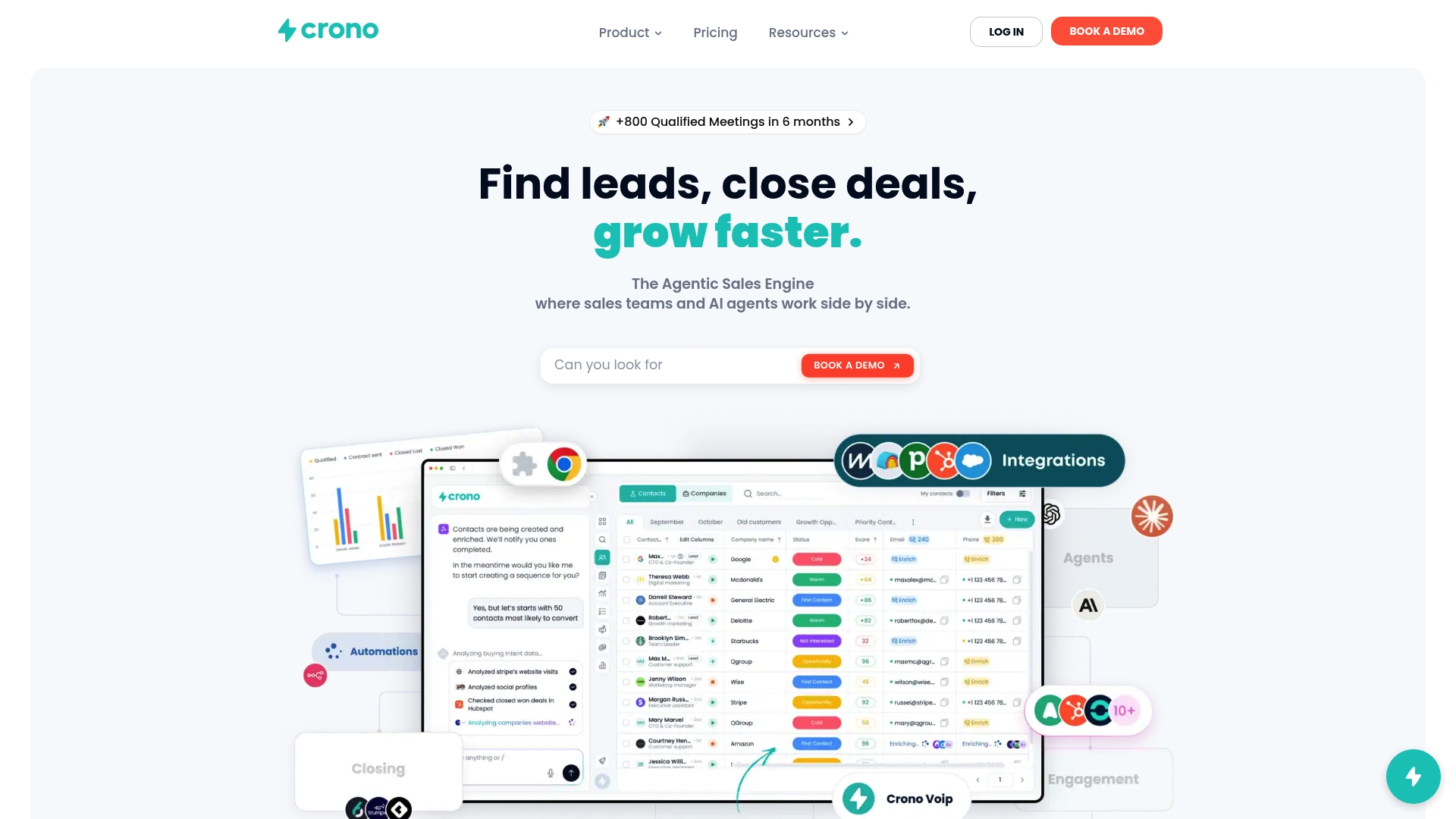
Crono’s AI sales agent deployment guide walks you through building and configuring custom AI agents tailored to your sales process, your CRM, and your team’s specific coaching objectives. You can also use AI custom fields to capture the rep performance signals that matter most to your coaching program. If you want coaching that connects to prospecting, sequencing, and deal execution in one place, Crono is worth a close look.
FAQ
What are AI tools for sales coaching?
AI tools for sales coaching are platforms that use conversation intelligence, automated call scoring, and rep workflow integration to deliver personalized feedback at scale. Leading examples include Nimitai, Rafiki, Salesforce Agentforce, AcePitch, and Degreed Maestro.
How fast should AI call scoring deliver feedback?
Feedback delivered within 5 minutes of call completion is the current benchmark for high-impact coaching. Nimitai’s two-pass scoring model achieves this through a streaming analysis during the call combined with a full post-call evaluation.
Why does CRM integration matter for AI sales coaching adoption?
Reps adopt coaching tools faster when feedback appears inside the CRM they already use. AI tools that reduce CRM update time from 30 to 10 minutes daily remove friction and increase the likelihood that coaching insights translate into behavior change.
Which AI coaching platform is best for regulated industries?
AcePitch is the strongest option for regulated industries because it includes recording consent management, policy retention settings, and full audit trails. Salesforce Agentforce also offers configurable compliance controls for enterprise environments.
Can AI role-play replace manager-led coaching sessions?
AI role-play scales coaching without replacing manager judgment. Platforms like Rafiki run automated practice sessions against AI buyer personas and score them consistently, freeing managers to focus their direct coaching time on the reps and situations that most need human input.
Recommended
Not sure where to start?
Let's talk.
Schedule a session with one of our specialists and get our exclusive Sales Playbook 2026 for free.
 BANT, SPICED & MEDDPICC frameworks
30+ ready-to-use sales templates
2026 outbound & pipeline benchmarks
Don’t sell the product. Sell the change the product makes possible.
This playbook is step one.
