
B2B lead generation is the process of identifying, attracting, and qualifying potential business buyers so your sales team spends time only on conversations that can become revenue. The single highest-impact priority for 2026 is shifting your program’s core metric from MQL volume to appointment quality, then building intent-driven orchestration around that standard. Companies that make this shift report significantly higher conversion rates and materially lower customer acquisition costs compared to traditional MQL-volume models. First-party intent signals, such as website behavior and webinar attendance, deliver accuracy well above 90%, while many third-party intent sources often reflect true buying intent at just 40–50% accuracy — a gap that makes owned-media instrumentation a strategic necessity, not a nice-to-have.
This guide gives you exactly what you need to act:
- A clear taxonomy of lead types and a sample scoring model you can copy today
- Core tactics ranked by speed, cost, and fit for your stage
- A step-by-step ops blueprint from ICP definition to sales handoff
- Five 30–90 day playbooks with sequences, timing, and KPI targets
- KPI definitions, dashboard guidance, and a test-and-learn cadence
- Compliance and data hygiene standards to protect your pipeline quality
Table of Contents
- Why modern B2B lead generation drives revenue outcomes
- How to classify and qualify your B2B leads
- High-impact B2B lead generation strategies for 2026
- How to build an operational B2B lead generation system
- What your tech stack should actually look like
- KPIs, dashboards, and a test-and-learn cadence
- The research case for prioritizing appointment quality
- Five 30–90 day playbooks you can run now
- Common mistakes that kill B2B lead gen programs
- Key Takeaways
- What actually works in B2B lead gen (and what most teams get wrong)
- Crono gives your team a faster path from signal to meeting
- Useful sources
Why modern B2B lead generation drives revenue outcomes
Pipeline quality is a direct input to revenue predictability. When lead generation programs optimize for volume, the downstream costs compound: AEs waste hours on low-intent meetings, sales cycles stretch, and CAC climbs. The economics shift sharply when you measure appointment-to-opportunity conversion instead.
The MQL-volume model creates a structural misalignment. Marketing is rewarded for filling the top of the funnel; sales is rewarded for closing the bottom. Neither team owns the middle, so leads stall, decay, and get recycled until they go cold. Revenue operations experts consistently point to this incentive gap as the primary driver of wasted pipeline spend.
A quality-first approach changes those economics at every stage:
- Lower CAC: Fewer wasted AE hours per closed deal means your cost per customer drops without reducing headcount.
- Faster pipeline velocity: High-intent appointments move through stages faster because the buyer is already engaged.
- Better forecast accuracy: When your SQL definition is tight and shared, conversion rates become predictable enough to model.
- Higher AE morale and retention: Reps who consistently meet qualified buyers close more and stay longer.
- Reduced no-show rates: Intent-triggered outreach reaches buyers at the right moment, so acceptance and attendance rates improve.
The strategic risk of ignoring orchestration is equally concrete. Without intent signals feeding your workflows, your outbound sequences run on timing alone. You reach buyers when your cadence says to, not when they are actually in-market. That mismatch is why many outbound programs plateau: the motion is there, but the trigger logic is missing.
How to classify and qualify your B2B leads
Not all leads deserve the same response speed or resource level. The four core types — MQL, SQL, PQL, and account-level leads — differ in signal strength, conversion probability, and the action they should trigger.
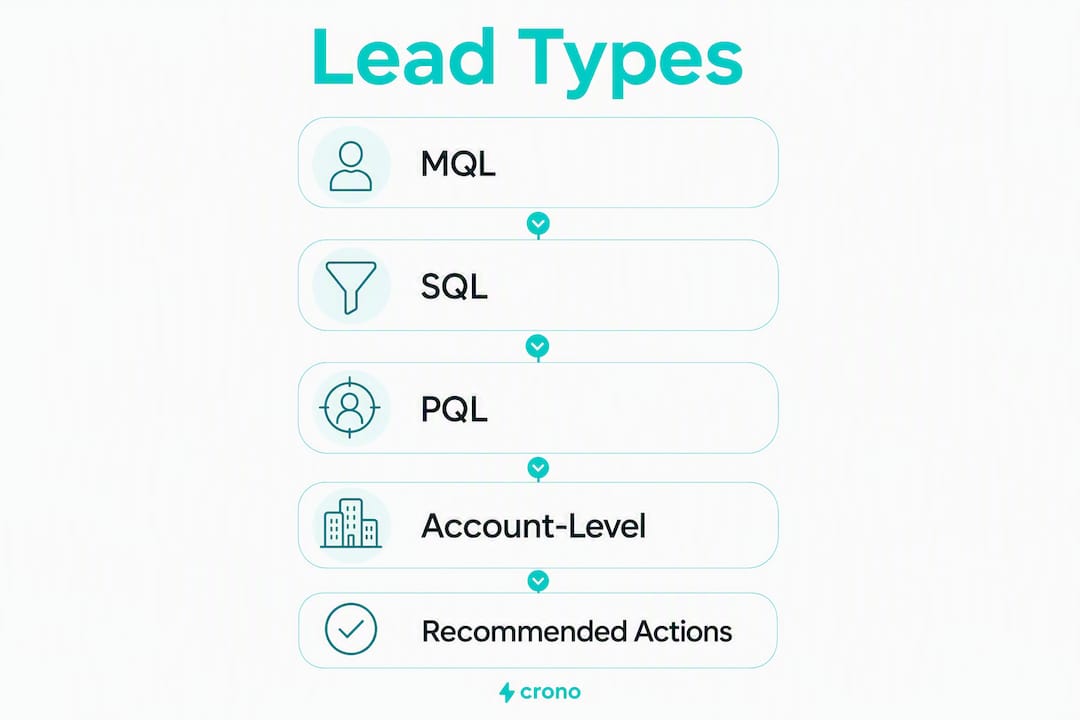
| Lead Type | Definition | Primary Signal | Typical Conversion to Opportunity | Recommended Action |
|---|---|---|---|---|
| MQL (Marketing Qualified Lead) | Contact meets ICP firmographics and has engaged with content | Content download, email open, webinar registration | Low to moderate (varies widely by scoring model) | Nurture sequence; score for upgrade |
| SQL (Sales Qualified Lead) | Contact has been qualified by sales against BANT/CHAMP criteria | Discovery call, demo request, pricing page visit x3+ | Moderate to high | AE assignment within hours |
| PQL (Product Qualified Lead) | Contact has used a free trial or freemium product feature | Feature activation, usage threshold, upgrade intent signal | High | Immediate AE or CSM outreach |
| Account-Level Lead | Multiple contacts at one account show coordinated buying signals | Multiple page visits, committee engagement, intent spike | High (buying committee active) | ABM play; multi-thread outreach |
The distinction between contact-level and account-level signals matters more as deal size grows. A single contact downloading a whitepaper is a weak signal. Three contacts at the same account visiting your pricing page within a week is a buying committee in motion. Your scoring model should weight account-level signal clusters separately from individual contact scores.
A modern BANT/CHAMP adaptation
Classic BANT (Budget, Authority, Need, Timeline) still works as a qualification skeleton, but modern buying committees require a few additions:
- Budget: Confirmed or estimated range; not just “do they have money” but “is this budgeted this quarter”
- Authority: Map the full buying committee (economic buyer, champion, technical evaluator, legal/procurement)
- Need: Specific, articulated pain tied to a business outcome, not a general interest
- Timeline: Hard deadline or trigger event (contract renewal, headcount expansion, tech migration)
- Competitive situation: Are they evaluating alternatives? Who? What’s the decision criteria?
- Champion strength: Does your internal advocate have access to the economic buyer and motivation to push the deal?
ICP checklist for lead qualification
Before a lead enters your scoring model, it should pass an ICP gate:
- Industry vertical matches your top-performing customer segments
- Company size (headcount and revenue) falls within your sweet spot
- Technology stack includes tools your product integrates with or replaces
- Geography and compliance requirements are compatible with your offering
- Growth signals (hiring, funding, expansion) indicate active investment
Pro Tip: Align sales and marketing on a single written definition of a “qualified buyer” before you build any scoring model. Without a shared definition, MQL-to-SQL handoff becomes a negotiation, not a workflow. Run a joint session quarterly to update the definition based on closed-won and closed-lost data.
Verified contact records should be updated in real time using third-party verification APIs at the point of acquisition. A scoring model built on stale data produces confident-looking scores on the wrong people.
High-impact B2B lead generation strategies for 2026
The right tactic depends on your speed requirement, budget, and ICP concentration. Here is how the core channels stack up, with decision rules and measurement guidance for each.

Content, SEO, and generative engine optimization (GEO)
Inbound content remains the lowest-cost-per-lead channel at scale, but the game has shifted. Search engines now surface AI-generated answers before organic listings, so content must be structured for citation in AI responses, not just for ranking. AI-powered SEO approaches are increasingly tied to measurable lead volume gains as generative engines pull from well-structured, authoritative content.
Best for: Companies with a 6–12 month horizon and a content team. Not a fast-start channel. Measure: Organic-to-MQL conversion rate, time-on-page, and assisted pipeline attribution.
Webinars and virtual events
Webinars are one of the most efficient first-party intent generators available. Attendance is a strong buying signal; post-webinar behavior (replays, resource downloads, follow-up clicks) is stronger. The key is treating webinar registration as the start of a sequence, not the end of a campaign.
Best for: Mid-funnel acceleration and account-level signal generation. Measure: Attendance-to-SQL conversion rate and appointment acceptance rate from post-webinar outreach.
Account-based marketing (ABM)
ABM concentrates resources on a defined target account list, coordinating marketing and sales touches across multiple contacts at each account. It produces higher average deal sizes and shorter sales cycles when the account list is well-researched and the buying committee is mapped correctly.
Best for: Enterprise deals with ACV above $50K and long sales cycles. Measure: Account engagement score, multi-thread coverage rate, and pipeline influenced per account.
Targeted outbound email and multichannel sequences
Outbound remains the fastest path to pipeline when your ICP is well-defined and your messaging is specific. Generic sequences fail; sequences triggered by a specific buying signal (tech stack change, new hire in a relevant role, funding event) convert at meaningfully higher rates.
Best for: Teams that need pipeline in 30–60 days and have a tight ICP. Measure: Reply rate, positive reply rate, and appointment-to-opportunity conversion.
LinkedIn and social selling
LinkedIn gives you direct access to decision-makers without a gatekeeper. The most effective approach combines profile optimization, content publishing, and direct outreach in a coordinated sequence rather than treating them as separate activities.
Best for: Relationship-driven sales and mid-market deals where the champion is active on LinkedIn. Measure: Connection acceptance rate, InMail response rate, and meetings booked per 100 outreach attempts.
First-party intent partnerships and co-media
Sponsored co-media — niche industry newsletters, co-branded webinars, and podcast sponsorships — can deliver lower cost-per-SQL and higher-intent leads than broad paid advertising. The audience is pre-qualified by the media property’s topic, and the signal is first-party because the reader chose to engage.
Best for: Reaching concentrated ICP audiences without building your own media property from scratch. Measure: Cost per SQL from co-media versus direct paid channels.
Paid search and cookieless retargeting
Paid ad platforms remain valuable, but rising CPLs require tight server-side conversion tracking and high-converting post-click experiences to justify the spend. Cookieless retargeting using first-party audiences (CRM lists, visitor ID data) outperforms pixel-based retargeting as third-party cookies continue to deprecate.
Best for: High-intent bottom-of-funnel capture and retargeting warm accounts. Measure: Cost per SQL (not cost per click), pipeline ROI, and attribution accuracy via server-side tracking.
Referral programs
Referrals produce the highest close rates and lowest CAC of any channel. Most B2B companies underinvest here because referral programs require process, not just goodwill. A structured ask at the right moment in the customer lifecycle converts satisfied customers into a consistent lead source.
Best for: Companies with a strong NPS and an existing customer base. Measure: Referral-to-SQL conversion rate and referral-sourced revenue as a percentage of new ARR.
How to build an operational B2B lead generation system
A lead generation system is only as strong as the process connecting each stage. Here is a stepwise blueprint you can implement or use to audit what you already have.
Step 1: Define your ICP with precision
Your ICP is not a persona. It is a set of firmographic, technographic, and behavioral criteria that predict a high probability of purchase and retention. Pull it from your closed-won data, not from assumptions.
- Identify your top 20% of customers by ARR and retention rate
- Extract shared firmographic attributes (industry, headcount, revenue, geography)
- Map the technology stack they used before and after buying from you
- Document the trigger events that preceded their purchase (funding, headcount growth, compliance deadline)
Step 2: Map the buying committee
For deals above a specified ACV threshold, a single contact is rarely the decision-maker. Map the roles involved: economic buyer, champion, technical evaluator, legal/procurement, and end users. Your outreach sequences need to address each role’s specific concern.
Step 3: Instrument first-party signals
Website visitor identification captures the majority of visitors who never fill out a form and feeds account-level intent into CRM workflows for timely outreach. Install visitor ID tools, set up event tracking on high-intent pages (pricing, integrations, case studies), and configure alerts for target accounts.

Step 4: Enrich and verify your data
Modern B2B prospecting databases can include hundreds of millions of records with firmographic and buying-trigger filters. Use enrichment APIs to append missing fields at the point of acquisition, and run verification on existing records on a rolling 90-day cycle. Stale data is the most common cause of low deliverability and wasted outreach.
Step 5: Build scoring and routing rules
Scoring should combine demographic fit (ICP match) with behavioral signals (page visits, email engagement, webinar attendance). Route leads based on score thresholds: high-fit, high-intent leads go directly to AE assignment; mid-fit leads enter a nurture sequence; low-fit leads are suppressed or recycled.
Step 6: Design orchestration workflows
Orchestrated execution means using automation to trigger specific sales actions from specific buyer behaviors — a pricing page visit triggers an AE alert, a webinar attendance triggers a personalized follow-up sequence, a tech stack change triggers an outbound play. This is what separates a modern lead gen system from a batch-and-blast operation.
Step 7: Define sales handoff SLAs
Without a written SLA, handoff is a hope, not a process. Define:
- Maximum time from SQL creation to AE first touch (recommended: under 4 hours for high-intent leads)
- Required fields before a lead is handed off (company, role, trigger event, notes from marketing)
- AE acceptance criteria and what happens when a lead is rejected (feedback loop to marketing)
- No-show policy and re-engagement sequence ownership
Pro Tip: Run a monthly “lead quality review” with sales and marketing together. Pull a sample of 20 SQLs from the prior month, score them against your ICP checklist, and compare marketing’s score to the AE’s assessment. The gap between those two scores is your calibration problem.
Data hygiene practices
- Verify new records at acquisition using real-time API verification
- Run a full database audit every 90 days: flag records with no activity in 180 days
- Remove or suppress contacts with hard bounces immediately
- Enrich records with job change signals monthly (role changes invalidate 20–30% of B2B contact data annually)
What your tech stack should actually look like
The debate between best-of-breed point tools and an integrated execution layer is not theoretical. Stack fragmentation creates workflow latency, data decay, and attribution gaps that cost pipeline. When enrichment, outreach, and orchestration live in separate tools with no shared data model, leads fall through the cracks between systems.
| Stack Category | Function | Where It Sits in the Workflow |
|---|---|---|
| Discovery and intent | Identify in-market accounts; surface buying signals | Top of funnel; feeds ICP targeting and account prioritization |
| Data enrichment | Append firmographic, technographic, and contact data | Point of acquisition and ongoing 90-day refresh cycle |
| CRM | Record of truth for contacts, accounts, and pipeline | Central; all other tools write to and read from it |
| Marketing automation | Nurture sequences, scoring, and campaign management | Mid-funnel; feeds SQLs to CRM |
| Outreach and sequencing | Multichannel cadences (email, LinkedIn, calls) | SDR and AE execution layer |
| Conversational AI | Chatbots, meeting scheduling, real-time qualification | Website and inbound capture |
| Analytics and orchestration | Pipeline reporting, attribution, workflow triggers | Governance and optimization layer |
The critical gap in most stacks is the orchestration layer: the system that reads signals from all other tools and triggers the right action at the right time. Without it, your SDRs are manually checking dashboards and deciding what to do next. With it, the system surfaces the highest-priority action automatically.
AI-enabled personalization and predictive scoring reduce manual prioritization costs and surface higher-propensity prospects by combining behavioral signals with firmographic fit in real time. The practical result is that reps spend more time on conversations and less time on research.
When enrichment, outreach, and orchestration run through a single execution layer, teams reduce time-to-first-meeting and prevent the data decay that plagues fragmented stacks. The signal that triggers an outreach sequence is the same signal that updates the CRM record and notifies the AE — no manual handoff, no latency, no lost context.
For a deeper look at how agentic sales execution works in practice, Crono’s academy covers real workflow examples across prospecting, enrichment, and multichannel outreach.
KPIs, dashboards, and a test-and-learn cadence
Measuring lead generation by MQL volume is like measuring a restaurant by the number of reservations. What matters is how many of those reservations turn into paying customers who come back.
| Metric | Definition | Calculation | Review Frequency |
|---|---|---|---|
| Appointment-to-opportunity conversion | % of booked meetings that become active pipeline opportunities | Opportunities created / meetings held | Weekly |
| Lead-to-SQL conversion | % of leads that meet SQL criteria after qualification | SQLs / total leads | Weekly |
| True cost per SQL | Total lead gen spend divided by SQLs produced | Total spend / SQLs | Monthly |
| Pipeline velocity | Speed at which opportunities move through stages | (# of deals × avg deal value × win rate) / avg sales cycle length | Monthly |
| AE acceptance rate | % of SQLs that AEs accept as worth pursuing | Accepted SQLs / total SQLs handed off | Weekly |
| No-show rate | % of booked meetings where the prospect does not attend | No-shows / total meetings booked | Weekly |
Dashboard layout and ownership
- Marketing owns: Lead-to-MQL conversion, cost per MQL, channel attribution, content engagement
- RevOps owns: MQL-to-SQL conversion, SQL-to-opportunity conversion, pipeline velocity, CAC
- Sales owns: AE acceptance rate, appointment-to-opportunity conversion, no-show rate, win rate
A single shared dashboard visible to both marketing and sales leadership is more valuable than separate departmental views. The shared view forces alignment on the metrics that matter at the handoff point.
Pro Tip: Before running an A/B test on messaging or channel, write a hypothesis in this format: “We believe [change] will improve [metric] by [direction] because [reason]. We will know in [timeframe] with [minimum sample size].” This discipline prevents you from calling a winner on 12 data points and changing your entire sequence based on noise.
The research case for prioritizing appointment quality
The shift from MQL volume to appointment quality is not a philosophical preference. The economics make it straightforward.
Consider a simplified comparison. A program generating 200 MQLs per month at $150 each spends $30,000 to produce, say, 20 SQLs (a 10% MQL-to-SQL rate) and 4 opportunities (a 20% SQL-to-opportunity rate). That is $7,500 per opportunity. A program generating 40 BANT-verified appointments at $400 each spends $16,000 and, with a 50% appointment-to-opportunity rate, produces 20 opportunities. That is $800 per opportunity — a fraction of the cost, at five times the output.
Programs that prioritize appointment quality over MQL volume report roughly 3x higher conversion rates and materially lower customer acquisition costs than MQL-volume models. The math above illustrates why: when qualification happens before the meeting, not after, AE time is spent on buyers, not on discovery calls that end in “not the right fit.”
The intent signal question follows the same logic. First-party intent signals deliver high accuracy, while many third-party intent sources have noticeably lower accuracy. Third-party intent signals often reflect research or non-buying behaviors and are shared with competitors simultaneously, which means you and three other vendors are calling the same prospect on the same day based on the same signal. First-party signals — a prospect visiting your pricing page three times, attending your webinar, or clicking a specific case study — are exclusive to you and far more predictive of actual purchase intent.
Pro Tip: Build a “signal ladder” for your ICP: rank every trackable behavior from lowest to highest intent, assign a point value to each, and set a threshold score that triggers a sales alert. Start simple (5–7 behaviors) and add complexity only after you have validated the model against closed-won data.
The AI in B2B revenue teams playbook from Crono covers how AI agents operationalize this signal ladder in practice, including how predictive scoring surfaces the right accounts at the right time.
Five 30–90 day playbooks you can run now
Playbook 1: Targeted outbound sequence (30 days)
Objective: Book 10–15 qualified appointments with ICP accounts in the first 30 days. Target ICP: Mid-market B2B SaaS companies, 50–500 employees, VP of Sales or CRO.
Sequence template (10 touches over 21 days):
- Day 1: Personalized email referencing a specific trigger event (funding, new hire, product launch)
- Day 3: LinkedIn connection request with a brief, relevant note
- Day 5: Follow-up email with a single case study or relevant data point
- Day 8: LinkedIn message referencing the email
- Day 10: Phone call with a voicemail if no answer
- Day 13: Email with a direct ask for a 15-minute call
- Day 16: LinkedIn video message (60 seconds, specific to their situation)
- Day 19: Final email with a “permission to close your file” frame
- Day 21: Phone call, no voicemail
KPI targets: 15–20% positive reply rate; 8–12% appointment rate from total outreach. Handoff rule: Any positive reply triggers immediate AE notification and CRM task creation.
For a deeper look at multichannel campaign execution, Crono’s playbook covers timing and sequencing across email, LinkedIn, and calls.
Playbook 2: Intent-triggered outreach (30–45 days)
Objective: Convert high-intent anonymous visitors and known contacts into booked meetings. Trigger rules:
- Pricing page visited 3+ times in 7 days → immediate AE alert + personalized email within 2 hours
- Case study page visited by a known contact → add to a 5-touch sequence starting same day
- Competitor comparison page visited → trigger a direct outreach with a specific differentiation message
Sequence: 5 touches over 10 days, starting within 2 hours of trigger. KPI targets: 25–35% reply rate (intent-triggered sequences outperform cold outreach because timing is right); 15–20% appointment rate.
Interactive, multi-step qualification funnels at the point of capture improve downstream conversion by qualifying leads in real time and reducing low-quality submissions before they enter your sequence.
Playbook 3: Webinar-to-appointment (45–60 days)
Objective: Convert webinar attendees into qualified appointments within 2 weeks of the event.
Pre-webinar: Send a personalized invite to your target account list 3 weeks out, with a follow-up 5 days before. Post-webinar sequence (attendees):
- Day 1: Thank-you email with recording link and a single resource
- Day 3: Follow-up email with a relevant case study and a soft CTA for a 15-minute call
- Day 7: LinkedIn message referencing a specific point from the webinar
- Day 10: Direct ask for a meeting with a specific agenda
Post-webinar sequence (no-shows):
- Day 1: “Sorry we missed you” email with recording link
- Day 5: Follow-up with a key takeaway and a meeting ask
KPI targets: 20–30% of attendees accept a follow-up meeting; 40–50% of those convert to opportunities.
Playbook 4: Account-based nurture (60–90 days)
Objective: Build multi-thread engagement across 25–50 target accounts over 90 days.
- Week 1–2: Map buying committee for each account; identify champion, economic buyer, and technical evaluator
- Week 3–4: Personalized outreach to champion with a specific value hypothesis
- Week 5–6: Content sequence to technical evaluator (integration guides, security documentation)
- Week 7–8: Executive-level outreach to economic buyer via LinkedIn and direct email
- Week 9–12: Coordinate a joint touchpoint (executive briefing, custom demo, or co-hosted event)
KPI targets: 3+ contacts engaged per account within 60 days; 30–40% of target accounts with an active opportunity by day 90.
Playbook 5: Partner co-media campaign (60–90 days)
Objective: Generate 20–30 high-intent SQLs through a co-branded content partnership.
- Identify 2–3 niche industry newsletters or podcast properties where your ICP is the audience
- Co-create a piece of original research or a practical guide with the media partner
- Sponsor a dedicated send or episode with a gated asset and a direct meeting CTA
- Follow up with all registrants using a 5-touch sequence over 14 days
KPI targets: Cost per SQL from co-media should be 30–50% lower than direct paid channels; 15–25% of registrants convert to meetings within 30 days of the campaign.
Common mistakes that kill B2B lead gen programs
Even well-resourced programs fail for predictable reasons. Here are the most common errors and the corrective actions to assign.
The MQL black hole
Marketing hands off leads that sales ignores, and neither team knows why. The fix is a shared SQL definition and a weekly lead quality review. Assign ownership to RevOps.
Fragmented data stack
Enrichment lives in one tool, outreach in another, and the CRM in a third. Data decays between syncs, sequences fire on stale records, and attribution is impossible. The fix is an integrated execution layer or a strict data governance protocol with daily syncs.
No SLA on handoff
SQLs sit in a queue for 48–72 hours before an AE touches them. High-intent leads go cold. The fix is a written SLA (under 4 hours for high-intent leads) with automated escalation if the SLA is breached.
Over-reliance on third-party intent
Buying third-party intent data and treating it as a pipeline trigger without enrichment or human qualification produces low-quality outreach at scale. The fix is combining third-party signals with first-party behavioral data and a qualification step before outreach.
No attribution model
Paid channels run without server-side tracking, so you cannot tell which campaigns produce SQLs versus vanity clicks. The fix is implementing server-side conversion tracking and attributing pipeline to the first meaningful touch, not just the last click.
Red-flag checklist for a quick program audit
Run through these questions quarterly:
- Is your MQL-to-SQL conversion rate below 10%? (Scoring model is miscalibrated or ICP is too broad)
- Is your AE acceptance rate below 60%? (SQL definition is not shared or enforced)
- Is your no-show rate above 25%? (Outreach is reaching low-intent contacts or timing is off)
- Are you unable to attribute pipeline to specific campaigns? (Attribution model is broken)
- Has your B2B contact database not been verified in the last 90 days? (Data hygiene is overdue)
- Do marketing and sales use different definitions of a qualified lead? (Alignment is missing)
If you answer yes to two or more of these, your program has a structural problem, not a messaging problem. Fix the process before optimizing the copy.
Key Takeaways
Effective B2B lead generation in 2026 requires shifting your core metric from MQL volume to appointment-to-opportunity conversion, then building intent-driven orchestration around that standard to produce predictable pipeline.
| Point | Details |
|---|---|
| Appointment quality over MQL volume | Programs prioritizing appointment quality report roughly 3x higher conversion rates and lower CAC than MQL-volume models. |
| First-party intent is your edge | First-party signals (website behavior, webinar attendance) deliver accuracy well above 90% versus 40–50% for many third-party sources. |
| Orchestration closes the execution gap | Automated triggers from buyer behavior reduce time-to-meeting and prevent data decay across fragmented stacks. |
| Shared SQL definition is non-negotiable | Sales and marketing must agree on a written qualified-buyer definition before any scoring model or SLA can function. |
| Crono as your execution layer | Crono connects CRM, enrichment, outreach, and orchestration into a unified platform so your team acts on the right signal at the right time. |
What actually works in B2B lead gen (and what most teams get wrong)
Most B2B lead generation programs fail not because of bad tactics but because of a misaligned measurement system. When marketing is measured on MQL volume and sales is measured on closed revenue, the middle of the funnel becomes a blame zone. Neither team owns the appointment-to-opportunity conversion rate, so nobody optimizes it.
The shift to orchestrated execution is not just a technology upgrade. It is an organizational change. The teams that get the most out of intent data and AI-driven workflows are the ones that have already agreed on what a qualified buyer looks like and who is responsible for each stage of the handoff. The technology amplifies the process; it does not replace it.
There is also a common misconception about AI personalization. Many teams implement AI-generated messaging and then wonder why reply rates do not improve. The issue is that AI personalization at scale still requires a strong signal to personalize around. Generic AI copy is still generic. The teams seeing real lift are the ones feeding their AI tools specific trigger events — a new hire in a relevant role, a funding announcement, a technology change — and using AI to craft a message around that specific context, not to generate a template that sounds personalized.
The 30–90 day playbooks in this guide are designed to be run as experiments, not commitments. Pick one, define your hypothesis, set your KPI targets, and measure against them before scaling. The teams that build compounding pipeline programs are the ones that run disciplined experiments and double down on what the data confirms.
Crono gives your team a faster path from signal to meeting
Many revenue teams have access to intent signals but lack a timely system to act on them effectively. Crono is built specifically for that gap: it connects your CRM, enrichment sources, and outreach channels into a single execution layer where AI agents and your reps work from the same real-time data.
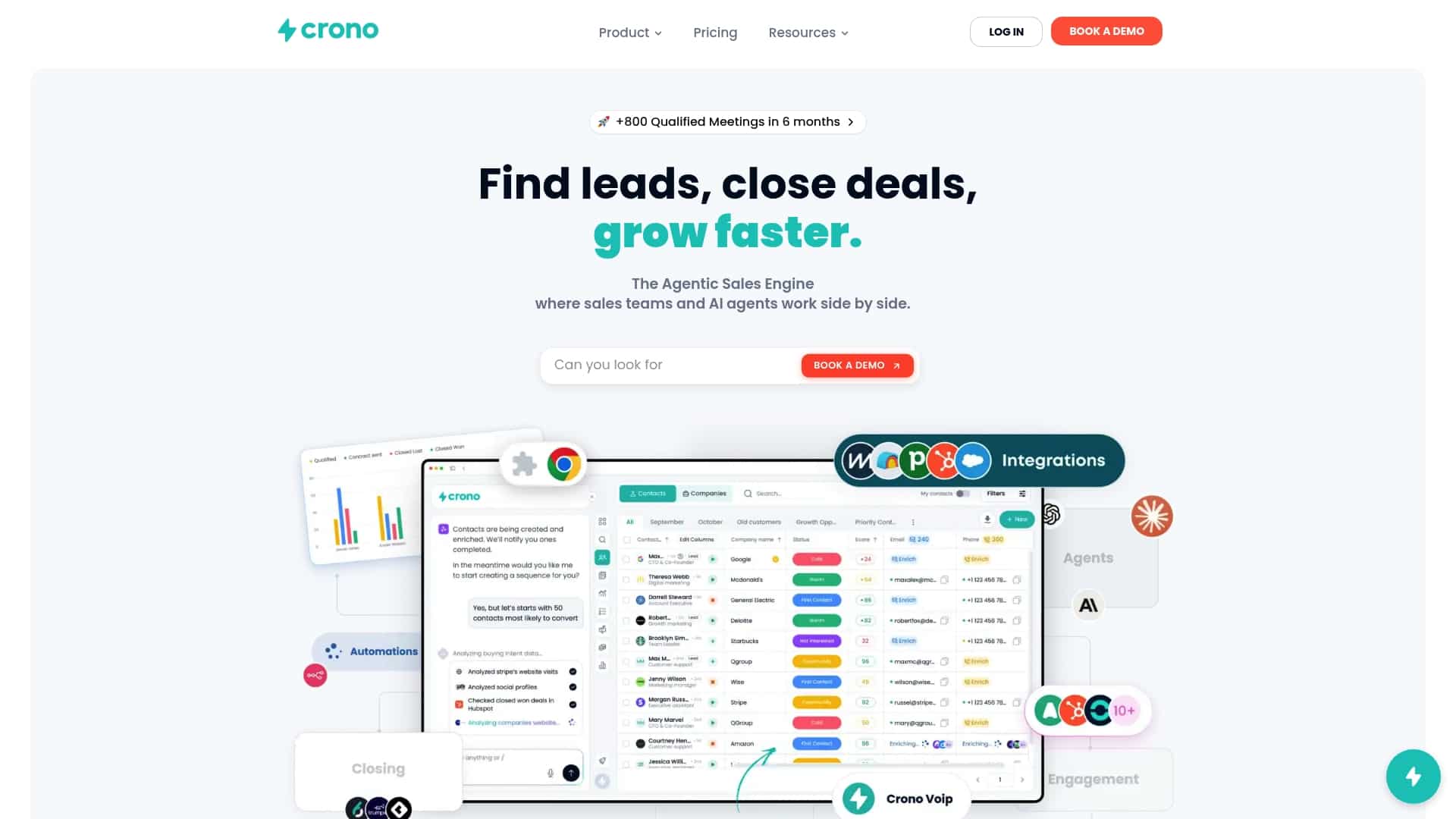
In the first 30 days, teams using Crono typically accomplish two things that take months with a fragmented stack: they get their ICP scoring model live and connected to automated outreach triggers, and they establish a clean handoff workflow with SLA enforcement built in. No more leads sitting in a queue. No more sequences firing on stale records. The signal that triggers the outreach is the same signal that updates the CRM and notifies the AE.
If you are ready to move from a volume-based program to an appointment-quality model, explore Crono’s outbound sales engagement approach or go deeper on execution with Crono’s B2B sales techniques masterclass. Both are practical starting points for teams that want to run the playbooks in this guide with the right infrastructure behind them.
Useful sources
- The New Rules of B2B Lead Generation — Harvard Business Review: Foundational HBR piece on how digital channels have changed B2B buyer behavior and lead generation strategy.
- B2B Buying Journey Research — Gartner: Gartner’s research on how B2B buying committees make decisions and what that means for lead generation and sales engagement.
- AI Sales Intelligence in Prospecting — G2 Learn Hub: Covers how AI-driven sales intelligence tools are changing prospecting workflows and lead prioritization.
- B2B Sales Orchestration Explained for Revenue Teams — Crono: Crono’s guide to orchestration workflows, trigger-based automation, and sales execution layer architecture.
- AI in B2B Revenue Teams: The 2026 Playbook — Crono Academy: Covers AI use cases across the revenue team, including predictive scoring, signal ladders, and agentic execution.
- Multichannel Campaign to Close Deals with Your ICP — Crono: Practical Crono playbook for coordinating email, LinkedIn, and call sequences across a target ICP.
