

If your B2B sales team isn’t hitting its pipeline goals, the problem is rarely the product and it’s rarely the market either.
In most cases, it’s a structural problem buried inside your outbound process. And it stays invisible until you actually measure it.
A B2B outbound audit is the fastest way to surface those gaps. In this guide, we’ll show you what an outbound audit covers, how to run one, and how to turn the results into immediate pipeline improvements.
In this article, we’ll show you how to use this audit to boost your sales performance and close more deals.
What Is a B2B Outbound Audit?
A B2B outbound audit is a structured evaluation of your sales team’s outreach process. It analyzes every component of how you identify, contact, and convert potential customers, from how you define your ideal customer profile to how you follow up after a cold email.
Unlike a CRM review or a pipeline forecast, an outbound audit doesn’t just tell you what happened. It tells you why your numbers look the way they do and where specifically the process is breaking down.
A thorough audit covers eight core areas: targeting, messaging, sequencing, channel mix, data quality, follow-up cadence, conversion metrics, and tool stack. Each one can silently kill pipeline if left unchecked.
The output is a concrete score and a prioritized action plan, not a generic checklist, but a specific list of what to fix first based on your actual situation.
Why Most B2B Sales Teams Need an Outbound Audit
Here’s an uncomfortable truth: most outbound problems are invisible to the people running the process.
When reply rates are low, teams blame the market. When demos don’t convert, they blame the AE. When sequences underperform, they try a new tool. But the root cause is almost always upstream, a targeting problem, a messaging mismatch, or a sequencing structure that was set up once and never revisited.
According to Gartner, the majority of B2B sales teams lack the basic capabilities to run outbound effectively. That’s not a talent problem. It’s a process problem and it compounds over time.
Without a periodic audit, small inefficiencies accumulate. An ICP that was defined 12 months ago may no longer match your best customers today. A sequence that worked last quarter may be getting flagged as spam this quarter. A channel mix that made sense for one segment may be completely wrong for the next.
The audit forces you to step back, look at each pillar independently, and measure rather than assume.
The 8 Pillars of an Effective B2B Outbound Audit
The Crono B2B Outbound Audit evaluates your sales process across eight distinct pillars.
Here’s what each one covers and why it matters.
1. ICP & Targeting
The most common source of outbound underperformance is targeting the wrong people. This pillar evaluates how precisely your team has defined the Ideal Customer Profile: industry, company size, job title, buying triggers, and disqualifiers, and whether your active lead lists actually reflect that definition.
A weak ICP doesn’t just waste outreach effort. It poisons your conversion data, because you end up drawing conclusions from interactions with prospects who were never a real fit.
Questions to ask: How recently was your ICP reviewed? What percentage of your current prospects match it? How do conversion rates differ between in-ICP and out-of-ICP leads?
2. Messaging & Personalization
Even if you’re reaching the right people, the wrong message will kill the conversation before it starts. This pillar looks at whether your outreach is genuinely relevant to the recipient or whether it reads like a template anyone could have sent.
Good B2B messaging addresses a specific pain the prospect actually has, demonstrates that you understand their context, and makes a clear case for why they should respond now. It doesn’t lead with features or company history.
Audit signals: reply rates, positive reply rates, message-to-meeting conversion by copy variant.
3. Sequence Structure
A sales sequence is more than a list of touchpoints. It’s a logic, how many steps, across how many days, using which channels, in what order. This pillar checks whether your sequence logic is working or inadvertently filtering out good prospects.
Common issues include sequences that are too short (stopping before the prospect was ready to engage), too long (burning goodwill with excessive follow-up), or too uniform (using the same channel and tone for every touchpoint).
Audit signals: drop-off rate by step, reply timing distribution, meeting-booked step breakdown.
4. Channel Mix
Email, LinkedIn, phone, video, each channel reaches different people at different points in their decision-making process. This pillar evaluates whether you’re using the right combination for your specific ICP, and whether the channels are integrated (each touchpoint aware of the others) or siloed.
Over-reliance on a single channel is one of the most common audit findings, especially in teams that grew up on cold email but haven’t adapted their stack as inbox competition increased.
5. Lead Data Quality
Outreach is only as good as the data behind it. This pillar looks at the accuracy and completeness of your lead data, verified emails, current job titles, correct company information, and at how often your team is manually correcting or discarding records.
Poor data quality creates two problems: deliverability issues (bounces, spam flags) and wasted time (reps contacting people who have left the company or moved to a non-relevant role).
6. Follow-up Cadence
The majority of B2B deals are not closed on the first touchpoint. Yet most outbound sequences treat follow-up as an afterthought, same message, different subject line, sent on a random day. This pillar evaluates whether your follow-up adds value at each step or simply repeats the ask.
Effective follow-up cadences use timing, content variation, and channel switching to give the prospect multiple reasons and opportunities to respond. Audit signals: reply rates by touchpoint number, positive response distribution across sequence steps.
7. Conversion Metrics
This pillar moves from qualitative to quantitative: are you tracking the right numbers, and do you actually know where leads are being lost? Key metrics include lead-to-reply rate, reply-to-meeting rate, meeting-to-opportunity rate, and the time between each stage.
The goal is to have enough visibility into your funnel that you can identify a specific step – not just “outbound isn’t working” – and fix it.
8. Tool Stack Alignment
The final pillar looks at whether your tools are helping or creating friction. A misaligned stack, CRM that doesn’t sync with your sequencer, prospecting data that can’t be enriched automatically, reporting that requires manual export, slows down reps and generates unreliable data.
This pillar also checks whether your team is actually using the tools available to them, or working around them.
The Crono B2B Outbound Audit
We built a free, fast, and precise tool to answer exactly that question.
→ Take your free Outbound Audit
The Crono B2B Outbound Audit is a 24-question assessment that analyzes your outbound process across 8 key pillars and gives you back:
- A score out of 100
- The critical gaps that are blocking your pipeline
- Immediate quick wins you can act on today
- A personalized action plan with deep-dive insights
All in under 4 minutes. No CRM required. 100% free.
How It Works: 4 Steps, 4 Minutes
Step 1 – Collect Sales Data
Gather your metrics: lead lists, open rates, reply rates, and conversion rates.
Step 2 – Complete the Audit
Input your data in the free B2B Outbound Audit tool.
Step 3 – Analyze Results
Review scores for each pillar and focus on the areas needing improvement.
Step 4 – Implement Changes & Track Progress
Adjust messaging, refine sequences, or improve targeting. Monitor performance over time to maximize ROI.
Why Your B2B Sales Team Needs an Outbound Audit
1. Quickly Identify Weak Points
Spot gaps in targeting, messaging, or sequence that hurt your pipeline.
2. Save Time & Resources
Focus on strategies that work instead of trial-and-error outreach.
3. Increase Lead Engagement & Response Rates
Better messaging + optimized targeting = more replies, meetings, and closed deals.
4. Clear steps
The audit provides clear steps, so you can implement improvements immediately.
Who Should Run This Audit
The Crono Outbound Audit is built for:
- Sales Managers and Revenue Leaders who want to understand where the team is losing effectiveness
- SDRs and BDRs who feel something isn’t working in their outbound strategy but can’t pinpoint the bottleneck
- B2B startup Founders and CEOs building or scaling their first sales function
- Heads of Sales who want an objective benchmark before kicking off a new quarterly planning cycle
If you’re already using Crono, or evaluating it, the audit will also give you an immediate view of how to optimize your stack to maximize results.
Find Out Where You Stand: Free, in 4 Minutes
We turned everything we know into a free assessment: 24 questions, 8 pillars, one score out of 100 and a personalized action plan that tells you exactly where to focus first.
Want to find out why your pipeline isn't generating enough pipeline?
+500 sales leaders have already optimized their outbound.
Answer these 24 questions, get a score across 8 pillars and a personalized action plan in 4 minutes.
Not sure where to start?
Start with the Playbook.
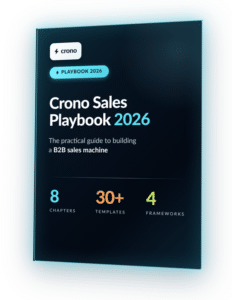
Download our free Sales Playbook 2026 and learn how top B2B teams structure their outbound process.
 BANT, SPICED & MEDDPICC frameworks
- 30+ ready-to-use sales templates
- 2026 outbound & pipeline benchmarks
Don't sell the product. Sell the change the product makes possible.
Build the process before the pipeline.
