
B2B Sales Conversion Rate: Benchmarks and Strategies
The B2B sales conversion rate is the percentage of prospects that successfully advance from one defined funnel stage to the next over a specific period. It is the single most direct measure of how well your sales process turns interest into revenue. Stage-specific benchmarks range from 15–25% for qualified leads moving to opportunities, up to 25–40% from proposal to closed deal. Understanding what is b2b sales conversion rate, and how to act on it, separates teams that grow predictably from those that rely on volume alone.
What is B2B sales conversion rate and how is it calculated?
The standard formula is straightforward: divide the number of conversions by total qualified prospects, then multiply by 100. This formula applies at every stage of the funnel, not just at the final close. That flexibility is what makes it so useful for diagnosing where deals stall.
Stage-by-stage calculation gives you a much clearer picture than a single end-to-end number. Here is how the math works at each level:
- Lead to MQL: Divide marketing-qualified leads by total raw leads, then multiply by 100. If 500 leads produce 110 MQLs, your rate is 22%.
- MQL to SQL: Divide sales-qualified leads by MQLs. If 110 MQLs yield 16 SQLs, your rate is roughly 14.5%.
- SQL to opportunity: Divide active opportunities by SQLs. At 16 SQLs producing 2 opportunities, you sit at about 12%.
- Opportunity to closed-won: Divide closed deals by total opportunities. Two wins from 20 opportunities equals a 10% close rate.
- Overall funnel rate: Divide total new customers by total leads at the top. This single number tells you your end-to-end B2B sales efficiency.
Measuring each stage separately reveals the exact point where your pipeline leaks. A strong MQL-to-SQL rate paired with a weak proposal-to-close rate points to a pricing or negotiation problem, not a prospecting one.
Pro Tip: Track conversion rates by time period, not just by cohort. Comparing month-over-month rates for the same stage shows whether process changes are actually working.

What are typical B2B sales conversion rate benchmarks by industry?
B2B pipeline benchmarks show a consistent pattern across industries: Lead to MQL runs 20–25%, MQL to SQL runs 12–18%, SQL to opportunity runs 10–12%, and closed-won sits at 6–9%. These numbers reflect median performance across a broad range of B2B markets. Your position relative to these ranges tells you whether you have a volume problem or a quality problem.
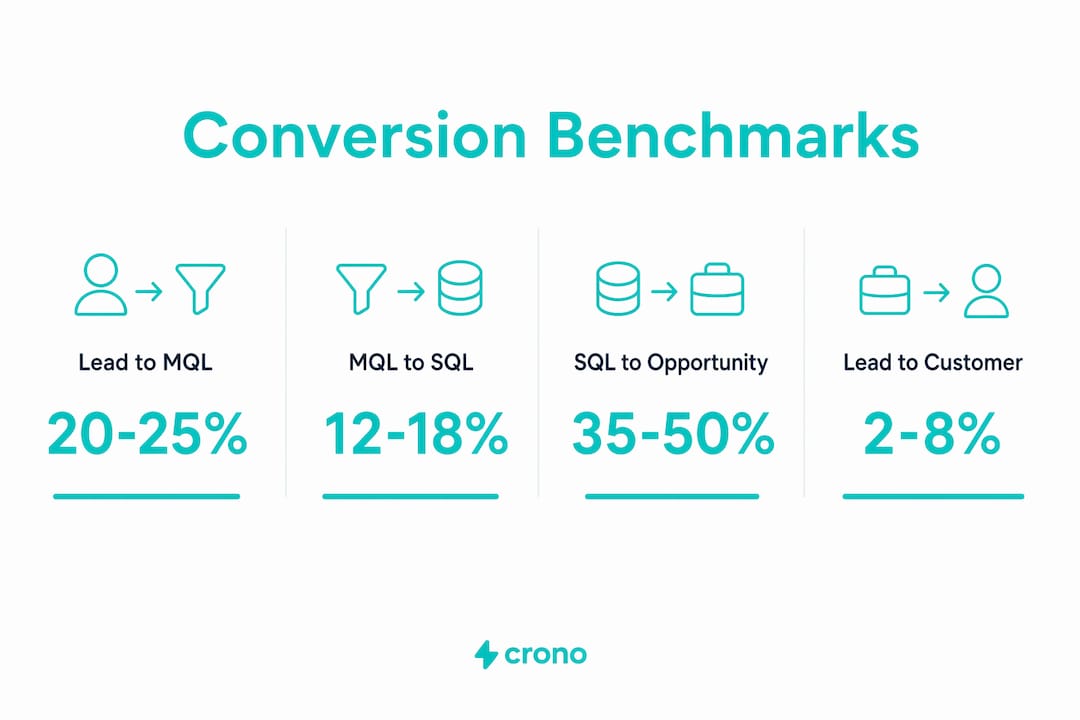
Industry type shifts these numbers significantly. B2B software companies typically see overall lead-to-customer rates of 2–5%, while professional services firms often reach 5–8%. The gap exists because professional services deals rely more on referrals and relationships, which carry higher intent from the start.
| Industry | Qualified lead to opportunity | Demo to proposal | Proposal to closed |
|---|---|---|---|
| B2B software | 15–20% | 20–25% | 20–30% |
| Professional services | 20–30% | 30–40% | 30–40% |
| Manufacturing | 10–18% | 18–25% | 25–35% |
| Financial services | 12–20% | 20–30% | 25–35% |
A few factors explain the variance across these categories:
- Deal complexity: Enterprise software deals involve more stakeholders and longer evaluation cycles, which compress conversion at every stage.
- Buyer intent at entry: Inbound leads from content or referrals convert at higher rates than cold outbound contacts.
- Average contract value: Higher-value deals face more scrutiny, which lowers close rates but raises revenue per win.
Benchmarks are useful as a starting point. The more important question is whether your rates are improving quarter over quarter.
Which key factors influence B2B sales conversion rates?
Lead quality is the single biggest driver of conversion performance. A tightly defined Ideal Customer Profile (ICP) filters out accounts that will never buy, which raises conversion at every downstream stage. Teams that skip ICP discipline generate high lead volume but low revenue.
Speed of response has a measurable and dramatic effect. Leads contacted within 5 minutes convert 21 times better than those reached after 30 minutes. That gap exists because early contact catches buyers while they are actively evaluating options. Automated lead routing is the only reliable way to hit that window consistently.
Pipeline hygiene directly affects your close rate. Removing deals stagnant over 45 days can increase close rates by 20–40% within a single quarter, without any additional marketing spend. Stale deals distort your forecast and pull rep attention away from live opportunities.
Additional factors that shape your B2B sales success rate include:
- Multi-stakeholder engagement: Engaging multiple stakeholders in a buying group reduces deal risk and accelerates consensus. Relying on a single champion leaves deals exposed if that contact changes roles.
- Personalization depth: Generic outreach produces declining returns. Targeted campaigns with tight ICP alignment drive reply rates of 3–8%, which is the realistic range for modern outbound.
- Value-based selling: Shifting the conversation from price to ROI and business outcomes justifies larger investments and shortens the approval cycle.
Pro Tip: Score your pipeline weekly using deal age, stakeholder count, and last activity date. Any deal missing two of those three signals needs immediate action or removal.
What strategies improve B2B sales conversion rates effectively?
Raising your conversion rate requires fixing the process, not just adding more leads at the top. The following strategies address the most common failure points in B2B funnels.
- Tighten your ICP. Define your best-fit accounts by industry, company size, tech stack, and buying trigger. Remove accounts that do not match from active sequences. This alone raises MQL-to-SQL rates within weeks.
- Automate lead routing. Automating lead assignment speeds up the sales cycle, improves pipeline coverage, and increases meetings booked. Set a service-level agreement of under 5 minutes for first contact on inbound leads.
- Run aggressive pipeline hygiene. Review every open deal weekly. Flag anything with no activity in 30 days and close it out at 45 days. A smaller, cleaner pipeline produces higher close rates and more accurate forecasts.
- Adopt value-based selling. Build every proposal around the buyer’s specific business outcomes. Quantify the cost of inaction. Buyers approve budgets faster when the ROI case is explicit and tied to their own metrics.
- Engage the full buying committee. Map every deal to at least three stakeholders across economic buyer, technical evaluator, and end user. Use multichannel outreach sequences to reach each persona with relevant messaging.
- Use AI for personalization at scale. AI-powered tools analyze intent signals and past engagement to surface the right message for each prospect at the right time. This raises reply rates without requiring reps to manually research every account.
Each of these tactics addresses a specific conversion leak. Applying all six creates a compounding effect on your overall B2B sales success rate.
How do tools and technology help track and improve conversion rates?
CRM dashboards are the foundation of any serious B2B conversion optimization effort. They let you track conversion rates by funnel stage, by rep, and by segment, so you can identify patterns that are invisible in aggregate numbers. Without stage-level visibility, you are guessing at where to focus.
Predictive lead scoring takes that visibility further. By analyzing firmographic data, behavioral signals, and historical win patterns, scoring models rank prospects by their likelihood to convert. Reps spend time on accounts that are actually ready to buy, which raises B2B lead conversion rates without increasing headcount.
Sales analytics platforms add pipeline health metrics on top of basic CRM reporting. They surface deal risk signals like single-threaded relationships, long gaps between touches, and stalled stage progression. These signals let managers coach reps on specific deals before they are lost.
Key capabilities to look for in a sales technology stack:
- Automated lead routing that assigns new leads to the right rep within minutes, not hours.
- Multichannel sequencing that coordinates email, LinkedIn, and phone touches across a defined cadence.
- Intent data integration that flags accounts showing active buying signals from third-party sources.
- Pipeline analytics that calculate conversion rates by stage and flag deals at risk of going stale.
Crono combines all of these capabilities in a single platform. Its AI agents handle lead prioritization, outreach sequencing, and pipeline monitoring, so sales teams can focus on conversations rather than coordination. You can review outbound sales metrics that actually move revenue inside the Crono academy.
Key Takeaways
The most effective way to raise your B2B sales conversion rate is to fix process quality at each funnel stage, not to increase raw lead volume.
| Point | Details |
|---|---|
| Use stage-by-stage calculation | Apply the conversion formula at each funnel stage to pinpoint exactly where deals stall. |
| Know your industry benchmark | B2B software averages 2–5% overall; professional services reaches 5–8%. Use these as your baseline. |
| Speed of contact matters most | Leads reached within 5 minutes convert 21 times better than those contacted after 30 minutes. |
| Pipeline hygiene drives close rates | Removing deals stagnant over 45 days raises close rates by 20–40% within a quarter. |
| Engage multiple stakeholders | Multi-threading buying committees reduces deal risk and accelerates consensus across the group. |
Why most B2B teams are measuring conversion wrong
Most sales teams I have worked with track one number: the overall close rate. That single metric hides more than it reveals. A 15% close rate looks identical whether your problem is weak prospecting, slow follow-up, or poor proposal quality. You cannot fix what you cannot see.
The teams that improve fastest are the ones that instrument every stage transition and review those numbers weekly. They treat a drop in MQL-to-SQL conversion as a signal to audit lead quality, not to run more campaigns. They treat a drop in proposal-to-close as a signal to review their pricing and ROI framing, not to add more follow-up emails.
The other thing most teams underestimate is multi-stakeholder engagement. Reps build a relationship with one contact and assume that person will carry the deal internally. That works until the contact changes jobs or loses internal support. Deals that involve three or more stakeholders from the buyer’s side close faster and at higher rates. It is not a nice-to-have tactic. It is a structural advantage.
Technology helps, but only after the process is clear. Deploying an AI sales platform on top of a broken ICP definition just automates bad targeting. Get the fundamentals right first: tight ICP, fast response, clean pipeline, multi-threaded deals. Then use automation to scale what already works.
— Alex
How Crono helps B2B teams convert more pipeline into revenue
Crono is built for revenue teams that need to move fast without sacrificing precision. Its AI agents handle lead prioritization, automated routing, and multichannel sequencing so your reps engage the right accounts at the right time, every time.
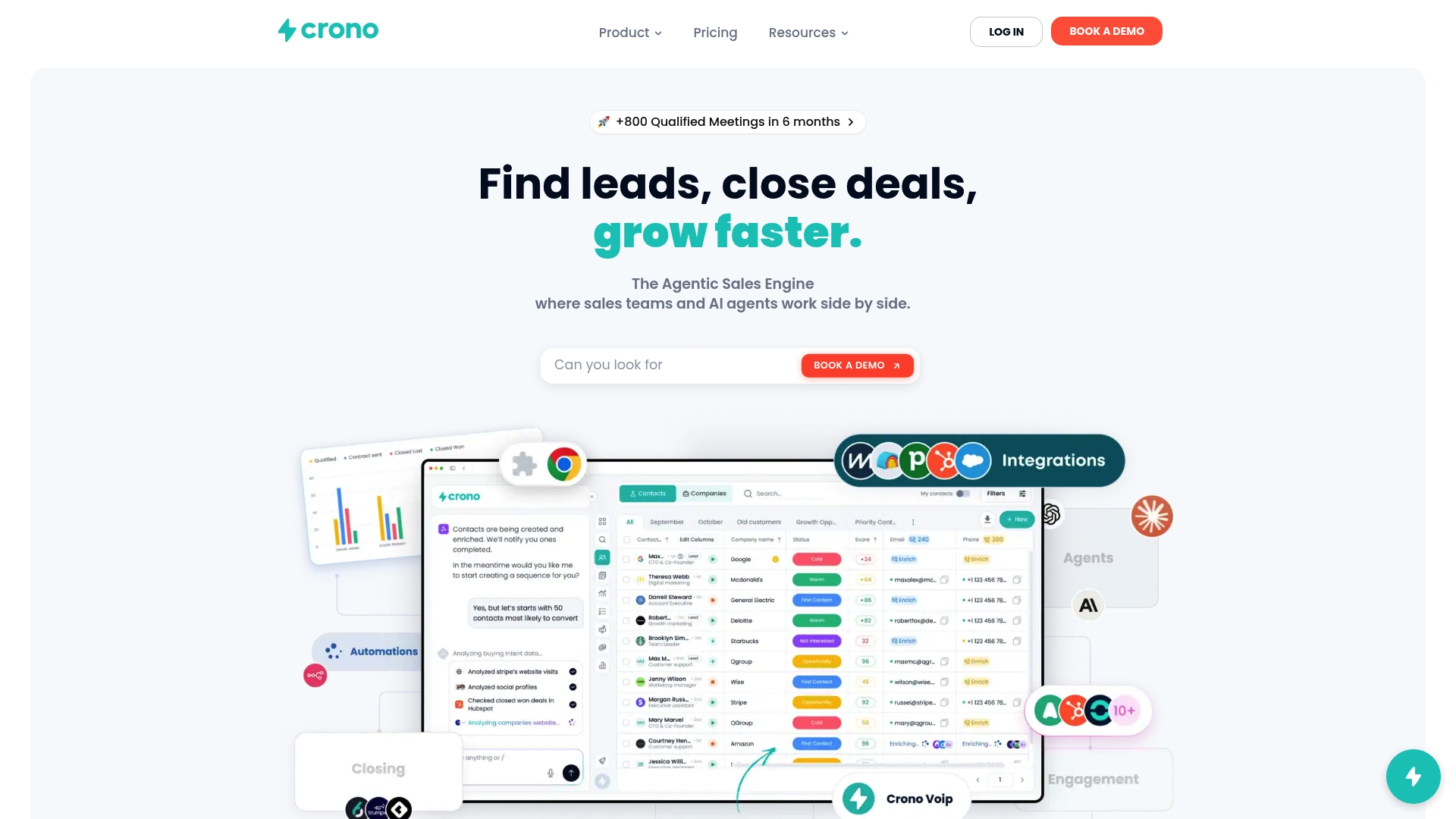
Crono’s sales orchestration platform connects signals, data, and execution in one place, giving you full visibility into pipeline health and conversion performance across every stage. Teams using Crono can also deploy AI sales agents that work alongside human reps to accelerate follow-up and keep deals moving. If you are ready to build a process that converts consistently, Crono gives you the execution layer to do it.
FAQ
What is a good B2B sales conversion rate?
A good overall B2B conversion rate is 2–5% for software companies and 5–8% for professional services. Stage-specific rates of 15–25% from qualified lead to opportunity and 25–40% from proposal to close are considered healthy benchmarks.
How do you calculate B2B sales conversion rate?
Divide the number of conversions at a given stage by the total number of prospects entering that stage, then multiply by 100. Apply this formula separately at each funnel stage for the most useful diagnostic view.
What causes low B2B conversion rates?
The most common causes are poor ICP fit, slow lead response, stale pipeline deals, and single-threaded buyer relationships. Fixing lead quality and response speed typically produces the fastest gains.
How does lead response time affect conversion?
Leads contacted within 5 minutes convert 21 times better than those reached after 30 minutes. Automated lead routing is the most reliable way to consistently hit that response window.
How often should B2B teams review conversion metrics?
Weekly pipeline reviews are the standard for high-performing teams. Monthly reviews are the minimum for tracking meaningful trends across funnel stages.
