
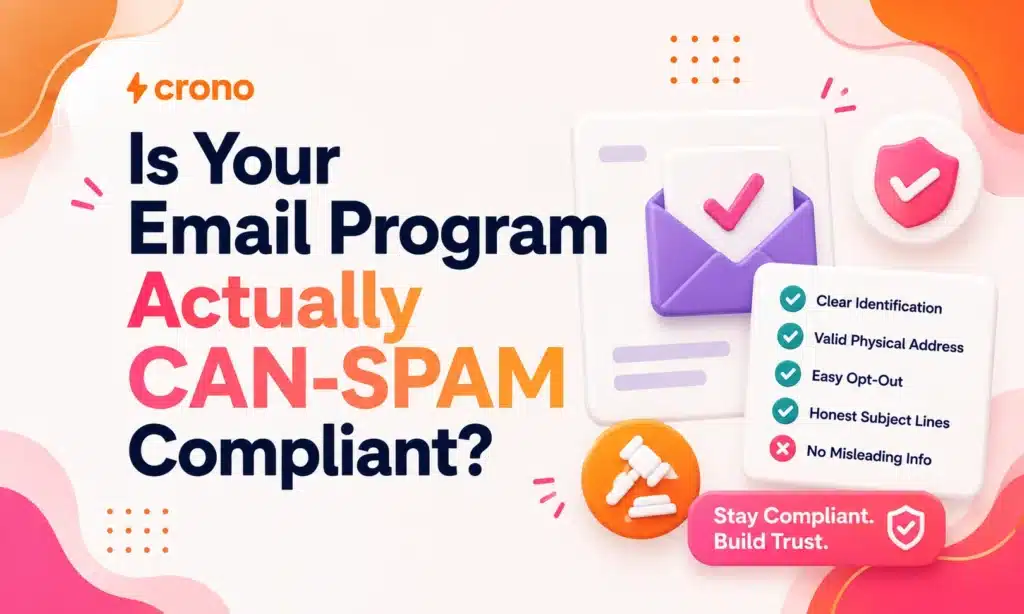
Yes, CAN-SPAM applies to any commercial email you send to U.S. recipients, including B2B messages sent to a work inbox. You need seven things in place: accurate headers, honest subject lines, ad disclosure, a valid postal address, a one-step opt-out, a 10-business-day honor rule, and oversight of any vendor sending on your behalf. Skip one, and you’re exposed to per-email fines that add up fast.
TL;DR:
- Accurate header information, honest subject lines, and a clear ad disclosure are essential to avoid penalties and build trust with recipients.
- Regularly testing unsubscribe links, centralizing suppression lists, and auditing vendor contracts are high-impact operational steps for ongoing compliance.
- Misleading header data or buying scraping contact lists significantly increases the risk of enforcement actions and fines.
- Clarify the primary purpose of emails using the three-factor test to prevent mistakenly classifying commercial messages as transactional.
- Immediate action and thorough documentation are crucial if flagged for violations, with proofs like suppression logs holding significant weight.
Table of Contents
- The Seven-Rule CAN-SPAM Compliance Checklist
- What CAN-SPAM Violations Actually Cost You
- Is That Email Commercial or Transactional? The Primary-Purpose Test
- Building an Unsubscribe Process That Won’t Fail
- Common Mistakes That Draw Regulatory Attention
- If You’ve Been Flagged: An Incident-Response Checklist
- Why This Is Revenue Protection, Not Legal Overhead
- Sources
The Seven-Rule CAN-SPAM Compliance Checklist
Every rule maps to something concrete you can build into a template or automation workflow. The FTC’s compliance guide lays out the seven core requirements, and none of them are optional, regardless of company size or list volume.
- Accurate headers: Your “From,” “To,” and routing information must identify you as the sender. No disguised domains, no misleading reply-to addresses.
- Non-deceptive subject lines: If the email is a promotion, the subject line has to say so, or at least not contradict it.
- Ad identification: Somewhere clear in the message, disclose that it’s an advertisement.
- Valid postal address: Include a street address, a USPS-registered PO Box, or a private mailbox registered with a commercial mail receiving agency.
- One-step opt-out: A reply email or a single-click web page. No login walls, no surveys before unsubscribing.
- 10-business-day honor rule: Process every opt-out within 10 business days, and keep that opt-out mechanism live for at least 30 days after the send.
- Vendor monitoring: If an agency or ESP sends on your behalf, you’re still on the hook for what they do.
CAN-SPAM also bars charging a fee, requiring extra personal information, or making someone log in just to unsubscribe. And you can’t sell or transfer opted-out addresses to anyone except a compliance vendor helping you honor the request.
Pro Tip: Pull a random sample of your last 20 sent campaigns and manually click every unsubscribe link. Broken links are the single most common violation auditors find, and they’re the easiest one to fix before someone else finds it.
What CAN-SPAM Violations Actually Cost You
As of January 2025, the maximum civil penalty is set per individual non-compliant email, adjusted annually for inflation. That’s not per campaign. That’s per message, which means a single broken unsubscribe link sitting live for a week across a 50,000-person send list carries theoretical exposure most legal teams would call catastrophic.
Enforcement comes from three directions:
- The FTC, which brings the majority of civil actions.
- State attorneys general, who can sue on behalf of residents.
- Internet service providers, who can pursue their own claims for unwanted email flooding their networks.
Aggravated violations, like address harvesting, dictionary attacks, or falsified registration at scale, cross into criminal territory under 18 U.S.C. § 1037, carrying fines up to several million dollars and prison time of multiple years.
The Verkada settlement is the case worth studying: a multi-million dollar amount resolved an FTC suit built largely around missing unsubscribe mechanisms. The lesson isn’t that Verkada was reckless. It’s that opt-out failures, the most fixable item on this list, are what regulators actually go after.
Is That Email Commercial or Transactional? The Primary-Purpose Test
Not every email you send falls under the full weight of CAN-SPAM’s rules. Transactional and relationship messages, like order confirmations, shipping updates, or account notices, get lighter treatment. But the line between “transactional” and “commercial” isn’t always obvious, and the CAN-SPAM Rule at 16 C.F.R. § 316.3 gives regulators a specific test to apply.
Run every ambiguous message through these three factors before you send:
- What does the subject line suggest? If it implies a deal or promotion, treat it as commercial even if the body is mostly transactional.
- Where does the promotional content sit? Promotional material placed at the top of the email carries more weight than a footer mention.
- How much of the email is promotional? A shipping confirmation with a small “10% off your next order” line stays transactional. A newsletter that’s 80% product pitch with a order-status line buried at the bottom is commercial.
B2B outreach almost always lands on the commercial side of this test, and that surprises a lot of sales teams. A cold email pitching your software to a director at another company follows the same rules as a consumer marketing blast. There’s no B2B carve-out in the statute.
Building an Unsubscribe Process That Won’t Fail
Compliance breaks down at the operational layer more often than the legal one. Here’s how to build controls that hold up under scrutiny.
Test your opt-out mechanism monthly, not once. A one-step unsubscribe link that worked at launch can break after a template redesign or an ESP migration. Automated monitoring that clicks the link on a schedule catches this before a regulator does.

Centralize your suppression list. If your sales team, marketing team, and any outside agency are pulling from separate lists, you will eventually email someone who opted out through a different channel. Scrub against a single suppression source as close to send time as commercially possible, and log the timestamp of that scrub.
Put compliance clauses in every vendor contract. The FTC is explicit that you can’t contract away liability: both the advertiser and the sender can be named in an enforcement action. If an agency manages your campaigns, require quarterly audit rights and documented suppression syncs in the contract itself.
Authenticate your domain. SPF, DKIM, and DMARC don’t satisfy CAN-SPAM directly, but they protect the sender reputation that compliance is ultimately meant to preserve, and ISPs watch complaint rates closely when deciding whether to filter you into spam.
A marketing automation checklist built around these sync points helps teams operationalize suppression management instead of treating it as a one-time setup task.
Pro Tip: Assign one named owner for suppression list health. When responsibility is split across marketing, sales, and IT, opt-outs slip through the cracks because everyone assumes someone else caught it.
Common Mistakes That Draw Regulatory Attention
Most CAN-SPAM problems trace back to a handful of repeat offenders:
- A hidden or nonfunctional unsubscribe link, or one that takes more than 10 business days to actually process.
- Subject lines that misrepresent the content, or header information that obscures who’s really sending the message.
- Buying or scraping contact lists instead of building them, which routinely produces addresses that already opted out somewhere else.
- Treating opt-outs as brand-specific when a recipient reasonably expected it to cover your whole company.
If You’ve Been Flagged: An Incident-Response Checklist
If you discover a compliance gap, whether through an ISP suspension, an FTC inquiry, or a state AG complaint, speed and documentation matter more than explanation.
- Stop the send immediately and preserve every log: send timestamps, opt-out records, and suppression list snapshots.
- Pull your vendor contracts and any correspondence showing what you instructed your ESP or agency to do.
- Loop in counsel and your ESP before responding to any inquiry, and start drafting a remediation timeline.
Pro Tip: Enforcement authorities almost always ask for proof of process, not just intent. A documented suppression-scrub log carries more weight than a statement that you “take compliance seriously.”
Why This Is Revenue Protection, Not Legal Overhead
Compliance work gets filed under “legal risk,” but that undersells it. A sender reputation damaged by spam complaints affects inbox placement for every campaign that follows, commercial or not. Treat the seven rules as an ongoing operational discipline, not a one-time checklist you complete before launch.
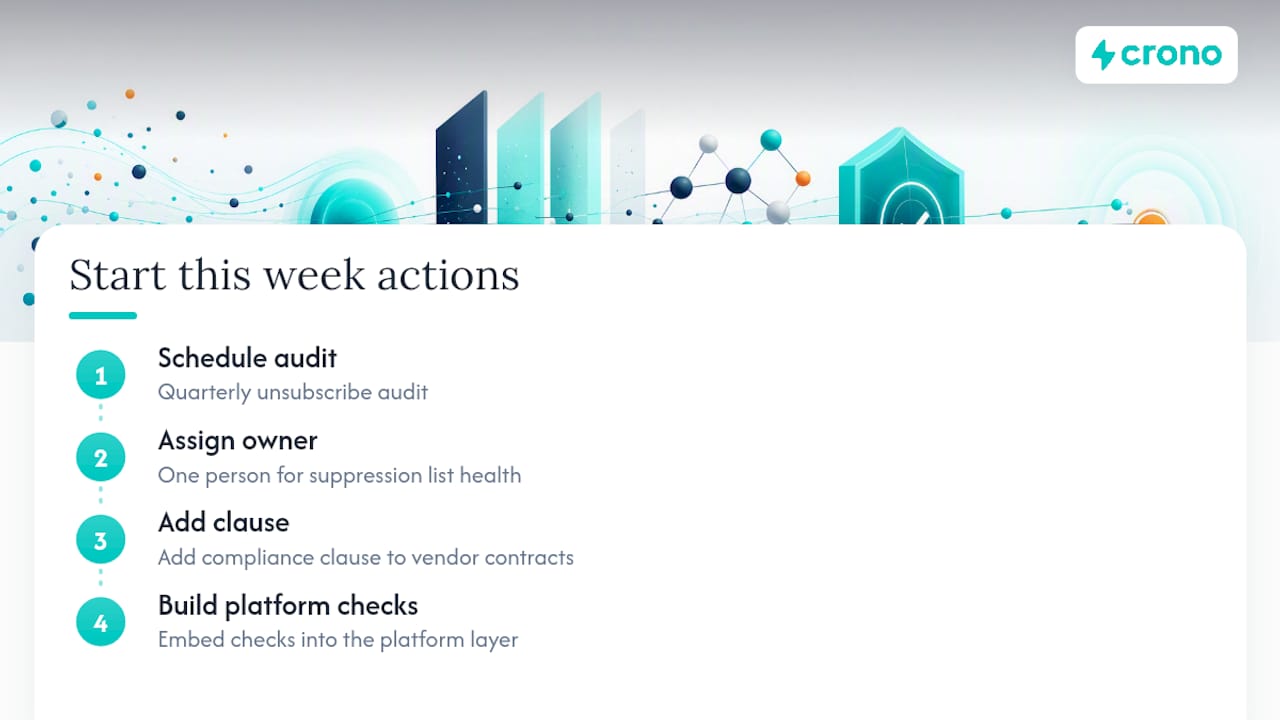
Start this week: schedule a quarterly unsubscribe audit, name one person accountable for suppression list health, and add a compliance clause to every vendor contract you renew. Teams running automated outreach at scale tend to build these checks into the platform layer instead of relying on manual review, which is the difference between catching a broken link in an audit and catching it in an FTC letter.
Sources
- CAN-SPAM Act: A Compliance Guide for Business | Federal Trade Commission
- 16 C.F.R. Part 316 (CAN-SPAM Rule)
- Justice Department press release on Verkada settlement
- CAN-SPAM Act criminal liability explanation | LII / Cornell Law
