
Your closing line has one job: restate the CTA as a single, low-friction next step. The formula is simple. State the ask, reduce the effort to say yes, and add a time option or light urgency when the sequence stage warrants it. For a meeting ask, that looks like this:
“Would Tuesday or Thursday at 2 PM work for a 15-minute call, or does another time suit you better?”
Place your primary ask near the top of the email. The closing line is reinforcement, not introduction. According to behavioral design guidance, the request-first structure keeps the prospect’s attention on the action while the body provides context. Your final sentence should never surprise the reader with a new ask.
- One explicit next step per close
- Match the CTA to the sequence stage (soft ask for cold, direct scheduling for warm)
- Keep the closing line to one sentence
- Add a professional sign-off immediately after
Table of Contents
- Do/don’t rules every team should enforce
- Five closing-line frameworks you can adapt today
- Copy-and-paste closing lines by scenario
- When should you use “Thanks in advance”?
- How to A/B test closing lines and measure lift
- Crono makes closing-line testing faster and more precise
- Key Takeaways
- The experiment worth running this quarter
- Cited sources and further reading
Do/don’t rules every team should enforce
Short rules beat long guidelines when you’re rolling out templates across an SDR team. Here are the ones that matter most, followed by a side-by-side comparison.
Do:
- State one explicit next step (“Book a 15-minute call here” or “Reply YES and I’ll send the one-pager”)
- Keep the closing line to a single sentence
- Offer two time options for scheduling asks
- Use a text link, not a button, in cold outreach — buttons can read as too salesy and hurt deliverability
- Match CTA specificity to sequence stage: soft asks for touch 1, direct scheduling for touch 3+
Don’t:
- Use vague openers like “Thoughts?” without a suggested next step
- Stack two asks in one closing line
- Bury the CTA in the final paragraph without restating it
- Use prominent CTA buttons in cold email
| Weak closing line | Why it fails | Stronger replacement |
|---|---|---|
| “Thoughts?” | No next step; high cognitive load | “Worth a 15-minute look? Reply and I’ll send a slot.” |
| “Let me know if you’re interested.” | Passive; no friction reduction | “Does Tuesday at 2 PM work, or would Thursday suit you better?” |
| “I’d love to connect and discuss synergies.” | Vague; no specific ask | “Can I show you how [Company] reduced churn in one quarter?” |
| “Please find the deck attached and let me know.” | Buries the ask; no clear next step | “The deck is attached — does a walkthrough on Friday make sense?” |
| “Feel free to reach out anytime.” | No urgency; no path forward | “I have two slots open this week — want me to hold one for you?” |
Five closing-line frameworks you can adapt today
These five frameworks cover the most common sequence stages. Each one is a one-line template with a brief note on when to use it.
-
Interest-based micro-ask (cold outreach) “Is [specific outcome] something your team is actively working on this quarter?” Use this on touch 1 when you have no prior signal. It asks for a yes/no, not a calendar commitment, and keeps initial touches under 80 words to maximize read-and-reply rates.
-
Direct scheduling prompt (warm/prospect stage) “Would [Day] at [Time] work for a 15-minute call, or does [Alternative Day] suit you better?” Deploy this on touch 3 or later, or after any positive signal (link click, reply, LinkedIn engagement). Two options reduce friction without overwhelming the prospect.
-
Resource offer close (value-first approach) “I put together a one-pager on how [Peer Company] solved [Problem] — want me to send it over?” Works well when the prospect has shown interest but hasn’t committed to a call. The ask is tiny; the value is concrete.
-
Breakup/assumption close (late sequence) “I’ll assume the timing isn’t right and won’t follow up again — but if [Problem] becomes a priority, reply here and I’ll pick it up.” Use on the final touch of a sequence. It removes pressure, often triggering a reply from prospects who were simply busy.
-
Small-commitment step (intention-action gap) “Reply YES and I’ll send the case study — no call needed yet.” Closes the intention-action gap by making the next step so small it’s easier to say yes than to ignore. Sequence templates map this type of micro-CTA to early touches specifically to preserve response rates.
Pro Tip: For cold B2B outreach, always use a text link rather than a button. Conversational CTAs outperform designed buttons in deliverability and tone.
Copy-and-paste closing lines by scenario
These are ready to use. Swap the tokens in brackets for real data.
Cold outreach (touch 1) “Is reducing [specific metric] something [Company] is focused on this quarter? Happy to share what worked for [Peer Company].” Sign-off: Best, [Name] Rationale: Ties the ask to a live business priority. Personalization token: the metric your prospect tracks.
Second or third follow-up “Still worth a quick look — does [Day] at [Time] work, or would [Alternative] be better?” Sign-off: Thanks, [Name] Rationale: Restates the ask without re-explaining the value prop. Works because ending with a scheduling prompt increases reply likelihood.
Initial meeting ask “I have 15 minutes blocked on [Day] — want me to hold it for you, or does another time work better?” Sign-off: Best regards, [Name] Rationale: Specific time + low-friction alternative. Use after a LinkedIn connection or a content download signal.
Demo-to-contract handoff “Based on what we covered, the next step is a 30-minute commercial call with [Decision Maker] — does [Day] work on your end?” Sign-off: Looking forward to it, [Name] Rationale: Names the next step explicitly and pulls in the decision maker. See high-converting templates for sales leaders for more handoff patterns.
Small-ask commitment close “Reply YES and I’ll send the one-pager — no call needed yet.” Sign-off: Thanks in advance, [Name] Rationale: Lowest-friction ask in the taxonomy. Ideal for prospects who have gone quiet after initial interest.
When should you use “Thanks in advance”?
The Boomerang dataset of 350,000 email threads found that gratitude sign-offs like “Thanks in advance” achieved a 65.7% response rate, the highest of any sign-off tested. That number holds for small, easy-to-agree asks. It does not hold universally.
Use gratitude closings when:
- The ask is small (a yes/no reply, a one-pager request, a 15-minute call)
- You’re on touch 2 or 3 and have already established some goodwill
- The prospect’s persona is collaborative rather than transactional
Avoid them when:
- The ask is large (a multi-stakeholder demo, a contract review, a budget commitment)
- The close could read as presumptive (“Thanks in advance for looping in your CFO”)
- You’re on touch 1 with a cold, senior buyer who hasn’t signaled interest
A quick decision rule: if the prospect could reply in under 30 seconds, “Thanks in advance” is appropriate. If the ask requires them to coordinate with others or commit resources, use a neutral sign-off like “Best regards” instead.
How to A/B test closing lines and measure lift
Testing closing lines is one of the highest-ROI experiments a RevOps team can run. The variables are small, the feedback loop is fast, and the lift compounds across every sequence.
Primary metrics to track:
- Reply rate (direct response to the closing line variant)
- Meeting rate (replies that convert to a booked call)
- Conversion-to-opportunity (meetings that enter the pipeline)
- Downstream opportunity value (optional; useful for later-stage closes)
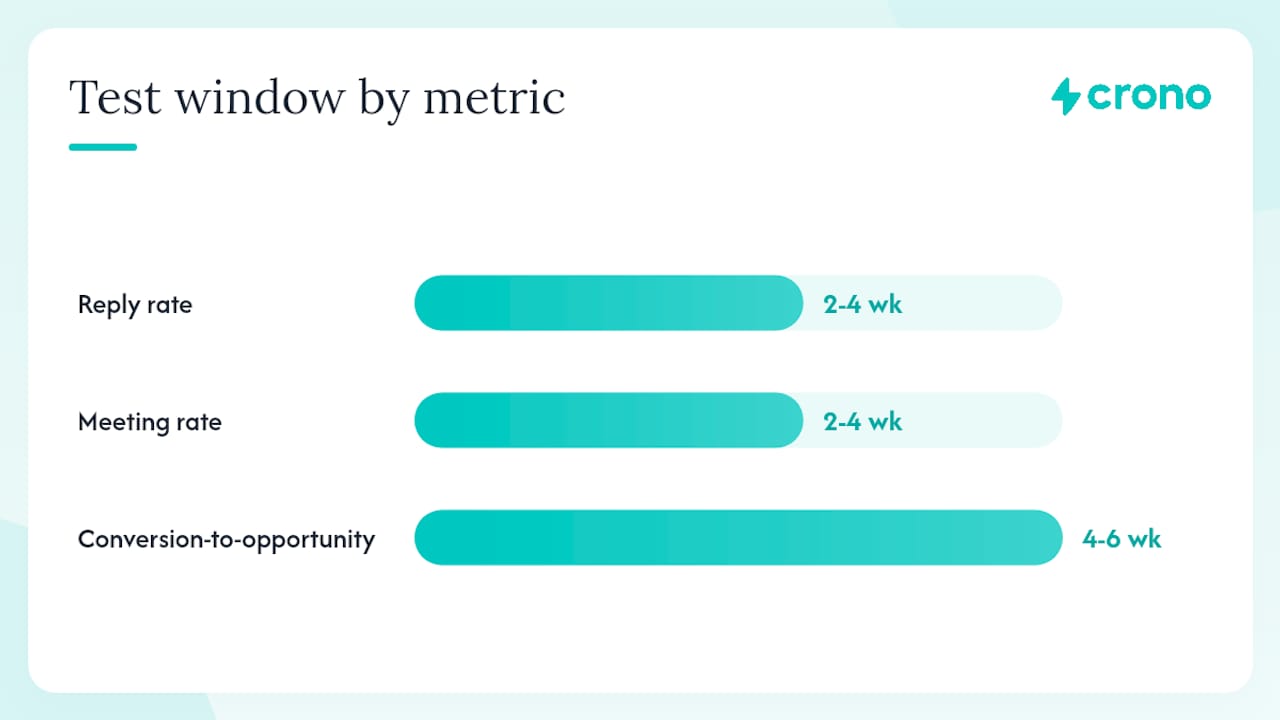
Sampling guidance: Run each variant for at least 2–4 weeks to avoid weekday sampling bias. For reply-rate tests, aim for a minimum of 200 recipients per variant before drawing conclusions.
| Metric | Minimum sample (per variant) | Test window | Expected lift range |
|---|---|---|---|
| Reply rate | 200 recipients | 2–4 weeks | Qualitative improvement expected |
| Meeting rate | 200 recipients | 2–4 weeks | Qualitative improvement expected |
| Conversion-to-opportunity | 200 recipients | 4–6 weeks | Qualitative improvement expected |
Test design options:
- Split-by-recipient (parallel): Assign variant A to odd-numbered records, variant B to even. Best for large lists.
- Within-sequence alternation: Alternate variants across sequence sends. Useful for smaller lists where parallel splits would under-power each arm.
Testing checklist:
Pre-test: Define the primary metric, set the minimum sample size, and log which variant is active per recipient in your sequence tool.
During test: Do not change the subject line or email body. Control for send day and time. Monitor for significant imbalances in open rate (which would indicate a deliverability issue, not a closing-line effect).
Post-test: Attribute meeting bookings to the variant. Calculate the lift. If the winner clears your significance threshold, promote it to the default template. Outbound sequence best practices recommend sequences of 4–7 touches, which gives you enough data points per recipient to test across multiple stages.
Crono makes closing-line testing faster and more precise
Faster test cycles and centralized attribution are where most RevOps teams lose ground on closing-line optimization. Running variants manually across a 7-touch sequence, for 15 reps, across three personas, generates more data than a spreadsheet can reliably track.
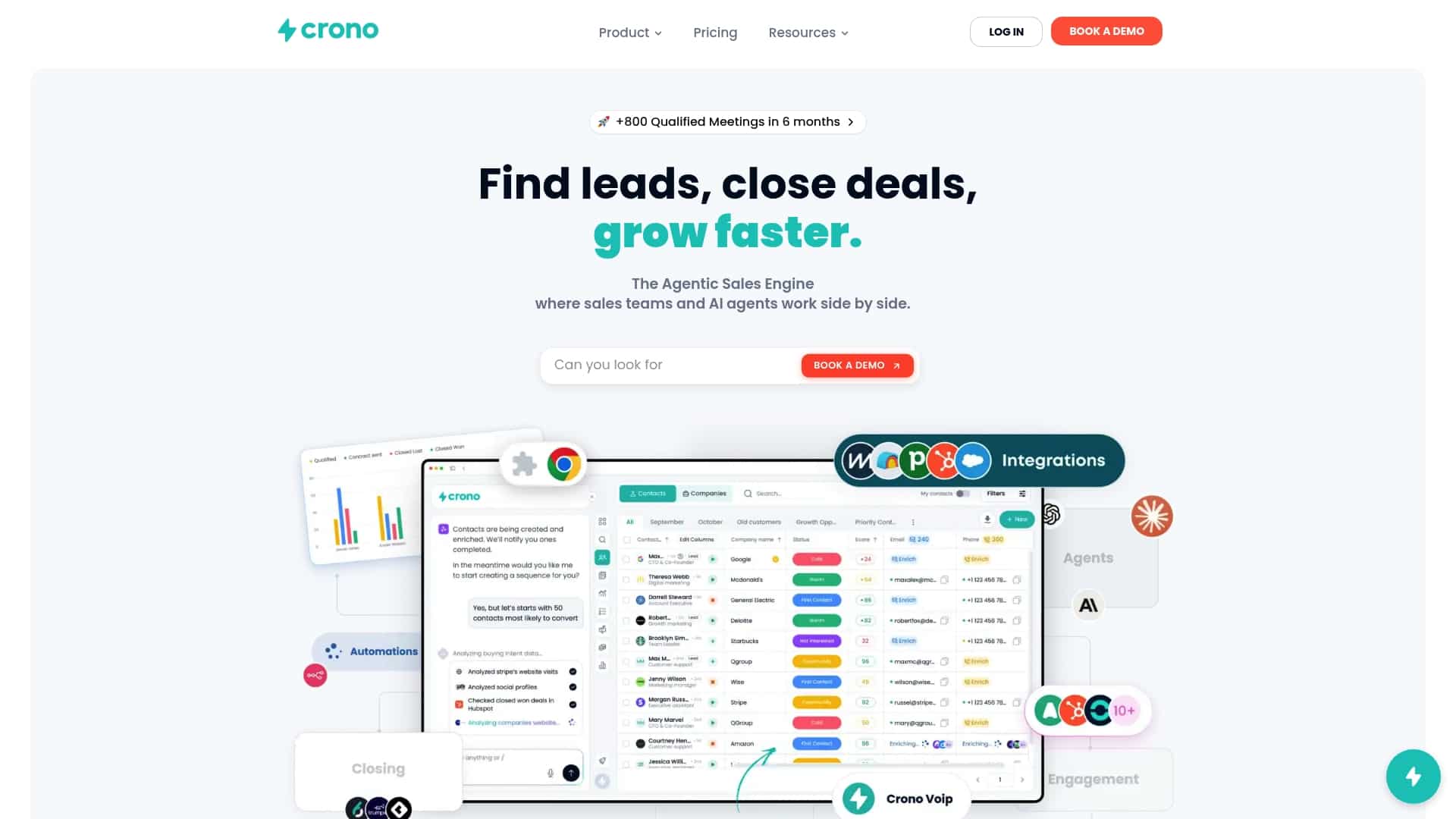
Crono’s sales engagement platform connects sequence orchestration, A/B variant management, and reply/meeting attribution in one place. You can deploy two closing-line variants across a segment, tag each recipient with the active variant, and pull meeting conversion data by variant without leaving the platform. Tokenized template libraries mean your SDRs always send the right close for the sequence stage, with the right personalization fields populated automatically.
The practical result: a test cycle that takes 2–4 weeks instead of a quarter, with attribution clean enough to act on. Start with a demo to see how Crono runs closing-line experiments at scale across your outbound motion.
Key Takeaways
The most effective closing line restates the CTA as one low-friction next step, matched to the sequence stage, in a single sentence.
| Point | Details |
|---|---|
| Canonical closing-line formula | One sentence, one explicit next step, matched to sequence stage, with a time option or light urgency when appropriate. |
| Top three templates to test first | Interest-based micro-ask (cold), direct scheduling prompt (warm), and small-commitment “Reply YES” close (re-engagement). |
| Gratitude sign-offs | “Thanks in advance” achieved a 65.7% response rate in a 350,000-thread dataset — use it for small, easy asks only. |
| A/B test minimum | Run each variant for 2–4 weeks with at least 200 recipients per variant before drawing conclusions. |
| Crono for rollout | Crono automates variant tagging, tokenized template deployment, and reply/meeting attribution across sequences. |
The experiment worth running this quarter
Most CROs treat the closing line as a copywriting detail. It isn’t. It’s the last behavioral prompt before a prospect decides whether to reply, and the peak-end rule means it carries disproportionate weight relative to its length.
The experiment worth prioritizing right now: take your two highest-volume sequence stages, write one alternative closing line for each using the frameworks above, and split 1,000 recipients evenly across the variants. Define success as a 10% relative lift in reply rate. That threshold is achievable within a single quarter, and the compounding effect across a full sequence library is material.
What most teams miss is that the closing line also signals intent. A vague close tells the prospect you’re not sure what you want from them. A precise one tells them you’ve thought about their time. That distinction shows up in reply rates, and it shows up in how prospects perceive your brand before they’ve ever spoken to a rep. For sales closing practice that reinforces these patterns at the rep level, roleplay is one of the fastest ways to make the right close instinctive rather than deliberate.
Cited sources and further reading
- How to End an Email: Email Sign-Offs (Boomerang blog)
- Persuasive email writing: the behavioural science playbook (Sue Behavioural Design)
- [Email call to action best practices: The complete guide [2026] — Stripo.email](https://stripo.email/blog/email-call-action-best-practices-examples/)
- Outbound Sales Outreach Messaging Playbook for 2026 (Prospeo)
- Email Sequence Strategy to 3x Your Replies in 2026 (Cleverly)
- How to Close an Email: Proven Strategies for B2B Sales in 2025 (Martal)
