

Closing of sales means finalizing a buyer’s commitment, whether that’s a signature, a payment, or a locked-in next step that moves the deal forward. The single highest-leverage habit for closing more deals isn’t a clever line. It’s securing a calendar-bookable next action on every call, no exceptions.
That’s the Next-Step Close, and it works because it turns “let me think about it” into a scheduled follow-up with a real date attached. But no technique, including this one, rescues a call where discovery was thin or the buyer’s criteria were never aligned.
- Definition: Closing of sales is securing a concrete commitment, whether financial or procedural, after value has been demonstrated.
- Highest-leverage habit: Book a specific next step, calendared before you hang up, every single time.
- Precondition: None of this works without proper discovery. Skipping that step is why most closing attempts fail.
Key Takeaways
Closing works best when it’s treated as an earned, moment-matched action built on solid discovery, not a scripted finish line.
| Point | Details |
|---|---|
| Adopt the Next-Step Close | Book a calendared next action on every call, without exception. |
| Match technique to buyer state | Use diagnostic questions for undecided buyers, assumptive closes only once budget and stakeholders are confirmed. |
| Fix vague next steps first | Require a specific calendared action before logging any call as complete. |
| Measure what matters | Track next-step booking rate and close attempts per opportunity, not just final win rate. |
| Systematize with Crono | Crono centralizes calls and automates follow-up so booked next steps don’t fall through the cracks. |
Table of Contents
- What Closing of Sales Means and Why Timing Determines Success
- Which Closing Techniques Work Best, and When Should You Use Them?
- How Do You Match a Closing Technique to the Buyer’s State?
- What Closing Mistakes Are Costing You the Sale?
- How Can You Systematically Improve Your Close Rate?
- Scripts and Example Closing Lines You Can Use Today
- What Resources Help Teams Enforce Better Closing Habits?
- A Manager’s Take on Coaching Better Closers
- Make the Next-Step Habit Automatic With Crono
- Sources
What Closing of Sales Means and Why Timing Determines Success
Closing sits at the end of a sequence, not apart from it. Closing is generally defined) as the final phase of the sales cycle, when the seller secures the buyer’s commitment after demonstrating fit and value elsewhere in the conversation.
That distinction matters because reps often try to force a close in the wrong phase. A close attempted before discovery is complete, before budget and timeline are confirmed, before the right stakeholders are in the room, tends to stall. A clean discovery process makes closing techniques for sales feel almost unnecessary, because the buyer has already told you what they need to say yes.
Think of closing less as a single dramatic moment and more as a series of small agreements:
- Agreement on the next step at the end of every call.
- Agreement on the criteria that define a good decision.
- Agreement on who else needs to be involved before a contract moves.
Each of these micro-commitments is itself a close. String enough of them together, and the final ask stops feeling like a pitch. It feels like the obvious next box to check.
Which Closing Techniques Work Best, and When Should You Use Them?
There’s no single best closing sales technique. There’s a right technique for the moment you’re actually in, which is why treating this as a mapping exercise, not a script memorization exercise, changes outcomes. HubSpot’s rundown of common closing techniques covers most of the field; here’s how to apply the ones that matter most in B2B deals.
- Next-Step / Calendar Close. Use this at the end of every single call, regardless of how the conversation went. Script: “Let’s get 20 minutes on the calendar next Tuesday so I can walk your team through pricing. Does 2 PM work?” This is the technique you deploy on repeat, not the one you save for the finish line.
- Summary Close. Use when the buyer has gone quiet or the conversation has covered a lot of ground. Recap the pain points and agreed value, then ask directly: “Based on everything we’ve covered, does it make sense to move forward with the standard plan?”
- Assumptive Close. Appropriate only after the buyer has confirmed budget, timeline, and stakeholder buy-in. Phrasing: “I’ll get the contract over today. Should I loop in your finance lead, or do you want to route it yourself?” Using this too early reads as pushy.
- Question / Diagnostic Close. Best for surfacing objections that haven’t been voiced yet. Ask: “What would need to be true for this to be a clear yes on your end?” This single question does more work than five follow-up emails.
- Alternative / Option Close. Use when the buyer is stuck between reasonable choices, not stalling outright. Offer two paths: “Would you rather start with the team plan and add seats later, or lock in the annual rate now?”
- Urgency / Calendar-Event Close. Reserve this strictly for genuine deadlines, like a pricing change taking effect or a fiscal-year cutoff. Manufactured urgency (“this offer expires Friday” with no real reason) erodes trust fast.
- Take-Away Close. Use sparingly, when a buyer has been vague for multiple cycles. Script: “It sounds like the timing isn’t right, should we pause this and revisit next quarter?” This can re-engage a stalled buyer, but overusing it reads as manipulative and can end the deal for good.
- Puppy Dog Close. Common in trial-based SaaS. Let the buyer use the product free for a set window before the ask. Works well when your product’s value is obvious in use but hard to explain in a deck.
Short email closing lines matter just as much as call scripts. Prospeo’s research on closing statements found that short, single-question CTAs outperform vague, multi-option asks in follow-up emails. Compare “Happy to answer any questions, let me know your thoughts whenever you get a chance” against “Does Thursday at 3 PM work for a 15-minute call to finalize details?” The second gets replies.
Pro Tip: Keep a running document of the closing lines that actually generated a “yes” on your last ten deals. Most reps default to whatever felt natural in the moment instead of what’s been proven to work with their specific buyers.

How Do You Match a Closing Technique to the Buyer’s State?
Picking the right technique starts with reading where the buyer actually is, not with picking your favorite line. Buyer states break down into a few recognizable categories, and each one calls for a different move.
- Engaged but undecided: The buyer is asking detailed questions but hasn’t committed to a timeline. Use the Question/Diagnostic Close to surface what’s holding them back.
- Aligned but slow-moving: Budget and fit are confirmed, but the deal is stuck in internal process. Use the Summary Close to re-anchor on agreed value and push for a decision date.
- Ready, multiple stakeholders onboard: Explicit budget, timeline, and buy-in across the buying group. This is the moment for an Assumptive or Direct Close.
- Stalled with no clear reason: Repeated soft “yes, let’s talk soon” with no forward motion. This is the rare case for a Take-Away Close.
The signals that tell you a buyer is ready include an explicit budget figure stated out loud, a specific implementation date mentioned unprompted, and more than one stakeholder actively participating in calls rather than just cc’d on emails.
A workable decision flow looks like this: run a diagnostic question to check for hidden objections, follow with a soft test close (“if we solved X, would this move forward?”), then escalate to an assumptive, summary, or direct ask depending on the response. Skipping the diagnostic step is how reps end up asking for the close too early and getting a “let me think about it” that could have been avoided.
Pro Tip: If a buyer hesitates on a soft test close, that hesitation is data. Don’t repeat the same ask louder. Ask what specifically gave them pause.
What Closing Mistakes Are Costing You the Sale?
Most lost deals aren’t lost at the close. They’re lost by mistakes made on the way there, and each one has a fix.
- Asking to close before discovery is complete. Reps push for a decision before confirming budget, timeline, or stakeholders. Fix: build a short qualifying checklist and don’t attempt a close until every box is checked.
- Vague next steps that let deals cool. “I’ll follow up soon” has no accountability built in. Fix: require every call to end with a specific calendared action, not a loose promise.
- Fake urgency and blanket discounting. Manufactured deadlines and knee-jerk discounts train buyers to wait you out. Fix: only invoke urgency around real events, and protect margin by trading concessions for something of equal value, like a faster signature or a longer contract term.
- Over-reliance on a single close type. Reps who only know the Assumptive Close force it into moments where it doesn’t fit. Fix: sequence multiple techniques across a deal cycle so no single ask carries all the pressure. A sales team that sequences micro-closes throughout the cycle tends to see higher overall win rates, because no single moment has to carry the entire weight of the decision.
How Can You Systematically Improve Your Close Rate?
Improving close rates is a coaching and measurement problem before it’s a scripting problem. Here’s a routine that works for individual reps and sales managers running a team.
- Run a call review routine. Pull three to five recent closing attempts each week. Mark exactly when the close was attempted relative to discovery, and flag any call that ended without a next step booked.
- Track the right metrics. Watch next-step booking rate, number of close attempts per opportunity, and win rate broken out by deal stage, not just the final win/loss number.
- Run short role-plays. A 15 to 20 minute weekly session where one rep plays a specific buyer state (stalled, aligned but slow, ready) sharpens technique selection faster than any deck.
- Change the process, not just the behavior. Make next-step booking a mandatory field before a call can be logged as complete in your CRM. That single rule does more to fix inconsistent closing than any script update.
Pro Tip: If a deal stalls after a close attempt, the right move is a diagnostic follow-up to surface the unstated objection, not a repeat of the same closing line with more enthusiasm.
Scripts and Example Closing Lines You Can Use Today
Adaptable language beats memorized scripts, but having a starting point speeds up the learning curve. Here’s what to say, and when to say it.
Call scripts:
- Next-Step: “Let’s lock in 30 minutes next week to walk through the proposal with your team. What’s a good day?”
- Summary: “So we’ve confirmed budget, a Q3 rollout, and sign-off from your ops lead. Does it make sense to finalize this week?”
- Assumptive: “I’ll send the agreement over today. Want me to CC your procurement contact directly?”
- Question: “What’s the one thing that would need to be true for this to be an easy yes?”
Email templates:
- Quick follow-up: “Following up on our call. Does Thursday at 2 PM work for a quick 15-minute review of next steps?”
- Send agreement: “Attached is the agreement we discussed. Happy to jump on a call this week if anything needs clarifying before signature.”
- Champion enablement: “Here’s a one-page summary you can share internally, covering the core ROI numbers and implementation timeline, in case it helps get buy-in from the rest of your team.”
For enterprise deals, arm your internal champion with language that survives being forwarded without you in the room. A one-page ROI summary that states the cost of inaction in plain numbers travels better through a procurement chain than any call recording, and it’s worth pairing with a strong follow-up email template so the champion always has something concrete to send. If the deal has reached the contract stage, removing friction with e-signature tools like BeeSign can shave days off the final step.
What Resources Help Teams Enforce Better Closing Habits?
Closing consistency is a systems problem as much as a skills problem. Reps who write down a next step still lose track of it if that action lives in a notebook instead of a shared workflow, which is exactly the gap orchestration tools are built to close.
- Centralizing call notes and next-step commitments in one workflow removes the manual step where good intentions get lost between calls.
- Automated follow-up sequences make sure a booked next step actually gets a reminder, instead of relying on memory.
- A closing line playbook built around deal moment, rather than a generic script list, gives reps a reference they’ll actually use mid-call.
- Reviewing sales engagement practices alongside call data shows where next steps are getting skipped across a whole team, not just one rep.
A Manager’s Take on Coaching Better Closers
The best sales managers treat closing as a coaching metric, not a talent some reps have and others don’t. Run a weekly call review, track next-step booking rate as seriously as you track pipeline value, and schedule short role-plays that force reps to practice reading buyer state before reaching for a script. Closing should be earned through the quality of everything that came before it, not staged as a theatrical finish reps perform when they sense a deal is close. Teams that treat it as the natural conclusion of good discovery close more deals, and they close them with less drama.
Make the Next-Step Habit Automatic With Crono
Writing “book a next step every call” on a whiteboard is easy. Enforcing it across a twelve-person sales team on a Tuesday afternoon is the hard part, and that’s the gap Crono is built to close. Crono centralizes calls, tracks whether a next action actually got booked, and automates the follow-up sequence so a scheduled step never quietly falls off a rep’s task list.
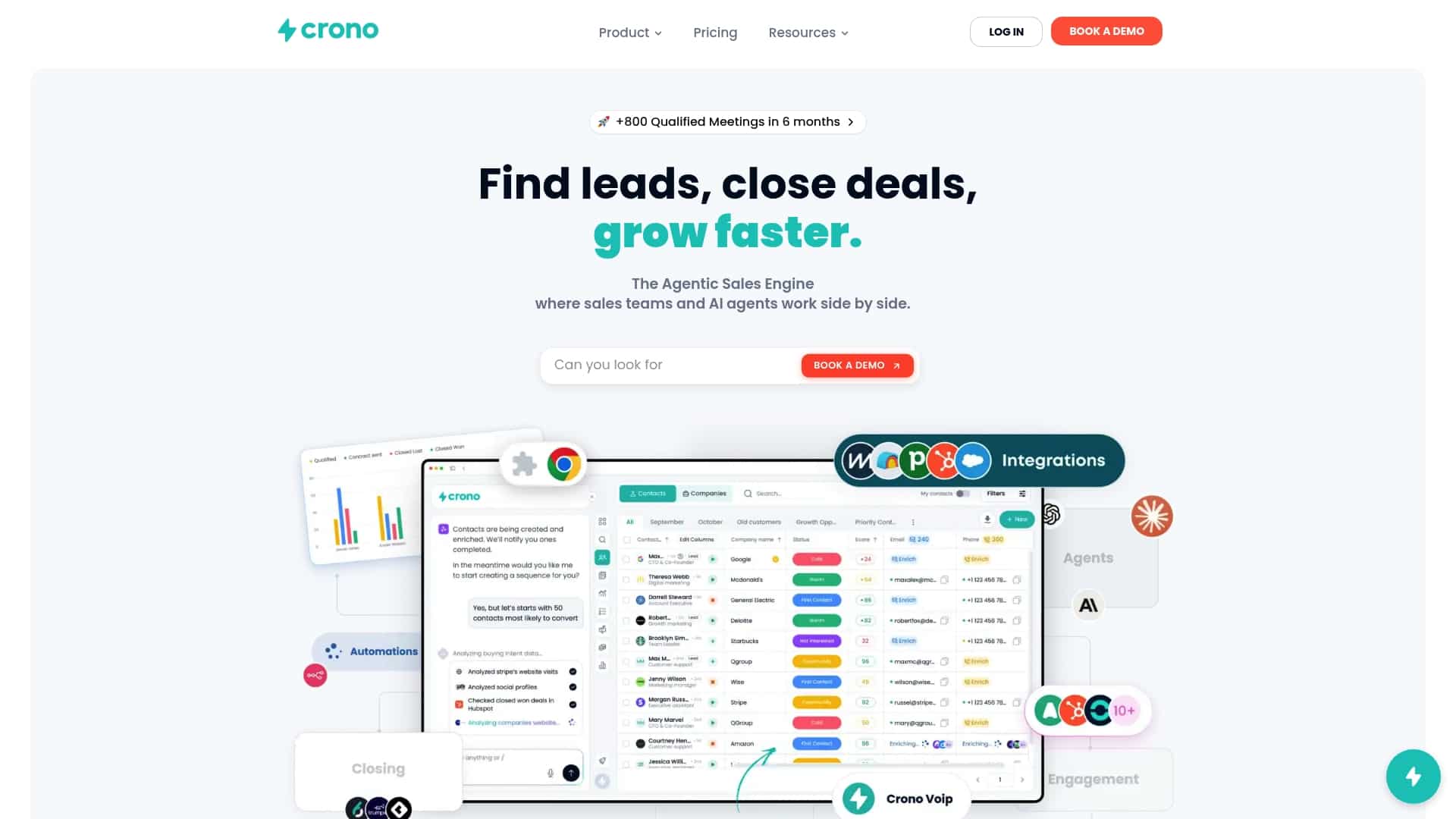
Instead of relying on a rep’s memory or a stray note in a CRM field, Crono’s orchestration layer flags opportunities where no next step exists and routes automated follow-ups so momentum doesn’t die between calls. For managers who want to see what a fully automated execution engine looks like in practice, the guide to building an automated sales engine walks through how orchestration, AI agents, and multichannel outreach work together to keep deals moving. If you’re ready to see it applied to your own pipeline, book a walkthrough of Crono’s sales engagement platform and watch how it enforces the habit your best reps already have.
Sources
- The Best Sales Closing Techniques in 2026: 12 for B2B SaaS — ItsConvo
- How to close a sale: 18 techniques & why they work — HubSpot
- Sales Closing Statements That Work in 2026 — Prospeo
