
1. What is Cold Calling and Why It Still Works in B2B
Cold calling is the practice of reaching out by phone to potential customers who have never expressed direct interest in a product or service. It is one of the oldest outbound channels in B2B — and one of the most misunderstood.
Every year, someone declares cold calling dead. Every year, the data says otherwise.
According to research by Gong and Cognism:
- 69% of B2B buyers accepted a call from a salesperson in the past year.
- 57% of C-level executives prefer to be contacted by phone over email for commercial conversations.
- In high-performing outbound teams, cold calling generates 25–40% of qualified pipeline.
The problem is not the channel. The problem is how it is used.
Cold calling works when it is:
- Relevant — the seller knows the prospect’s context
- Timely — the call arrives at the right moment (triggered by a signal)
- Personalized — the first message does not sound generic
Cold calling fails when it starts with “Hi, how are you today?”
2. The Real Problem: The First 10 Seconds
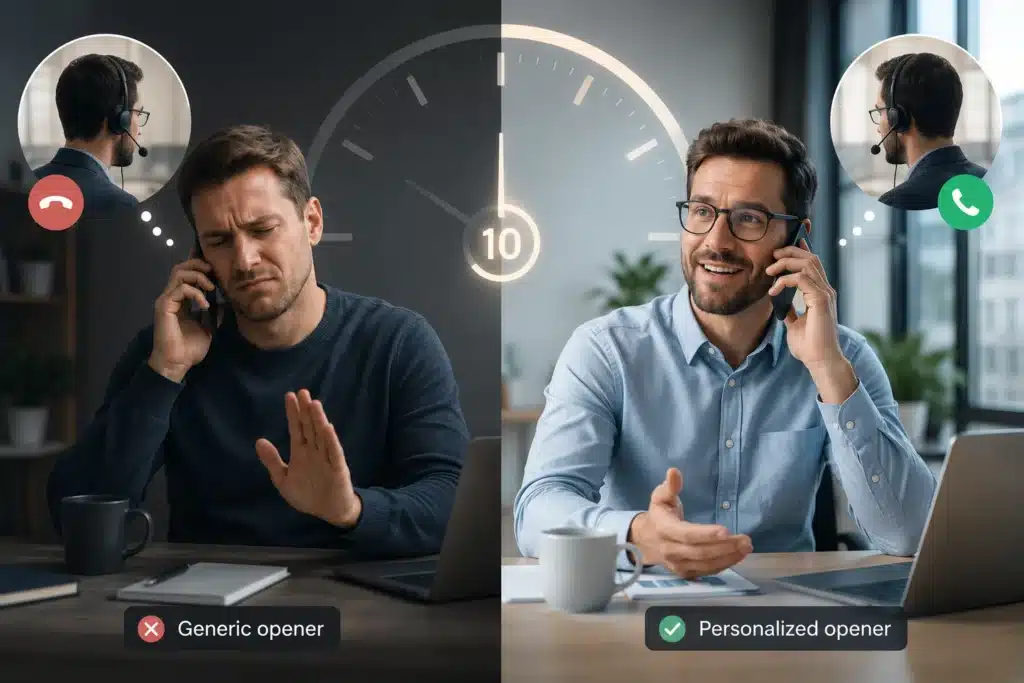
A Gong study on over 100,000 cold calls identified the critical window: the first 10 seconds of the call determine whether the prospect stays on the line or hangs up.
In those 10 seconds, the prospect’s brain is already classifying the call:
- Is this relevant to me?
- Does this person know who I am?
- Is it worth continuing to listen?
The answer depends almost entirely on the opener — the first sentence spoken by the salesperson after the greeting.
A generic opener activates the defensive response (“another sales call”). A personalized, contextual opener creates a micro-moment of genuine interest.
The paradox: every SDR knows they should personalize the opener. Very few have a fast system to do it before each call.
3. The Most Effective Cold Call Opening Techniques
There are five main categories of openers for B2B cold calls, with significantly different conversation rates (prospects who keep listening beyond 30 seconds):
Trigger-Based Opener
References a specific recent event related to the company or prospect: funding round, hiring, product launch, leadership change, geographic expansion.
Why it works: the prospect perceives that the seller did real research. The trigger demonstrates immediate relevance.
Example
“I saw that you just closed an 8M Series A — congratulations. At this stage, sales teams often find they need to scale outbound fast. Is that a priority for you right now?”
Permission-Based Opener
Explicitly asks for permission to continue, disarming the defensive response.
Why it works: honesty builds trust. The prospect feels in control of the conversation.
Example
“I know this is an unexpected call — can I have 30 seconds to explain why I thought of you?”
Name-Drop / Referral Opener
Cites a person or company the prospect knows as a connection point.
Why it works: social proof reduces friction. ‘A contact of mine’ carries more weight than any credential.
Problem Hypothesis Opener
Opens with a specific, quantified challenge the prospect is likely facing.
Why it works: demonstrates understanding of their context. Immediately shifts the conversation from ‘who are you’ to ‘what is my problem’.
Pattern Interrupt Opener
Breaks the typical commercial call frame with something unexpected — radical honesty, measured humor, a provocative question.
Why it works: interrupts the autopilot response of someone who already knows it’s a sales call.
4. How AI Is Changing Cold Calling in 2026
In 2026, AI applied to cold calling does not mean robots making automated calls. It means amplifying the research and personalization capacity of human SDRs before they pick up the phone.
The most common practical applications today:
- Automatic prospect research. Automated prospect research
Before calling, AI analyzes the prospect’s LinkedIn profile, company website, recent news, and intent signals. What used to take 15–20 minutes of manual research now takes under a minute.
- Contextual opener generation. Contextual opener generation
AI tools can generate personalized opening lines based on the prospect’s profile, the seller’s value proposition, and the identified trigger.
- Real-time coaching. Real-time coaching
Conversation intelligence platforms analyze live calls and suggest adjustments during the conversation itself.
- Call scoring. Call scoring
AI automatically evaluates the quality of recorded calls, identifying patterns in top performers.
Result: outbound teams that integrate AI into cold call preparation report significantly higher connection and conversation rates than teams using manual or generic approaches.
5. First Line: The AI Tool for Personalized Openers
First Line is an open-source tool developed by Alex Roggero — co-founder of Crono — designed to solve exactly this problem: giving every SDR and BDR a fast, structured way to build personalized openers before each cold call.
The concept is simple: paste the prospect’s LinkedIn profile, add your company URL, and get 3 ready-to-use openers in under 60 seconds — complete with the technique used and a psychological explanation of why each one works.
Feature | Detail |
Automatic LinkedIn research | Extracts name, role, company, triggers, background |
Website reader | Auto-fills what you sell from your company URL |
5 languages | IT, EN, ES, FR, DE — full UI and AI output |
3 openers per session | Different techniques, verbatim-ready |
Psychological explanation | 4–6 sentences on why each opener works for that profile |
Adaptive greetings | C-level gets formal tone; SDR gets direct tone |
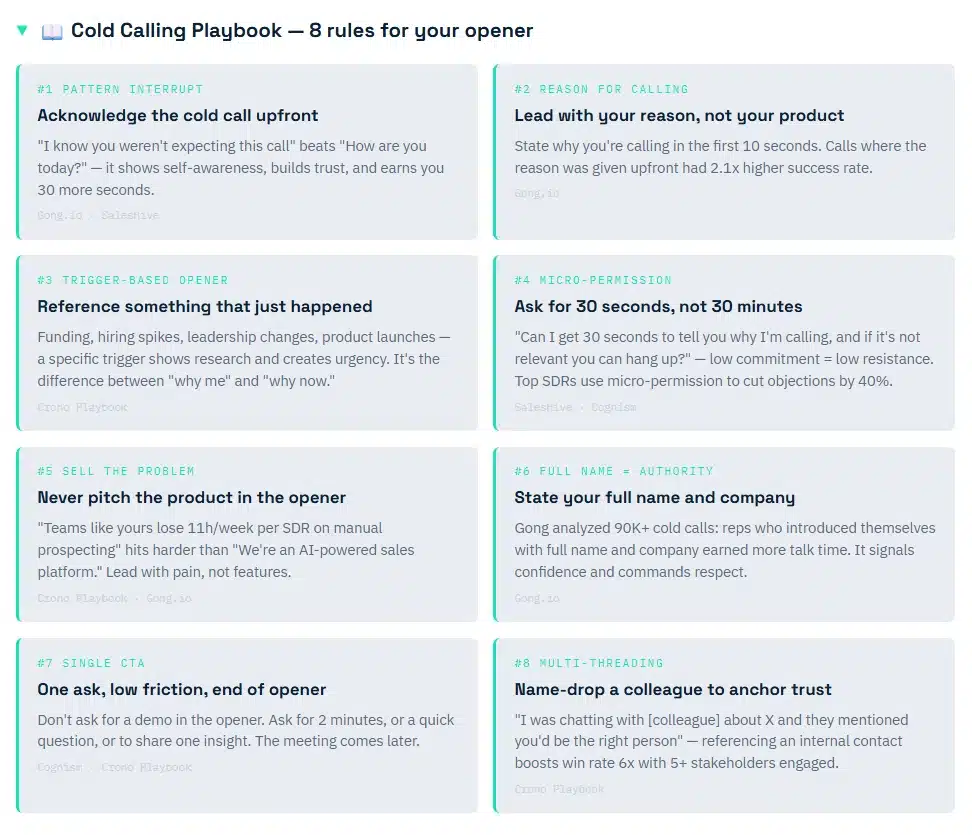
Integrated Cold Calling Playbook | 8 principles from Gong, Cognism, Crono |
One-click copy | Clipboard-ready |
Cost per session | ~$0.03 (research + opener generation) |
Architecture | Zero backend, zero framework — one HTML file |
Live tool: first-line-app.netlify.app
Open source: github.com/Alex-Roggero/first-line
6. How First Line Works — Step by Step
Step 1 — Choose your language
First Line supports five languages: Italian, English, Spanish, French, and German. Both the interface and the AI-generated openers will respect the selected language.
Step 2 — Paste the prospect’s LinkedIn profile
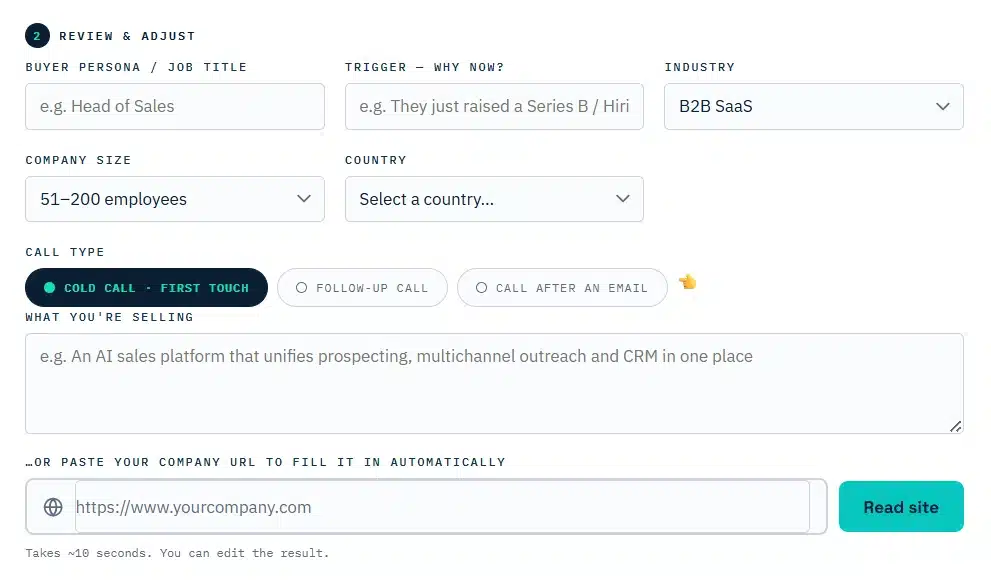
The AI analyzes the profile in ~10 seconds and auto-fills: name, surname, role, company, industry, country, company size — and, most importantly, relevant triggers (recent activity, published posts, role changes, company milestones).
Step 3 — Paste your company URL
The AI reads your site and auto-fills the ‘what you sell’ field. You can manually adjust to sharpen the value proposition for that specific prospect.
Step 4 — Adjust context
Before generating openers, refine: call type (discovery, referral, follow-up), target industry, company size, country.
Step 5 — Generate the openers
One click on ‘Build my openers’ gives you 3 complete openers, each with: the technique used (trigger-based, permission-based, name-drop, problem hypothesis, pattern interrupt), the verbatim opener ready to read or adapt, and a detailed psychological explanation of why it works for that specific profile.
Step 6 — Copy and call
One click to copy the chosen opener. Then pick up the phone.
7. Real Opener Examples Generated by First Line
The following are illustrative examples based on typical prospect profiles.
Profile A — VP Sales, B2B SaaS, 150 employees, recently posted about scaling outbound
Trigger-based opener:
Opener
“I saw your post yesterday about the challenge of scaling outbound while maintaining quality — it touches a point we hear a lot at this growth stage. Have you already evaluated a more structured approach to sequencing?”
Profile B — Sales Director, manufacturing company, 500 employees, no recent LinkedIn activity
Permission-based opener:
Opener
“I know this is a cold call and we’ve never spoken. Could I ask for 40 seconds? I work with Sales Directors in manufacturing who are looking to modernize outbound without overhauling existing processes — I wanted to check if that’s a relevant conversation for you.”
Profile C — Co-founder, FinTech startup, 30 employees, Seed round closed 3 months ago
Problem hypothesis opener:
Opener
“Hi Marco — Alex here from Crono. I work with co-founders in the post-Seed phase who find themselves needing to build the commercial machine from scratch in 6–9 months, often without a VP Sales on board yet. Does that ring a bell?”
8. Cold Calling B2B: Best Practices for Outbound Teams
Beyond the opener, there are fundamental principles that separate high-performance outbound teams from those accumulating rejections.
- Research before every call. Never call without knowing at minimum: the prospect’s correct name, role, company, and one relevance trigger. Even 60 seconds of research dramatically changes conversation rates.
- Volume does not replace quality. 100 calls with a generic opener produce fewer results than 40 calls with contextual openers. Personalization is not a luxury — it is an efficiency multiplier.
- The goal of a cold call: the conversation, not the sale. Cold calling does not close deals. It opens conversations. The objective is to qualify and book a meeting. Trying to sell on the cold call burns the prospect.
- Handle gatekeepers with respect. The gatekeeper is not an obstacle. They often have the most context on who the decision-maker is and when they are available. Treating them respectfully increases pass-through rates.
- Systematic follow-up. Most outbound deals require 5–8 touchpoints before a positive response. A sequencing system integrating cold calls, email, and LinkedIn is more effective than any single channel.
- Analyze your best calls. Top performers record and listen to their own calls. Patterns that work: strategic pauses, open-ended questions, no interruptions in the first 30 seconds.
- Optimal timing. Aggregated data from Gong and conversation intelligence tools indicates that Wednesday and Thursday, 10:00–11:30 AM and 4:00–5:30 PM, are the time slots with the highest connection rates in Europe.
- Context without execution is just expensive noise. Having buying signals is not enough. Having triggers is not enough. Competitive advantage lies in execution — in the ability to translate every signal into a personalized, fast, and systematic action.
Frequently Asked Questions
Q: Is cold calling still effective in 2025?
A: Yes. Industry data confirms that cold calling remains one of the highest-ROI outbound channels in B2B, especially when combined with personalized research and trigger-based selling. The difference from the past is that prospects today have less tolerance for generic calls and higher expectations of relevance.
Q: What is the average success rate of a cold call?
A: Benchmarks vary significantly by industry and prospect seniority. High-performance teams typically achieve conversation rates (calls that go beyond 30 seconds) of 15–25%. The conversion rate from cold call to qualified meeting sits typically between 3–8% for teams following structured best practices.
Q: How many cold calls should an SDR make per day?
A: There is no universal number. An SDR who researches and personalizes openers should aim for 40–60 quality calls per day. A purely volumetric approach without personalization requires more calls for the same results — and often leads to higher burnout rates.
Q: What is a cold call opener?
A: An opener is the first sentence spoken by the salesperson in the cold call, after the initial greeting. It is the most critical moment of the call because it determines whether the prospect stays to listen or looks for an exit. An effective opener is personalized, contextual, and immediately creates perceived relevance.
Q: How do I use First Line for cold calls?
A: First Line is a free, open-source web tool. Access it at first-line-app.netlify.app, paste your prospect’s LinkedIn profile and your company URL, and get 3 personalized, ready-to-use openers in under 60 seconds. The tool uses AI (Claude by Anthropic) to research the prospect and generate openers using different persuasive techniques.
Q: How much does it cost to use First Line?
A: First Line is open source and the code is freely available on GitHub. To use the hosted version, you need an Anthropic API key. The cost per session is approximately $0.03, which includes LinkedIn research, company website reading, and the generation of 3 openers.
Q: What opening techniques does First Line use?
A: First Line generates openers using five main techniques: trigger-based (reference to a recent event), permission-based (explicit permission request), name-drop/referral (social connection), problem hypothesis (pain point hypothesis), and pattern interrupt (breaking the sales call frame). Each opener includes the psychological explanation of why it works.
Q: Can I use First Line in languages other than English?
A: Yes. First Line supports five languages: English, Italian, Spanish, French, and German. Both the interface and the AI-generated openers are available in full in all five languages.
Not sure where to start?
Start with the Playbook.
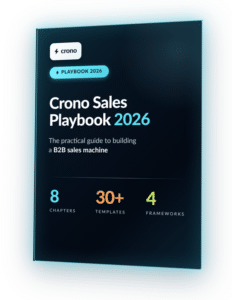
Download our free Sales Playbook 2026 and learn how top B2B teams structure their outbound process.
 BANT, SPICED & MEDDPICC frameworks
- 30+ ready-to-use sales templates
- 2026 outbound & pipeline benchmarks
Don't sell the product. Sell the change the product makes possible.
Build the process before the pipeline.
