
Consultative selling is a conversational, needs-first sales approach where reps diagnose a buyer’s problem before proposing a solution, which aims to improve deal quality and long-term retention. It works because it replaces feature pitches with genuine diagnosis, and it pays off directly: better-fit deals, higher lifetime value, and stronger buyer relationships that survive past the first contract renewal.
Salesforce frames this as discovering needs before offering a solution, since asking the right questions drives value and converts leads into loyal customers. Sales leaders adopting this approach, including teams using platforms like Crono to coordinate outreach and data, see it show up in three concrete places:
- Deal size: reps who diagnose before pitching tend to uncover budget and urgency the buyer never volunteered upfront.
- Win rate: proposals built on stated priorities outperform generic feature decks.
- Retention: customers who felt understood at the sale are far less likely to churn at renewal.
Key Takeaways
Consultative selling improves deal quality and retention because it replaces feature pitches with a diagnosis built on the buyer’s own words.
| Point | Details |
|---|---|
| Lead with diagnosis | Confirm the business impact of a problem before proposing any solution. |
| Balance questions and insight | Aim for roughly 60% questions and 40% insight-sharing to avoid pure interrogation. |
| Follow a repeatable workflow | Move through research, discovery, diagnosis, proposal, objections, and follow-up every time. |
| Track behavior, not just revenue | Use discovery depth scores and proposal match rates as leading indicators. |
| Let technology handle the busywork | Platforms like Crono free reps to spend more time on the diagnostic conversation itself. |
Table of Contents
- What Is Consultative Selling and Why Does It Work?
- What Are the Steps in the Consultative Selling Process?
- What Discovery Questions Uncover the Real Need?
- How Is Consultative Selling Different From Solution Selling?
- How Do You Build a Consultative Selling Culture on Your Team?
- What Does a Consultative Sales Call Actually Sound Like?
- How Do You Measure the ROI of Consultative Selling?
- How Does Sales Technology Support a Consultative Approach?
- Frequently Asked Questions
- Sources
What Is Consultative Selling and Why Does It Work?
Consultative selling works because it inverts the traditional pitch. Instead of leading with a product, the seller leads with questions, and the recommendation that follows is grounded in what the buyer actually said, not what the seller wants to sell.
The industry-standard term for this discipline traces back decades in B2B sales training, and modern practitioners often use “consultative sales approach” and “insight selling” interchangeably. RAIN Sales Training argues the discipline has evolved further still: top performers now anticipate needs the buyer hasn’t articulated yet, educate them with new ideas, and collaborate on the decision rather than simply reacting to stated requirements.
Here are the core principles that separate consultative reps from order takers:
- Curiosity before conclusions. Ask why a problem exists before assuming you know the fix. A rep who hears “our pipeline is inconsistent” should probe the cause, not pitch a dashboard.
- Active listening over talking time. Reflect back what you heard before responding. Repeating a buyer’s exact phrase (“so the real issue is forecast accuracy, not volume”) builds trust fast.
- Empathy for the business, not just the person. Understand the pressure the buyer is under from their own boss or board, not just their stated preferences.
- Insight over information. Bring a perspective the buyer hasn’t considered, such as a benchmark from a similar company, rather than restating what they already know.
- Trust built on knowledge, not rapport alone. HubSpot notes that credibility comes from demonstrated understanding of the buyer’s industry, not just likability.
- Value framing tied to outcomes. Connect every recommendation back to a business result the buyer already named as a priority.
Pro Tip: Cap discovery at a balanced proportion of questions and insight-sharing to avoid pure interrogation. Pure interrogation without a point of view makes buyers feel like they’re filling out a survey, and that stalls momentum instead of building it.
What Are the Steps in the Consultative Selling Process?
A commonly cited framework breaks the workflow into five stages: identify needs and implications, present a solution, handle objections, negotiate, and ask for the business, according to MindTools. In practice, most B2B teams stretch this into six working stages with real timing attached.
- Research (before the call). Review the account’s firmographics, recent news, and any signals from tools like Crono that surface buying intent. Budget a reasonable amount of time per meaningful account.
- Discovery (first 20 to 30 minutes of the call). Ask open questions about current process, the impact of the problem, and who else is affected.
- Diagnosis (same call or a short follow-up). Synthesize what you heard into a clear problem statement and confirm it with the buyer before moving on.
- Proposal within a few days. Build a recommendation that maps directly to the language the buyer used in discovery, not a generic template.
- Objection handling (during the proposal review). Treat objections as requests for more information, not rejections.
- Close and follow-up (post-signature). Confirm success metrics and schedule a check-in at 30 and 90 days.
Discovery checklist:
- Confirmed the business impact of the problem, not just its symptoms
- Identified who else is involved in the decision
- Understood what “success” looks like in the buyer’s own words
Proposal checklist:
- Every recommendation ties back to something the buyer said
- Pricing and next steps are unambiguous
- A named owner exists on both sides for implementation
What Discovery Questions Uncover the Real Need?
The quality of a consultative call depends almost entirely on question design. Harvard Business Review found that leading questions, the kind that hint at the answer the rep wants, actually undermine trust and produce weaker diagnosis than genuinely open, diagnostic questions.
Three question types matter most:
- Open questions that let the buyer set the frame: “Walk me through how this process works today.”
- Diagnostic questions that isolate the root cause: “What have you already tried, and why didn’t it stick?”
- Implication questions that quantify the cost of inaction: “If this stays unresolved for another two quarters, what happens to the team’s targets?”
Active listening tactics that make these questions land:
- Pause for a moment after a buyer finishes talking before responding.
- Reflect the buyer’s own words back before adding your interpretation.
- Summarize the conversation at the 20-minute mark to confirm alignment before moving to solutioning.
Three short sequences to adapt:
- For a skeptical technical buyer: “What’s driving the timing on this now?” → “What’s the cost of the current workaround?” → “Who feels this pain most acutely on your team?”
- For a budget-conscious economic buyer: “How is this measured today?” → “What would an improvement of this kind be worth?” → “What’s blocked you from fixing this already?”
- For a champion inside a larger deal: “How will this be perceived internally if it goes well?” → “Who needs to be convinced besides you?” → “What would make this an easy yes for them?”
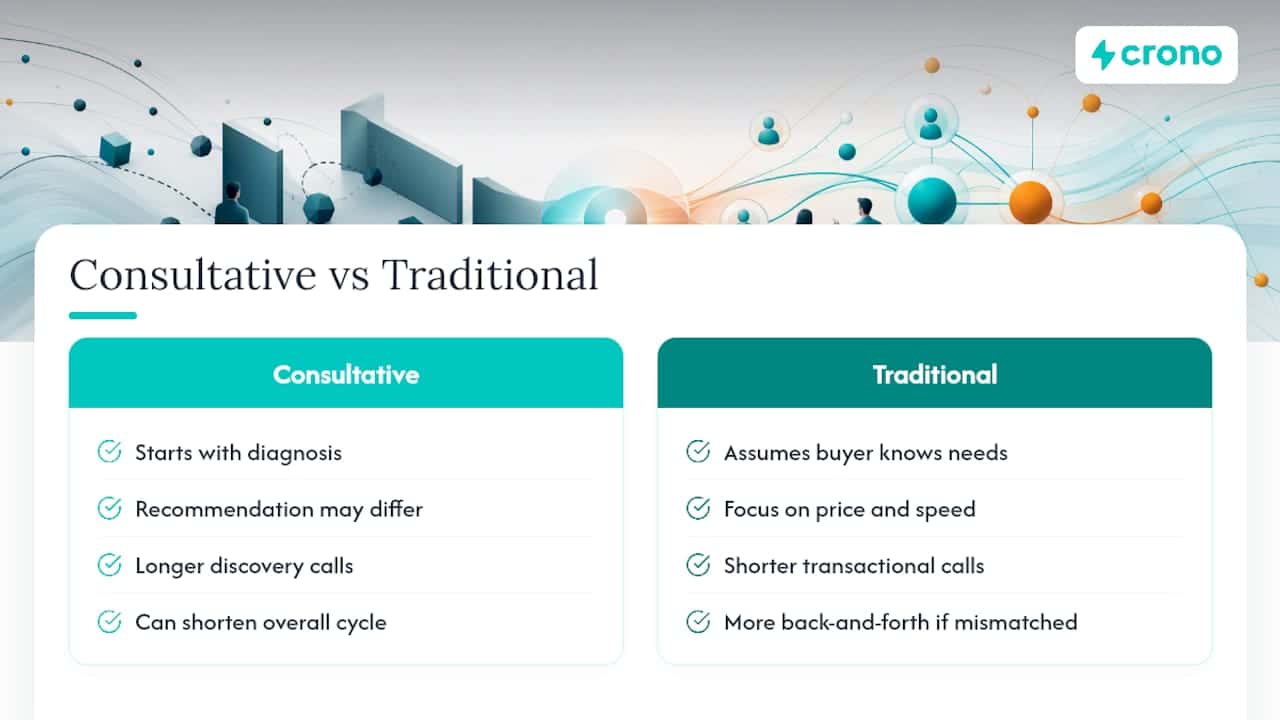
How Is Consultative Selling Different From Solution Selling?
Consultative selling, solution selling, and transactional selling sit on a spectrum, and confusing them leads to the wrong playbook for the deal in front of you.
- Transactional selling assumes the buyer already knows the problem and the solution; the rep’s job is price and speed. It fits low-complexity, low-risk purchases.
- Solution selling starts from a known product and maps its features to buyer pain points, largely through a scripted discovery. It works when the offer is fairly standardized.
- Consultative selling goes further: the rep may not know the right answer walking in, and the recommendation, sometimes a smaller deal than originally scoped, comes only after real diagnosis.
Consultative selling fits best when the deal is complex, configurable, or high-stakes enough that a wrong fit creates churn risk later, a pattern Shopify’s sales research ties directly to larger deal sizes and better retention. A bad fit example: a buyer needing a same-day quote for a commodity product doesn’t want a 45-minute discovery call. They want a price.
How Do You Build a Consultative Selling Culture on Your Team?
Embedding consultative habits requires routines, not a one-time training session. Two coaching cadences work particularly well:
- Weekly call reviews (30 minutes). Managers listen to one recorded discovery call per rep and score it against a simple rubric: did the rep ask open questions, did they reflect the buyer’s words, did the proposal match what was discovered?
- Monthly role-play sprints (45 minutes). Rotate through buyer personas and objection scenarios so reps practice diagnostic questioning under mild pressure before it matters on a live call.
Enablement assets worth building once and reusing constantly: a question bank organized by buyer persona, a proposal template with fields for “buyer’s own words,” and three or four scripted objection scenarios pulled from real lost deals. A tool built for objection handling can formalize this practice further for teams scaling past a handful of reps.
KPIs should measure the behavior, not just the outcome:
| Point | Details |
|---|---|
| Discovery depth score | Rate each call on whether it surfaced business impact, stakeholders, and success criteria. |
| Proposal match rate | Track what percentage of proposals directly reference language from the discovery call. |
| Expansion revenue | Monitor upsell and renewal rates as a lagging indicator of relationship quality. |
What Does a Consultative Sales Call Actually Sound Like?
Scripts help less as word-for-word text and more as a structure you personalize with real account detail.
- Discovery opener: “Before I share anything about what we do, I’d like to understand how your team handles this today. Can you walk me through the current process?”
- Probing follow-up: “You mentioned the workaround takes about a day per week. What’s that costing the team when you add it up across a quarter?”
- Insight-led recommendation: “Based on what you’ve described, three things stand out: the manual handoff, the lack of visibility for your manager, and the delay in follow-up. Here’s how we’d address each one specifically.”
Avoid two common failures: pitching before the buyer finishes describing the problem, and reusing the exact same discovery script word-for-word across every persona. A rep should sound like they’re diagnosing, not reading from a card.
Micro-case: A mid-market sales director told a rep their team was “just busy,” but three follow-up questions revealed the real issue: reps were manually re-entering contact data across four tools before every outbound sequence. The proposal that followed led with automated enrichment, not a generic pitch about “AI-powered prospecting,” and closed in half the usual cycle time.

How Do You Measure the ROI of Consultative Selling?
Consultative selling shows up in the numbers when you track the right leading indicators, not just closed-won revenue.
- Discovery depth score, scored per call against a simple rubric, predicts proposal accuracy better than call volume does.
- Average contract value (ACV), since well-diagnosed deals tend to include add-ons the buyer didn’t originally ask about.
- Renewal and expansion rate, the clearest signal that the original recommendation actually fit.
Quick test: Split your team into two groups for one month. Group A follows a strict discovery checklist before any proposal goes out; Group B proceeds as usual. Compare proposal-to-close rate and average deal size between the groups.
One caveat: consultative selling’s biggest gains, retention and expansion, often take one to two renewal cycles to show up fully, so don’t judge the approach on a single quarter of closed-won data alone.
How Does Sales Technology Support a Consultative Approach?
Orchestration and enrichment tools don’t replace the diagnostic conversation, but they remove the busywork that eats the time reps need for it. When account research, data enrichment, and outreach sequencing run through a unified platform like Crono, reps spend fewer hours on manual list-building and more time actually preparing for discovery calls.
- Automated enrichment surfaces firmographic and intent signals before the first call, so discovery starts from a stronger baseline.
- Multichannel sequencing keeps follow-up consistent without requiring a rep to manually track every touchpoint.
- AI agents can draft initial outreach, but the diagnostic judgment in the actual conversation stays human. Crono’s Prospecting Masterclass covers this balance in more depth.
The goal is augmentation, not replacement: technology should buy back time for the parts of selling that still require a person paying close attention.
A Practitioner’s Take on Where Consultative Selling Is Headed
Consultative selling used to mean a longer discovery call. Now it means fewer, sharper calls, because buyers arrive better informed and expect the rep to already know their context. Try this next week: before your next five discovery calls, write down the one insight you plan to bring that the buyer hasn’t heard elsewhere. If you can’t name it, you’re not ready for the call.
Scale Consultative Selling Without Losing the Human Touch
Crono gives sales teams the execution layer that makes deep discovery practical at volume: enrichment surfaces the account context reps need before they dial, and multichannel orchestration handles the follow-up sequencing that otherwise eats into prep time. Instead of choosing between doing real diagnosis and hitting activity targets, teams running on Crono get both, because the repetitive research and outreach work runs on automation while the conversation stays human.
If you want a structured way to build these habits into your team’s daily routine, Crono’s prospecting masterclass on B2B sales techniques walks through the discovery and proposal discipline covered here in more detail. When you’re ready to see how the platform itself supports it, start with Crono and connect it to the tools your team already uses.
Frequently Asked Questions
What is the main difference between consultative selling and traditional selling?
Traditional or transactional selling assumes the buyer already knows what they need and focuses on price and speed. Consultative selling starts with genuine diagnosis, so the recommendation may look different from what the buyer initially expected.
Does consultative selling take longer than a standard sales process?
Individual discovery calls can run longer upfront, but the overall cycle often shortens because proposals match the buyer’s actual priorities the first time, reducing back-and-forth revisions.
Can consultative selling work for transactional, low-cost products?
It’s a poor fit there. Buyers purchasing commodity items usually want speed and price clarity, not a lengthy diagnostic conversation.
How do you train a team on consultative selling techniques?
Combine weekly call reviews scored against a discovery rubric with monthly role-play sessions covering common objections and buyer personas, reinforced by a shared question bank.
What KPIs best reflect consultative selling success?
Discovery depth scores, proposal match rates, and expansion or renewal revenue reflect the approach better than raw call volume or short-term close rate alone.
Sources
- Consultative Selling — MindTools
- What Is Consultative Sales? Principles and Best Practices — Salesforce
- What Is Consultative Selling? — RAIN Sales Training
- Sales reps: stop asking leading questions — Harvard Business Review
