

A go to market strategy must turn product insight into repeatable revenue, and the fastest path there starts narrow: pick one ideal customer profile, test one channel, and validate with outcome-driven pilots before you scale. Anchor your plan against TAM, SAM, and SOM to size the opportunity, and track CAC payback period as your efficiency check. Teams build execution runbooks around exactly this sequence.
TL;DR:
- Focusing on a single ideal customer profile and testing one channel at a time maximizes early momentum and reduces the risk of underwhelming results.
- Pilots must be tied to clear customer outcomes, including time to value, usage thresholds, and defined success metrics before they begin.
- Scaling relies on building operational systems, hiring for deal complexity, and automating workflows to maintain early pilot success as a repeatable revenue engine.
- Key metrics such as CAC, LTV, and payback period should be established upfront and used to demonstrate unit economics and scalability to investors.
- Avoid broad ICPs, short pilots, and unstructured post-sale planning; instead, narrow the target segment, extend pilots with ongoing usage checks, and develop detailed operational runbooks.
Table of Contents
- Core GTM components and five pillars to check off
- Step-by-step: build the initial GTM plan from insight to first paying customers
- Validate and test your GTM: pilots, evidence, and consumption signals
- Scale and operations: hiring, org design, and adoption enforcement
- Metrics and investor readiness: the numbers VCs actually ask for
- Practitioner playbook: operationalizing GTM with execution runbooks and templates
- Common GTM mistakes and a 30 to 60 day corrective checklist
- A concise alternative: how Crono helps execution teams convert pilots into repeatable revenue
- Sources
- FAQ
Core GTM components and five pillars to check off
A go to market strategy organizes target market selection, positioning, pricing, distribution, and sales execution into one system that converts product insight into repeatable revenue. Before you write a single tactic, audit your plan against five pillars.
- Ideal customer profile and prioritization: Use TAM, SAM, and SOM to size the market, then choose the smallest segment where you can win fastest.
- Value proposition and positioning: Frame the pitch around the outcome the customer gets, not the features you built.
- Primary channel: Decide whether you are sales led, product led, partner led, or driven by digital demand, and commit to one before testing a second.
- Pricing shape: Pick a pricing model that matches how customers perceive value, then run small tests before locking it in.
- Playbook elements: Document messaging, map the buying motion stage by stage, and define clean handoffs between marketing, sales, and customer success.
Skipping any one of these pillars tends to show up later as a stalled pipeline or a sales team that cannot explain why deals close or die.
Step-by-step: build the initial GTM plan from insight to first paying customers
Building your first GTM motion is a sequence, not a brainstorm. Practitioner sessions on GTM execution, including a TechCrunch Disrupt discussion on GTM strategy, consistently point to the same tactical order: messaging, hiring, and demand generation, sequenced deliberately rather than launched all at once.
- Form a hypothesis from customer insight. Base it on a real pain point you have observed, not a guess about what the market wants.
- Pick one ICP. Narrow beats broad every time at this stage.
- Write a one-line value proposition. State the outcome the customer gets, in their language.
- Build a minimal test. A landing page or a lightweight MVP is enough to start collecting signal.
- Run one channel experiment at a time. Set a clear success metric before you launch it.
- Apply decision rules. Track activation rate, trial-to-paid conversion, and CAC per channel, and set thresholds in advance for what “working” looks like.
- Assign early GTM roles. Keep handoffs between founder, sales, and product minimal so friction does not kill early momentum.
Pro Tip: Run only one variable at a time. Changing the message and the channel together makes it impossible to know which one moved the needle.
Validate and test your GTM: pilots, evidence, and consumption signals
A pilot only proves something if it is tied to customer outcomes, not vanity engagement. Design pilots around time to value, usage thresholds, and dollar value per user or per use case, then define upfront what “ready for production” looks like.
- Set outcome-based success criteria before the pilot starts, not after you see the results.
- Map a clear conversion path from pilot to paid, production-scale deployment.
- Track consumption by customer and use case, especially for AI-enabled or complex products.
- Avoid short pilots, vanity metrics, and skipping the post-sale plan, all of which undercut the evidence you need later.
For AI and consumption-driven products, BCG recommends tracking usage by customer and use case and feeding those signals into CRM and account workflows. That visibility lets sellers prioritize accounts showing real adoption instead of chasing signed contracts that never activate.
Scale and operations: hiring, org design, and adoption enforcement
Once a pilot proves the motion works, the operational shift is what makes it repeatable. Hiring, coverage, and incentives all need to catch up to what the pilot evidence actually showed.
- Hire based on deal complexity: an SDR for volume, an AE for complex deals, a CS hire once retention and expansion matter more than net-new logos.
- Design coverage and handoffs so a deal moving from pilot to production does not lose momentum between teams.
- Build comp plans around consumption and expansion, not just new bookings, especially for usage-based products.
- Integrate your core tooling, connecting CRM, automation, and signal feeds so reps see prioritized accounts instead of a flat list.
Skipping this step is the most common reason a validated pilot never becomes a repeatable revenue engine.
Metrics and investor readiness: the numbers VCs actually ask for
Investors judge a GTM strategy on channel-market fit, unit-economics viability, scalability, and evidence from real pilots or early customers, not on the size of your deck. Get your numbers in order before the conversation starts.
| Metric | What it shows | Benchmark context |
|---|---|---|
| CAC | Cost to acquire one customer | Compare against your average deal size |
| LTV | Revenue expected per customer over time | Should meaningfully exceed CAC |
| CAC payback period | Months to recover acquisition cost | Median is about 16 months for SaaS, best-in-class is under 12 months |
| Gross margin | Profitability per unit of revenue | Assumptions should hold at scale, not just in pilots |
Come to fundraising conversations with pilot outcomes and repeatable funnel metrics in hand. A single strong pilot means little without a funnel that repeats it.
Practitioner playbook: operationalizing GTM with execution runbooks and templates
A sales execution layer connects CRM signals, data enrichment, and automation so a pilot does not stall the moment it needs to scale. Instead of tracking prospects in spreadsheets, the workflow surfaces which accounts are showing real buying signals and routes them to the right rep automatically.
- Prioritize opportunities using enriched account and contact data rather than gut instinct.
- Automate outreach cadences across email, LinkedIn, and calls without losing personalization.
- Formalize pilot-to-production handoffs so momentum from an early win carries into a full rollout.
Crono’s Academy offers templates for teams building this out from scratch.
Common GTM mistakes and a 30 to 60 day corrective checklist
The most frequent GTM mistakes are an ICP defined too broadly, pilots that run too short to produce real evidence, and no plan for what happens after the contract is signed. Fix the ICP first: narrow it to one segment within 30 days. Within 60 days, extend every pilot to include a post-sale usage check and a defined production handoff. Before scaling or raising, confirm you can show a repeatable funnel, not just one good story.
A concise alternative: how Crono helps execution teams convert pilots into repeatable revenue
Running the plan above by hand across spreadsheets and disconnected tools is where most GTM motions lose momentum. A sales execution layer can connect your CRM, enrichment data, and AI agents into one workflow, so the prioritization and handoffs described above happen inside the tools your team already uses.
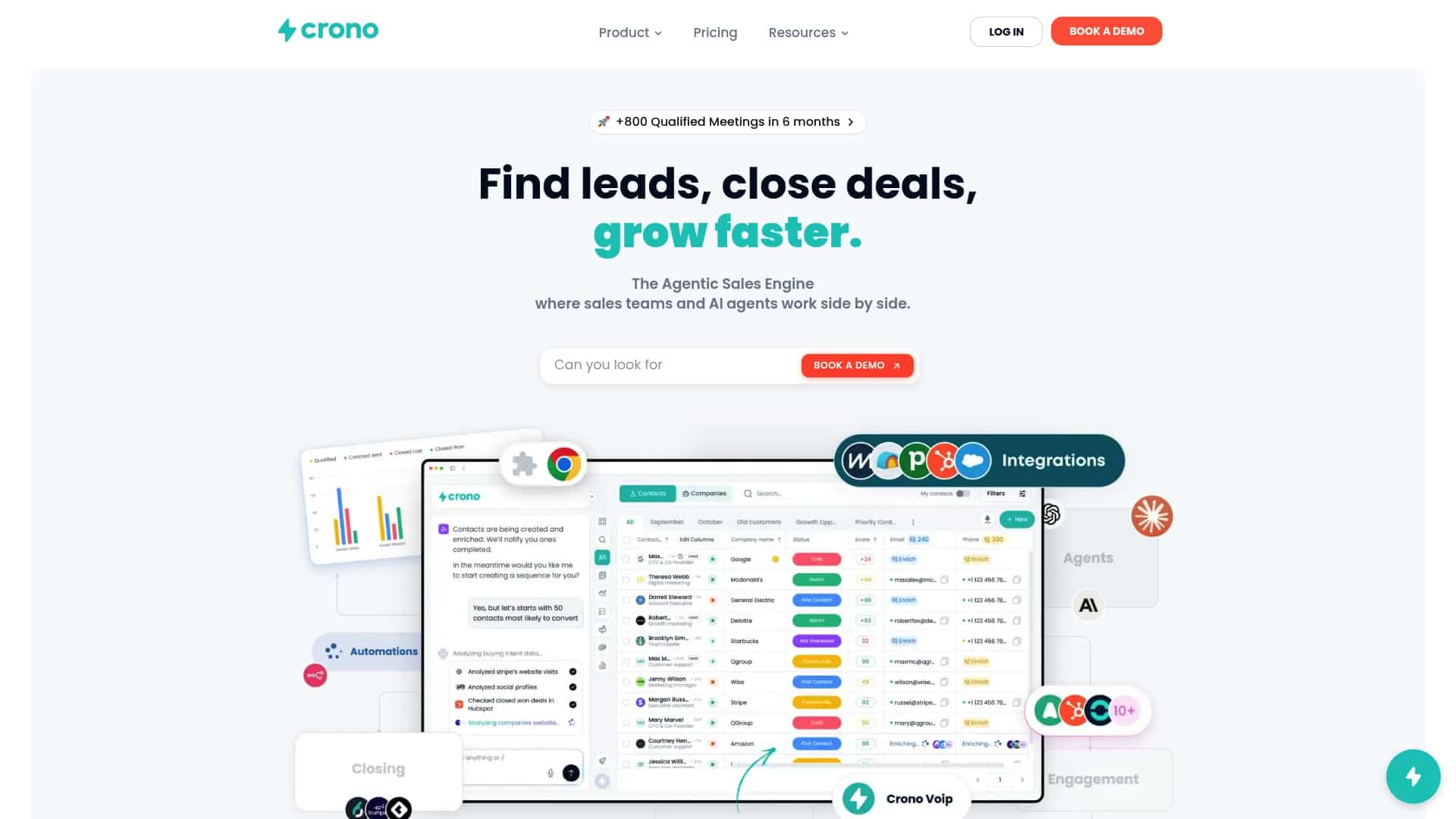
- Prioritization: buying signals and enrichment data surface which accounts to work first.
- Cadence automation: multichannel outreach across email, LinkedIn, and calls runs without manual follow-up.
- Pilot-to-production handoffs: workflows carry account context forward instead of losing it between teams.
See current plans on the Crono pricing page or explore credit packages on the Agents Hub if you are evaluating automation for your next pilot.
Sources
- Selling AI products requires a new commercial model (BCG)
- What is a Go-To-Market Strategy? (Amazon Ads guide)
- How to build a GTM strategy that actually drives results (TechCrunch Disrupt session)
FAQ
What are the five pillars of a go to market strategy?
The five pillars are ICP and prioritization, value proposition and positioning, channel choice, pricing shape, and a documented playbook covering messaging and handoffs. Checking a plan against all five before launch catches most early GTM gaps.
What are some tools founders use to run GTM execution?
Founders typically rely on a CRM, enrichment tools, and outreach automation platforms, with Crono built specifically as a sales execution layer connecting those systems together. The right stack depends on deal complexity and channel mix rather than a fixed list.
What is GTM versus RTM?
GTM (go to market) strategy focuses on how a company brings a product to buyers, covering positioning, pricing, and channel choice. RTM (route to market) is a narrower piece focused specifically on the distribution path a product takes to reach the customer.
Who owns the go to market strategy inside a company?
Ownership typically sits with a cross-functional group spanning founders or executives, sales leadership, and marketing, since the plan touches positioning, pricing, and execution across teams. In early-stage companies, the founder or CEO often holds final accountability until a dedicated GTM or RevOps leader is hired.
How long should a GTM pilot run before scaling?
There is no fixed universal duration, but a pilot needs enough time to show real usage patterns and a clear path from adoption to renewal, not just an initial signature. Tying the pilot to outcome-based success criteria from the start makes the right length obvious rather than arbitrary.
