

A GTM engineer is a commercial operator who builds and runs the automations, integrations, and data flows that drive modern revenue teams. The role sits at the intersection of sales, growth, and operations, and most people who hold the title arrive after years in one of those functions rather than from a software background. Demand has climbed fast: median base pay sits at $150,000 in disclosed US vacancies, and open roles fill quickly.
TL;DR:
- GTM engineers should develop expertise across multiple domains like outbound flows, data enrichment, and automation to effectively diagnose and fix system issues.
- Familiarity with tools such as Clay, HubSpot, Salesforce, SQL, and AI models is essential, with median salaries around 150,000 dollars and high demand reflected in rapid job turnover.
- Building a working demo project and practicing SQL queries significantly improves candidacy, as hiring cycles average only seven days for this high-value role.
- A senior GTM engineer owns complex, interconnected systems influencing revenue outcomes, signaling readiness through system reliability, impact, and cross-team collaboration.
- Prioritize deep tool knowledge over broad but superficial familiarity, and focus on operational projects that demonstrate practical skills to meet the immediate needs of fast-paced GTM teams.
Table of Contents
- Core Responsibilities and Capability Domains for GTM Engineers
- Common Tools and Technical Patterns GTM Engineers Use
- Skills, Background, and How to Become a GTM Engineer
- Salary, Demand, and Hiring Signals in 2026
- How a GTM Engineer Differs From RevOps, Revenue Architect, and Sales Engineer
- Career Path and Seniority: How GTM Engineers Progress
- Example Workflows: Mapping an Execution Layer to GTM Engineering Work
- Editorial Perspective: Hiring and Skill Priorities for 2026
- Where Crono Fits When You’re Scaling GTM Engineering Output
- FAQ
- Sources
Core Responsibilities and Capability Domains for GTM Engineers
A GTM engineer’s day rarely looks the same twice, but the work breaks into a handful of recurring domains. Most people in the role own a mix of these rather than specializing in just one, and the breadth is part of what makes the title valuable to a revenue team.
Outbound and prospecting flows come first for most practitioners. This means building the logic that decides who gets contacted, through which channel, and in what sequence, often pulling from multiple data sources before a rep ever sees a lead.
Data enrichment is the connective tissue. GTM engineers write the workflows that take a raw contact or company record and layer on firmographic, technographic, and intent data so the information reaching a rep’s screen is usable rather than a bare name and email.
RevOps automation covers the plumbing: syncing fields between a CRM and a marketing platform, triggering alerts when a deal stalls, or routing leads based on territory and score. This is often the least visible work but the most consequential when it breaks.
Analytics and reporting round out the technical side. A GTM engineer typically builds the dashboards and queries that tell a sales leader whether a campaign is converting, where pipeline is leaking, and which tool integrations are producing clean data versus noise.
Internal tools are the newer addition. As teams lean on AI more heavily, GTM engineers increasingly build lightweight internal applications, Slack bots, or scripts that give reps a faster way to pull account context or draft outreach without leaving their workflow.
Tasks a hiring manager might list under any of these domains include:
- Build an enrichment pipeline that scores inbound leads before they reach a sales development rep.
- Automate CRM field updates when a deal stage changes in a connected tool.
- Write SQL queries to audit pipeline data for duplicate or stale records.
- Configure a multichannel sequence that adjusts timing based on prospect engagement.
- Maintain deliverability settings across email domains to protect sender reputation.
The reason domain depth matters is that a GTM engineer who only automates outbound sequences but can’t troubleshoot a broken CRM sync is limited in how much ownership they can take. Teams building out this function tend to look for someone who can move across at least two or three of these domains, because revenue systems break in ways that don’t respect job titles. A practitioner who can diagnose a data problem, fix the automation causing it, and explain the impact in a report is far more valuable than one who can only execute a single workflow. For a broader look at how these pieces fit into a single operating layer, our explainer on the GTM execution layer walks through how orchestration connects CRM data, signals, and automation into one system instead of scattered scripts.
Common Tools and Technical Patterns GTM Engineers Use
The tool stack a GTM engineer touches daily is fairly consistent across companies, even when the underlying tech choices differ. Clay is the dominant pick for enrichment and outbound list building, letting practitioners pull data from dozens of sources and run it through waterfall logic before anything hits a sequence. HubSpot and Salesforce are the two CRM platforms that show up most often as the system of record and the target for automation rules, field syncs, and reporting. SQL gets used constantly, not for building flashy dashboards but for quieter work: auditing data quality, pulling ad hoc extracts, and verifying that an automation did what it was supposed to do. OpenAI and similar models now show up in workflows for drafting outreach copy, summarizing account research, or classifying unstructured data at a scale no human team could match manually.
The tool mention frequency in this dataset tells the story clearly: HubSpot appears 166 times and Clay around 150 times across job postings, putting both tools near the top of what employers expect candidates to know.
The recurring technical pattern looks roughly like this, as outlined in our Marketing Automation Checklist: Step-by-Step Guide for SMBs:
- Signals or intent data trigger a workflow, often from a tool tracking website visits, funding news, or hiring activity.
- Enrichment fills in the gaps on that signal, adding contact details and firmographic context.
- Scoring logic decides whether the lead is worth routing to a human or an automated sequence.
- Activation pushes the enriched, scored record into a multichannel cadence across email, LinkedIn, or calls.
- AI assists with drafting or summarizing content at any stage, with a human reviewing before anything goes out at scale.
Minimum technical proficiency for this work doesn’t require a computer science degree. Comfort with no-code or low-code builders, a working knowledge of SQL for QA and extracts, and enough familiarity with API documentation to connect two tools without an engineer’s help covers most of what the role demands day to day. For a rundown of specific platforms that fit into this pattern, our guide to B2B sales automation tools for lead gen and outreach breaks down where each tool fits.
Skills, Background, and How to Become a GTM Engineer
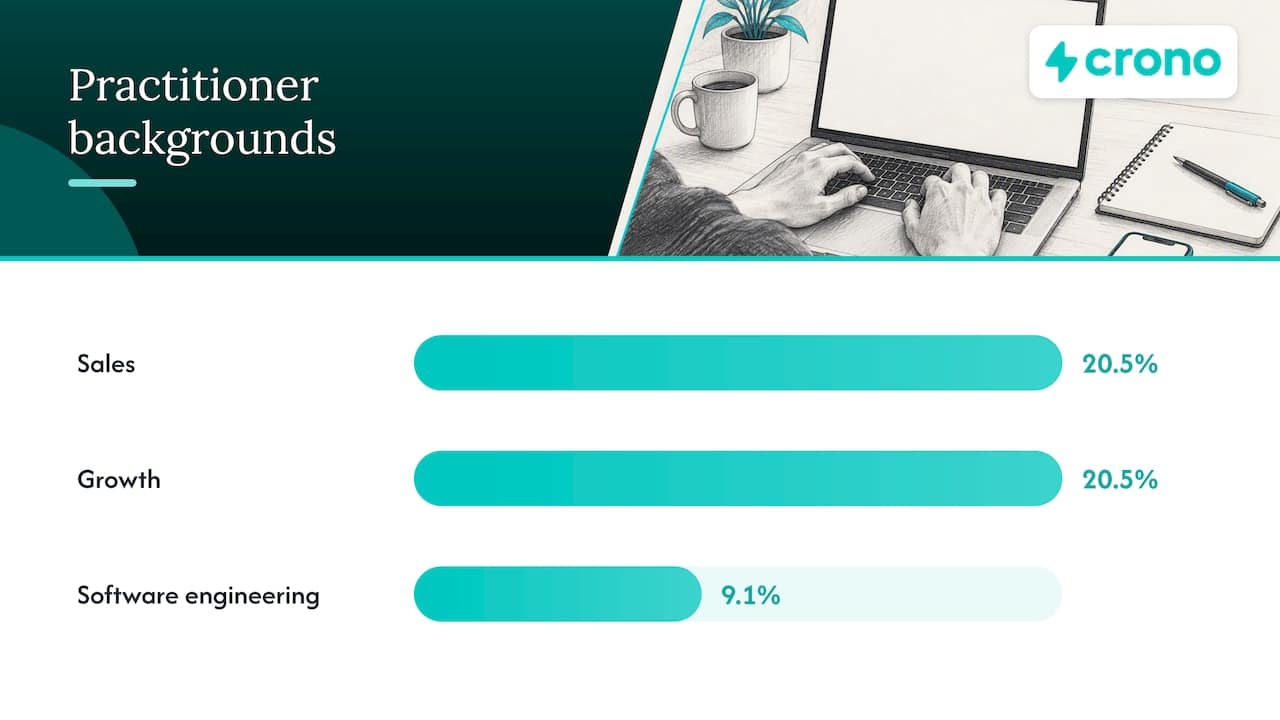
Most people don’t become GTM engineers by studying computer science. Sales and growth each account for roughly 20.5% of practitioner backgrounds, while only 9.1% came from software engineering, which means the path runs through operational experience far more often than through a coding bootcamp. The role tends to be a senior destination rather than an entry point: practitioners typically spend several years in a revenue function before picking up the technical skills that earn them the title.
If you’re building toward this role, a realistic set of steps looks like this:
- Pick one domain and build a working project. A Clay workflow that enriches a list of 50 target accounts and scores them by fit is a tangible, demonstrable output.
- Automate something real in a CRM. Build a field-sync rule or a lead-routing workflow in HubSpot or Salesforce, even in a free trial account, and document what problem it solved.
- Write and run SQL queries against a sample dataset. Practice pulling extracts and spotting data quality issues, since this shows up constantly in both the job and the interview.
- Package these into a short demo. A five-minute walkthrough of a workflow you built, with before-and-after metrics, is more persuasive than a resume bullet.
- Apply with the demo ready to share, not just referenced. Hiring managers moving fast will often skip a full case study assignment if you can show working proof upfront.
Pro Tip: Keep a running folder of screen recordings for every workflow you build, even small ones. When a recruiter asks for a portfolio, you want something ready in minutes, not a project you have to rebuild from memory.
Given that the median job listing stays live only 7 days, speed matters on both sides. Candidates who show up with a working demo instead of promising to build one later have a real edge, and teams that drag out their interview process risk losing candidates to someone who moved faster.
Salary, Demand, and Hiring Signals in 2026
Pay for this role has settled into a fairly tight band, and the data gives hiring managers and candidates a clear benchmark. Median base salary across disclosed US vacancies sits at $150,000, with the mean close behind.
The GTM engineer title saw 244 postings in a single month (April 2026) in this dataset, with a median listing life of just 7 days, a pace that signals real urgency on the hiring side.
| Experience band | Median base salary |
|---|---|
| Entry | $113,000 |
| Middle 50% range | $129,871 to $170,000 |
| Overall median | $150,000 |
| Senior | $188,000 |
Tool demand concentrates around the same names candidates should expect in interviews: HubSpot, Clay, Salesforce, SQL, and OpenAI dominate the postings. There’s a real skills gap worth noting too. Employers frequently list Python as a requirement, yet most practitioners report learning on no-code and SQL-based tools instead, which means hiring managers may need to either widen their screening criteria or invest in short upskilling projects for strong operational candidates who haven’t coded in Python.
For individuals, the implication is straightforward: build toward the tools employers are actually naming, not the ones that sound most technical. For hiring teams, the short listing life means a slow interview loop is a real cost.
How a GTM Engineer Differs From RevOps, Revenue Architect, and Sales Engineer
Title confusion is common because these roles overlap in places, but the core distinctions hold up once you look at what each one actually owns.
- RevOps typically owns process design, reporting cadence, and cross-functional alignment between sales, marketing, and customer success, with less emphasis on writing the automation logic itself.
- A GTM engineer builds and maintains the technical systems, enrichment pipelines, and orchestration rules that RevOps processes depend on, making the role more hands-on with tools and data.
- A revenue architect takes a step back to own the data layer and governance decisions across systems, especially as AI tools introduce new questions about data trust and access.
- A sales engineer supports pre-sales technical conversations with prospects, demoing product capability rather than building internal revenue infrastructure.
A useful rule of thumb: hire a sales engineer when your buyers need technical validation before they’ll sign, hire RevOps when your process needs structure and reporting discipline, and hire a GTM engineer when you need someone to actually build and maintain the systems that make that process run without manual intervention every day.
Career Path and Seniority: How GTM Engineers Progress
Promotion in this role tracks less with years on the job and more with the size and complexity of the systems someone owns. A junior GTM engineer might maintain a single enrichment workflow, while a senior one owns the orchestration logic across outbound, inbound routing, and reporting for an entire revenue org.
Signals that typically mark a move up include:
- Domain expansion, meaning ownership has grown from one capability area, like outbound flows, to several, including RevOps automation and analytics.
- System reliability, measured by how rarely a practitioner’s automations break and how fast they get fixed when they do.
- Pipeline impact, where a practitioner can point to specific campaigns or workflows that measurably contributed to booked meetings or closed revenue.
- Cross-functional reach, shown by being pulled into marketing or customer success projects rather than staying confined to sales tooling.
Practical next moves for someone looking to advance include mentoring newer hires on the same systems, volunteering to own a cross-functional project like a lead-scoring overhaul that touches multiple teams, and gradually shifting focus from building individual workflows to designing the architecture other builders will work within. That shift, from builder to architect, is often the clearest signal a GTM engineer is ready for a lead or revenue architect title.
Example Workflows: Mapping an Execution Layer to GTM Engineering Work
An execution layer that connects signals, enrichment, automation, and AI agents gives a concrete picture of what GTM engineering output looks like once it’s running. Three short examples show the pattern in practice:
- Signal-driven outreach: a buying signal, like a job change or funding announcement, triggers enrichment and a scored record that routes straight into a sequence.
- Multichannel cadence orchestration: email, LinkedIn, and call tasks get sequenced and timed based on how a prospect engages, instead of firing on a fixed schedule.
- AI-personalization with human review: a model drafts tailored outreach copy from account context, and a rep reviews before anything sends.
Pro Tip: Start with one signal-to-outreach workflow before building a full multichannel system. A single working flow is easier to debug and gives you a template to extend.
Our Agents Hub shows how these pieces come together as reusable templates, and the GTM execution layer guide walks through the underlying logic in more depth.
Editorial Perspective: Hiring and Skill Priorities for 2026
Hiring managers overweight tool lists and underweight domain depth. A candidate who can diagnose a broken CRM sync and fix the enrichment feeding it beats one who knows five tools shallowly. Prioritize that depth, build fast hiring loops given the short listing life, and skip Python screens in favor of SQL and no-code fluency. Expect the role to lean further into orchestration and AI governance through 2026. Build one small workflow this week and see what breaks.
— Alex
Where Crono Fits When You’re Scaling GTM Engineering Output
When a revenue team outgrows what one GTM engineer can maintain by hand, the choice usually comes down to hiring another specialist or adopting a platform that handles more of the execution layer directly. We built Crono to connect the enrichment, outbound, and orchestration work a GTM engineer would otherwise script manually into one system, so teams get signal-driven prioritization and multichannel sequencing without stitching together five separate tools.

A few signs it’s worth evaluating us alongside, or instead of, another hire:
- Your team is maintaining the same enrichment and routing logic across multiple disconnected tools.
- You want AI agents handling repetitive outreach steps while reps focus on conversations that need judgment.
- Budget favors a subscription over a six-figure salary for the next several quarters.
Our Pro and Ultra plans start at €79 and €119 per seat per month, and the Agentic Sales Engine tiers scale with credit usage as your automation needs grow. Visit our pricing page to see which plan fits your team’s current execution gap.
FAQ
What is the average salary for a GTM engineer?
Median base salary for GTM engineers sits at $150,000 across disclosed US vacancies, with the middle 50% of roles ranging from about $129,871 to $170,000. Senior practitioners report a median closer to $188,000, while entry-level roles median around $113,000.
What is the GTM job salary?
The GTM engineer job pays a median base of $150,000, with a mean close behind at $147,504. Pay scales meaningfully with experience, moving from roughly $113,000 at entry level up toward $188,000 for senior practitioners.
Is GTM a good job?
GTM engineering offers strong pay, fast hiring timelines, and a path that doesn’t require a traditional engineering background, since most practitioners come from sales or growth roles. Demand has also been high, with postings moving quickly and a median listing life of just 7 days.
How do I become a GTM engineer?
The most reliable path runs through sales, growth, or operations experience paired with hands-on projects in tools like Clay, HubSpot, or Salesforce, plus basic SQL for data work. Building a short demo of a working automation, rather than just listing tools on a resume, tends to move candidates through interviews faster given how quickly roles get filled.
