
Pipeline hygiene is the ongoing discipline of keeping every open opportunity accurate, complete, and current. The single highest-leverage move is to run a weekly hygiene audit, using a saved CRM report, that grades every deal pass or fail on four fields: next step, close date, stage, and recent activity. Standards like MEDDIC and BANT give you the qualification logic; a tool can help enforce it without adding manual busywork.
Table of Contents
- The Prioritized Fixes For Cleaning Up Your Sales Pipeline
- The Five Core Disciplines Of Sales Data Governance
- How Often Should You Run A Pipeline Hygiene Check?
- What Makes Reps Actually Follow Pipeline Rules?
- Which CRM Rules Should You Automate First?
- What Metrics Prove Your Pipeline Is Clean?
- When Should A Deal Be Closed, Nurtured, Or Archived?
- The Mistakes That Kill Hygiene Programs Before They Start
- How An Execution Layer Reduces The Manual Hygiene Burden
- An Honest Take On Enforcement Versus Autonomy
- A Practical Next Step For Reducing Manual Hygiene Work
- Sources
The Prioritized Fixes For Cleaning Up Your Sales Pipeline
Not every hygiene fix deserves equal attention in week one. Sequence matters more than effort here.
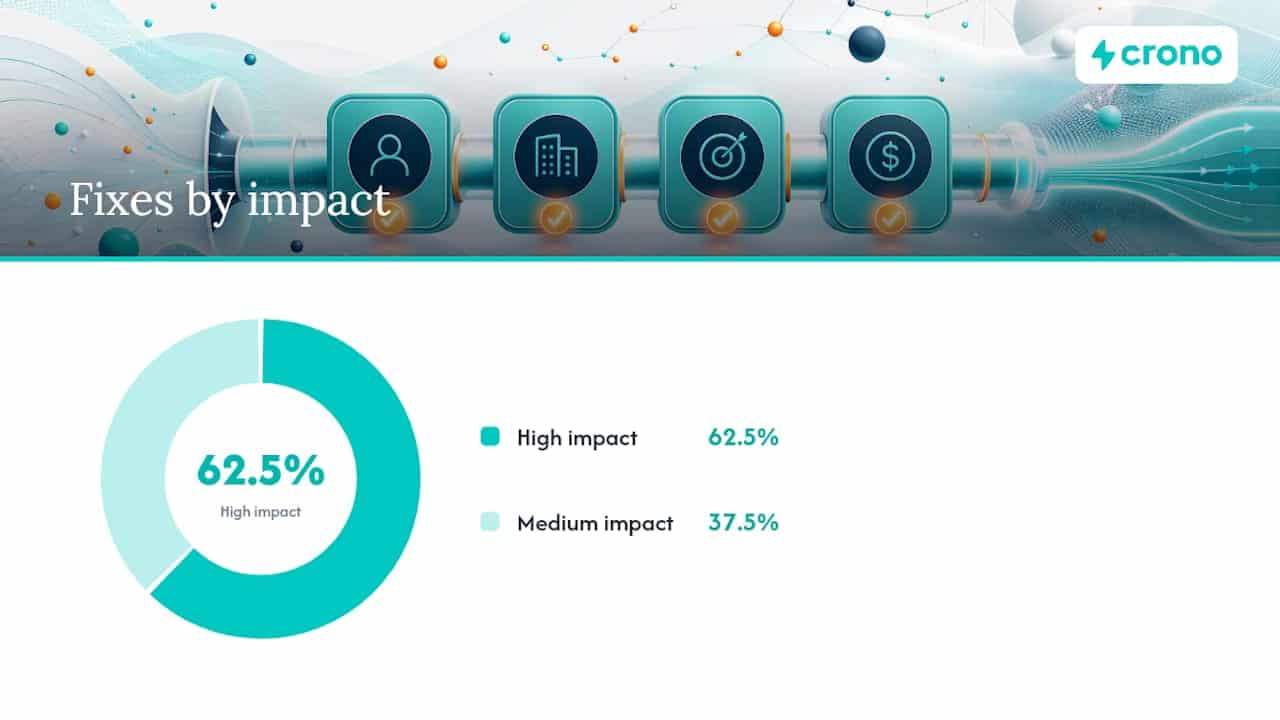
- Weekly hygiene report — high impact, low effort, owned by RevOps. Risk: reps ignore it without manager follow-up.
- Validation rules on next step/close date — high impact, medium effort, owned by ops. Risk: overly rigid rules blocking legitimate edge cases.
- Stale-deal auto-flags — medium impact, low effort, owned by ops. Risk: false positives on long enterprise cycles.
- Lock opportunity creation fields — medium impact, low effort, owned by ops.
- Required-field gating by stage — high impact, medium effort, owned by ops with manager sign-off.
- Dedupe sweeps — medium impact, medium effort, owned by RevOps monthly.
- Hygiene score dashboard — high impact for visibility, low effort once metrics exist, owned by RevOps.
- Forecast gating on hygiene status — high impact, low effort, owned by sales leadership.
This week: launch the hygiene report and pass/fail fields. This month: add validation rules and stale flags. This quarter: build the dashboard and tie forecast gating to it.
Pro Tip: Assign the dedupe sweep to one named owner, not “the team” — shared ownership of a recurring task is how it quietly stops happening.
The Five Core Disciplines Of Sales Data Governance
Grading pipeline health only works when the standards are objective enough that two managers would score the same deal the same way. Fairview’s breakdown of pipeline hygiene identifies five disciplines worth turning into pass/fail tests.
- Stage accuracy: define exit criteria per stage (a signed scope document, not “the call went well”) and audit weekly. Target above 85% of deals meeting their stage’s criteria.
- Close-date accuracy: a passing close date needs evidence, like a scheduled next meeting or a mutual action plan, not a guess rounded to month-end. Watch for a cluster of deals all closing the last week of the quarter; that pattern usually means reps are stuffing dates, not forecasting them, and close-date concentration is often the fastest tell of poor hygiene. Require manager approval for any date push beyond 30 days.
- Stale-deal handling: flag any deal with no logged activity in 14 to 21 days depending on your cycle length, then route it into a disposition review rather than letting it rot in the forecast.
- Duplicate elimination: run automated detection weekly, but only auto-merge above a high confidence threshold; anything ambiguous goes to a human reviewer, and every merge should leave an audit trail.
- Required-field completion: keep the required-field list short. Next step, close date, deal amount, and primary contact at minimum, with stage-specific additions layered on top and enforced at save.
How Often Should You Run A Pipeline Hygiene Check?
Hygiene fails when it becomes a quarterly scramble instead of a habit. Inveo’s model builds hygiene into the existing weekly rhythm rather than adding a new meeting.
- Monday: an automated hygiene report goes out; reps self-audit their own deals against the four pass/fail fields before anyone else looks.
- 1:1s: managers review deals data-first, asking “what does the CRM say” before “what do you think will close.”
- Thursday: forecast lock. Any deal moved or added after this point needs a documented reason.
- Monthly: managers run a full pipeline audit and RevOps executes the duplicate sweep.
- Quarterly: a deep clean, a refresh of stage definitions if they’ve drifted, and archival of anything that should have been closed months ago.
Reps own the data entry. Managers own the grading and coaching. RevOps or a data steward owns the rules, the reports, and the audit trail, a division of labor PulseRevOps ties directly to a functioning governance framework. For teams running structured outbound motions, a defined cadence framework makes the Monday-to-Thursday rhythm easier to enforce without extra meetings.
What Makes Reps Actually Follow Pipeline Rules?
Rules without consequences turn into suggestions. A working enforcement model needs both a gate at data entry and a check afterward.
- Point-of-entry enforcement: stage-gated required fields and a duplicate-check that blocks the save, not a warning that gets clicked past.
- Detective controls: a scheduled exception report, routed to a named owner by email or Slack, not buried in a dashboard nobody opens.
- Escalation: a missed field triggers a reminder, a repeated miss triggers coaching in the next 1:1, and a chronic pattern gets that rep’s deals excluded from the official forecast until fixed.
- Incentives: tie a small piece of comp or recognition to hygiene score, and make forecast credit conditional on a deal passing its checks. Reps who see their number affected by data quality treat it differently than a compliance chore.
Pro Tip: Publish the hygiene leaderboard by team, not by individual rep, for the first quarter. It builds the habit without turning data quality into a public shaming exercise.
Which CRM Rules Should You Automate First?
Automation should handle detection and enforcement, never judgment calls about a real buyer relationship. Safe candidates include stale-deal flags, required-field gating, auto-population of account fields from enrichment data, scheduled dedupe merges above a confidence threshold, and alerts when close dates cluster suspiciously at quarter-end.
Avoid these anti-patterns:
- Mass auto-closing deals based purely on age, with no human review.
- Blind auto-merges on anything below a high match confidence.
- Automated date pushes with no requirement for updated buyer evidence.
The safest pattern pairs automation with an exception report and a human review window, an approach PulseRevOps frames as a two-tier model: a trusted layer where automation and comp calculations can run freely, and a quarantine layer for anything flagged as questionable until a person clears it. For teams building this out inside a broader workflow, a structured automation template is a useful reference for setting up alerts and validation logic correctly the first time.
What Metrics Prove Your Pipeline Is Clean?
A hygiene program that leadership can act on needs a small set of numbers with clear thresholds, not a vague sense that “the data looks better.”
Hygiene improvements to close-date accuracy and stage integrity can move forecast accuracy by 8 to 15 percentage points, which is a wider swing than most teams get from a new forecasting tool. Rather than reporting five separate numbers to leadership, PulseRevOps recommends rolling them into one composite score, a single hygiene number out of 100 that a CRO can track quarter over quarter the same way they track win rate. Clean data like this is also what feeds accurate forecasting in the first place; a dirty pipeline makes even a good forecasting model useless.
When Should A Deal Be Closed, Nurtured, Or Archived?
Every open deal that isn’t actually moving is noise in your forecast, and noise erodes trust in the whole pipeline.
- Close-lost trigger: five to seven touches with no response over 30 days, an explicit “not interested,” or a budget that’s been eliminated all qualify as immediate close-lost, per Rework’s disposition guidance.
- Nurture trigger: real interest exists but timing is wrong. Move it out of active pipeline into a nurture track with a future review date.
- Archive trigger: age past roughly twice your typical sales cycle length with no meaningful engagement signals it’s dead, not dormant.
Document the disposition reason on every closed or archived deal. That single field is what lets you audit decisions later and spot a manager who’s quietly sandbagging or a rep who’s afraid to close anything lost.
The Mistakes That Kill Hygiene Programs Before They Start
- Treating hygiene as the rep’s job alone. Fix: managers grade it in 1:1s; it’s a shared standard, not an admin chore.
- Quarter-end-only cleanups. These are hygiene theater. Rework’s data points to weekly checks as the only cadence that actually holds.
- Over-automating with no exceptions. Every automated rule needs a human review path for edge cases.
- Diffuse field ownership. If nobody owns a field’s definition, it drifts within two quarters. Name an owner for every required field.
How An Execution Layer Reduces The Manual Hygiene Burden
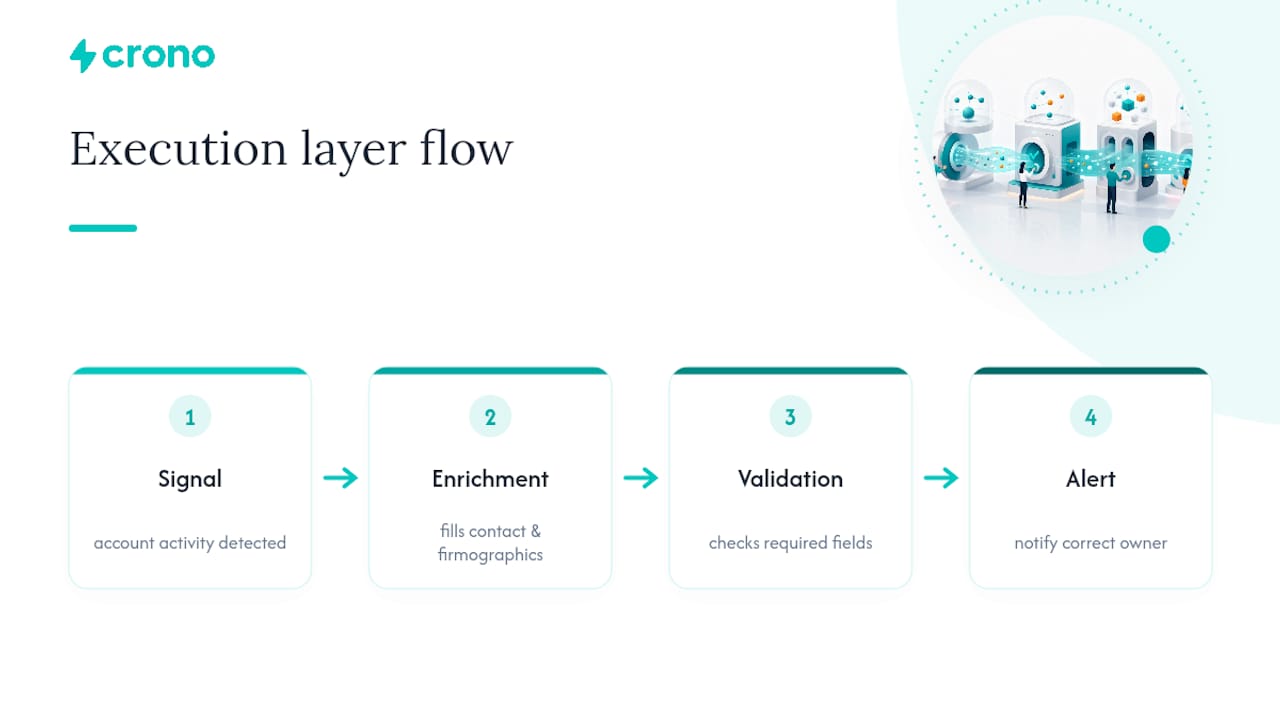
Most hygiene work is manual because signals, enrichment, and validation live in separate tools that don’t talk to each other. An execution layer like Crono connects buying signals and data enrichment directly into the CRM workflow, so a stale-deal flag or a missing next-step field triggers an alert to the right owner automatically instead of surfacing in a spreadsheet a week later. A typical orchestration might look like this: a signal indicates account activity, enrichment fills in the missing contact and firmographic data, a validation rule checks the record against your required fields, and a manager gets notified only when something actually needs a human decision.
An Honest Take On Enforcement Versus Autonomy
Strict field enforcement and seller autonomy are genuinely in tension, and pretending otherwise sets a program up to fail. Reps push back the hardest against rules that feel arbitrary, not rules that feel useful.
That’s why starting with just four fields, close date, next step, stage, and recent activity, matters more than it sounds. It’s small enough to enforce without friction and specific enough to produce a real forecast improvement inside a month. Once that credibility is banked, expanding into duplicate rules, stage-exit criteria, and automation gets far less resistance. Skip that sequencing and you’ll spend a quarter fighting adoption instead of measuring results.
A Practical Next Step For Reducing Manual Hygiene Work
Running a hygiene program by hand, chasing reps for updates, manually flagging stale deals, cross-checking duplicates, works, but it consumes hours every week that could go toward selling. A sales execution platform can serve as an alternative to that manual grind: it connects your CRM, enrichment data, and outreach signals into one execution layer, so validation and stale-deal detection happen automatically instead of through a weekly spreadsheet chase.
Rather than adding another dashboard to check, such platforms route exceptions to the right owner and keep enrichment data flowing into the fields your hygiene standards depend on. If your team is ready to spend less time policing pipeline data and more time working it, start with Crono’s sales enablement guide to see how enforcement and automation fit into your existing workflow.
Sources
- Pipeline Hygiene: Definition — Fairview
- What should a sales ops data governance framework include…? — PulseRevOps
- Pipeline Hygiene: 4 Proven Standards for Accurate Forecasts — Inveo
- Pipeline hygiene operational checklist — Rework Resources
