
A sales commission is variable pay tied to a specific sales outcome, layered on top of (or instead of) a base salary. Companies pay it because it links earnings directly to revenue, and because the Fair Labor Standards Act does not mandate it, which means the terms live entirely in your employment agreement. Get that agreement wrong and you’ll spend more time fighting payout disputes than closing deals.
This guide gives you the tools to get it right: verbatim formulas for nine-plus commission structures, two fully worked payout calculations, standard accounting journal entries, and the contract language that keeps you out of a wage claim. Here’s what’s ahead:
- Commission structures and formulas, with pros and cons for each
- Step-by-step payout calculations, including a SaaS quota example
- Legal and payment-timing rules, with sample contract clauses
- Accounting entries for accrual, draws, and clawbacks
- A design checklist and red flags that wreck commission plans
Key Takeaways
Accurate sales commissions depend on matching the right structure to your sales motion, documenting terms in writing, and modeling payouts before launch, not after disputes start.
| Point | Details |
|---|---|
| Structure beats rate | Choose the commission structure that matches your sales motion before fine-tuning the percentage. |
| Document everything in writing | Written agreements defining “earned” status prevent most legal and payroll disputes. |
| Accrue, then reverse | Record commission expense when the sale is recognized, then reverse the liability at payout. |
| Model before you launch | Run historical deal data through any new plan to catch distortions before reps see them. |
| Automate once complexity grows | Platforms like Crono capture commissionable activity accurately at the source, reducing downstream disputes. |
Table of Contents
- What Are the Main Sales Commission Structures?
- How Do You Calculate a Commission Payout Step by Step?
- What Are Typical Sales Commission Rates by Role?
- How Do Legal Rules Affect Commission Payment Timing?
- How Do You Record Commissions in Accounting?
- How Do You Design a Fair Commission Plan?
- What Causes Most Commission Disputes?
- What Tools Help You Track Commissions?
- How Is Automation Changing Commission Management?
- Why Most Commission Plans Fail Before They’re Launched
- Should You Automate Commission Management?
- Where Can You Learn More About Commission Rules?
- Frequently Asked Questions
- Sources
What Are the Main Sales Commission Structures?
Structure, not rate, is usually what breaks a commission plan. A nine-type framework for commission structures makes the case plainly: most plan failures trace back to picking the wrong payout mechanism for the sales motion, not to setting the percentage too low or too high. Here are the structures that cover nearly every real-world plan.
Straight commission. Formula: Commission = Sale Value × Rate. No base salary at all. Common in real estate and door-to-door sales, where reps control the full sales cycle. Pro: maximum earning upside attracts hunters. Con: income volatility drives turnover.
Base plus commission. Formula: Total Pay = Base Salary + (Sale Value × Rate). The dominant model for B2B software sales, where cycles run long and reps need income stability while prospecting. Pro: balances stability and incentive. Con: base costs add fixed overhead regardless of output.
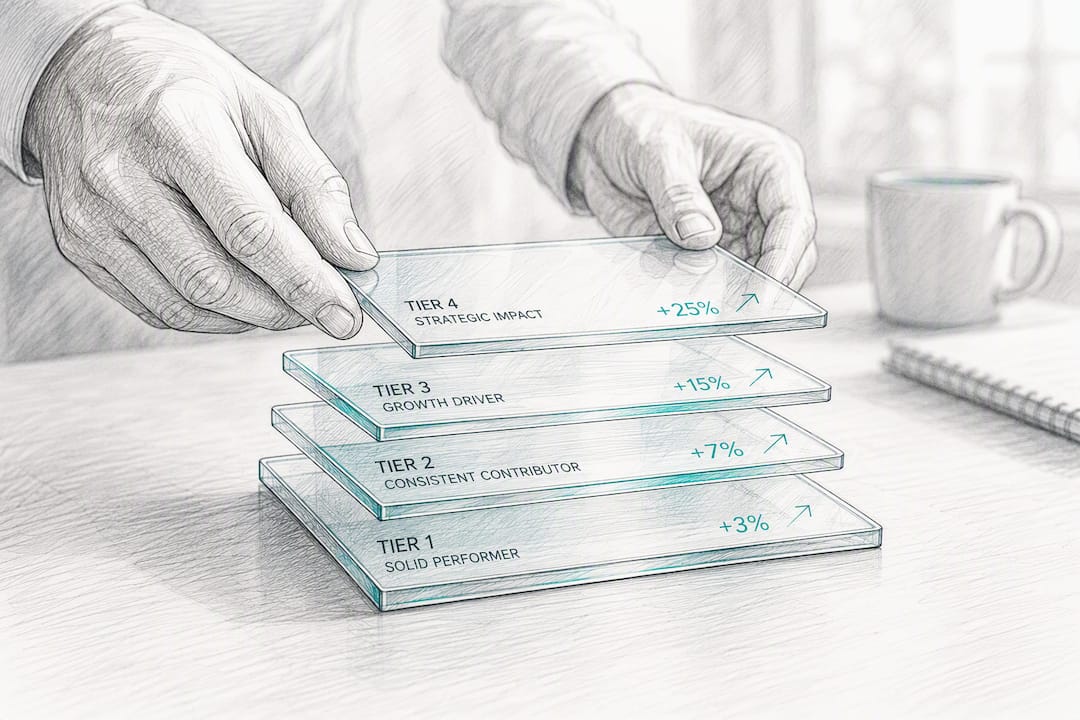
A rep who closes $120,000 earns $2,500 + $4,000 + $2,400 = $8,900. Pro: rewards overperformance without inflating base cost. Con: reps can hold deals back to hit the next tier in a later period.
Pro: concentrates incentive on stretch performance. Con: poorly calibrated accelerators can blow through your compensation budget.
Draw against commission. A recoverable draw advances cash (say $3,000/month) against future commissions; a non-recoverable draw is closer to a guaranteed minimum. New reps ramping on a six-month cycle lean on this heavily. Pro: smooths income during ramp. Con: recoverable draws create debt that damages morale if targets slip.
Gross-margin commission. Formula: Commission = Gross Margin × Rate, not top-line revenue. Common where deal profitability varies widely, like distribution or hardware resale. Pro: discourages margin-destroying discounts. Con: requires clean, timely margin data, which many CRMs don’t track well.
Standard in SaaS and insurance. Pro: rewards account retention, not just new logos. Con: can undercompensate net-new hunters if the residual pool grows too large relative to new-business commission.
Territory or volume bonus. Pays a flat bonus or rate bump when an entire territory or team hits a collective number. Pro: encourages collaboration. Con: free-rider problem when individual effort is hard to isolate.
MBO (management by objective) commission. Ties a portion of variable pay to non-revenue outcomes, like logo diversity or product adoption. Pro: shapes behavior beyond pure dollar volume. Con: subjective measurement invites disputes.
Most real plans stack two or three of these; a SaaS AE might run base + commission, with tiers above quota, plus a small residual on renewals, leveraging proven growth channels for SaaS businesses strategies to align commission plans with GTM priorities.
| Structure | Formula | Best fit |
|---|---|---|
| Straight commission | Sale Value × Rate | Short-cycle, rep-controlled sales |
| Base + commission | Base + (Sale Value × Rate) | Long-cycle B2B sales |
| Tiered | Rate increases at revenue thresholds | Motivating overperformance |
| Quota + accelerator | Standard rate to quota, higher rate above | Enterprise reps with set targets |
| Draw against commission | Advance recovered from future payouts | Ramping new hires |
| Gross margin | Gross Margin × Rate | Variable-margin products |
| Residual | Rate × recurring revenue | SaaS renewals, insurance |
Pro Tip: Before you finalize a structure, run last year’s actual deal data through the proposed formula. If the payout curve rewards a behavior you don’t want, like padding tier thresholds late in the quarter, redesign it before reps ever see the plan.
How Do You Calculate a Commission Payout Step by Step?
Every commission calculation follows the same sequence, whether you’re doing it in a spreadsheet or a payroll system, according to AccountingTools’ calculation guidance:
- Define the pay period. Monthly and quarterly are most common; align it with your accounting close, not an arbitrary calendar cutoff.
- Establish the commission basis. Decide whether you’re paying on gross revenue, gross margin, net revenue after discounts, or cash actually collected.
- Adjust for returns and discounts. Subtract refunded or canceled deals from the basis before applying any rate.
- Apply the rate or tier structure. Run the adjusted basis through your formula, including any accelerators.
- Handle splits and overrides. Divide credit between reps on a deal, and add manager overrides where applicable.
- Apply withholdings and finalize payout. Commissions are typically taxed as supplemental wages; confirm the correct withholding rate with payroll before cutting the check.
The rep closes $460,000.
In Excel, a tiered formula often looks like =IF(Sales>Quota, Sales*HighRate, Sales*BaseRate), while split credit across two reps on one deal is typically =Sale_Value*Rate*Split_Percentage. A SUMPRODUCT formula works well when you’re calculating commission across multiple line items with different rates in one order.
Pro Tip: Round commission dollars, not rates, and always round at the final step. Rounding a rate mid-calculation on a large book of deals compounds into real payout discrepancies by year-end.
What Are Typical Sales Commission Rates by Role?
There’s no universal commission rate, and any guide claiming otherwise is oversimplifying. Rates vary by gross margin, deal size, sales cycle length, and how much risk sits with the rep versus the base salary.
Transactional retail and inside sales reps often see commission in the 5% to 10% range on revenue, tracking the wide pay variability documented for retail sales roles. High-ticket enterprise reps, where deals take six to eighteen months to close, sometimes command lower percentages on much larger dollar figures, keeping total on-target earnings competitive.
A commonly cited benchmark is 20% to 30% of gross margin allocated to sales compensation across a deal’s lifetime. Treat it as a sanity check on your total variable comp budget, not a rate to copy directly. Margin-based benchmarks fall apart fast in low-margin industries like distribution, where a 25% commission on margin might translate to under 3% of revenue.
How Do Legal Rules Affect Commission Payment Timing?
The FLSA sets a wage floor, but it never requires an employer to pay commissions at all. Commission terms live in the contract you write, which is exactly why the Department of Labor’s commissions guidance stresses documentation. If your agreement is vague about when a commission is “earned,” you’re inviting a wage claim.
State law fills the gaps federal law leaves open, and it varies sharply. California, for example, requires written commission agreements for most sales employees and treats commissions as wages once earned, meaning an employer generally can’t withhold an earned commission simply because the employee has since resigned. Other states leave more of this to contract language, so what counts as standard practice in one state can be a violation in another.
Your commission agreement should spell out, in writing:
- The exact event that triggers “earned” status (contract signature, invoice, or cash collection)
- The payout date relative to that trigger
- Clawback conditions if a deal cancels or a customer doesn’t pay
- How disputes get escalated and by whom
Avoid these red flags in any commission agreement:
- Oral promises about rates that never make it into writing
- Ambiguous triggers like “when the deal closes” without defining close
- Undisclosed clawback policies introduced after a rep has already been paid
Pro Tip: Have every new hire sign a commission agreement before their first commissionable activity, not after their first payout. Retroactive agreements are far harder to enforce and invite exactly the disputes you’re trying to avoid.
How Do You Record Commissions in Accounting?
On an accrual basis, you record commission expense when the triggering sale is recognized, not when cash actually goes out the door. A typical entry:
Debit: Commission Expense $5,000
Credit: Commission Payable $5,000
When the payout happens, usually the following pay period, you reverse the liability:
Debit: Commission Payable $5,000
Credit: Cash $5,000
Accrual-basis accounting matches the expense to the period the sale occurred, according to AccountingTools’ guidance on commission accruals, while cash-basis businesses simply record the expense when paid.
Draws complicate this. A recoverable draw is booked as a receivable against the rep until commissions earned catch up to what was advanced; a non-recoverable draw is closer to guaranteed compensation and gets expensed outright. Clawbacks, triggered by a canceled contract or an unpaid invoice, require a reversing entry against the original commission expense, and payroll needs to flag the affected pay period so withholding on the reversal is handled correctly.
Pro Tip: Reconcile draws monthly, not at year-end. A rep who’s $8,000 underwater on a recoverable draw in month three is a very different conversation than the same number discovered in month eleven.
How Do You Design a Fair Commission Plan?
Start with the outcome you’re actually trying to buy: new logos, expansion revenue, margin, or retention. Every design decision should trace back to that answer.
Run through this checklist before you launch anything:
- Define the primary outcome and pick a measurable basis (revenue, margin, or units)
- Set quota math that reflects realistic territory and pipeline capacity, not a top-down revenue target divided by headcount
- Model full payout tables at 50%, 100%, and 150% of quota before anyone sees the plan
- Set accelerator thresholds and caps deliberately, don’t leave payout uncapped without modeling worst-case cost
- Define split and override rules for team-sold deals in writing
Loop in finance, legal, and sales leadership before rollout; finance owns the budget ceiling as a percentage of revenue or gross margin, legal reviews contract language, and sales leadership sanity-checks whether the quota math is achievable.
Watch for these red flags, which reliably distort behavior according to compensation design guidance: accelerators that trigger too early and reward mediocre performance as if it were exceptional, split rules left informal until a dispute forces a decision, and revenue-based funding with no gross-margin guardrail, which quietly incentivizes discounting.
Pro Tip: Before finalizing any plan, pull three real reps’ historical deal data through it. If your top performer would have earned less under the new plan than the old one, expect them to notice on day one.
What Causes Most Commission Disputes?
Five problems account for most commission headaches: delayed payments, mismatched CRM and payroll data, unprocessed returns or chargebacks, mid-period territory reassignments, and undocumented manager overrides.
Resolve disputes on a consistent timeline: investigate the discrepancy within a few business days, reconcile against the CRM and signed contract, communicate the finding to the rep in writing, correct the payout in the next cycle, and update the written plan if the dispute exposed a gap in the language.
A short, direct message works better than a vague one: “Your Q3 commission was recalculated because the Acme deal was flagged as a partial return on October 12. Adjusted payout: $2,340, reflected in your November check.” Keep a written audit trail of every adjustment, and escalate to finance and legal together when a dispute involves more than a data-entry correction.
Pro Tip: Track every manual override in a shared log the moment it happens, not from memory during dispute season.
What Tools Help You Track Commissions?
A basic spreadsheet works fine at low volume, as long as it includes these columns: sale ID, rep, territory, commission basis, rate applied, returns adjustment, and final payout. Export it as CSV so it can move cleanly between your CRM and payroll system without manual retyping.
You’ll outgrow the spreadsheet when any of these show up:
- Deal volume exceeds a few hundred transactions per period
- Split and override rules multiply across more than a handful of reps
- Disputes recur every single pay cycle
- Auditors or finance leadership start requesting a formal audit trail
When you evaluate dedicated commission software or an ERP add-on, judge it on four things: calculation accuracy against your actual formulas, an auditable change log, native payroll integration, and role-based visibility so reps see their own numbers without exposing the whole team’s pay.
How Is Automation Changing Commission Management?
Automated commission calculation delivers three concrete gains: fewer arithmetic errors on complex tiered or split formulas, a built-in audit trail for every adjustment, and real-time visibility that lets reps check their own numbers instead of emailing finance every week.

Before you roll anything out, run a data hygiene pass on your CRM, map every plan rule to its exact formula (including edge cases like partial returns), test the system against a full prior quarter’s actual payouts, and pilot with one team before company-wide rollout.
One caution payroll and HR platforms consistently raise: automation should increase transparency for reps, not reduce it. Keep the underlying formula visible and keep a manual audit capability alive even after automation, since governance over overrides still needs a human decision-maker.
Pro Tip: Run your automated system in parallel with manual calculations for one full pay cycle before cutting over completely. Discrepancies surface fast when both numbers sit side by side.
Why Most Commission Plans Fail Before They’re Launched
The biggest mistake I see in commission design isn’t a badly chosen rate.
The single highest-leverage move you can make before launching any new plan is to run three realistic payout scenarios against real historical deal data, not hypothetical numbers. If your best rep would have earned less under the proposed plan, you already know how the rollout conversation is going to go.
Document every rule in writing, then publish a plain-language FAQ to your sales team before the plan goes live. Ambiguity is where trust in a compensation plan quietly dies.
Should You Automate Commission Management?
Manual commission tracking works fine until it doesn’t; the tipping point usually arrives with growing headcount, more split deals, or your first serious payroll dispute. At that point, automation stops being a nice-to-have and starts reducing real administrative cost and audit risk.

It’s worth being precise about what automation actually solves. Dedicated commission tools calculate and audit payouts, but they don’t manage the sales activity that generates those payouts in the first place, which is a separate problem. That’s where a platform like Crono fits in: it connects your CRM, outreach, and pipeline data into one execution layer, so the commissionable activities, calls, emails, deal stages, get captured accurately at the source instead of reconstructed later from scattered tools. Cleaner activity data upstream means fewer commission disputes downstream. If you’re evaluating how AI agents and automation fit into a modern revenue team, Crono’s guide for sales leaders is a solid next step, or you can see the platform directly and check whether it fits your current stack.
Where Can You Learn More About Commission Rules?
- U.S. Department of Labor: Commissions for the federal wage baseline
- Fair Labor Standards Act overview for broader wage and hour context
- AccountingTools’ commission calculation guide for accrual and payout mechanics
- 29 CFR Part 779 for exemption classification rules
State laws on commission disputes vary significantly. Consult payroll counsel before finalizing contract language specific to your state.
Frequently Asked Questions
Is a sales commission the same as a bonus?
No. A commission is typically calculated as a percentage of a specific, measurable sale, while a bonus is often discretionary or tied to broader performance goals that don’t map directly to a formula.
Can an employer change a commission rate after a deal is in progress?
Generally not for deals already earned under the existing agreement. Most states treat an earned commission as a wage; changing the rate retroactively on completed work invites a legal claim.
What’s the difference between a recoverable and non-recoverable draw?
A recoverable draw is an advance that gets deducted from future commissions once the rep earns enough to cover it. A non-recoverable draw functions closer to a guaranteed minimum payment that isn’t clawed back.
How often should commissions be paid?
Most companies pay on the same cycle as regular payroll, monthly or biweekly, though the underlying commission period (the deals being counted) might follow a monthly or quarterly cadence tied to your accounting close.
Do commissions get taxed differently than regular wages?
Commissions are usually taxed as supplemental wages, which can carry a different withholding rate than a standard paycheck. Confirm current treatment with your payroll provider.
This article is general information, not a substitute for advice from a qualified financial advisor. Consult a qualified financial professional about your own circumstances before acting on anything here.
Sources
- Commissions | U.S. Department of Labor
- Sales Commission Structures: Nine Plan Types With Formulas, Examples, and a Decision Framework – Sales Commissions Explained
- 10 Commission Structures & Plans to Motivate and Scale
- How to calculate a commission — AccountingTools
