

A sales executive is a revenue-facing professional who finds prospects, builds relationships, and closes deals to grow a company’s customer base. Pay usually blends a base salary with commission or bonuses tied to targets, and projected job growth for sales roles ranges from slight to very low through 2034, depending on the sector.
This role fits you if you check most of these boxes:
- You’re comfortable being measured against a number every month or quarter.
- Cold outreach and rejection don’t rattle you for long.
- You enjoy building relationships more than checking boxes.
- You can hold two conversations at once: one about the product, one about the person buying it.
Key Takeaways
Success as a sales executive comes down to owning your pipeline metrics, mastering CRM and outreach tools, and building resilience against a results-driven pay structure.
| Point | Details |
|---|---|
| Pay is performance-linked | Expect a base salary plus commission or bonuses tied to quota attainment and deal size. |
| Job growth is modest | BLS projects slight to very low growth through 2034, so openings favor turnover over expansion. |
| Titles vary widely | “Sales executive,” “account executive,” and “BDR” overlap; check the actual duties in each posting. |
| Tools matter early | CRM proficiency and outreach sequencing skills now show up in interviews, not just onboarding. |
| Advancement rewards results | Promotion tracks faster with strong quota performance than with tenure alone. |
Table of Contents
- What Is a Sales Executive, Exactly?
- What Does a Sales Executive Do Day to Day?
- The Different Types of Sales Executive Roles
- How Much Do Sales Executives Get Paid?
- Skills, Education, and Qualifications Employers Want
- What the Work Environment Actually Looks Like
- Career Path and Job Outlook for Sales Executives
- How to Become a Sales Executive
- How AI and Sales Technology Are Changing the Job
- What This Career Actually Rewards
- Frequently Asked Questions
- Sources
What Is a Sales Executive, Exactly?
A sales executive connects a company with the customers it needs to grow. According to Prospects, the role centers on winning new business, managing existing accounts, and often opening entirely new markets, with commission or bonus pay tied directly to results. In B2B settings, sales executives typically sell to other businesses through longer, multi-stakeholder deals. In B2C, the cycle is shorter and often transactional, closer to retail or direct consumer sales.
Some sales executives work “inside,” managing calls and video demos from a desk. Others work “outside,” meeting clients on-site or at industry events. Most report to a sales manager, director, or in larger organizations, a Chief Revenue Officer.
Job titles vary by company size and sector, and the terms overlap more than employers admit:
- Business Development Representative (BDR/SDR): focuses on early-stage prospecting, usually junior to the sales executive role.
- Account Executive: often used interchangeably with sales executive, especially in software sales.
- Account Manager: manages existing clients rather than hunting new business.
- Sales Manager: oversees a team of sales executives rather than carrying an individual quota.
What Does a Sales Executive Do Day to Day?
The core job breaks into six recurring tasks: prospecting, qualifying leads, pitching or running demos, negotiating terms, closing deals, and maintaining accounts after the sale. Daily work also includes prepping proposals and logging every interaction in a CRM so nothing falls through the pipeline.
A typical day might include:
- Two or three blocks of outbound outreach (calls, emails, LinkedIn messages).
- One or two discovery calls or product demos.
- Proposal or contract prep for deals moving toward close.
- A quick pipeline review to flag stalled deals before they go cold.
- Internal syncs with marketing or customer success on shared accounts.
Performance gets measured through specific KPIs: quota attainment, pipeline coverage (how much pipeline exists relative to the quota), win rate, and average deal size. Understanding how pipeline stages actually work makes those numbers far less abstract once you’re the one accountable for them.
Pro Tip: Track your activity metrics (calls made, emails sent) separately from outcome metrics (deals closed, revenue booked). Activity tells you if you’re working hard enough; outcomes tell you if you’re working on the right things. Most reps who miss quota have strong activity numbers and weak conversion.

The Different Types of Sales Executive Roles
Job ads use “sales executive” loosely, so it helps to know what you’re actually applying for. Six categories cover most of the market:
- B2B account executive: sells to businesses, usually with a longer, consultative sales cycle.
- B2C retail or field sales: sells directly to consumers, often transactional and fast-moving.
- Inside sales executive: works remotely or from an office, selling by phone, email, and video.
- Outside/territory sales executive: travels to meet clients within an assigned geographic region.
- Enterprise or key account executive: handles the largest, highest-value clients with the most complex deals.
- Sales engineer/technical seller: pairs sales skills with deep product expertise for technical buyers.
Transactional, lower-complexity products tend to pair with shorter sales cycles and junior titles. Consultative, high-ticket B2B sales stretch out over months and typically come with senior titles and higher earning potential.
How Much Do Sales Executives Get Paid?
Compensation almost always breaks into two parts: a fixed base salary and variable pay tied to performance. The variable portion, commission, bonuses, or accelerators once you exceed quota, is what separates strong earners from average ones.
Pay bands vary considerably by industry, region, and deal complexity. Career-data platforms show wide percentile spreads for sales roles, and industry pay guides confirm that commission structures differ sharply between sectors like software, manufacturing, and retail.
When you evaluate a job offer, look past the headline number and check these:
- OTE (On-Target Earnings): base plus commission if you hit 100% of quota, not a guaranteed number.
- Ramp period: whether new hires get reduced quotas or a draw against commission while they build pipeline.
- Cap structure: capped plans limit upside; uncapped plans reward overperformance without a ceiling.
- Accelerators: some plans pay a higher commission rate once you clear quota, rewarding your best months disproportionately.
An offer with a lower base but uncapped commission can outearn a higher base with a hard cap, depending on how realistic the quota actually is.
Skills, Education, and Qualifications Employers Want
Hiring managers weigh a mix of hard and soft skills, and the balance shifts depending on how technical the product is.
Hard skills that show up in nearly every job posting:
- CRM proficiency (Salesforce, HubSpot, or similar platforms).
- Pipeline management and forecasting.
- Product and industry knowledge deep enough to handle objections.
- Proposal and contract writing.
Soft skills that separate good reps from great ones:
- Communication that adapts to different buyer personalities.
- Negotiation that protects margin without losing the deal.
- Resilience, since rejection is a constant in outbound sales.
Many employers prefer a bachelor’s degree in business or marketing, but in complex B2B and technical sectors, industry experience frequently outweighs the degree itself. Short courses in consultative selling or negotiation, along with hands-on familiarity with sales engagement and enrichment tools, can matter more than a diploma once you’re past your first job.
What the Work Environment Actually Looks Like
Most sales executives split time between an office and remote work, though the exact mix depends on whether the role is inside or outside sales. Outside and territory reps travel regularly to client sites, trade shows, and regional offices. Inside reps rarely leave their desk except for occasional team meetings or client visits.
A realistic day, time-blocked:
- 8:30 to 10:00 AM: outbound calls and email outreach.
- 10:00 AM to noon: discovery calls or product demos.
- 1:00 to 2:30 PM: proposal work and CRM updates.
- 2:30 to 4:00 PM: pipeline review and internal syncs.
- 4:00 to 5:00 PM: follow-up outreach and admin.
End-of-quarter stretches bring real pressure, with deals needing to close on a deadline that doesn’t move. Reps who last in this career build routines around that cycle instead of treating every quarter as a crisis.
Career Path and Job Outlook for Sales Executives
Most sales executives follow a recognizable ladder: junior sales executive to senior account executive, then either account manager or key account executive, then sales manager, and eventually director or Chief Revenue Officer. Some branch into specialist tracks like sales engineering or customer success instead of pure management.
BLS data projects slight overall growth for wholesale and manufacturing sales representatives through 2034, with growth in some categories described as very low. That doesn’t mean stagnant hiring. It means job openings will come primarily from turnover and retirements rather than a rapidly expanding number of positions, so competition for the strongest roles stays real.
Promotion in sales is unusually results-based compared to other career paths. Strong quota performance moves people up faster than tenure does, so owning your metrics and developing basic leadership skills, coaching newer reps, running team pipeline reviews, accelerates advancement more than almost anything else.
How to Become a Sales Executive
- Build relevant experience first. BDR, SDR, or retail sales roles teach prospecting and objection handling without the full quota pressure of a closing role.
- Learn the core tools and metrics. Get hands-on with CRM software and understand quota attainment, pipeline coverage, and conversion rate before your first interview.
- Write a results-focused resume. Lead with numbers: quota percentage, deals closed, revenue generated, not job duties.
- Use targeted outreach and referrals. Apply directly to hiring managers on LinkedIn rather than relying solely on job boards.
- Prepare for sales-specific interviews. Expect role-play demos, objection-handling scenarios, and questions that require you to tell your performance story with numbers, not adjectives.
- Consider mentorship or shadow programs. Pairing new hires with experienced reps shortens ramp time significantly compared to generic onboarding.
Studying proven B2B sales techniques before your first interview gives you concrete talking points instead of generic enthusiasm.
How AI and Sales Technology Are Changing the Job
CRM automation and data enrichment tools now handle much of the manual research and list-building that used to eat up a sales executive’s morning. Salesforce research points to shifting customer expectations as a top challenge for sales teams, which pushes the job further toward strategy and personalization and further away from repetitive admin work.
The skills gaining value: reading data to prioritize the right accounts, structuring outreach sequences across multiple channels, and knowing when to trust versus override an AI-driven coaching for live calls recommendation. Understanding how AI sales agents fit into a B2B workflow is quickly becoming as relevant to interviews as knowing your CRM.
Pro Tip: In interviews, mention specific tools you’ve used for outreach sequencing or lead scoring, not just “I’m comfortable with technology.” Hiring managers remember specifics.
Ready to build the execution habits that make you promotable faster? Crono’s Sales Engagement guide breaks down how outbound sales is shifting with AI, and the platform itself connects your CRM, enrichment, and multichannel outreach into one workflow so you spend less time on admin and more time closing. Explore Crono to see how modern revenue teams are running execution today.
What This Career Actually Rewards
Most career guides oversell the glamour of closing deals and undersell the grind of pipeline maintenance that makes closing possible. The research here points to a clearer truth: sales executives who advance fastest aren’t the best talkers in the room. They’re the ones who treat their CRM like a second job and their metrics like a scoreboard they check daily, not quarterly.
The conventional advice, “build relationships and the numbers follow,” gets the order backward. Strong relationships without disciplined pipeline management still lose to mediocre relationships backed by consistent, tracked activity. That’s not cynical. It’s just what quota attainment data tends to show across sales organizations.
If you’re deciding whether to pursue this career, prioritize learning the tools and metrics before polishing your pitch. A sales executive who can speak fluently about conversion rates and pipeline coverage in an interview stands out more than one who simply says they’re a “people person.” The tech layer changes fast, but that fluency in numbers ages well no matter which platform your future employer uses.
Frequently Asked Questions
What’s the difference between a sales executive and an account executive?
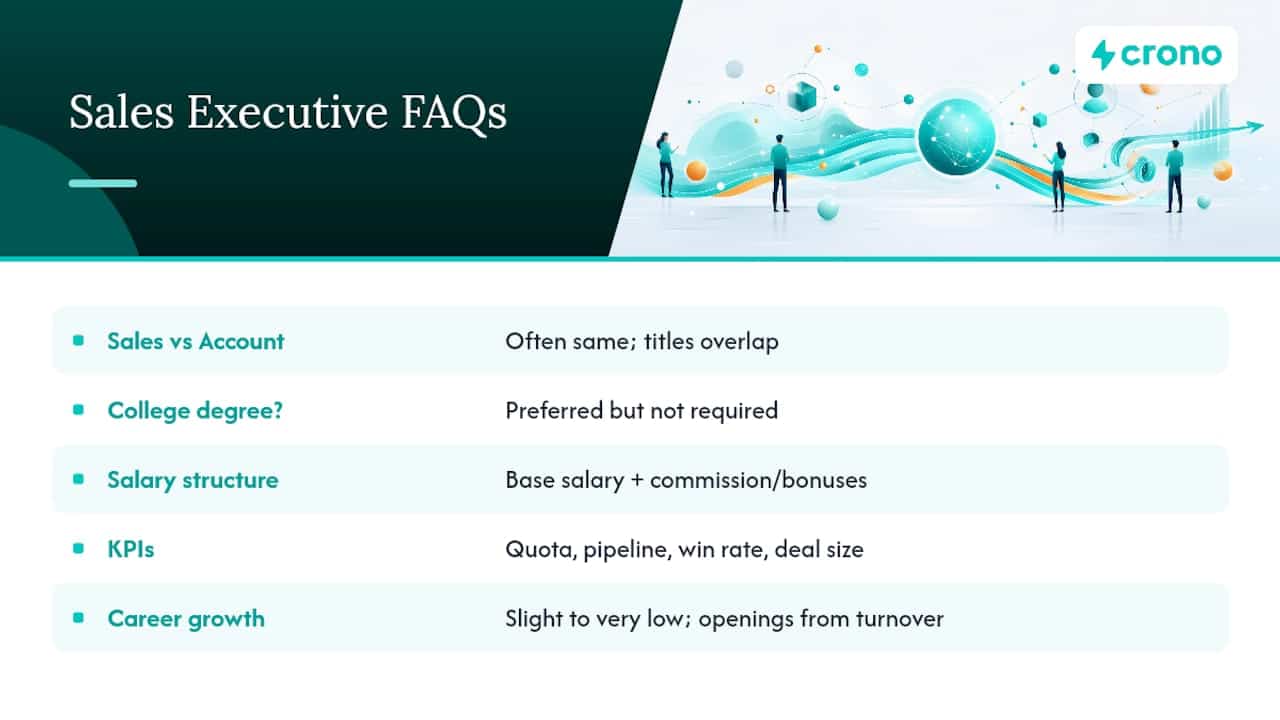
The titles overlap heavily and often mean the same job, especially in software sales. Where companies distinguish them, “account executive” sometimes leans toward closing new business, while “sales executive” can span both new business and existing account growth.
Do sales executives need a college degree?
Many employers prefer a bachelor’s degree, but it’s rarely an absolute requirement. Proven results and industry knowledge often outweigh formal education, particularly in technical B2B sectors.
How is a sales executive’s salary structured?
Pay typically combines a base salary with commission or bonuses tied to hitting quota. The variable portion can range from a modest supplement to the majority of total earnings, depending on the industry and company.
What KPIs matter most for sales executives?
Quota attainment, pipeline coverage, win rate, and average deal size are the most common metrics used to evaluate performance and inform promotion decisions.
Is the sales executive career path growing?
Growth projections through 2034 range from slight to very low depending on the specific sales category, meaning most openings will come from turnover rather than significant expansion of new roles.
Sources
- Wholesale and manufacturing sales representatives | Occupational Outlook Handbook | BLS
- Sales executive | Prospects
- Sales representative – Best Jobs | U.S. News & World Report
