
Aligning sales team AI agents means mapping specific AI capabilities, such as lead qualification, prospecting, and forecasting, to human roles so each amplifies the other’s output.
Sales leaders who get this right are building what the industry now calls AI-native sales organizations: leaner, faster, and more profitable than traditional models.
Tools like AI SDRs, CRM-integrated agents, and conversation intelligence platforms such as Gong are already reshaping how revenue teams operate.
The question is no longer whether to integrate AI agents in sales. The question is how to structure that integration so it drives measurable results.
What roles should AI agents fill in a modern sales team?
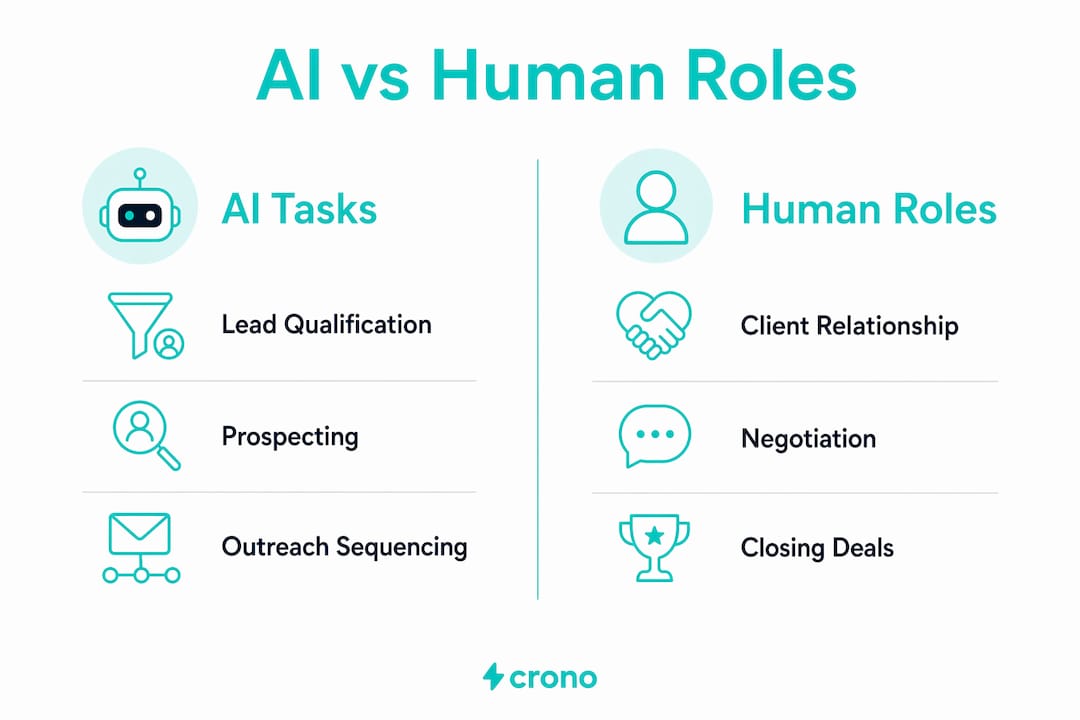
AI agents excel at volume, consistency, and speed on top-of-funnel tasks. That finding has a direct implication: your AI agents should own the work that requires scale, not judgment.
The clearest way to think about this is a division of labor by comparative advantage. AI handles the tasks where repetition and speed matter. Humans handle the tasks where trust and context matter.
Where AI agents perform best:
- List building and data enrichment: AI agents pull firmographic and technographic signals to build prospect lists without manual research.
- Lead qualification: Agents score inbound leads against your ICP criteria in real time, routing only qualified accounts to human reps.
- Sequencing and first-touch personalization: AI drafts and schedules outreach across email, LinkedIn, and phone based on account signals.
- Follow-up cadences: Agents monitor reply intent and trigger the next step automatically, keeping deals moving without rep intervention.
- Forecasting inputs: AI surfaces deal health signals and pipeline risk, giving sales managers a cleaner view for AI in sales forecasting accuracy.
Where humans must stay in control:
- Complex discovery conversations and multi-stakeholder negotiations
- Relationship management with strategic accounts
- Final approval on pricing, contract terms, and escalations
- Coaching and performance interpretation
The role of AI agents for SDRs is particularly significant. AI can handle the prospecting volume that used to require a full SDR team, freeing human SDRs to focus on conversation quality rather than activity quantity. That shift changes the hiring profile and the performance metrics you track.
Pro Tip: Limit the number of AI recommendations your agents surface per rep per day. Flooding reps with AI suggestions creates decision fatigue and erodes trust in the system. Treat agent output as drafts that require explicit human approval before execution.

How should you redesign your sales team structure for AI?
Redesigning your org to align sales team AI agents with human roles is not optional. It is the structural prerequisite for getting value from the technology.
AI-native sales teams operate with 60–70% of pre-AI headcount and produce 80–100% of prior output. That is not a cost-cutting story. It is a profitability story, with teams reporting 2–3x higher per-rep output when fewer, more senior AEs manage broader deal cycles with AI support.
The transition happens in three phases:
- Pilot AI workflows on existing team. Deploy AI agents for list building, sequencing, and follow-up. Measure baseline output per rep before restructuring anything.
- Reshape roles based on actual AI coverage. Identify which SDR tasks AI now handles fully. Consolidate those roles. Redirect human capacity toward conversation management and account strategy.
- Hire for AI fluency going forward. New AE and SDR hires should demonstrate comfort working with AI outputs, editing agent drafts, and interpreting AI-generated signals. Upskill current team members or manage transitions where fluency gaps are too wide.
Many sales leaders find AI agents require reducing SDR team size by 30–40% while increasing total output. That reduction is not a failure of the SDR function. It reflects AI absorbing the high-volume, low-judgment work that junior reps previously handled.
| AI Autonomy Level | AI Agent Tasks | Human Rep Responsibilities |
|---|---|---|
| Low (draft mode) | Generates outreach drafts, enriches records | Reviews and approves all agent outputs |
| Medium (supervised) | Sends first-touch emails, qualifies leads | Monitors performance, handles replies |
| High (autonomous) | Runs full sequences, updates CRM, flags risks | Manages exceptions, closes deals |
The phased approach to AI deployment typically spans 6–12 months. That timeline gives your team enough runway to adapt without losing pipeline momentum.
Pro Tip: Test AI fluency during recruitment by asking candidates to review and improve an AI-generated email draft. How they edit it tells you more about their judgment than any resume line.
What role does sales enablement play in AI agent integration?
Sales enablement is the function that determines whether your AI investment actually changes rep behavior. Without it, you get tool adoption without performance improvement.
Effective alignment between sales enablement and AI strategies improves win rates by 20–30% and reduces new-hire ramp time by 40–50%. Teams with strong enablement report a 49% forecasted deal win rate versus 42.5% for teams without it. That gap is the cost of skipping enablement when you deploy AI.
The role of AI in sales enablement has expanded well beyond content libraries and onboarding decks. Enablement teams now own three new responsibilities:
- AI output coaching: Teaching reps how to evaluate, edit, and act on AI-generated recommendations rather than accepting them blindly.
- Tool adoption tracking: Monitoring which agents reps use, how often, and with what results. Low adoption is a signal of poor training, not poor technology.
- Conversation intelligence integration: Using platforms like Gong to analyze how reps engage with AI-assisted outreach and where human judgment improves outcomes.
Enablement functions that centralize content and use conversation intelligence tools reduce rep ramp time by 25–40% and increase win rates by 5–15%. The mechanism is straightforward: reps who understand how to use AI outputs close faster because they spend less time on research and more time on selling.
One structural insight worth noting: sales enablement reporting to sales leadership, rather than marketing, yields better prioritization of field needs and higher win rates. If your enablement function sits under marketing, that reporting line may be limiting its impact on AI adoption.
How do you implement AI agent workflows step by step?
Deploying AI agents without a structured workflow plan produces inconsistent results and CRM pollution. A phased, controlled rollout protects data quality and builds rep confidence.
Follow these steps to implement AI agent workflows in your existing sales process:
- Baseline your current output. Before deploying any agent, measure rep activity: emails sent, calls made, meetings booked, and pipeline generated per week. You need this data to prove ROI after deployment.
- Map agent tasks to workflow stages. Assign AI agents to specific stages: research and enrichment at the top of funnel, sequencing and follow-up in the middle, and deal health monitoring and forecasting inputs at the bottom.
- Set permission controls and approval policies. AI agents should operate within your CRM with source links, recommendation context, and permission controls that match the risk level of each action. Low-risk actions like data enrichment can run autonomously. High-risk actions like sending a contract or updating a deal stage require human sign-off.
- Integrate agents with your CRM contextually. Surface AI recommendations inside the tools reps already use. An agent that requires reps to switch platforms will be ignored. Recommendations embedded in CRM workflows get acted on.
- Review and iterate every 30 days. Track which agent outputs reps accept, edit, or reject. High rejection rates signal a calibration problem. Low engagement signals an adoption problem. Both are fixable with the right data.
The role of AI agents in sales grows over time as agents learn from rep feedback and CRM signals. Starting at a lower autonomy level and expanding permissions as trust builds is the most reliable path to full integration.
Pro Tip: Log every agent action in your CRM with a clear audit trail. When a deal goes wrong, you need to know whether the agent or the rep made the last decision. That accountability structure also reduces automation errors over time.
Key takeaways
Aligning AI agents with your sales team requires structural redesign, phased deployment, and enablement investment working together, not any single tactic in isolation.
| Point | Details |
|---|---|
| Define AI vs. human roles clearly | Assign AI to volume tasks and humans to judgment tasks to maximize output from both. |
| Restructure your org in phases | Deploy AI first, then reshape roles over 6–12 months based on actual agent coverage. |
| Invest in enablement for AI adoption | Enablement that includes AI coaching improves win rates by 20–30% and cuts ramp time significantly. |
| Set permission controls by risk level | Low-risk agent actions can run autonomously; high-risk actions require explicit human approval. |
| Measure before and after deployment | Baseline rep output before deploying agents so you can quantify the impact and iterate. |
The part most sales leaders get wrong
I have watched a lot of AI rollouts stall not because the technology failed but because the org structure never changed. Leaders deploy AI agents on top of an existing team, expect productivity gains, and then wonder why reps are ignoring the recommendations.
The uncomfortable truth is that aligning AI agents with your sales team is an organizational design problem first and a technology problem second. The teams I have seen succeed treated AI deployment the same way they would treat a new hire: with a defined role, a ramp period, clear performance expectations, and a feedback loop.
What surprises most leaders is how quickly the cultural shift follows the structural one. Once reps see that AI handles the work they disliked, such as manual research, data entry, and follow-up scheduling, they stop resisting it. The resistance is almost never about AI. It is about fear of replacement. Address that directly and early.
The other mistake I see consistently is over-automating before trust is established. Automation fatigue is real. When agents flood reps with low-quality recommendations, reps stop reading them entirely. Start narrow, prove value on one workflow, and expand from there. The AI-native sales model is not about removing humans. It is about putting humans where their judgment creates the most value.
How Crono helps you deploy and align AI sales agents
If you are ready to move from theory to execution, Crono is built for exactly this transition.
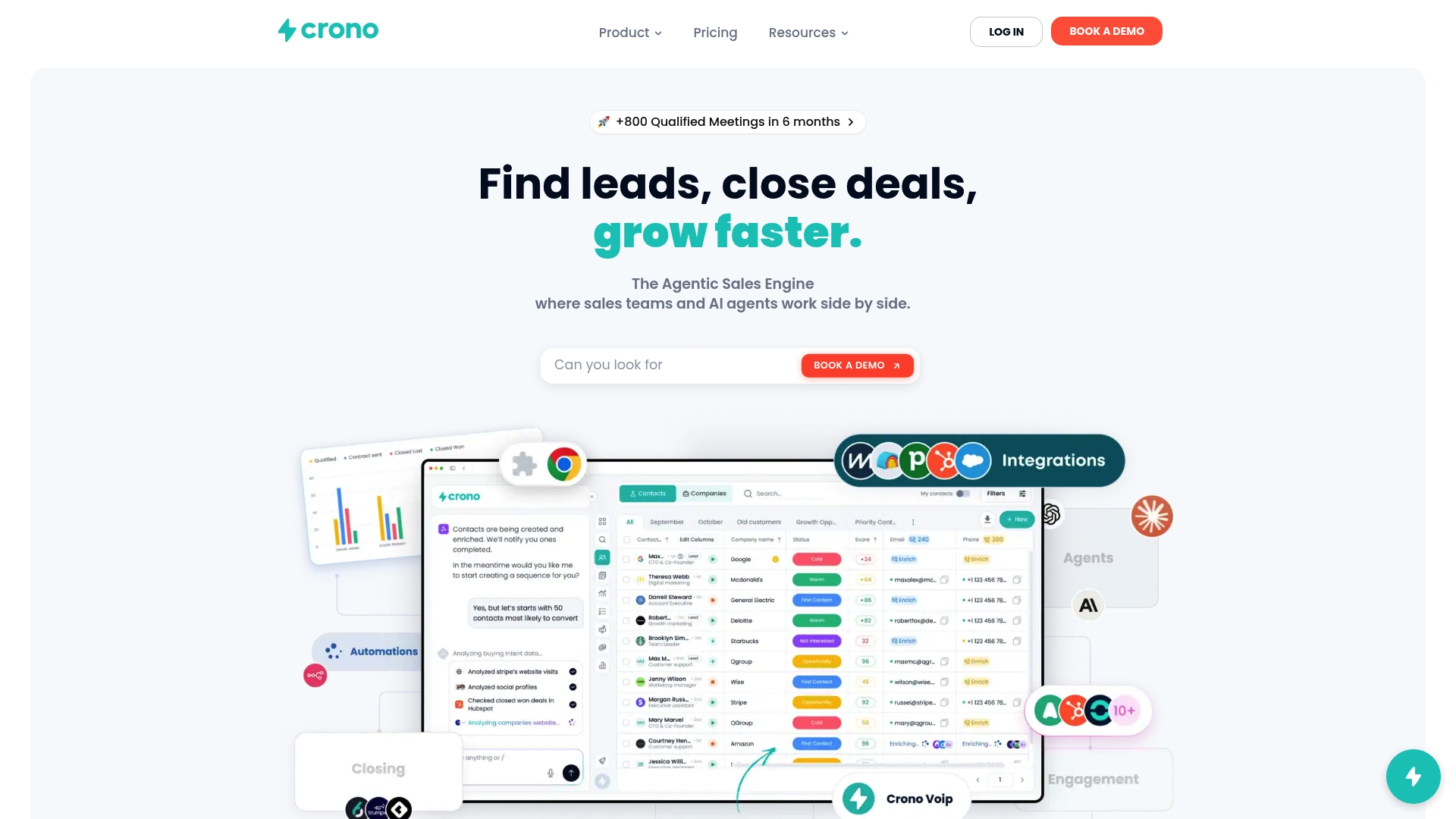
Crono is an Agentic Sales Engine that combines AI agents, workflow automation, data enrichment, and multichannel engagement in one platform. It acts as the execution layer between your signals, your data, and your revenue, so your reps and AI agents work from the same context. Sales leaders use Crono to map AI agents to specific revenue tasks, from prospecting and lead qualification to pipeline monitoring, without rebuilding their entire tech stack. The 2026 deployment guide in Crono’s academy walks you through every phase of the rollout, from baselining output to setting permission controls and scaling autonomy over time.
FAQ
What does it mean to align AI agents with a sales team?
Aligning AI agents with a sales team means assigning specific AI capabilities, such as lead qualification, sequencing, and forecasting, to defined workflow stages so they complement human rep activities rather than duplicate or disrupt them.
How many SDR roles does AI typically replace?
AI agents typically reduce SDR team size by 30–40% while increasing total output, shifting remaining human roles from manual research toward conversation management and account strategy.
What is the role of enablement when integrating AI agents?
Sales enablement trains reps to evaluate and act on AI outputs, tracks tool adoption, and uses conversation intelligence platforms like Gong to coach reps on where human judgment improves AI-assisted outreach.
How long does it take to fully integrate AI agents into a sales workflow?
A phased AI deployment typically spans 6–12 months, starting with a pilot on existing workflows, then reshaping roles, and finally hiring for AI fluency as the org matures.
What guardrails should sales leaders put in place for AI agents?
Sales leaders should require human approval for high-risk actions like contract updates or deal stage changes, log all agent actions in the CRM with source context, and limit the volume of AI recommendations surfaced per rep per day to prevent decision fatigue.
Not sure where to start?
Start with the Playbook.
Download our free Sales Playbook 2026 and learn how top B2B teams structure their outbound process.
 BANT, SPICED & MEDDPICC frameworks
- 30+ ready-to-use sales templates
- 2026 outbound & pipeline benchmarks
Don't sell the product. Sell the change the product makes possible.
Build the process before the pipeline.
