
Types of sales refers to the ways professionals classify selling by buyer, channel, deal complexity, and methodology. Each classification determines who you sell to, how you reach them, and which sales technique closes the deal fastest.
A B2B enterprise deal and a B2C e-commerce purchase are both “sales,” but they share almost nothing else. One might involve seven stakeholders and a six-month cycle managed through MEDDIC; the other closes in ninety seconds off a single product page. Understanding which taxonomy and which methodology apply to your deal is the difference between a rep who improvises and a team that executes on a repeatable process. Sales strategies are typically grouped into two overarching motions, inbound and outbound, and most revenue organizations run a blend of both.
Here’s how to use this guide:
- Start with the taxonomy section to identify your category (buyer type, channel, deal complexity).
- Move to the methodology primer to learn what each major framework actually does.
- Use the mapping and decision sections to match your deal profile to the right approach.
- Reference the KPI and stage sections when you’re ready to coach your team or set metrics.
Key Takeaways
Choosing the right sales type means matching buyer, channel, and deal complexity to a methodology built for that exact context, not the other way around.
| Point | Details |
|---|---|
| Taxonomy comes first | Classify by buyer (B2B, B2C, B2G), channel (inside, outside, direct, indirect), and deal complexity before picking a methodology. |
| Methodologies solve different jobs | BANT fits transactional deals, MEDDIC fits enterprise qualification, SPIN fits discovery, Value Selling fits negotiation. |
| Layer frameworks by stage | Enterprise teams often stack MEDDIC, SPIN, and Value Selling across qualification, discovery, and negotiation instead of using one framework. |
| Pilot before rollout | Test a methodology on one segment for eight to twelve weeks with a defined success metric before a company-wide rollout. |
| Tools accelerate, not replace | AI-driven prospecting and multichannel sequencing speed up execution but can’t substitute for discovery skill or the right methodology. |
Table of Contents
- Types of Sales by Buyer, Channel, and Deal Complexity
- Common Sales Methodologies and What They Actually Do
- Matching Methodology to Deal Complexity and Funnel Stage
- What Sales Behavior Looks Like Across Different Deal Types
- The Seven-Stage Sales Pipeline
- How to Choose the Right Sales Type or Methodology
- How Technology Is Changing Sales Execution
- Why Most Teams Get Methodology Selection Backward
- Frequently Asked Questions
- Sources
Types of Sales by Buyer, Channel, and Deal Complexity
Before you pick a methodology, you need to know what kind of sale you’re running. Three overlapping taxonomies do that work: who you’re selling to, how you reach them, and how complicated the deal is.
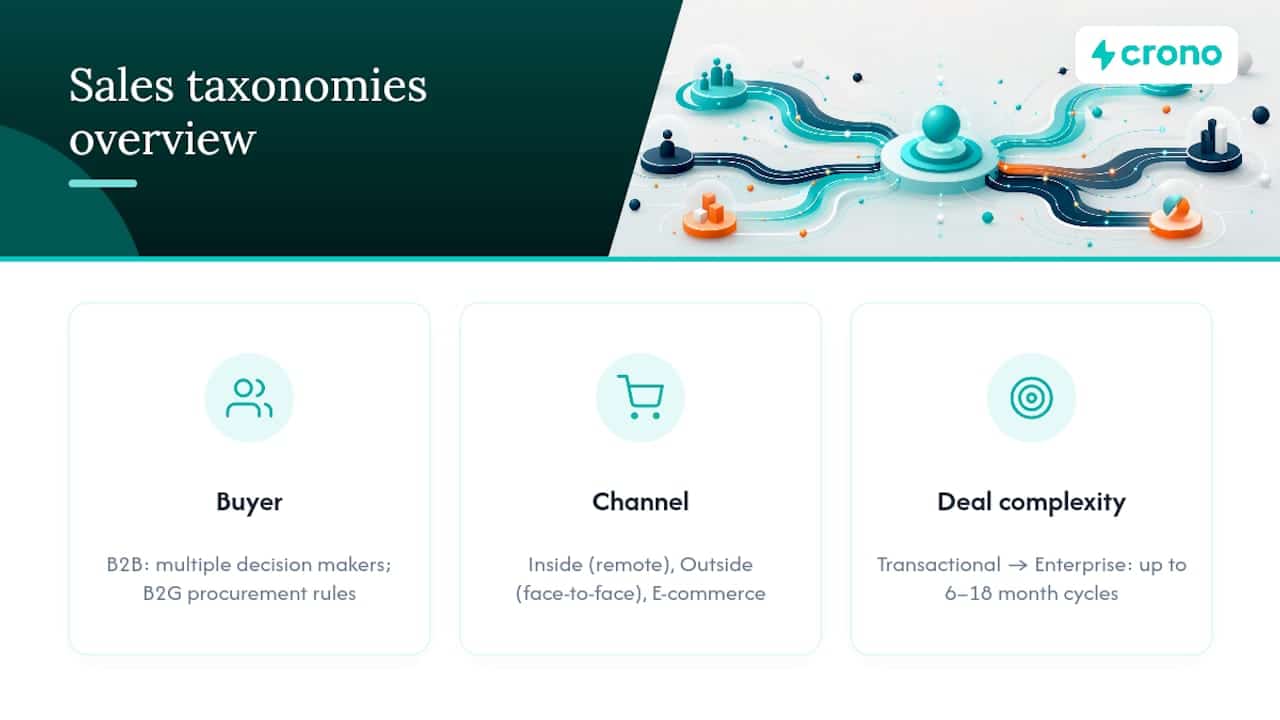
By buyer. B2B sales target other businesses and usually involve multiple decision makers, longer evaluation cycles, and contract-based pricing. A cybersecurity vendor selling to a 500-person company is a textbook example. B2C sales target individual consumers making personal purchase decisions, often in a single session, like buying running shoes online. B2G sales target government entities and layer in procurement rules, RFP processes, and compliance requirements that don’t exist in the other two categories. Each buyer type changes your sales cycle length before you’ve even picked a methodology.
By channel and motion. Inside sales happen remotely, by phone, email, or video, and dominate SaaS and mid-market B2B. Outside sales involve face-to-face meetings and still matter in industries like medical devices or enterprise manufacturing, where relationship depth and physical demos carry weight. Direct sales put your own team in front of the buyer; indirect or channel sales route through resellers, distributors, or partners who take a cut but extend your reach into markets you can’t cover alone. E-commerce and retail sales remove the human seller almost entirely, relying on product pages, reviews, and checkout flow to do the persuading.

By deal size and complexity. Transactional sales close fast, often in one call, with minimal negotiation. SMB deals involve a short cycle and one or two decision makers. Mid-market deals stretch the cycle to weeks or months and typically involve a buying committee. Enterprise deals can run six to eighteen months, involve six or more stakeholders, and require procurement, legal, and security review before anyone signs anything, a pattern Salesforce’s overview of sales types breaks down in more detail.
Pro Tip: Diagnose your category in under five minutes by checking three signals: average deal size, number of people involved in the final decision, and whether your primary channel is a rep-led conversation or a self-service page. If the answer to all three points toward “complex,” don’t run a transactional playbook. It will fail, and it will fail slowly.
Career-focused breakdowns of operational sales types, like inside, outside, agency, and business development roles, are worth a skim if you’re building a team structure rather than just picking a technique. The taxonomy tells you the shape of the deal. The methodology tells you how to run it.
Common Sales Methodologies and What They Actually Do
Methodologies are the actual playbooks reps use inside a deal, as detailed in this SaaS Sales Strategy Guide for Rapid Business Growth that explores how different sales types move prospects from discovery to close. Confusing a taxonomy (B2B, enterprise) with a methodology (MEDDIC, SPIN) is one of the most common mistakes sales leaders make when building enablement programs. Here’s what each one actually does.
- BANT/CHAMP. Qualifies leads on Budget, Authority, Need, Timeline (or Challenges, Authority, Money, Prioritization for CHAMP). Best for transactional and SMB deals with short cycles. Fits early in the funnel, at lead qualification. Coaching question: “Can this rep tell me who signs the check and by when, in one sentence?”
- MEDDIC. Stands for Metrics, Economic Buyer, Decision Criteria, Decision Process, Identify Pain, Champion. Built for enterprise qualification, where multiple stakeholders and long cycles punish sloppy discovery. Fits mid-funnel, especially forecasting and deal review. Coaching question: “Who is our champion, and have they ever said no to their own boss for us?”
- SPIN Selling. A structured question sequence: Situation, Problem, Implication, Need-payoff. Best for consultative conversations where the buyer doesn’t yet feel the full cost of their problem. Fits early-to-mid funnel, at discovery. Coaching question: “What did the prospect say the problem was costing them, in their own words?”
- Challenger Sale. Centers on teaching the buyer something new about their business, tailoring the message, and taking control of the conversation. Best for differentiated, complex solutions sold to informed buyers. Fits mid-funnel, at the insight and positioning stage. Coaching question: “What did you teach this buyer that they didn’t already know?”
- Solution Selling. Diagnoses a buyer’s specific pain and maps your product to it as the fix. Best for mid-market and enterprise deals where the product isn’t a commodity. Fits discovery through proposal. Coaching question: “What pain did we diagnose before we pitched a single feature?”
- Consultative Selling. A broader posture, more advisor than vendor, that prioritizes understanding the buyer’s business before recommending anything. Best across mid-market and enterprise, particularly in relationship-driven industries. Fits the entire funnel. Coaching question: “Did we ask more questions than we answered on this call?”
- Value Selling. Frames every conversation around quantifiable ROI, cost savings, or revenue impact. Best for late-stage negotiation, especially against procurement or a skeptical economic buyer. Fits negotiation and close. Coaching question: “Can the champion repeat our ROI number without us in the room?”
- Gap Selling. Focuses on the distance between a buyer’s current state and their desired future state, then sells the path to close that gap. Best for deals where the buyer hasn’t fully diagnosed their own problem. Fits discovery. Coaching question: “What does the buyer’s world look like on the other side of this fix?”
- Sandler/SNAP Selling. Sandler flips traditional persuasion by having the buyer sell themselves on the need; SNAP emphasizes simplicity and speed for time-strapped buyers. Best for skeptical or busy buyers resistant to pressure. Fits discovery and qualification. Coaching question: “Did the buyer state the need out loud, or did we say it for them?”
This grouping echoes what’s sometimes called the four main types of selling: solution, transactional, consultative, and provocative or Challenger-style selling. That four-part frame is a useful teaching shorthand, but the nine methodologies above give you the granularity to actually coach against.
Matching Methodology to Deal Complexity and Funnel Stage
No single methodology covers a full deal from cold outreach to signature. The strongest revenue teams layer frameworks by stage rather than picking one and forcing every deal through it.
Transactional and SMB deals do fine with BANT or CHAMP alone, since the cycle is short and the qualification bar is low. Complex enterprise deals need more scaffolding: MEDDIC for qualification and forecast accuracy, paired with SPIN or Challenger for structured discovery earlier in the cycle. Late-stage negotiation, regardless of deal size, tends to benefit from Value Selling, because that’s where an economic buyer wants to see the number before they’ll sign anything.
Decision checklist, in order of weight:
- Deal size and contract value (bigger deals justify heavier frameworks)
- Number of stakeholders in the buying group (more people means more qualification rigor)
- Sales cycle length (short cycles can’t absorb a six-step discovery process)
- Buyer sophistication and readiness (a naive buyer needs more teaching; a sophisticated one needs more proof)
Pro Tip: Layer, don’t swap. A common enterprise stack runs MEDDIC for qualification, SPIN for discovery, and Value Selling for negotiation, each framework doing the job it’s actually built for instead of stretching one methodology past its useful range.
What Sales Behavior Looks Like Across Different Deal Types
Theory matters less than what a rep actually does on a call. Three quick vignettes show the difference.
In an enterprise SaaS deal, a rep spends the first two calls almost entirely on discovery, mapping out the buying committee and identifying an internal champion before ever mentioning price. That’s MEDDIC and SPIN working together in real time. In an SMB transactional sale, the same rep would be wasting the buyer’s time; a fifteen-minute demo call followed by a same-week close is the expected rhythm, and BANT qualification happens in the first two minutes. In a B2C e-commerce context, there’s often no rep at all. The “sale” happens through product copy, reviews, and a frictionless checkout, which means the real skill is in merchandising and page design rather than conversation.
KPIs shift accordingly:
- Inside sales / transactional: call volume, connect rate, and time-to-first-response.
- Enterprise: pipeline velocity, win rate, and forecast accuracy.
- Channel/indirect: partner-sourced revenue and deal registration compliance.
- E-commerce: conversion rate, cart abandonment, and average order value.
Pro Tip: Discovery training produces the biggest lift for consultative and SPIN-heavy motions, since most reps default to pitching before they’ve earned the right to. For transactional teams, the higher-leverage investment is usually objection-handling drills, since the cycle is too short for deep discovery anyway.
The Seven-Stage Sales Pipeline
Every sales motion, regardless of methodology, moves through a version of the same pipeline. Knowing which stage a deal sits in tells you which methodology should be doing the heavy lifting.
- Prospecting — identifying and researching potential buyers.
- Lead qualification — confirming budget, authority, and fit, often with BANT or CHAMP.
- Discovery — uncovering pain and context, the natural home for SPIN and Gap Selling.
- Demo or presentation — showing the product mapped to diagnosed pain, Solution Selling territory.
- Proposal — formalizing scope and pricing.
- Negotiation — where Value Selling earns its keep, defending price against procurement.
- Close — securing signature and handing off to onboarding.
MEDDIC runs underneath stages two through six as an ongoing qualification and forecasting layer rather than a single stage. Challenger behaviors tend to surface earliest, often during prospecting and discovery, when teaching a buyer something new is what earns you the next meeting.
How to Choose the Right Sales Type or Methodology
Picking a methodology isn’t a one-time decision. It’s a hypothesis you test against real pipeline data.
Start with a decision checklist:
- What’s the average deal size and contract length?
- How many stakeholders sit in a typical buying group?
- How fast can you train and certify reps on a new framework?
- How mature is your tooling, can it actually track the metrics the methodology requires?
- Which KPI are you actually trying to move: win rate, cycle length, or average deal size?
Once you’ve answered those, pilot before you roll out company-wide. A workable three-step plan:
- Select a narrow scope. Pick one team or one segment, not the entire org, and one methodology to test.
- Train the coaches first. Managers need to internalize the framework before they can score reps against it.
- Run an eight to twelve week pilot with a clear success metric defined before day one, such as a specific lift in qualified pipeline or forecast accuracy.
Watch for mismatch signals: pipeline velocity dropping instead of rising, reps giving inconsistent answers about deal status, or forecast accuracy getting worse after rollout. Any of those means the framework doesn’t fit the motion, not that reps need more training on it. Sometimes the fix is scoring the methodology against your actual deal profile again, the way Demodesk recommends, rather than pushing harder on adoption.
How Technology Is Changing Sales Execution
Methodology still decides what a rep says on a call. Technology now decides how fast that rep gets to the call in the first place, and how consistently the follow-up actually happens.
A modern execution workflow typically looks like this:
- Buying signals and intent data surface accounts worth prioritizing before a rep manually searches for them.
- Enrichment tools fill in contact and firmographic data automatically, cutting research time per lead.
- Multichannel sequencing coordinates LinkedIn, email, and calls so outreach doesn’t rely on a rep remembering step four of a cadence.
- AI agents draft and personalize messaging at a volume no human team could sustain manually.
Platforms built as a sales execution layer, connecting existing CRM and prospecting tools rather than replacing them, are where this shows up most concretely for B2B teams running high-volume outbound alongside enterprise ABM motions.
Pro Tip: Measure tooling impact with lift metrics, not activity counts: meetings booked per 1,000 touches, time-to-first-response, and forecast accuracy before and after adoption. Activity volume alone tells you nothing about whether the pipeline is actually healthier.

None of this replaces methodology. A perfectly automated sequence sent by a rep who never diagnosed the buyer’s actual problem still loses the deal; tools accelerate execution, they don’t substitute for discovery skill.
Why Most Teams Get Methodology Selection Backward
Most sales organizations pick a methodology because a competitor uses it or because a well-known book made it famous, not because it fits their actual deal profile. That’s backward. Start with your taxonomy, buyer type, channel, deal complexity, and let the methodology follow from that, not the reverse.
If you’re unsure where to start, diagnose before you train. Pull twenty recent closed-won and closed-lost deals, and look for the pattern: were the losses concentrated in long, multi-stakeholder deals where discovery was thin? That tells you more than any framework’s marketing ever will.
Three things to do in the next thirty days:
- Audit your last quarter of deals against the taxonomy categories in this guide, and tag each by buyer type, channel, and complexity.
- Pick one underperforming segment and pilot a single methodology against it, not three at once.
- Align one KPI, forecast accuracy or win rate, to that pilot before you touch anything else.
Frequently Asked Questions
What are the main types of sales?
The main types split across three taxonomies: buyer (B2B, B2C, B2G), channel (inside, outside, direct, indirect, e-commerce), and deal complexity (transactional, SMB, mid-market, enterprise). Most teams sit in more than one category at once.
What’s the difference between a sales type and a sales methodology?
A sales type describes the deal’s shape, who the buyer is, how you reach them, how complex the deal is. A methodology like MEDDIC or SPIN is the actual playbook a rep runs inside that deal. Confusing the two leads to picking the wrong framework.
Which sales methodology works best for enterprise deals?
Most enterprise teams run MEDDIC for qualification and forecasting, paired with SPIN or Challenger for discovery and Value Selling at the negotiation stage. No single framework covers the entire enterprise cycle.
Is inbound or outbound better for B2B sales?
Neither wins outright. Inbound and outbound are complementary strategies: inbound attracts prospects through content and search, outbound proactively targets high-value accounts. Most modern B2B teams run both simultaneously.
How do I know if my team is using the wrong sales methodology?
Watch for dropping pipeline velocity, inconsistent deal-stage answers across reps, and worsening forecast accuracy after a framework rollout. Those signals usually mean the methodology doesn’t match your actual deal complexity, not that reps need more training.
Sources
- Sales Methodologies Compared: BANT, MEDDIC, SPIN, and More (Rework/Resources)
- Two types of sales strategies are inbound and outbound sales (Coursera)
- The different types of sales | A complete guide (Zendesk)
- What Is Sales | Sales Meaning | Types of Sales (Salesforce)
