
A sales methodology is a repeatable framework that prescribes how reps engage buyers at each stage of a deal to increase predictable closes. Pick one your team will actually use, integrate it into your daily tools, and measure adoption from week one.
Most methodologies share the same structural DNA, regardless of name or origin:
- Qualification — determining whether a prospect fits your ideal customer profile before investing significant rep time
- Discovery — surfacing the buyer’s real problems, priorities, and decision criteria through structured questions
- Value articulation — connecting your solution’s capabilities to the buyer’s specific business outcomes
- Objection handling — addressing concerns with evidence and reframing rather than pressure
- Close — guiding the buyer to a decision with clear next steps and mutual accountability
The adoption signal is hard to ignore. 88% of salespeople trained in the Sandler Selling System reported improvements in their sales strategy. That figure reflects a broader truth: structured methodology training, when reinforced in daily workflows, produces measurable behavior change.
Table of Contents
- What does a sales methodology actually cover?
- How does a sales process differ from a methodology?
- What are the major sales methodologies and when does each fit?
- How do you choose the right methodology for your team?
- How do you implement a methodology and drive adoption?
- How do you embed a methodology into your sales execution stack?
- What should you do right now? A manager’s action checklist
- Key Takeaways
- The gap between choosing a methodology and actually using one
- Faster methodology adoption with Crono
- Useful sources and further reading
What does a sales methodology actually cover?
A sales methodology is a philosophy or framework, not a company-specific checklist. It tells reps how to think and behave in a sales conversation. Your sales process, by contrast, is the organization-specific sequence of stages your deals move through: prospecting, discovery, proposal, negotiation, close. The methodology is the guardrail that shapes behavior inside each of those stages.
Most methodologies define four things:
- Core moves or questions — the specific conversational techniques reps use (e.g., problem-implication questions in SPIN Selling, or teaching insights in the Challenger Sale)
- Qualification rules — the criteria that determine whether a deal deserves continued investment
- Role responsibilities — which rep, manager, or specialist owns each interaction
- Buyer outcomes — the results the buyer should experience at each stage, not just the seller’s internal milestones
What methodologies generally do not define: the exact CRM fields your team fills in, the specific sequences your automation runs, or the company-specific scripts your enablement team writes. Those are your process and tooling decisions. A methodology gives you the principles; your team operationalizes them.
Methodologies apply across the full funnel. MEDDIC, for example, is most powerful at qualification and late-stage negotiation. SNAP Selling is designed for early-stage outreach when buyers are overwhelmed and distracted. Consultative Selling runs through discovery and proposal. Understanding where a methodology concentrates its value helps you decide whether you need one framework end-to-end or different approaches at different stages.
How does a sales process differ from a methodology?
The simplest way to hold the distinction: your process is the what (the steps), and your methodology is the how (the approach). HubSpot’s breakdown frames it well: a process is company-specific and sequential; a methodology is broader, often publicly documented, and informs how reps execute within each step.

Here is a practical mapping. Take a standard five-stage process: Prospect → Qualify → Discover → Propose → Close. If you adopt MEDDIC/MEDDICC, the methodology reshapes your qualification gate by requiring reps to document Metrics, Economic Buyer, Decision Criteria, Decision Process, Identify Pain, Champion, and Competition before a deal advances. If you adopt SPIN Selling instead, the same qualification stage looks different: reps lead with Situation and Problem questions, then probe Implications before articulating value. Same process stage, two entirely different behavioral approaches.
Signs your process and methodology are out of sync:
- Reps skip CRM fields because the methodology’s qualification criteria don’t map to your stage gates
- Coaching conversations focus on activity metrics rather than methodology moves
- Win rates vary widely across reps using the “same” process, suggesting no shared behavioral standard
- Pipeline reviews surface deals that stall at the same stage repeatedly, pointing to a discovery or qualification gap
- New rep ramp time is long because there is no consistent behavioral playbook to learn from
When you see two or more of these signals together, the gap is usually between a well-documented process and an under-embedded methodology.
What are the major sales methodologies and when does each fit?
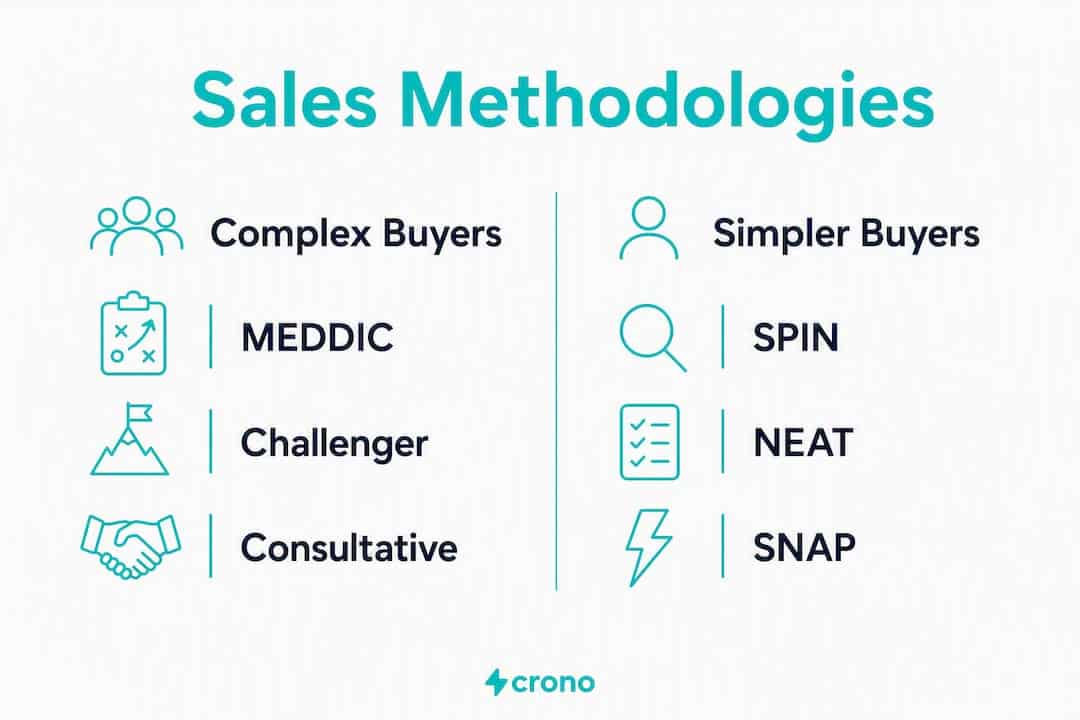
Methodology selection depends on buyer complexity, deal size, rep seniority, and sales motion. The eleven frameworks below cover the full range from transactional to enterprise, from SDR-friendly to AE-led.
SPIN Selling
Developed by Neil Rackham from research across 35,000 sales calls, SPIN structures discovery around four question types: Situation, Problem, Implication, and Need-Payoff. Reps uncover pain by moving from context-setting to consequence-surfacing before presenting value. It works best in complex B2B deals where the buyer does not yet fully understand the cost of their problem.
The Challenger Sale
Based on Gartner research, the Challenger model identifies the “Challenger” rep profile as the highest performer in complex sales. Reps teach the buyer something new about their business, tailor the message to the buyer’s specific priorities, and take control of the conversation. Gartner’s analysis showed that Challenger reps outperformed other profiles significantly in complex, multi-stakeholder deals.
MEDDIC / MEDDICC
MEDDIC (Metrics, Economic Buyer, Decision Criteria, Decision Process, Identify Pain, Champion) and its extended version MEDDICC (adding Competition) are qualification frameworks, not full-cycle methodologies. They are most powerful in enterprise deals with long cycles and multiple stakeholders. The framework forces reps to document what they actually know versus what they assume, which tightens forecast accuracy.
NEAT Selling
NEAT stands for Needs, Economic Impact, Access to Authority, and Timeline. It is a lighter-weight qualification alternative to MEDDIC, suited to mid-market deals where reps need a structured but faster qualification gate. The economic impact dimension pushes reps to quantify value early, which shortens later negotiation cycles.
Consultative Selling
Consultative Selling positions the rep as a trusted advisor rather than a vendor. The approach prioritizes deep discovery, active listening, and co-creating solutions with the buyer. It fits well in professional services, complex SaaS, and any context where the buyer’s situation is unique enough that a standard pitch would miss the mark. The learning curve is moderate; the payoff is higher trust and larger average contract values.
Sandler Selling System
Sandler flips the traditional sales dynamic. Reps qualify hard upfront, surface the buyer’s pain and budget early, and are willing to walk away from bad-fit deals. The “upfront contract” technique sets mutual expectations at the start of every call. It suits experienced reps in competitive markets where time-wasting prospects are a real cost. The 88% strategy improvement figure cited earlier comes specifically from Sandler-trained sellers.
SNAP Selling
Jill Konrath’s SNAP framework addresses the modern, distracted buyer: Simple, iNvaluable, Aligned, and Priority. Reps must earn attention in seconds, demonstrate relevance immediately, and connect to the buyer’s top priorities. It is most effective in early outreach and top-of-funnel engagement, particularly for SDRs working high-volume sequences.
Gap Selling
Gap Selling, developed by Keenan, centers on the distance between the buyer’s current state and their desired future state. Reps diagnose the problem deeply before ever mentioning a solution. The methodology works well in discovery-heavy, consultative motions where buyers are not yet solution-aware. It pairs naturally with Consultative Selling principles.
Inbound Selling
Inbound Selling aligns rep behavior with the buyer’s self-directed research journey. Reps engage buyers who have already shown intent (content downloads, demo requests, trial sign-ups) and focus on helping rather than pitching. It fits teams with strong marketing pipelines and works best when reps can access intent data to personalize outreach. Pairing this with AI-driven outbound engagement lets teams extend the same personalized approach beyond inbound leads.
Command of the Sale
Command of the Sale, developed by Force Management, focuses on rep control of the buying process. Reps define required capabilities, connect them to the buyer’s business outcomes, and establish proof points that differentiate the solution. It is enterprise-grade and pairs well with MEDDIC for qualification. The learning curve is steep; it typically requires formal enablement investment.
Conceptual Selling
Conceptual Selling, from Miller Heiman, shifts focus from product features to the buyer’s concept of an ideal solution. Reps ask questions across three categories: confirmation questions, new information questions, and attitude questions. It is designed for complex, multi-stakeholder deals where the buyer’s internal concept of success must be understood before any solution is proposed.
Methodology comparison table
| Methodology | Best for | Deal size / cycle | Team role fit | Complexity | Key moves | Pros / Cons | Implementation time |
|---|---|---|---|---|---|---|---|
| SPIN Selling | Complex B2B discovery | Mid to large / long | AE, senior SDR | Moderate | Situation, Problem, Implication, Need-Payoff questions | Strong research base; requires practice to feel natural | 4–8 weeks |
| The Challenger Sale | Multi-stakeholder enterprise | Large / long | Senior AE, enterprise | High | Teach, Tailor, Take Control | Proven at enterprise level; hard for junior reps | 8–12 weeks |
| MEDDIC / MEDDICC | Enterprise qualification | Large / very long | AE, enterprise | High | Metrics, Economic Buyer, Decision Criteria, Decision Process, Pain, Champion | Tightens forecast accuracy; not a full-cycle framework | 6 weeks |
| NEAT Selling | Mid-market qualification | Mid / medium | AE, SDR | Low–Moderate | Needs, Economic Impact, Authority, Timeline | Fast to learn; lighter than MEDDIC | 2–4 weeks |
| Consultative Selling | Professional services, SaaS | Mid to large / long | Senior AE | Moderate | Deep discovery, active listening, co-creation | Builds trust; slower to close | 6 weeks |
| Sandler Selling System | Competitive markets | Mid / medium | Experienced AE | Moderate–High | Upfront contract, pain/budget qualification, walk-away posture | Reduces wasted time; requires rep confidence | 6–12 weeks |
| SNAP Selling | High-volume outreach | Small–Mid / short | SDR, BDR | Low | Simple, iNvaluable, Aligned, Priority | Fast to adopt; limited depth for late-stage | 2–4 weeks |
| Gap Selling | Discovery-heavy motions | Mid / medium–long | AE | Moderate | Current state, future state, gap diagnosis | Strong discovery discipline; requires coaching | 4–8 weeks |
| Inbound Selling | Intent-driven pipelines | Small–Mid / short–medium | SDR, AE | Low | Identify, Connect, Explore, Advise | Aligns with buyer journey; depends on marketing pipeline | 2–4 weeks |
| Command of the Sale | Enterprise, competitive | Large / long | Enterprise AE | High | Required capabilities, business outcomes, proof points | Highly structured; strong differentiation | 16 weeks |
| Conceptual Selling | Multi-stakeholder complex | Large / long | Senior AE | High | Confirmation, new information, attitude questions | Buyer-centric; steep learning curve | 8–12 weeks |
Pro Tip: Organizations often apply methodologies selectively by stage: Challenger for front-end discovery, MEDDIC for qualification gates, Consultative for late-stage negotiation. You do not have to pick one and apply it uniformly across every motion.
How do you choose the right methodology for your team?
Selection comes down to six variables. Score each candidate methodology against them before committing to a pilot.
| Criterion | What to assess | Weight (suggested) |
|---|---|---|
| Buyer complexity | How many stakeholders, how long is the cycle, how defined is the problem? | High |
| Deal size | Larger deals justify higher methodology complexity and longer ramp time | High |
| Sales motion | Transactional (volume, speed) vs. consultative (depth, trust) | High |
| Rep seniority | Junior reps need simpler frameworks; senior reps can handle nuance | Medium |
| Process maturity | Immature processes need a simpler overlay; mature ones can absorb complexity | Medium |
| Enablement budget | Complex methodologies require formal training investment | Medium |
| CRM / tooling fit | Can you embed the methodology’s qualification criteria into your existing stack? | Medium |
Run these discovery questions with your stakeholders before scoring:
- Sales leadership: Where do deals most commonly stall or die? What behavior do your top reps share that others don’t?
- Enablement: What training infrastructure exists today? Can you run role-play and reinforcement at scale?
- RevOps: Which CRM fields are consistently filled? Which are routinely skipped? What stage conversion data do you have?
- Top reps: What questions do you ask that others don’t? What do you do differently in discovery?
The answers will surface the gap your methodology needs to close. If deals stall at qualification, MEDDIC or NEAT is the priority. If discovery is shallow and buyers disengage at proposal, SPIN or Gap Selling addresses the root cause. If reps are losing to competitors on differentiation, Challenger or Command of the Sale is worth piloting.
On mixing methodologies: many organizations do better selecting a primary framework and allowing stage-specific adaptations rather than enforcing one rigid system for every motion. A mid-market team might use SNAP for outreach, NEAT for qualification, and Consultative Selling for late-stage negotiation. The key is documenting which framework applies where, so reps are not guessing. Tracking B2B sales trends also helps you anticipate when your chosen methodology may need updating as buyer behavior shifts.
How do you implement a methodology and drive adoption?
Most methodology rollouts fail not because the framework is wrong, but because adoption is treated as a training event rather than an operational change. The implementation below is structured as a six-phase sequence.
Phase 1: Choose (weeks 1–2)
Apply the scoring framework above. Involve sales leadership, enablement, and RevOps. Document the decision and the rationale so the team understands why this methodology, not just what it is.
Phase 2: Pilot (weeks 3–8)
Run a focused pilot with 4–8 reps, ideally a mix of tenures and deal types. Define success criteria upfront: target win rate improvement, stage conversion lift, or qualification accuracy. Build a minimum viable playbook: one discovery script, one qualification checklist, and one coaching rubric.

Phase 3: Train (weeks 3–6, overlapping with pilot)
Role-based learning matters here. SDRs need different training than AEs; managers need coaching rubrics, not rep scripts. Use role-play for the highest-leverage methodology moves (discovery questions, qualification gates). Micro-learning reinforcement, short weekly modules tied to real deal reviews, outperforms one-time workshops for retention. The sales enablement resources your team uses should map directly to the methodology’s core moves.
Phase 4: Embed (weeks 6–12)
This is where most rollouts stall. Embedding means:
- Adding required CRM fields that map to the methodology’s qualification criteria
- Building playbook templates and call guides that reflect the methodology’s core questions
- Creating automated task prompts that surface methodology checkpoints at the right deal stage
- Updating stage exit criteria so deals cannot advance without documented methodology evidence
Phase 5: Measure (weeks 8–16)
Track two categories of KPIs:
- Adoption KPIs: CRM field completion rate for methodology-specific fields, percentage of deals with documented discovery notes, coaching session frequency
- Outcome KPIs: Stage-to-stage conversion rate, win rate, average deal cycle length, average contract value
Phase 6: Iterate (ongoing)
Review pilot results at week 12. If adoption KPIs are strong but outcome KPIs lag, the methodology is embedded but may need calibration. If adoption is low, the embedding (phase 4) needs reinforcement before you can read outcome data.
Compact implementation timeline:
| Phase | Timing | Key deliverable |
|---|---|---|
| Choose | Weeks 1–2 | Scored methodology decision with stakeholder sign-off |
| Pilot + Train | Weeks 3–8 | Minimum viable playbook, trained pilot cohort |
| Embed | Weeks 6–12 | CRM fields, playbook templates, automated prompts |
| Measure | Weeks 8–16 | Adoption and outcome KPI dashboard |
| Iterate | Week 12 onward | Calibration decisions based on pilot data |
Implementation checklist:
- [ ] Methodology selected and documented with rationale
- [ ] Pilot cohort defined (4–8 reps, mixed tenure)
- [ ] Success criteria set before pilot begins
- [ ] Discovery script and qualification checklist built
- [ ] CRM fields mapped to methodology criteria
- [ ] Stage exit criteria updated
- [ ] Coaching rubric created for managers
- [ ] Micro-learning reinforcement schedule in place
- [ ] Week 12 review date locked in calendar
Pro Tip: Tie methodology adoption to your weekly pipeline review. Ask reps to walk through one deal using the methodology’s core questions, not just the stage and dollar amount. That single habit, repeated weekly, does more for adoption than any training event.
How do you embed a methodology into your sales execution stack?
Training alone does not sustain methodology adoption. The research is consistent: integrating methodology steps into CRM workflows and task automation converts training into daily habits and prevents the drop-off that typically follows a launch event.
The practical checklist for tooling alignment:
- Required CRM fields: Map each methodology qualification criterion to a mandatory field. For MEDDIC, that means fields for Metrics, Economic Buyer, Champion, and Decision Process, all required before a deal advances to proposal.
- Playbook templates: Build call guides and email templates that embed the methodology’s core questions. A SPIN discovery call guide, for example, sequences Situation questions before Problem questions, with Implication prompts built in.
- Automation rules: Set task triggers that surface methodology checkpoints at the right moment. A deal entering the proposal stage should automatically prompt the rep to confirm Champion access and documented Metrics before the proposal goes out.
- Coaching triggers: Flag deals that skip required fields or stall beyond the average cycle length. These become the agenda for weekly coaching, not a separate audit.
Consider a hypothetical mid-market SaaS team running MEDDIC. Before embedding, their qualification accuracy (deals that close as forecast) sits at roughly 40%. After adding required MEDDIC fields to their CRM and building automated stage-gate prompts, their reps document Economic Buyer and Champion on every deal. Forecast accuracy improves because the CRM now reflects what reps actually know, not what they hope is true. Agentic sales execution takes this further by automating the prompts, data enrichment, and follow-up tasks that keep methodology adherence visible without adding manual overhead.
Pro Tip: Tie methodology checkpoints to rep scorecards. Score each rep weekly on two or three methodology behaviors (e.g., “Champion confirmed,” “Metrics documented,” “Implication questions asked in discovery”). Review the scorecard in your 1:1 before reviewing the pipeline. Reps who score well on methodology behaviors consistently outperform those who don’t, and the scorecard makes coaching specific rather than generic.
What should you do right now? A manager’s action checklist
If you have read this far, you have enough to act. Here is the short version:
- Decide who decides. Assign one owner (typically VP of Sales or Head of Enablement) to lead the methodology selection. Committees slow the process; one accountable leader moves it.
- Pick one methodology. Use the scoring table from the selection section. Shortlist two, score them against your six criteria, and commit to the higher scorer for the pilot.
- Run a 6–12 week pilot. Four to eight reps, defined success criteria, minimum viable playbook in place before day one.
- Integrate into your CRM. Add required fields, update stage exit criteria, and build at least one automated methodology prompt before the pilot begins.
- Measure and iterate. Track adoption KPIs weekly and outcome KPIs at week 12. Make a go/no-go decision on full rollout based on data, not enthusiasm.
Pilot metrics to track from day one:
- CRM field completion rate for methodology-specific fields (target: 80%+ by week 4)
- Percentage of pilot deals with documented discovery notes (target: 90%+ by week 6)
- Stage conversion rate for pilot cohort vs. control group
- Win rate at week 12 vs. pre-pilot baseline
A pilot team of 4–8 reps over 6–12 weeks gives you enough data to make a confident rollout decision without betting the entire team on an untested framework.
Key Takeaways
The most effective approach to sales methodology adoption is choosing one framework that fits your buyer complexity and deal size, embedding it into your CRM and coaching rituals, and measuring behavioral adoption before expecting outcome improvement.
| Point | Details |
|---|---|
| Methodology vs. process | A methodology is the behavioral framework; your process is the company-specific sequence of stages it informs. |
| Adoption drives results | 88% of Sandler-trained sellers reported improved strategy, illustrating that structured training with reinforcement produces measurable change. |
| Match methodology to motion | Transactional teams benefit from SNAP or NEAT; enterprise teams need MEDDIC, Challenger, or Command of the Sale. |
| Embed before you measure | Add required CRM fields and automated prompts before the pilot begins; adoption KPIs must be strong before outcome KPIs are meaningful. |
| Crono as execution layer | Crono connects methodology checkpoints to CRM workflows, automated task prompts, and AI-driven coaching triggers to accelerate adoption without manual overhead. |
The gap between choosing a methodology and actually using one
Most sales teams do not have a methodology problem. They have an adoption problem. The framework gets announced, a training session runs, and within six weeks reps are back to doing what they always did, because the methodology lives in a slide deck rather than in their daily workflow.
The conventional wisdom says to pick the right methodology and train hard. That advice is not wrong, but it is incomplete. The real lever is operational embedding. A methodology that is wired into your CRM stage gates, your coaching rubrics, and your weekly pipeline review will outlast any training event by months. One that is not embedded will fade in weeks, regardless of how well-designed it is.
There is also a tendency to over-engineer the selection. Teams spend months evaluating frameworks, building scoring matrices, and debating MEDDIC versus MEDDICC, when the more honest question is: which methodology will your managers actually coach to? Because the methodology your managers reinforce is the one that sticks, and the one they ignore is the one that disappears. Start with what your managers can credibly model and coach, then build the tooling around it.
One more thing worth saying plainly: mixing methodologies is not a failure of commitment. It is often the right answer. Applying Challenger at the front end of a deal and MEDDIC at the qualification gate is not inconsistent; it is contextually appropriate. The mistake is mixing without documenting, so reps are left guessing which framework applies when.
Faster methodology adoption with Crono
Teams that want to move from methodology selection to measurable adoption in weeks rather than months need more than a training program. They need an execution layer that makes the methodology visible in every rep’s daily workflow.
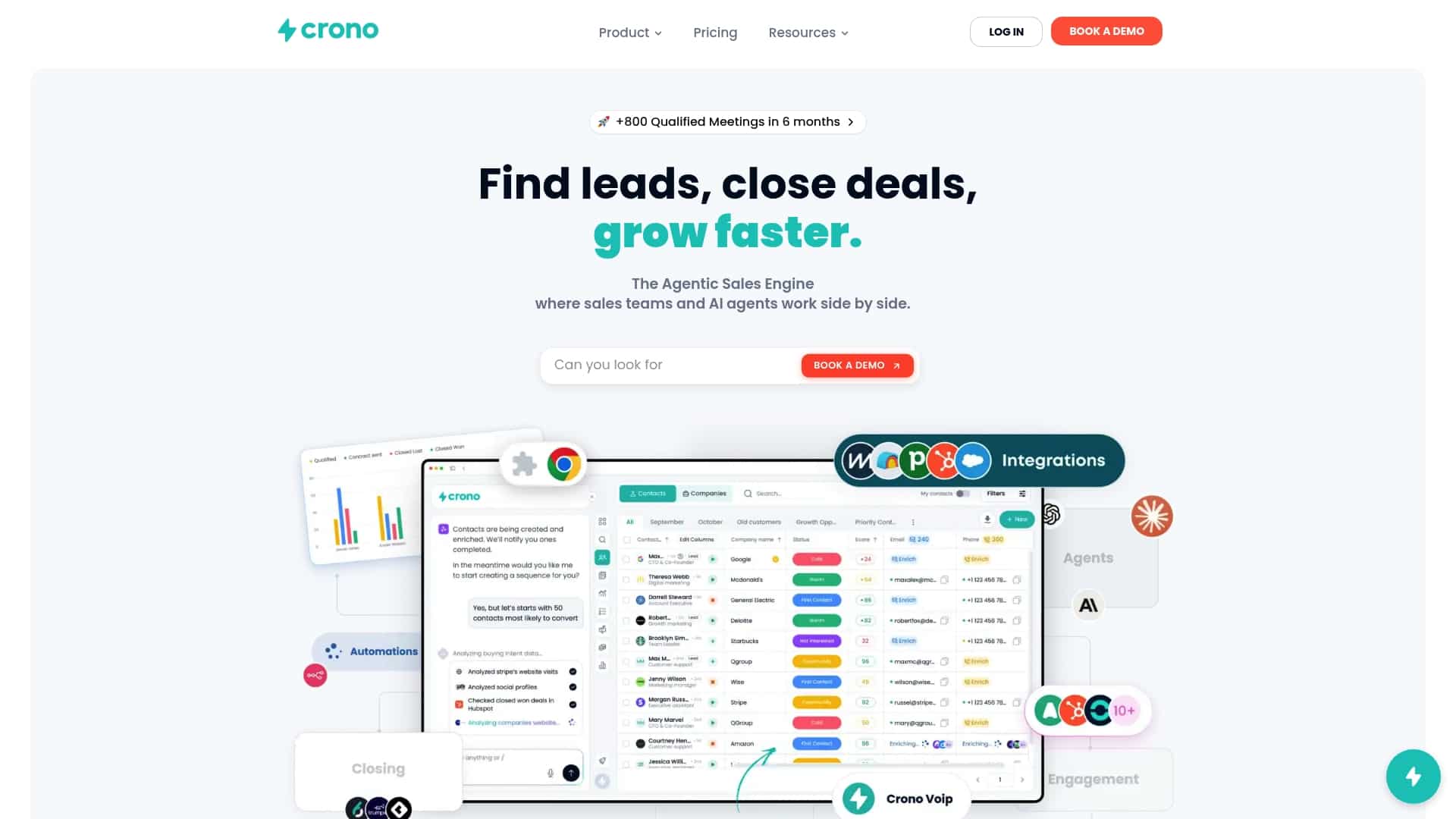
Crono connects your CRM, playbooks, and outreach sequences into a unified platform where methodology checkpoints become automated prompts, required fields, and AI-driven coaching triggers. Instead of relying on reps to remember the framework, Crono surfaces the right question at the right deal stage, flags qualification gaps before they become forecast misses, and gives managers a real-time view of methodology adherence across the team. For teams ready to go beyond theory and apply B2B sales techniques with precision, Crono provides the operational layer that turns a chosen methodology into a daily habit. Start your pilot with Crono and see adoption KPIs move in the first two weeks.
Useful sources and further reading
The sources below are worth bookmarking for deeper study on methodology selection, implementation, and operationalization.
- Sales Methodologies: How to Choose the Right One | Salesforce — Covers the distinction between methodology and process and offers practical guidance on adapting frameworks to your business context.
- Sales Methodologies Explained | Richardson Sales Training — Frames methodology selection around business context, buyer type, deal complexity, and team readiness.
- Power of the Challenger Sales Model | Gartner — Primary source for the Challenger rep profile research and its performance data in complex sales.
- Crono: The Agentic Sales Engine — Crono’s platform overview for teams that want to operationalize a chosen methodology through CRM integration, AI agents, and automated execution workflows.
