

Territory planning in B2B is the process of dividing your total addressable market into defined segments and assigning each segment to a sales rep to maximize coverage, minimize overlap, and connect rep activity directly to revenue targets.
The outputs are concrete: ownership assignments, workload balance, and quotas tied to real opportunity value.
Tools like Salesforce, LeanData, and Apollo feed the data that makes this work. Without a deliberate plan, reps chase the same accounts, ignore others entirely, and quota attainment becomes a guessing game. A well-designed territory plan is the foundation of every B2B sales plan that actually holds up through the year.
What is territory planning in B2B, and why does it matter?
Territory planning segments the total addressable market into manageable parts and assigns them to reps to maximize coverage, minimize overlap, and link coverage to revenue targets. That definition matters because it shifts the conversation from “how many accounts does each rep have” to “how much revenue opportunity does each rep own.” Those are very different questions.

The importance of territory planning shows up most clearly when it breaks down. Reps in overlapping territories compete internally instead of selling. Reps in undersized territories hit quota easily while others struggle with impossible workloads. Both outcomes destroy morale and distort your forecast. Fair quota distribution requires balancing revenue potential, not just account counts. A territory with 500 SMB accounts is not equivalent to one with 20 enterprise accounts, even if the headcount looks balanced.
Territory planning also gives sales leadership a structured way to allocate resources. When you know which segments are covered and which are not, you can make hiring decisions based on data rather than instinct. That clarity is what separates a revenue team that scales from one that just grows headcount and hopes for the best.
What are the main models used for B2B territory design?
Territory design follows four primary models. Each fits a different team structure, average contract value, and buyer profile.
| Model | Best for | Key criteria |
|---|---|---|
| Geographic | Field sales, regional buyers | Location, travel time, density |
| Named accounts | Enterprise, strategic deals | Company size, revenue, relationship |
| Vertical/industry | Specialized reps, niche markets | Industry, use case, compliance needs |
| Hybrid | Mid-market, complex orgs | Mix of geography + account tier |
Geographic territories work well when buyers prefer in-person relationships or when travel efficiency matters. A field rep covering the Pacific Northwest has a clear boundary and a manageable drive time between accounts.
Named account models assign specific companies to specific reps regardless of location. This model fits enterprise sales where a single deal can be worth more than an entire geographic territory. Reps build deep relationships with a short list of high-value targets.
Vertical models group accounts by industry. A rep who covers financial services exclusively develops expertise that a generalist cannot match. This model works when your product has meaningfully different use cases across sectors.
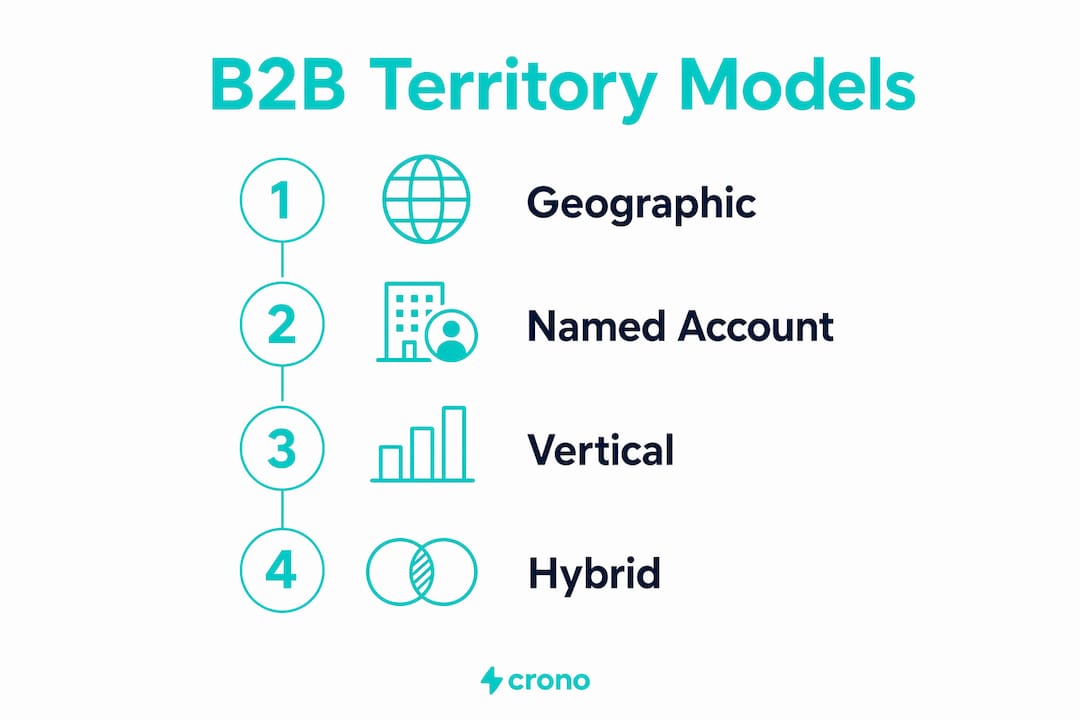
Hybrid models combine elements of the above. A mid-market team might assign accounts by geography within a named list filtered by company size. The tradeoff is complexity. Hybrid models require more maintenance and clearer rules of engagement to prevent overlap.
The right model depends on three factors: team size, average contract value, and buyer profile. A 10-person team selling $50,000 ACV deals to enterprise CFOs needs a different structure than a 50-person team selling $5,000 ACV deals to operations managers across every industry.
How does data-driven territory planning work?
Data-driven territory planning balances three variables for every territory: opportunity value, workload, and win probability. Get one wrong and the plan fails. A territory with high opportunity value but impossible workload produces burnout. A territory with low win probability and light workload produces disengagement.
The mechanics start with capacity math. You need to define what “coverage” actually means before you can calculate how many accounts a rep can handle. Meaningful coverage means at least three outbound attempts with relevant follow-up per account per quarter. That definition changes everything. A rep who can make 200 meaningful touches per quarter can cover far fewer accounts than a raw account count suggests.
Key variables to track for each territory:
- Opportunity value: Total addressable revenue within the segment, weighted by deal size and close probability
- Workload: Number of accounts multiplied by the touches required per account per quarter
- Win difficulty: Historical win rates by segment, competitor presence, and buyer maturity
- Account mix: Ratio of active pipeline accounts to cold prospects
Data-driven models aim for less than 20% variance across territories to maintain fairness and forecasting accuracy. That 20% threshold is the practical ceiling. Below it, reps accept the plan as fair. Above it, you get complaints, sandbagging, and political fights over account ownership.
Pro Tip: Start with 3–5 segmentation variables maximum. Adding more variables before your data is clean creates false precision. Build the minimum viable model first, validate it against last year’s attainment, then add complexity one variable at a time.
The most common mistake in territory planning is treating it as a spreadsheet exercise. The math is necessary but not sufficient. You also need rep-level input on local market knowledge, existing relationships, and account history that no CRM field captures automatically.
What are best practices for ongoing territory management and review?
Territory planning is a periodic exercise. Territory management is continuous. Confusing the two is how plans fall apart by Q2.
Most B2B teams run territory planning annually or semi-annually, with mid-year adjustments and quarterly reviews built into the calendar. Quarterly reviews catch coverage gaps roughly three times faster than annual reviews. That speed matters when a rep leaves, a key account goes dark, or a new competitor enters a segment.
A quarterly territory review should examine five metrics:
- Pipeline coverage ratio: Target 3–5x quota for established B2B SaaS territories. New territories need 5–7x coverage to account for longer ramp times and lower win rates.
- Quota attainment rate: Tracks whether the territory design is producing realistic targets or setting reps up to fail.
- Deal velocity: Measures how long deals take to move through stages. Slowing velocity signals a coverage or qualification problem.
- Win rate by segment: Identifies which parts of a territory are productive and which are consuming effort without return.
- Activity levels: Confirms that reps are actually executing the coverage plan, not just managing existing pipeline.
Pro Tip: Flag any territory where pipeline coverage drops below 3x quota mid-quarter. That is not a rep performance problem yet. It is a territory design problem that you can still fix before it becomes a missed number.
Automation changes the speed of this process significantly. Automation can reduce planning time by 75% and improve sales objective attainment by up to 30%. The shift from static annual maps to dynamic, real-time territory adjustments is where most modern revenue teams are headed. Platforms that connect CRM data, intent signals, and rep capacity can flag imbalances before they show up in the quarterly review. The outbound sales tech stack you choose directly affects how fast you can act on those signals.
What rules of engagement prevent territory overlap and protect team morale?
Overlap between sales reps causes morale issues and reduces conversion. That finding is consistent across B2B sales environments. When two reps contact the same buyer, the buyer gets confused and the reps get competitive with each other instead of with the market.
Clear rules of engagement are as important as the territory model itself. A well-designed geographic territory means nothing if two reps can both claim an account that moved headquarters across a state line. The rules need to cover every edge case before it happens, not after.
Core rules of engagement every territory plan needs:
- Account ownership definition: Who owns an account when it fits two territories? Define the tiebreaker criteria upfront, whether that is the rep who sourced the lead, the rep whose territory covers the billing address, or a named account override.
- Inbound lead routing: Specify how inbound leads are assigned when the buyer’s company spans multiple territories. Tools like LeanData automate this routing based on predefined logic.
- Escalation procedures: Define what happens when a rep believes an account belongs in their territory. The process should be fast and documented, not a conversation that escalates to the CRO every time.
- Partner and channel conflicts: If you sell through distributors or channel partners, define which accounts are direct-only and which are partner-led. Engagement software can help enforce those boundaries at scale.
- Documentation standards: Every account ownership decision should be logged in the CRM with a timestamp and reason. This prevents the same argument from happening twice.
The goal is not to eliminate every gray area. Gray areas will always exist in a dynamic market. The goal is to resolve them quickly and consistently so reps spend their time selling, not arguing.
Key Takeaways
Effective B2B territory planning connects market opportunity, rep capacity, and clear ownership rules to produce a plan that holds up through the full sales cycle.
| Point | Details |
|---|---|
| Define territory by revenue, not headcount | Balance total addressable revenue across territories, not just account counts. |
| Use 3–5 segmentation variables | Start simple, validate against past attainment, then add complexity gradually. |
| Review quarterly, not annually | Quarterly reviews catch coverage gaps roughly three times faster than annual reviews. |
| Set a 20% variance ceiling | Keep territory imbalance below 20% to protect forecast accuracy and rep morale. |
| Document every ownership decision | Log account assignments in your CRM to prevent recurring conflicts and confusion. |
The part most territory plans get wrong
The most underrated failure mode in territory planning is not the model choice or the data quality. It is the operational definition of coverage. Sales leaders spend weeks debating geographic vs. named account models, then ship a plan that never defines what “working an account” actually means.
I have seen territories that looked perfectly balanced on paper collapse by june because no one defined how many touches constituted real coverage. Reps interpreted coverage differently. Some sent one email and moved on. Others ran full sequences. The result was a plan that looked fair in the spreadsheet and produced wildly different outcomes in the field.
The fix is simple but uncomfortable. You have to define coverage operationally before the plan goes live. Three outbound attempts with relevant follow-up per account per quarter is a reasonable floor. That number forces an honest capacity calculation. When you run the math, you often find that your reps are carrying two or three times more accounts than they can meaningfully cover. The right response is to cut account loads, not to pretend the coverage is happening.
The second thing I would push back on is the instinct to protect rep relationships when rebalancing territories. Reps resist territory changes because they fear losing accounts they have invested time in. That fear is legitimate. But a territory plan that protects every existing relationship cannot respond to market changes. The solution is to grandfather active opportunities through the current cycle while applying the new model to everything else. That approach respects rep investment without locking the plan in place permanently.
RevOps and sales operations need a seat at the table from the start. Territory planning that happens in a sales leadership vacuum, without input from the people who run the data and the systems, produces plans that are politically acceptable but operationally broken.
How Crono supports territory planning and sales execution
Territory planning sets the structure. Execution is where revenue is actually won or lost. Crono’s AI sales agents work alongside your reps to maintain coverage across every account in a territory, running multichannel sequences, surfacing intent signals, and flagging accounts that are going cold before they drop out of the pipeline entirely.
For sales leaders who want to move from static territory maps to dynamic execution, Crono’s AI sales agents guide covers how to deploy agents that align with your territory structure and rep assignments. Teams using Crono reduce the manual work of territory monitoring and spend more time on the accounts most likely to close.
FAQ
What is territory planning in B2B sales?
Territory planning is the process of dividing a company’s total addressable market into defined segments and assigning each segment to a sales rep. The goal is to maximize coverage, balance workload, and connect rep activity to revenue targets.
How often should B2B teams review their territories?
Most B2B teams plan territories annually or semi-annually and conduct quarterly reviews to monitor pipeline coverage, quota attainment, and deal velocity. Quarterly reviews catch coverage gaps roughly three times faster than annual reviews alone.
What is the right variance between territories?
Keep variance below 20% across territories to maintain fairness and protect forecasting accuracy. Above that threshold, reps begin to view the plan as unfair, which leads to sandbagging and internal conflict.
How do you prevent overlap between sales reps?
Define account ownership rules, inbound lead routing logic, and escalation procedures before the plan launches. Document every ownership decision in your CRM so the same conflict does not recur each quarter.
What data do you need to start territory planning?
Start with three to five variables: total addressable revenue by segment, historical win rates, account count, average deal size, and rep capacity. Clean, minimal data produces a more reliable plan than complex models built on incomplete inputs.
