
Most outbound conversion drops are a performance problem, not a market problem. Before you restructure the team or change the offer, run three CRM queries: pull contact/answered rate, lead-to-opportunity, and opportunity-to-closed-won by cohort for the last 90 days versus the prior 90 days. If those ratios are falling while the broader market is growing, you are looking at ICP drift, qualification decay, or sender ops failure, not a demand problem.
Research confirms that when competitors grow while you stagnate, the root cause is almost always internal. One data point worth anchoring to immediately: Q1 2026 analysis shows AI-heavy, autonomous SDR configurations underperform hybrid human+AI setups on closed-won conversion by roughly 22 percentage points. If your team recently leaned into AI-only outreach, that gap is a likely contributor. Gmail’s high-volume sender rules (enforced from February 1, 2024) add another layer: domain reputation is now a hard ceiling on how many of your emails reach the inbox at all.
Table of Contents
- Which funnel metrics prove a conversion drop?
- What are the most common root causes of a sales decline?
- How do you tell a market problem from a performance problem?
- Why does AI-heavy outbound hurt closed-won rates?
- A prioritized 30/90-day remediation playbook
- How do you measure recovery and know your fixes worked?
- How to gather direct feedback from prospects and reps
- Key Takeaways
- The real lesson most teams learn too late
- Crono helps you diagnose and fix outbound conversion faster
- Useful sources
Which funnel metrics prove a conversion drop?
Start with the metrics that tell you where the funnel is leaking, not just that it is. Tracking the right KPIs separates a real diagnosis from a gut feeling.
| Metric | Current 90d | Prior 90d | % Change | Signal |
|---|---|---|---|---|
| Contact / answered rate | — | — | — | Deliverability or data quality issue |
| Human-only reply rate | — | — | — | Inbox health; exclude auto-replies |
| Lead → opportunity | — | — | — | Qualification or ICP fit problem |
| Opportunity → proposal | — | — | — | AE discovery or urgency gap |
| Opportunity → closed-won | — | — | — | Downstream quality of sourced meetings |
| Average deal size | — | — | — | Segment or ICP drift signal |
| Time-in-stage (days) | — | — | — | Stalled pipeline or coaching gap |
Cohort every metric by acquisition source, rep, territory carve date, ICP score, and AI-sourced versus human-sourced opportunities. A drop isolated to AI-sourced meetings but stable on human-sourced ones points directly to meeting quality, not market conditions.
Open rates are no longer reliable because Apple Mail Privacy Protection blocks tracking pixels. Use human-only reply rate as your primary inbox health signal, filtering out out-of-office and auto-responder replies. Pair that with soft bounce rate, unsubscribe spikes, and Google Postmaster Domain Reputation scores for a complete deliverability picture.
What are the most common root causes of a sales decline?
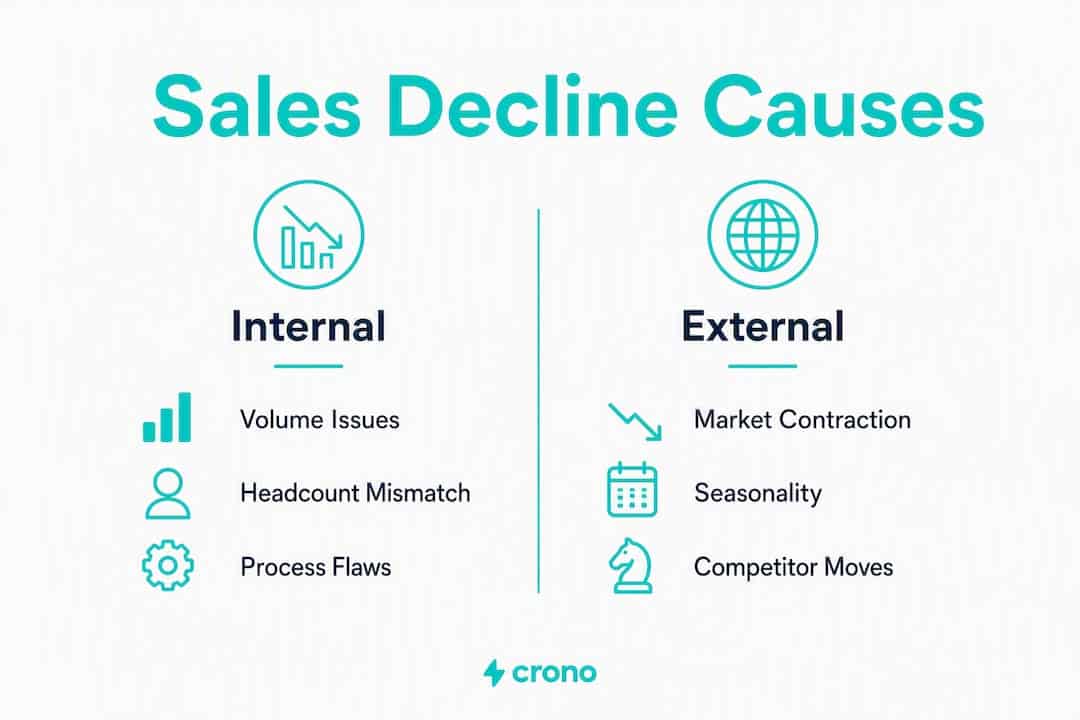
Root causes split cleanly into internal and external. Most teams are dealing with internal failures dressed up as market headwinds.
Internal causes
- ICP drift: Your closed-won profile has shifted, but your target list has not. Watch for falling stage-to-stage conversion in specific firmographic segments.
- Stale territory modeling: Reps are working accounts that no longer match the ICP, leaving high-fit accounts uncovered. Coverage gaps show up as low pipeline density in your best segments.
- Qualification decay: Reps pass meetings that should never reach an AE. The signal is a rising meeting-held rate paired with a falling opportunity-to-closed-won rate.
- Coaching and onboarding gaps: New reps ramp slower when call review and deal inspection cadences slip. Check rep-level conversion variance; outliers reveal where coaching has broken down.
- Sender ops failure: Rising soft bounces, unsubscribe spikes, and reduced human reply rates all point to domain reputation damage. Sequence fatigue compounds this: contacting too many stakeholders per account saturates inboxes and frustrates inbox providers simultaneously.
Pro Tip: Adding volume or headcount when the root cause is internal accelerates the problem. More sends from a damaged domain deepen the reputation hole; more reps working a broken ICP list generate activity without pipeline. Teams that build toward a hybrid human+AI configuration and focus on account quality consistently see a 22 percentage-point gain in closed-won conversion versus AI-heavy autonomous setups.
External causes

Market contraction, seasonality, and competitor moves leave different fingerprints. If win rates are falling uniformly across reps, segments, and territories, and your competitors are reporting the same, the cause is external. Check industry growth rates, publicly available competitor win-rate commentary, and your own cross-segment performance stability before concluding the market has moved.
How do you tell a market problem from a performance problem?
Run these three checks in order.
-
Cohort win-rate comparison. Pull your opportunity-to-closed-won rate for the last two quarters and compare it against available industry benchmarks. B2B outbound benchmarks for 2026 show blended cold email reply rates under 1% across millions of sends. If your rate tracks the benchmark decline, the market is moving. If you are falling faster, the problem is yours.
-
Cross-segment performance stability. If conversion is dropping in one segment but holding in another, the cause is internal to that segment (ICP fit, rep coverage, or territory design). Uniform decline across all segments is a stronger market signal.
-
Rep-level conversion variance. High variance between reps on the same accounts means execution and coaching are the issue. Low variance with uniform decline points to something structural: the account list, the offer, or the market.
If your competitors are growing while you stagnate, look inward first. A market problem calls for pricing and offer adjustments informed by external intelligence. A performance problem calls for territory redesign, ICP refresh, and qualification tightening.
Why does AI-heavy outbound hurt closed-won rates?
The volume gains from autonomous AI SDRs are real. The downstream costs are also real. Q1 2026 data puts the closed-won gap between AI-heavy and hybrid human+AI configurations at roughly 22 percentage points. That gap comes from two compounding problems.
22 percentage-point closed-won gap between AI-heavy autonomous SDR configurations and hybrid human+AI setups, per Q1 2026 industry analysis.
First, deliverability. High-volume AI sends from a small number of domains hit reputation walls fast. Successful teams use 8–14 domain pools, strict per-mailbox send caps, daily Google Postmaster and Microsoft SNDS monitoring, and multi-week warmup rotations before scaling volume. Without that architecture, inbox placement collapses.
Second, meeting quality. Autonomous AI books meetings that human AEs cannot convert. The AI optimizes for meeting volume; the AE’s win rate pays the price.
Best practices for deploying AI correctly:
- Use hybrid pods: AI handles prospecting research, personalization drafts, and sequence execution; humans review before AE handoff on pricing or security-sensitive queries.
- Set pre-qualification rules the AI cannot override (minimum ICP score, verified contact data, confirmed buying trigger).
- Run a human second-touch on every booked meeting before it reaches the AE calendar.
- Feed closed-loop data (won/lost outcomes) back to the AI qualification model weekly.
- Monitor Postmaster Domain Reputation daily; pause sequences immediately when reputation drops below “High.”
Hybrid pod configurations produce more pipeline per seat and lower cost per qualified opportunity while preserving downstream win rates. That is the configuration worth building toward.
A prioritized 30/90-day remediation playbook
48–72 hour triage
Run the CRM cohort queries from the metrics section. Isolate whether the decline is account-level, rep-level, or cohort-level. Pause any high-volume sequences running from domains showing soft bounce rates above 2% or Postmaster reputation below “High.” Check sender architecture: domain count, per-mailbox daily caps, and warmup status.
2–4 week fixes
| Action | Owner | KPI Target |
|---|---|---|
| Refresh ICP scoring against last 12 months of closed-won | RevOps | ICP match rate improved in active pipeline |
| Rebuild focused rep books (remove low-fit accounts) | Sales Ops | Coverage visibility on Tier 1 accounts |
| Tighten qualification rubric; add mandatory fields before stage advance | Sales Enablement | Meeting → opportunity conversion +10 pp |
| Implement human second-touch on all AI-booked meetings | SDR Leads | AE no-show rate reduced by half |
| Introduce phone-first cadences with verified contact data | SDR Team | Answered rate improvement vs. prior 30d |
30/90-day structural work
Redesign territories using similarity-based scoring: score your entire account universe against your closed-won customer profile and build dynamic rep books with replacement rules when accounts age out of fit. Layer automation on top of verified account foundations, not before. Automation on a weak account list generates activity without pipeline. Establish a weekly coaching cadence anchored to call recordings and deal inspection, with AE qualification reviewed at the opportunity stage.
How do you measure recovery and know your fixes worked?
Track leading indicators weekly; lagging indicators monthly.
| Indicator | Type | Baseline | Target | Confidence Signal |
|---|---|---|---|---|
| Human-only reply rate | Leading | — | Restore to prior-period level | 4–6 weeks of data |
| Answered-call rate | Leading | — | Match AE warm-call benchmark | 4–6 weeks of data |
| Meeting held rate | Leading | — | Improved compared to triage baseline | 4–6 weeks of data |
| Opportunity creation rate | Lagging | — | Return to prior-90d level | 8–12 weeks of data |
| Opportunity → closed-won | Lagging | — | Reduce the closed-won conversion deficit between AI-heavy and hybrid human+AI configurations by 22 percentage points | 8–12 weeks of data |
| Average deal size | Lagging | — | Stable or improving | 8–12 weeks of data |
Run A/B experiments by territory rather than by rep to avoid cross-contamination. Use separate sender pools for test and control groups. Inbox placement experiments need at least 4–6 weeks for reliable signal; closed-won recovery requires 8–12 weeks minimum before drawing conclusions.
For qualitative signals, sample call recordings systematically: tag objection type, stage at which objection appeared, and whether the rep had a prepared response. A sample of 20–30 calls per rep per month is enough for reliable pattern detection. Email reply analysis should separate genuine objections from polite declines; the former tells you about fit, the latter about messaging.
How to gather direct feedback from prospects and reps
Qualitative data closes the gap that metrics leave open. Two sources matter most: prospects who said no, and reps who are closest to the friction.
For prospect feedback, run a short post-decision survey (three questions maximum) sent within 48 hours of a closed-lost deal. Ask what the primary reason was, what would have changed the outcome, and whether the problem you were solving was a priority. Keep it anonymous and unbranded if possible; response rates improve significantly. For prospects who ghosted, a single direct email from a senior leader asking for honest feedback recovers more signal than any automated sequence.
For rep feedback, run a structured weekly debrief: what objections came up most, which accounts are generating meetings but not opportunities, and where the qualification rubric feels misaligned with what AEs actually close. Reps surface ICP drift and messaging mismatch faster than any dashboard will. The key is making the feedback loop safe and systematic, not ad hoc.
Key Takeaways
Outbound conversion drops are almost always a performance problem first; run cohort-level CRM queries on contact rate, lead-to-opportunity, and opportunity-to-closed-won before assuming the market has moved.
| Point | Details |
|---|---|
| Check metrics before changing strategy | Pull contact rate, lead→opportunity, and opportunity→closed-won by cohort for the last 90 days versus the prior 90 days. |
| AI-heavy outbound costs closed-won rate | Autonomous AI SDR configurations trail hybrid setups by roughly 22 percentage points on closed-won conversion. |
| Fix account selection before adding volume | Automation on a weak ICP list generates activity without pipeline; score accounts against closed-won customers first. |
| Recovery takes 8–12 weeks to confirm | Leading indicators (reply rate, meeting held rate) show in 4–6 weeks; closed-won signal needs 8–12 weeks minimum. |
| Crono surfaces the signals that matter | Crono’s execution platform connects CRM data, sender ops signals, and human-in-loop AI workflows to diagnose and fix conversion issues in one place. |
The real lesson most teams learn too late
The teams that recover conversion fastest share one habit: they look at account selection before they look at messaging, cadence, or headcount. The instinct when numbers drop is to change the pitch or hire more reps. Both moves are expensive and slow. What actually works is pulling up your closed-won cohort, scoring your active pipeline against it, and removing the accounts that were never going to buy. That single action typically improves meeting-to-opportunity conversion faster than any messaging refresh.
The closed-won conversion gap between AI-heavy and hybrid human+AI configurations is 22 percentage points, according to Q1 2026 industry analysis. This is not an argument against AI; rather, it’s an argument against deploying AI before you have fixed account selection and qualification. AI amplifies whatever foundation it runs on. A clean, well-scored account list with tight qualification rules and a human second-touch before AE handoff is the configuration that actually closes deals. The teams still treating AI as a volume lever rather than a quality multiplier will keep seeing that gap widen.
Crono helps you diagnose and fix outbound conversion faster
When conversion drops, the hardest part is knowing where to look first. Crono connects your CRM, enrichment data, sender ops signals, and AI agents into a single execution layer so you can run the cohort queries, spot coverage gaps, and monitor domain health without switching between five tools.
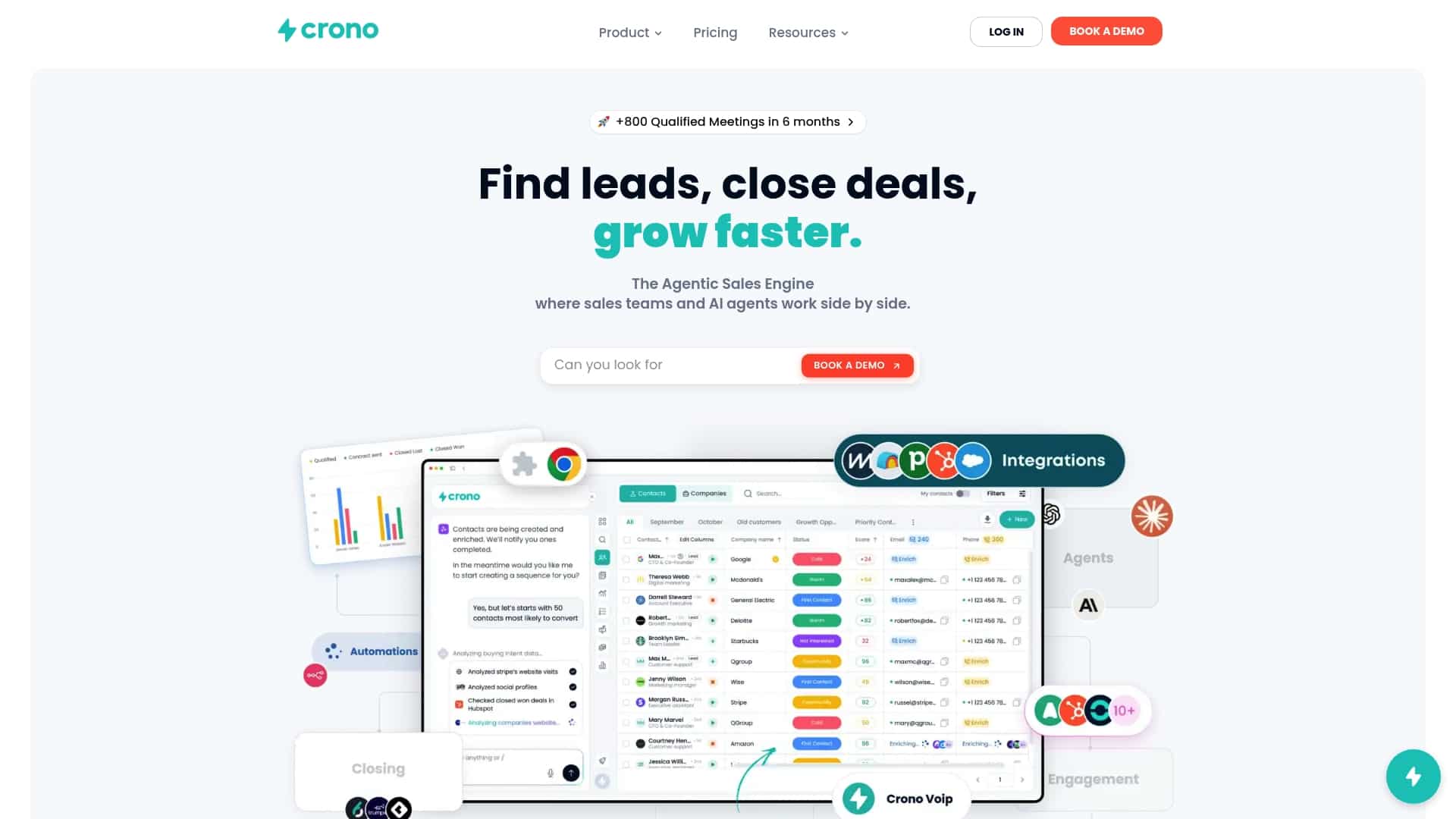
Teams using Crono get coverage visibility on their Tier 1 accounts, human-in-loop AI workflows that enforce pre-qualification rules before any meeting reaches an AE, and closed-loop feedback that keeps the AI model calibrated to what actually closes. If you want to see how that works against your current funnel, book a demo with Crono or start with the Outbound Sales Automation guide to map your current gaps before the next pipeline review.
Useful sources
- AI SDR Statistics 2026: 100+ Outbound Sales Data Points — Q1 2026 synthesis on the 22 pp closed-won gap, hybrid pod performance, and sender architecture best practices.
- Why Sales Are Dropping in a Strong Market | B2B Sales Audit — Practitioner analysis on why stagnation in a healthy market almost always points to internal performance failure.
- Why Your Outbound Isn’t Converting (and It’s Not Your Messaging) — Account selection and coverage visibility as the primary lever for restoring conversion.
- Why Is Quantitative Outbound Collapsing (Really) in 2026? — Sequence fatigue, sender reputation feedback loops, and the case against volume-first fixes.
- From Volume to Precision: The New Era of Outbound Sales — Cognism’s 2025/2026 data on verified contact data, phone-first cadences, and answered-rate improvements.
- Outbound Conversion Rate Benchmarks 2026 — Guidance on replacing open rates with human-only reply rate as the primary inbox health signal.
- State of B2B Outbound 2026 | ORRJO — Independent benchmark report covering the five characteristics of teams still making outbound work in 2026.
- State of Outbound 2026 | KNK Outbound — Blended cold email reply rates, inbox placement failure rates, and the shift from volume to targeting precision.
- Crono: Outbound Sales Metrics That Actually Matter — Practical KPI framework for mid-market teams building conversion dashboards.
- Crono: Outbound Sales in B2B SaaS — Prospecting discipline and focused rep book guidance for teams rebuilding after a conversion drop.
