

Sales team productivity stagnates primarily because workflow fragmentation, not lack of effort, consumes the hours that should go toward selling. Industry data shows reps spend only 28–39% of their time on actual selling, with the rest absorbed by CRM hygiene, internal meetings, research, and tool overhead. The highest-leverage correction is straightforward: reclaim selling hours, reallocate them to high-value accounts, and embed AI as a diagnostic layer rather than a volume tool.
Before you read further, here are five actions you can start this week:
- Run a calendar audit. Pull the last 30 days of calendar data for three to five reps and categorize every event: customer-facing, internal, admin, or prep. The ratio tells you where time is going.
- Identify three automation quick-wins. Look for tasks every rep repeats daily (CRM logging, follow-up sequencing, meeting scheduling) and automate at least one this week.
- Make one de-prioritization decision. Identify the bottom 20% of accounts by deal size and strategic fit. Stop assigning high-effort coverage to them.
- Check pipeline hygiene. Count opportunities with no activity in the last 14 days. If that number exceeds 20% of open pipeline, you have a qualification problem, not a closing problem.
- Name a productivity owner. Assign one person (RevOps lead or sales enablement manager) to own the measurement and governance of selling time as a budgeted resource.
Key Takeaways
Sales team productivity stagnates because workflow fragmentation, not effort, consumes selling time, and the fix requires reclaiming those hours, governing where they go, and embedding AI as a diagnostic layer rather than a volume tool.
| Point | Details |
|---|---|
| Selling time is the core metric | Reps spend only 28–39% of their time selling; reclaiming hours is the highest-leverage fix available. |
| Audit before you act | A 2–4 week calendar and CRM audit identifies which root causes are active before you invest in solutions. |
| Govern reclaimed time | Time saved by automation must be explicitly reassigned to high-value activities or it evaporates into internal work. |
| AI works as a diagnostic layer | Use AI to validate deal viability and surface coaching signals, not to increase outreach volume. |
| Crono as the execution layer | Crono connects CRM, automation, AI diagnostics, and multichannel engagement into one platform to sustain productivity gains. |
Table of Contents
- What sales productivity actually measures, and which KPIs matter
- Why sales team productivity stagnates: the root causes beneath the symptoms
- How to run a 2–4 week diagnostic audit to find what’s stealing selling time
- Prioritized strategies to reverse stagnation: what to do first, second, and third
- Your 30/60/90-day roadmap with realistic costs and timelines
- How to measure progress: dashboards, cohorts, and an A/B mindset
- Use AI as a diagnostic layer, not a volume machine
- How training and onboarding gaps slow your entire team down
- How motivation and engagement issues contribute to a productivity plateau
- How communication breakdowns stall sales performance
- How market and external factors affect sales productivity
- The role of sales leadership and culture in sustaining productivity
- A practitioner’s perspective on what actually moves the needle
- Crono connects the fixes you just mapped into one execution layer
- Sources
What sales productivity actually measures, and which KPIs matter
Sales productivity is not the same as sales efficiency. Efficiency asks whether you are doing things right. Productivity asks whether you are doing the right things at the right volume. The practical formula is:
Sales Productivity = Revenue (or Qualified Pipeline) ÷ Seller Capacity
Seller capacity is measured in customer-facing hours or fully-loaded FTE cost per period. Revenue or qualified pipeline is the output. When that ratio stagnates or declines, you have a productivity problem regardless of how busy your team looks.
Leading indicators (predictive, adjustable in real time):
- Customer-facing hours per rep per week
- Opportunities worked per rep (active, not just open)
- Qualification rate (% of conversations that advance to next stage)
- Time-to-first-touch on inbound leads
- Coaching sessions completed per rep per month
Lagging indicators (outcomes, measured after the fact):
- Quota attainment rate
- Win rate by stage and segment
- Revenue per seller
- Average deal cycle length
- Forecast accuracy
The gap between leading and lagging indicators is where most sales leaders lose visibility. A team can show strong activity metrics (calls made, emails sent) while qualified pipeline quietly shrinks. HubSpot’s sales performance guidance identifies exactly this pattern as a warning sign that precedes a plateau: busy activity with declining qualified pipeline, stalled opportunities after proposal, and rising discount rates.
Statistic to anchor your baseline: Sales reps spend roughly 28–39% of their time selling, which means the average rep’s productive selling window is roughly 11–16 hours per week in a standard 40-hour week. Every hour reclaimed from non-selling work is a direct productivity multiplier.
Why sales team productivity stagnates: the root causes beneath the symptoms
Surface symptoms (missed quota, declining win rates, low pipeline coverage) are outputs of deeper operational and cultural failures. Here are the root causes, ordered by frequency and impact:
-
Workflow fragmentation and tool sprawl. Reps routinely toggle between CRM, email, LinkedIn, sequencing tools, call platforms, and notetakers. Each context switch costs time and attention. 2026 reporting documents a specific new drag: AI notetaker proliferation, where multiple AI bots join the same sales call, creating reconciliation work and consent friction that inverts the promised productivity gain.
-
Internal meeting overload. Pipeline reviews, forecast calls, team standups, and cross-functional syncs consume hours that belong in front of customers. This is especially acute in mid-market companies scaling from 10 to 50 reps, where meeting culture often grows faster than headcount.
-
Poor qualification and funnel hygiene. Reps work unqualified opportunities because no one enforces a qualification gate. The result is a bloated pipeline that looks healthy in a CRM dashboard but produces little revenue.
-
Mis-prioritization of low-value accounts. Without a formal account tiering model, reps default to the accounts that respond fastest, not the ones with the highest revenue potential. High-effort coverage of long-tail accounts is one of the most common and least-discussed factors affecting sales productivity.
-
Lack of structured coaching. Ad hoc feedback after a lost deal is not coaching. Structured coaching means scheduled, recurring sessions with a defined framework (call review, deal inspection, skill gap mapping). Without it, performance variance between reps widens over time.
-
Weak onboarding and veteran upskilling. New reps ramp slowly when onboarding is unstructured. Veteran reps plateau when they stop receiving skill development. Both problems compound over a 12–18 month horizon.
-
Approvals and quote bottlenecks. In mid-market and enterprise deals, pricing approvals, legal reviews, and proposal generation can add weeks to a deal cycle. These are process failures, not rep failures.
-
Burnout and role ambiguity. When reps are unclear about what they own (prospecting vs. closing vs. account management) or feel their effort is not recognized, engagement drops. A systematic review of sales performance determinants extends the framework to include work-related social support and technology skills as independent determinants of performance, meaning both belong in your diagnostic.
-
Buying-committee complexity. Enterprise B2B deals now involve 11–14 stakeholders on average, requiring reps to multithread, conduct more pre-meeting research, and manage longer consensus-building cycles. This increases per-deal effort without a corresponding increase in rep capacity.
The pattern that emerges across mid-market and enterprise is the same: organizations buy tools to solve a productivity problem, then fail to govern where the reclaimed time goes. The tools work. The reinvestment doesn’t happen.
How to run a 2–4 week diagnostic audit to find what’s stealing selling time
A structured audit produces prioritized findings in under a month. Here is the week-by-week plan:
-
Week 1: Calendar analysis and seller time baseline. Pull calendar data for a representative sample of reps (aim for 8–12 across tenure levels). Categorize every event into four buckets: customer-facing, internal, prep/research, and admin. Calculate the percentage of total working hours in each bucket. Flag any rep below 30% customer-facing time as a priority case.
-
Week 2: CRM and pipeline hygiene audit. Run three queries: (a) opportunities with no activity in 14+ days, (b) opportunities missing key fields (budget, authority, timeline), and © deals that have been in the same stage for more than twice the average stage duration. Each query surfaces a different failure mode: neglect, poor qualification, and stalled momentum.
-
Week 3: Tool and process tax assessment. Interview five to eight reps with a structured 20-minute script. Ask: which tools do you use daily? Which ones create duplicate work? Where do you wait on someone else before you can move forward? Map the answers to a process flow and identify the three highest-friction handoffs.
-
Week 4: Synthesis and prioritization. Combine calendar data, CRM findings, and rep interviews into a single prioritized findings document. Apply the decision rules below to assign each finding to a workstream.
Audit data collection template:
| Metric | How to collect | Decision rule |
|---|---|---|
| % selling time | Calendar categorization | Below 30%: prioritize shared services and automation |
| Tools touched per day | Rep interview + IT audit | Above 6: consolidate or integrate |
| Avg internal meeting length | Calendar data | Above 45 min average: implement meeting rules |
| Opportunities worked per rep | CRM activity report | Below 15 active: check qualification gate |
| Deals stalled post-proposal | CRM stage duration | Above 20% of pipeline: inspect approval process |
The audit is not a performance review. Frame it to reps as a process improvement exercise, and you will get honest answers. Frame it as an evaluation, and you will get managed answers.
Prioritized strategies to reverse stagnation: what to do first, second, and third
Not all fixes deliver equal returns. The strategies below are ordered by impact-to-effort ratio, so you can sequence them without burning out your team or your budget.
Priority 1: Reclaim selling hours (high impact, low cost, fast)
Implement two meeting rules immediately: no internal meeting longer than 25 minutes without a written agenda, and no recurring meeting that cannot demonstrate a decision output from the last session. McKinsey’s research across nearly 500 B2B companies found top performers open roughly 20% more seller capacity by offloading non-selling tasks to shared services and automation. That 20% is the equivalent of adding one day per week per rep without hiring.
Priority 2: Consolidate the tool stack
Identify tools with overlapping functions and eliminate the redundant one. The goal is not fewer tools for its own sake; it is fewer context switches per selling day. Consolidating to a unified AI sales platform that connects CRM, sequencing, enrichment, and call workflows into one interface reduces the daily tool-switching tax significantly.
Priority 3: Create shared services for non-selling tasks
Move CRM data entry, research, proposal formatting, and contract prep off rep plates and onto a shared services function (internal or outsourced). This is the structural fix that produces the most durable capacity gain.
Priority 4: Implement a structured coaching cadence
Schedule weekly 30-minute one-on-ones with a defined agenda: one deal inspection, one call review, and one skill gap discussion. AI coaching tools can surface call summaries and deal risk signals automatically, so managers spend the session coaching rather than gathering information.
Priority 5: Account prioritization
Build a simple tiering model (Tier 1: high revenue potential, strategic fit; Tier 2: moderate; Tier 3: low). Stop assigning high-effort coverage to Tier 3 accounts. Redirect that capacity to Tier 1 expansion and new logo pursuit.
Priority 6: Embed AI as a diagnostic layer
Use AI to pressure-test deal viability (champion validation, budget authority, competitive positioning) rather than to increase outreach volume. Analyst Karl Pinto argues that using AI to scale outreach amplifies noise; the real return comes from using it to validate deals early and surface coaching signals.
Priority 7: Credentialed upskilling for tenured reps
Veteran reps who have not received structured skill development in 12+ months are a hidden productivity drag. Enroll them in a formal program (SPIN Selling, Challenger, or a structured B2B sales techniques course) tied to a specific skill gap identified in coaching.
Strategy comparison by time-to-impact and ownership:
| Strategy | Time to impact | Owner | One implementation item |
|---|---|---|---|
| Meeting rules and calendar surgery | 1–2 weeks | Sales manager | Audit and cancel all recurring meetings this week |
| Tool consolidation | 4–8 weeks | RevOps | Map tool overlap; eliminate one redundant tool |
| Shared services for non-selling tasks | 6–12 weeks | RevOps + Sales Ops | Define task list; assign or outsource |
| Structured coaching cadence | 2–4 weeks | Sales manager | Schedule weekly 1:1s with fixed agenda |
| Account tiering and de-prioritization | 2–3 weeks | Sales manager + RevOps | Build tier model; reassign Tier 3 accounts |
| AI as diagnostic layer | 4–8 weeks | RevOps + Enablement | Deploy propensity scoring on top 20% of pipeline |
| Credentialed upskilling | 8–16 weeks | Enablement | Identify skill gaps; enroll reps in structured program |
Pro Tip: Treat AI-reclaimed time as a budgeted resource with a named owner. When AI saves a rep two hours per week, assign those two hours explicitly to a high-value activity (prospecting, executive outreach, deal multithreading) and measure whether the reallocation actually happens. Without governance, reclaimed time evaporates into internal work.
Your 30/60/90-day roadmap with realistic costs and timelines
The roadmap below maps diagnostic findings to execution workstreams. Costs are directional ranges for U.S.-based teams; actual figures depend on team size and existing infrastructure.
The 30-day phase is deliberately low-cost and high-signal. It gives you data to justify the larger investments in months two through six, and it builds credibility with reps who need to see that leadership is serious about removing friction, not just adding new tools.
How to measure progress: dashboards, cohorts, and an A/B mindset
Measuring productivity improvement requires both the right metrics and the right comparison frame. A single team-wide average hides the variance that tells you what is actually working.
Recommended dashboard metrics:
- Selling hours % (weekly, by rep and by team)
- Opportunities worked per rep (active pipeline, not just open)
- Conversion rate by stage (especially proposal-to-close)
- Time-to-first-touch on new inbound leads
- Quota attainment rate (monthly and rolling 90-day)
- Revenue per seller (quarterly)
Cohort your data. Group reps by tenure (0–6 months, 6–18 months, 18+ months) and by segment (SMB, mid-market, enterprise). A productivity intervention that works for a tenured enterprise rep may not move the needle for a new SMB rep. Cohort tracking surfaces these differences before they become a management problem.
Run simple A/B pilots. When testing a new process or tool, split a team of eight or more reps into two groups: one that adopts the change and one that continues with the current process. Run the pilot for 30–45 days and compare the leading indicators (selling hours %, opportunities worked) before drawing conclusions. Statistical significance is hard to achieve with small teams, so look for directional signals and rep-level qualitative feedback together.
Sample dashboard layout:
| Metric | Type | Measurement frequency | Target signal |
|---|---|---|---|
| Selling hours % | Leading | Weekly | Above 40% |
| Opportunities worked per rep | Leading | Weekly | Increasing trend |
| Stage conversion rate | Leading/Lagging | Bi-weekly | Stable or improving |
| Time-to-first-touch | Leading | Daily | Below 4 hours |
| Quota attainment | Lagging | Monthly | Above 60% |
| Revenue per seller | Lagging | Quarterly | Quarter-over-quarter growth |
A dashboard that shows only lagging indicators is a rearview mirror. Build it around leading indicators first, and use lagging indicators to confirm that leading improvements are translating into revenue.
Use AI as a diagnostic layer, not a volume machine
The most common AI mistake in sales organizations is using it to send more outreach. More outreach at the same qualification rate produces more noise, not more revenue. The organizations seeing real returns are using AI differently.
Bain’s 2026 B2B Growth Agenda research makes the same point from an organizational design angle: AI raises the productivity ceiling only when leaders redesign roles, routines, and coaching to absorb AI outputs into daily work. Buying AI is not enough. Embedding it is.
Practical diagnostic outputs leaders should extract from AI:
- Propensity scores on open opportunities, updated weekly, to identify deals at risk before they stall visibly in the CRM.
- Call summaries used in coaching, so managers review AI-generated transcripts before 1:1s and spend session time on skill development rather than deal recaps.
- Calendar analytics that flag reps spending less than 30% of their time in customer-facing activities, triggering a manager check-in.
- Deal risk signals (missing stakeholders, no executive sponsor identified, long time since last customer interaction) surfaced automatically rather than discovered in a pipeline review.
The AI productivity ROI case is real, but it depends entirely on governance. When AI saves time that gets reabsorbed into internal meetings, the ROI disappears. When it saves time that gets reinvested into high-value selling activities, the compounding effect is significant. For a practical framework on aligning AI agents to team roles and routines, the 2026 guide to sales team AI agents covers implementation patterns that work at the team level.
How training and onboarding gaps slow your entire team down
Onboarding is where productivity problems are born. A new rep who takes six months to reach full productivity instead of three months costs the organization roughly half a year of selling capacity per hire. Multiply that across a team of 10 new reps per year and the cumulative loss is substantial.
The most common onboarding failures are structural, not motivational. Reps receive product training but not process training. They learn what to sell but not how to qualify, how to multithread a buying committee, or how to handle a stalled deal. By the time they figure it out through trial and error, they have already developed habits that are hard to change.
Veteran reps face a different version of the same problem. After 18–24 months in a role, most reps stop receiving meaningful skill development. Their performance plateaus not because they lack motivation but because they lack new inputs. A structured upskilling program tied to specific skill gaps (identified through call review and deal inspection) can restart the improvement curve for tenured reps who have been flat for two or more quarters.
The fix requires two things: a structured onboarding curriculum with clear milestones (30-day, 60-day, 90-day competency checkpoints) and a continuous learning program for tenured reps that is tied to observed skill gaps rather than generic training catalogs.
How motivation and engagement issues contribute to a productivity plateau
Engagement is a productivity variable, not a soft HR concern. A rep who is disengaged completes the minimum required activity but does not bring the discretionary effort that separates average performance from high performance. That gap shows up in pipeline quality, not in call counts.
The most common engagement killers in sales organizations are:
- Unachievable quotas. When reps believe their number is set to fail, they stop trying to hit it and start managing their manager’s perception instead. Quota attainment at roughly 46% across the industry suggests this is a widespread structural problem, not an individual motivation issue.
- Lack of recognition. Sales cultures that only celebrate the top 10% of performers create disengagement in the remaining 90%. Recognition programs that reward improvement, not just absolute rank, sustain motivation across the full team.
- Role ambiguity. When reps are unclear about whether they own prospecting, closing, or account management, they default to the activities they are most comfortable with, which are rarely the highest-value ones.
- No visible career path. Reps who cannot see a clear path from their current role to the next one disengage within 12–18 months. A defined career ladder with transparent criteria for advancement is a retention and productivity tool, not just an HR deliverable.
Engagement is also a leading indicator of attrition. A disengaged rep who leaves takes pipeline knowledge, customer relationships, and institutional knowledge with them. The replacement cost and ramp time make attrition one of the most expensive productivity problems a sales leader faces.
How communication breakdowns stall sales performance
Communication failures inside a sales team and between sales and adjacent functions (marketing, product, finance, legal) are a direct cause of stagnation. They are also among the hardest to diagnose because they rarely appear in a CRM report.
Within the sales team, the most damaging communication failure is inconsistent deal qualification. When reps apply different standards for what counts as a qualified opportunity, pipeline data becomes unreliable. Forecasts miss. Managers make resource allocation decisions based on inaccurate information. The fix is a shared qualification framework (MEDDIC, MEDDPICC, or a custom variant) enforced consistently in pipeline reviews.
Between sales and marketing, the most common breakdown is lead quality disagreement. Marketing measures lead volume; sales measures lead quality. Without a shared definition of a marketing-qualified lead (MQL) and a sales-accepted lead (SAL), both teams optimize for different outcomes and blame each other for the gap. A joint SLA that defines MQL criteria, response time expectations, and feedback loops closes most of this gap.
Between sales and finance or legal, the bottleneck is usually approval speed. A deal that requires three rounds of pricing approval and two legal reviews before a contract goes out loses momentum and sometimes the customer. Mapping the approval process and setting SLAs for each step is a RevOps responsibility that directly affects deal cycle length and win rate.
How market and external factors affect sales productivity
External conditions set the ceiling on what your team can achieve, regardless of how well you execute internally. Understanding which external factors are at play helps you set realistic expectations and adjust your strategy accordingly.
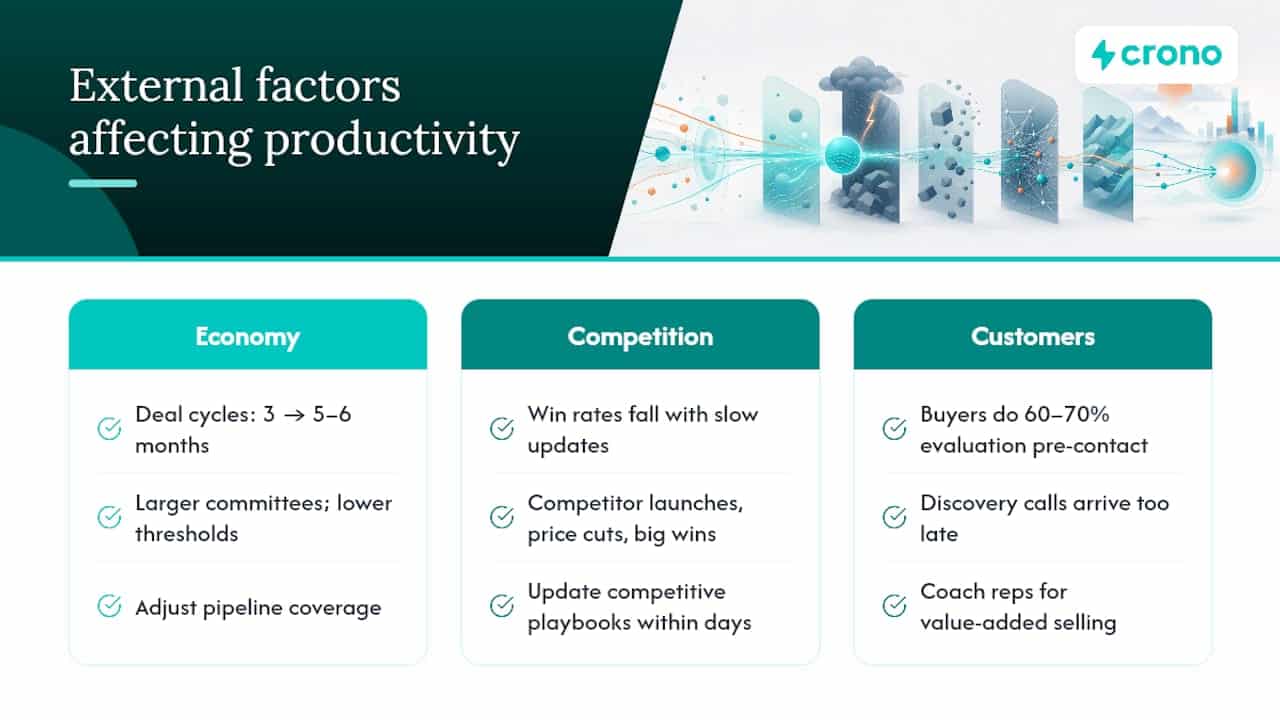
Economic conditions affect buyer behavior directly. In a tightening budget environment, buying committees grow larger, approval thresholds drop, and deal cycles lengthen. Reps who were closing mid-market deals in three months may find the same deals taking five or six months when CFO approval is required for purchases above a lower threshold. This is not a rep performance problem; it is a market condition that requires adjusting pipeline coverage ratios and coaching reps on multi-stakeholder navigation.
Competitive landscape shifts require continuous enablement updates. When a competitor launches a new product, drops pricing, or wins a high-profile customer in your segment, your reps need updated competitive positioning within days, not weeks. Organizations that update their competitive playbooks quarterly (or faster) maintain win rates; those that update annually lose ground steadily.
Customer behavior shifts are the subtlest external factor. B2B buyers increasingly complete 60–70% of their evaluation before engaging a sales rep, which means reps who rely on discovery calls to educate buyers are entering conversations too late. The reps who perform best in this environment are those who can add value to a buyer who already knows the basics, which requires a different skill set than traditional solution selling.
None of these factors are within a sales leader’s control. What is within your control is how quickly you detect the shift and how effectively you adjust your team’s approach, coverage model, and messaging.
The role of sales leadership and culture in sustaining productivity
Productivity gains from process changes and tool investments decay within six to twelve months without leadership reinforcement. Culture is the operating system that determines whether improvements stick.
The most productive sales cultures share three characteristics. First, they treat selling time as a protected resource. Leaders who allow internal meetings to crowd out customer-facing time signal, through their actions, that internal work is more important than selling. Second, they make coaching a non-negotiable management activity, not an optional add-on. When managers are measured on the development of their reps, not just on team quota attainment, coaching quality improves. Third, they create psychological safety around pipeline accuracy. Reps who fear that an honest forecast will trigger a performance conversation learn to manage their pipeline data rather than their actual performance.
Sales leadership also sets the pace of adoption for new tools and processes. A manager who does not use the CRM consistently cannot credibly require their team to use it. A manager who skips the coaching cadence sends the message that it is optional. The behavioral norms at the manager level cascade directly to the rep level, which is why leadership behavior is the single most important variable in sustaining any productivity improvement.
A practitioner’s perspective on what actually moves the needle
Most sales productivity frameworks focus on what to measure and what to implement. Fewer address the sequencing problem: doing the right things in the wrong order produces frustration, not results.
The teams that make the most durable progress start with the audit, not the solution. They resist the pressure to deploy a new tool or launch a new initiative before they understand where time is actually going. The audit data creates alignment across sales, RevOps, and enablement on what the real problem is, which makes every subsequent decision faster and less contested.
The second thing high-performing teams do differently is govern the reclaimed time. This is the insight that most articles miss. When you automate CRM logging and save each rep 45 minutes per day, that time does not automatically flow into prospecting. It flows into whatever is next on the rep’s to-do list, which is often another internal task. The organizations that see sustained productivity gains are the ones that explicitly assign reclaimed time to a specific high-value activity and measure whether the reallocation happened.
The third pattern is treating AI as a coaching input rather than an outreach tool. Managers who review AI-generated call summaries before their 1:1s have better coaching conversations. Reps who receive deal risk signals from an AI layer before a pipeline review show up better prepared. The technology is the same; the use case is different, and the use case is what determines the return.
Crono connects the fixes you just mapped into one execution layer
The roadmap in this article works. The challenge is that executing it across disconnected tools creates the same fragmentation problem you are trying to solve. Crono is built specifically for this moment: it connects your CRM and existing sales tools into a unified execution layer where AI agents, workflow automation, multichannel engagement, and pipeline orchestration work together in one place.
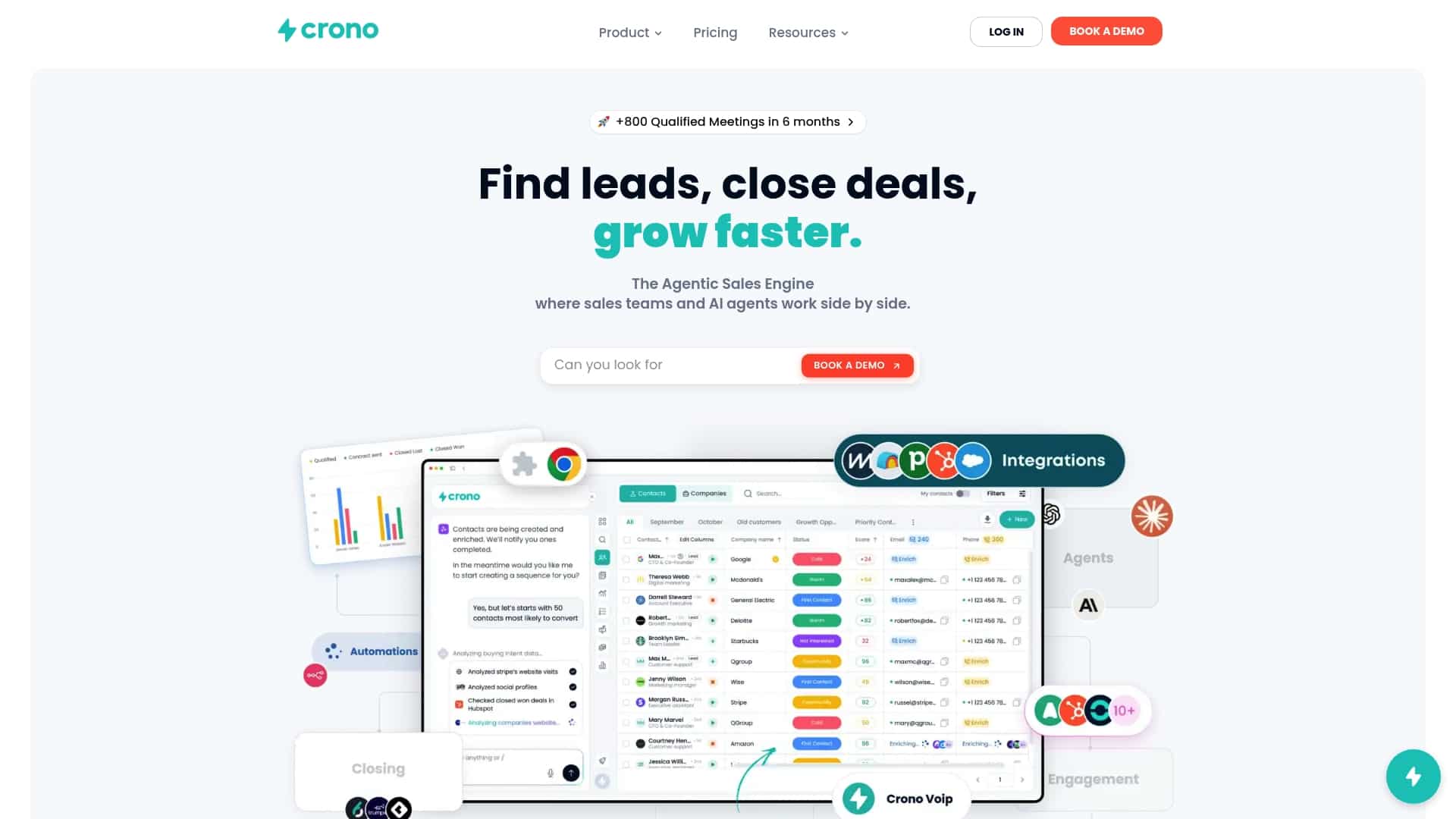
When you implement the strategies above, Crono handles the operational layer: automating non-selling tasks, surfacing AI diagnostic outputs (deal risk signals, propensity scores, call summaries) directly in your workflow, and giving managers real-time visibility into selling time and pipeline quality without building a separate reporting stack. The result is that the capacity you reclaim through meeting rules and shared services actually flows into selling, because the execution layer keeps it there.
If you are ready to move from diagnosis to execution, explore how Crono’s agentic sales engine works for B2B revenue teams, or go deeper on the outbound automation side with the 2026 outbound sales automation guide.
Sources
- AI is making sales teams faster — not better (Karl Pinto) | The Next Web
- The new sales productivity equation — B2B Growth Agenda 2026 | Bain & Company
- Sales Productivity Statistics 2026: Where Reps Spend Time
- Quota attainment just hit 46% in the middle of the biggest sales tech boom ever.
- Systematic review of determinants of sales performance — extended framework (Lyngdoh et al.)
- How to improve sales performance | HubSpot
