
Hey Croners! Welcome to Crono Talks, a series of interviews with projects and people that have blown our minds. We aim to inspire and give deserved credit to those working hard and with great ideas.
In this article, we interviewed Rob Illidge the founder of Vulse, a platform built to turn employees into a company’s strongest marketing channel on LinkedIn.
It all started from a simple frustration: brand pages were getting ignored while a single post from a real employee was outperforming them many times over. So in 2019, Vulse was born, not as a workaround, but as a proper, API-compliant solution to activate employee advocacy and measure it at the individual level.
We dive into why LinkedIn reach lives with people, not pages, and what B2B teams are still getting wrong about building a real presence.
Crono Talks ep.12 - Vulse
1. Can you walk us through your story. How did you end up building Vulse?
Honestly, it started from frustration.
I spent years in marketing watching companies pour money into their LinkedIn company pages and get almost nothing in return. At the same time, a single post from an actual employee would outperform the brand account many times over. The reach was sitting with people, not pages, and nobody was doing much with it.
The bigger problem was that you couldn’t measure any of it properly. The tools that existed scraped data off LinkedIn in ways that were fragile and against the rules, and they reported at the company level, which tells you nothing about who’s actually driving results.
So in 2019 I started building Vulse to do it properly: help companies activate their people on LinkedIn, and measure it at the individual level using LinkedIn’s official API rather than a workaround that breaks the moment LinkedIn changes something.
2. How would you describe Vulse to someone who's never heard of it?
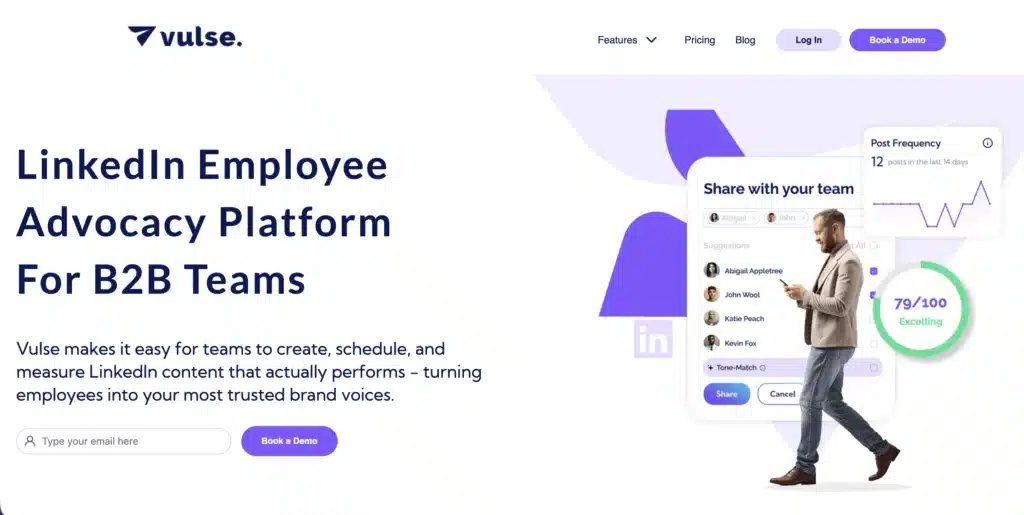
Vulse turns your employees into your strongest marketing channel on LinkedIn, and actually proves it’s working.
Most companies already sense their people have more reach and more trust than the brand page ever will. What they don’t have is a way to make sharing easy for employees, and a way to measure it beyond vanity numbers.
Vulse does both.
It helps your team post in their own voice without it feeling like corporate homework, and it shows you reach and engagement for every individual, not just one aggregate dashboard.
If you’re a B2B team trying to build real presence on LinkedIn and prove the return, that’s who we’re for.
3. Most people think "just post more on LinkedIn." What are they getting wrong?
Volume isn’t the lever. I’ve watched companies triple their output and move nothing, because more posts from a faceless brand page are just more noise.
Two things actually matter. First, who’s posting? A real person with a face and a point of view beats the company account every time, because people trust people.
Second, whether you can see what’s working. Most teams are flying blind on aggregate impressions that never tell them which person, which post, or which topic drove anything. “Post more” without those two things just buys you more vanity metrics and the same flat results.
The question was never how often you post. It’s whose voice is carrying it, and whether you can measure it.
4. What's one thing you wish more people understood about building a presence on LinkedIn?
That the reach lives with individuals, not the brand, and that’s a feature, not a bug.
People resist this because it feels like losing control. You’re handing your visibility to your employees’ personal profiles. But that’s exactly why it works.
Audiences have basically stopped engaging with logos and started engaging with humans. The companies that win on LinkedIn aren’t the ones with the slickest company page, they’re the ones whose people show up consistently, as themselves, in their own voice. And it compounds, which is the part most underestimate.
Nobody builds a real presence in a fortnight.
5. What's next for Vulse?
The timing’s genuinely interesting, because the ground is shifting in our favour. A lot of the LinkedIn analytics tools people leaned on were built on scraping, and LinkedIn has been shutting those down. We made the harder choice early to build on the official API, so as that shake-out plays out, compliant, profile-level measurement is going from a nice-to-have to the thing teams actually need.
So the focus is going deeper on exactly that: making the measurement layer richer, helping teams tie advocacy to real outcomes rather than impressions, and keeping the bar high on doing it the legitimate way.
The mission hasn’t changed since 2019. Make a company’s people their best channel, and prove it.
