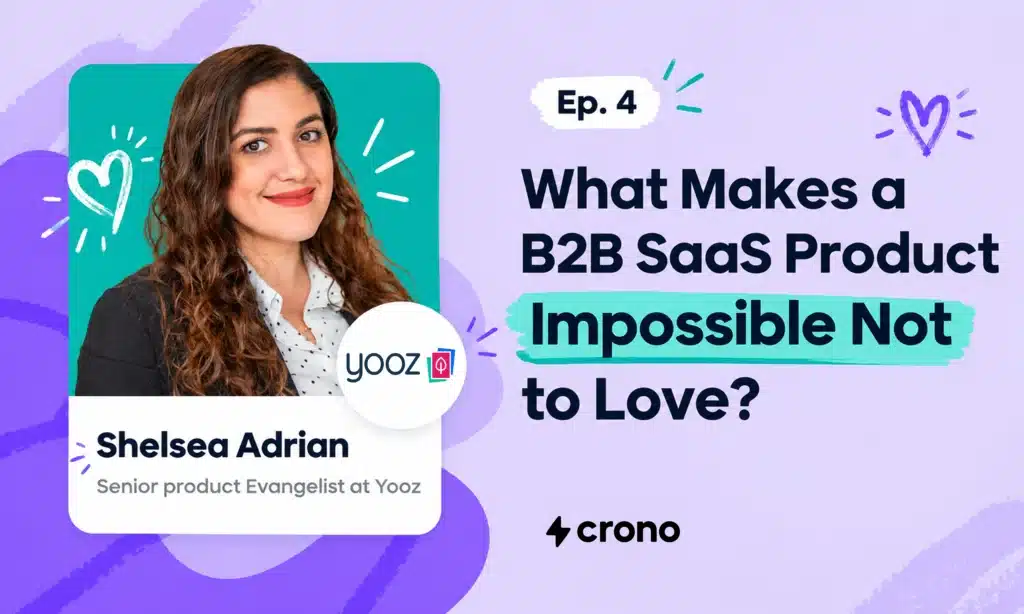
What Makes a B2B SaaS Product Impossible Not to Love?

Hey there Croners! Here’s a brand new column covering SaaS Products, and more specifically, how to build a product that people love.

Everyone, at some point in their lives, has had an incredible idea: but how does that turn into a product? We’ve asked some experts in design and product development and founders to bring their own experience and knowledge to you.

In B2B, the person buying the software and the person using it every day are rarely the same human and that gap is where most products go to die.

For this episode of SaaS Genius, we sat down with Shelsea Adrian, Senior Product Evangelist at Yooz, to unpack what actually makes B2B products stick: the difference between collecting feedback and acting on it, why “intuitive” beats “feature-rich” and why the best product people often never touch a roadmap.

1. Let's start with a quick warm-up: 5 words to describe yourself, and 1 tool you can't live without.

Five words:
  • Curious
  • Collaborative
  • Strategic
  • Customer-focused
  • Adaptable


One tool I can’t live without is LinkedIn!!
 
LinkedIn is probably the one “tool” I couldn’t live without. It’s where I stay connected with customers, peers, industry leaders, and the wider SaaS community. It helps me keep up with market trends, understand what businesses are talking about, and engage in conversations that shape how we position our product. For me, it’s not just a networking platform, but more like an important source of customer insight and continuous learning.

2. What does a "Product Evangelist" actually do day to day, and how is it different from a more traditional Product Manager role?

A Product Evangelist is essentially the bridge between the people building the product and the people using and selling it.
 
There are 3 areas of work I do as a PE:
  1. All forms of presentations for the company, almost like being the “face” or ambassador for the brand (webinars, roundtables, speeches, podcasts, the YoozUniversity, etc) so I attend lots of different events each year
  2. I train our new sales team members, partners and resellers on how to sell and implement the solution
  3. I am responsible for the demonstration platform used by our sales team and partner community to highlight the features and functionalities, meaning I have extensive knowledge on existing functionalities and stay up to date with what’s new in the product
 
So I kind of sit at the intersection of product, sales, marketing, and customer success. My role is to connect those teams around one common goal which is to create customer value.
 
On a typical day, I might be speaking with customers to understand their challenges, enabling sales teams with product knowledge, presenting new capabilities through webinars or events, or collaborating with Product Managers by sharing market insights and customer feedback.
 
The biggest difference between my role and a Product Manager’s is ownership. Product Managers own the roadmap and prioritization, while I influence those decisions by bringing the voice of the customer, market trends, and commercial insights into the conversation.
 
Ultimately, my role is about driving product adoption, helping sales succeed through strong product knowledge, and making sure we’re providing solutions that solve real customer problems.

3. What's the most exciting part of your job as a Product Evangelist at Yooz?

The most exciting part is the PEOPLE I work with and seeing the full customer journey.
 
I can hear about a challenge directly from a customer, work with internal teams to communicate that feedback, and then help introduce a solution once it’s available. Seeing that complete cycle (from identifying a problem to delivering value) is incredibly rewarding. You can only image some of the horror stories I have heard from teams!!
 
I also enjoy translating complex technology into clear business outcomes. AP Automation and e-invoicing can sound technical, but when you show customers how much time they can save, how processes become more efficient, and how they can focus on higher-value work, that’s where the real impact happens. You can literally see the lightbulb moment.
 
I love sharing the honest truth that if I can do it (someone with no “finance” or “tech” background) that literally anyone can do it!!
 
For me, product evangelism is about creating customer value by helping people understand not just what the product does, but why it matters.

4. You sit right at the intersection of product, sales, and customer experience. How do you make sure customer feedback actually reaches the product team and shapes what gets built next?

I don’t believe every piece of feedback deserves a feature. The goal isn’t to collect requests, it’s to identify patterns!!
 
I spend a lot of time talking to customers, prospects, implementation teams, and sales. When the same problem keeps appearing across different conversations, that’s usually a signal worth investigating.
 
I make feedback actionable by adding context (Who’s asking? What’s the business impact? How many customers are affected? Is this solving a symptom or the root cause?) Product teams make better decisions when they have evidence instead of anecdotes.
 
Just as importantly, I in a sense “close the loop”. When customers see that their feedback influenced a product improvement, even if it wasn’t implemented exactly as requested, it builds trust and encourages more meaningful conversations.

5. What are the key elements a product can't miss in order to be loved by its users, particularly in B2B, where the "user" and the "buyer" are often different people?

I think great B2B products balance the needs of both the buyer and the end user.
 
And I think there are four main essentials:
First, the product has to solve a real problem (not just add another feature!!)
Second, it has to be intuitive. Users compare every piece of software to the best consumer apps they use every day, so ease of use matters more than ever.
 
Third, it has to demonstrate value quickly. If users don’t experience a meaningful benefit early on, adoption becomes much harder.
 
Finally, they support clear business outcomes. Buyers want ROI, scalability, security, and compliance, while users simply want technology that makes their jobs easier.
 
The best products succeed because they create customer value for everyone involved. Buyers feel confident in the investment, and users genuinely enjoy working with the product. That’s what drives long-term adoption.

6. What would you suggest to someone who wants to build a career at the crossroads of product, sales, and customer success?

My biggest piece of advice is to stay close to your customers. Become genuinely curious about customers. Learn as much as you can about alternative solutions, as I think it is super impressive when you have that knowledge you can make recommendations based off of what you really think that company or business will need even if it is not your solution your are selling.
 
You don’t need to start in Product Management to influence products. Some of the best product professionals begin in sales, customer success, support, or consulting because they spend so much time understanding real customer problems.
 
I’d also recommend developing three core skills:
First, communication! Really being able to explain complex ideas in a simple and engaging way.
 
Second, cross-functional collaboration. Great products aren’t built by one department. Learning how to work effectively with product, sales, marketing, customer success, and engineering is essential.
 
Third, use your brain for “business thinking”. It’s important to understand not only what customers ask for, but also how product decisions create value for both customers and the business.
 
When you combine customer obsession with strong collaboration and a focus on delivering measurable value, you’re able to make a real impact across the entire customer journey.
In this article

Start your sales revolution

Join 300+ sales teams using Crono and change your sales game.

Picture of Alessandra Bertelli
Alessandra Bertelli
Marketing Specialist