In this article
Hey there Croners!
Welcome back to The Prospecting Masterclass, the original Crono column where we bring you insights and tips from the brightest minds in sales.
In today’s B2B SaaS world, prospecting is harder than ever. Buyers are flooded with automated messages, generic outreach, and AI-generated content. Standing out doesn’t come from sending more messages, it comes from sending better ones. And better messages start with a deeper understanding of who you’re talking to, what they actually need, and why it matters right now.
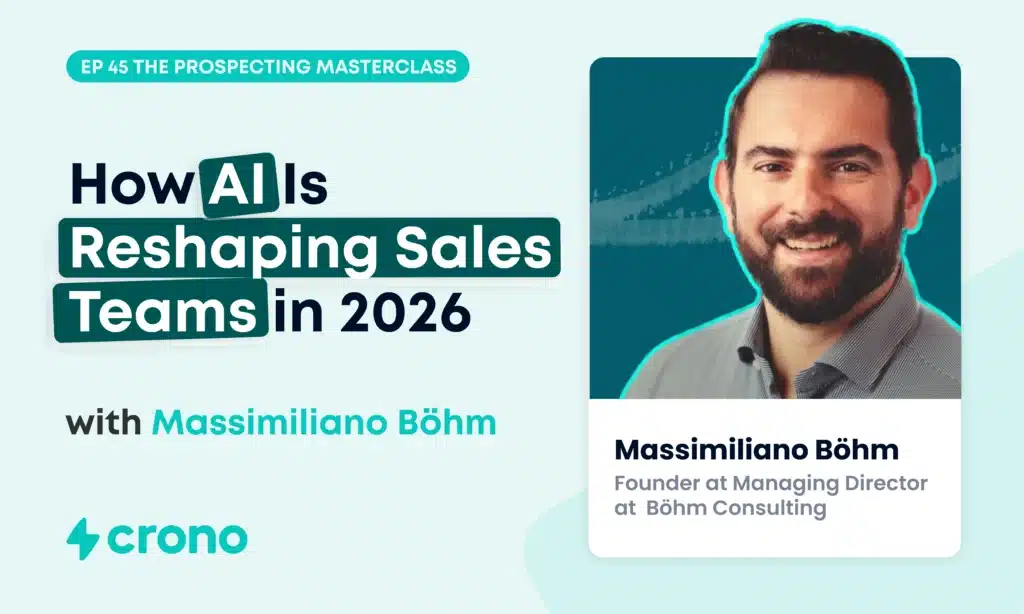
In this episode of The Prospecting Masterclass, we sit down with Massimiliano Böhm, chemical engineer turned sales leader, now Founder & CEO of Böhm Consulting.
With over 15 years of international B2B sales experience and a track record of building high-performing commercial teams across Europe, Max has seen the full evolution of the sales profession, from cold calls to AI-powered pipelines.
A certified sales coach and author, Max has spent the last few years at the forefront of one of the most debated questions in the industry: what happens to human selling when AI enters the room? His answer, as you’ll discover, is both pragmatic and refreshingly honest.
From his accidental entry into sales to his sharp take on where most outbound strategies go wrong, Max shares why the best reps don’t just use better tools, they ask better questions, show up with a genuine point of view, and never stop being curious about their customers’ world.
Massimiliano, what brought you into the world of sales?
I’m a chemical engineer by training, not exactly the typical sales origin story.
I was working in consultancy, and I kept finding myself less interested in the technical delivery and more drawn to the client side: understanding their problems, figuring out what they could do better, helping them see possibilities they hadn’t considered. I was basically selling without knowing it.
Then one day my boss called me into his office and said, “Max, why don’t you just start selling?” Turns out I’d been doing it all along, I just needed someone to point it out.
From there I never looked back.
From your experience, what’s the most common mistake B2B SaaS teams make when building their outbound prospecting strategy?
They sell a solution to someone who doesn’t have a problem, or worse, to someone who doesn’t know they have one yet.
That’s the fastest way to burn through a prospect list with nothing to show for it.
Most outbound teams start from their product: here’s what we built, here’s why it’s great, let me book you a demo.
But if the person on the other end isn’t feeling any pain, your brilliant solution is just noise.
The real work starts before the first email, understanding who actually has the problem you solve, how they experience it, and what language they use to describe it.
If you skip that step, you’re not prospecting. You’re just bothering people at scale.
Many companies focus heavily on volume. In your opinion, what actually makes prospecting effective today?
Relevance beats volume every time.
The teams that win are the ones that can make a prospect feel like the message was written specifically for them, because it was.
That means doing real research, segmenting properly, and crafting sequences that speak to a specific problem in a specific context. It also means knowing when not to reach out.
Discipline in targeting is the most underrated skill in outbound today.
Ten well-researched conversations will always outperform a thousand spray-and-pray emails.
You recently published a book on sales, diving deep into how AI is reshaping commercial teams. What’s one idea from the book you think every sales leader should rethink about how they approach prospecting and customer engagement?
In my book, one thing I push hard is this: AI doesn’t replace the sales process, it makes the non-selling steps easier.
Most reps spend 60-70% of their time on activities that aren’t selling: researching accounts, writing emails, updating CRMs, qualifying leads.
AI can handle most of that grunt work, which means reps can finally spend their time where it matters, having real conversations.
The leaders who get this right won’t just have faster teams, they’ll have smarter ones.
In practical terms, how can AI support sales reps without removing the human element from conversations?
The trick is using AI for everything around the conversation, not inside it.
Let AI do the research, enrich your leads, surface intent signals, draft a first version of your outreach, prioritize your pipeline.
But it doesn’t stop at preparation.
AI is incredibly powerful for analysis too: reviewing your own calls, spotting patterns in what works and what doesn’t, understanding where you lose deals and why.
It’s like having a coach that watches every game and gives you honest feedback without ego.
But the moment you’re actually talking to a human being, be a human being.
Nobody wants to feel like they’re on the receiving end of an algorithm. AI should make you more informed before the call and more self-aware after it, not more robotic during it.
The human element isn’t a limitation, it’s your competitive advantage.
Which metrics do you trust most to understand whether a prospecting strategy is actually working?
I look at three things.
First, conversion rate by stage, not just “how many meetings did we book” but where exactly prospects drop off in the pipeline.
That tells you where your process is broken.
Second, time-to-first-meaningful-
If it’s too long, your targeting or messaging is off.
Third, pipeline velocity, the speed at which deals move through your funnel.
Vanity metrics like open rates or number of emails sent tell you almost nothing about whether your strategy is actually generating revenue.
What’s one piece of advice you’d give to a sales team in 2026?
Not sure where to start? Let's talk.
Schedule a session with one of our specialists and get our exclusive Sales Playbook 2026 for free.