

The sales and marketing funnel handoff is the operational transfer of a qualified lead from marketing to sales, specifically the moment an MQL (Marketing Qualified Lead) meets agreed criteria and becomes an SQL (Sales Qualified Lead) with a defined owner, a complete data payload, and a response SLA attached. Get this wrong and pipeline leaks silently. Get it right and conversion rates climb without adding headcount.
Three actions to take right now:
- Agree on MQL/SQL criteria jointly. Schedule a one-hour alignment meeting between marketing and sales ops to write down exactly what “sales-ready” means in your CRM.
- Set a first-contact SLA. Decide the maximum time between MQL creation and first sales touch, and make it visible in your dashboard.
- Automate routing with context. Configure your CRM or MAP to assign leads automatically and attach engagement history, lead score, and firmographic data to every handoff record.
You can complete the first step in under an hour: pull one recent MQL from your CRM, walk through whether it would pass your current criteria, and note every field that is blank or inconsistent. That single exercise usually surfaces the biggest gap.
Key Takeaways
A reliable MQL→SQL handoff requires agreed criteria, an enforced SLA, a complete data payload, automated routing, and a closed feedback loop working together.
| Point | Details |
|---|---|
| Agree on MQL/SQL criteria | Define firmographic, behavioral, and intent requirements jointly with sales before automating anything. |
| Set and enforce an SLA | First contact within 1 hour for high-intent leads; leads not actioned in 24 hours should auto-escalate. |
| Standardize the data payload | Every routed lead must carry verified contact data, lead score, top behavioral events, and campaign source. |
| Automate routing with fallbacks | Apply territory, vertical, and deal-size rules with a fallback that reassigns if the rep is unavailable. |
| Close the feedback loop | Log rejection reasons with specific codes and review them monthly to recalibrate scoring and targeting. |
Table of Contents
- What the sales and marketing funnel handoff actually covers
- Where handoffs break: the most common failure modes
- How to define MQL and SQL: a template you can copy
- SLA and routing: a sample service-level agreement
- Metrics and benchmarks to track handoff performance
- Operational checklist: building a repeatable handoff workflow
- Tools and automation categories that support the handoff
- How to audit your handoff and find where leads are leaking
- Common fixes to stabilize the handoff, organized by time horizon
- How Crono orchestrates reliable handoffs with signal-driven automation
- The handoff is an engineering problem, not a relationship problem
- Sources
What the sales and marketing funnel handoff actually covers
Full-funnel thinking separates marketing activity from sales activity and places the MQL→SQL handoff as the operational bridge between them. Understanding where that bridge sits requires a clear picture of the funnel’s three zones.
The funnel in brief:
- Top of Funnel (ToFu): Marketing owns awareness and lead capture. Metrics: impressions, click-through rate, form fills, cost per lead.
- Middle of Funnel (MoFu): Marketing nurtures and scores. Metrics: email engagement, content downloads, webinar attendance, lead score progression.
- Bottom of Funnel (BoFu): Sales owns qualified opportunities through close. Metrics: pipeline value, stage velocity, win rate.
The handoff sits at the MoFu/BoFu boundary. Marketing’s job ends when a lead crosses the MQL threshold. Sales’ job begins when a rep accepts the SQL and opens an opportunity.
What travels with the lead at handoff:
- Firmographic data: company name, industry, employee count, revenue band, location
- Contact data: name, title, verified email, direct phone
- Behavioral data: pages visited, content downloaded, emails opened, webinar attended
- Lead score and scoring rationale
- Inferred pain point or use-case match (one paragraph, written by marketing automation or enrichment)
- Campaign source and attribution
Passing engagement history and context to sales reduces duplicate discovery work and lets reps personalize the first call rather than re-asking questions the prospect already answered in a form.
Where handoffs break: the most common failure modes
Inter-team alignment problems are a primary cause of handoff failure. Marketing and sales routinely disagree on what “sales-ready” means, and that disagreement compounds into four specific anti-patterns.

1. Misaligned definitions
Marketing passes leads that sales considers unqualified. The signal: a high MQL volume paired with a low SQL acceptance rate. In CRM terms, look for a large gap between MQL-created and SQL-accepted counts in the same period.
2. Missing context
Leads arrive with incomplete firmographic data or no behavioral history. Reps spend the first call re-qualifying instead of selling. The signal: high call-to-connect ratios with short call durations and low conversion to next stage.
3. Unclear ownership
No one knows who is responsible for a lead between MQL creation and SQL acceptance. Leads sit in a queue for days. The signal: leads with status “MQL” that are more than 48 hours old with no activity logged.
4. Slow response
Reps contact leads hours or days after the MQL fires. By then, intent has cooled. The signal: average time-to-first-touch exceeding your SLA threshold in your CRM activity reports.
5. No feedback loop
Sales rejects leads without logging reasons. Marketing keeps sending the same profile. The signal: rejection reasons are blank or all labeled “other” in your CRM.
An SLA and routing logic fix most of these failure modes, but only after the definitions are agreed on. Automating a broken process just makes it fail faster.
How to define MQL and SQL: a template you can copy
A defensible MQL definition combines firmographic fit, behavioral signals, and intent data. Calibrate score thresholds against historical converting leads rather than setting arbitrary cutoffs.
MQL/SQL definition template:
Required firmographic fields (must be populated):
- Company name, industry vertical, employee count, annual revenue band, HQ country/state
- Technology stack (if relevant to your ICP)
Behavioral triggers (minimum threshold to qualify):
- Lead score above an agreed threshold reflecting actual conversion data
- At least one high-intent action: demo request, pricing page visit (2+), ROI calculator use, or free trial signup
- Email engagement: opened ≥ 3 emails in last 30 days OR clicked ≥ 1 CTA
Intent signals (optional but weighted heavily):
- Third-party intent data showing active research in your category
- Competitor comparison page visit
Mandatory enrichment fields before routing:
- Verified direct email and phone
- LinkedIn profile URL
- Job title seniority (Director+, VP, C-suite for enterprise; Manager+ for mid-market)
Example rule-set 1: Mid-market SaaS inbound
- Company: 50–500 employees, SaaS or tech-adjacent vertical
- Lead score ≥ 45 (demo request auto-qualifies regardless of score)
- At least one product page visit in the last 14 days
- Title: VP of Sales, Head of Revenue Ops, Sales Director, or equivalent
- Enrichment: email verified, LinkedIn URL present
Example rule-set 2: ABM/enterprise with intent signals
- Company on named account list OR matching ICP firmographics (1,000+ employees, target verticals)
- Intent signal active in category (6sense, Bombora, or equivalent)
- Lead score ≥ 30 (lower threshold because account fit is confirmed)
- Any engagement with ABM content or personalized landing page
- Enrichment: full contact record including direct dial
An MQL definition must include firmographic, behavioral, and intent criteria plus the minimal enrichment set required for routing. Without all three, routing logic breaks and prioritization becomes guesswork.
SLA and routing: a sample service-level agreement
A well-structured SLA removes ambiguity about who does what and when. Here is a practical template your team can adapt.
Sample SLA elements:
- First-contact time: Sales must attempt first contact within 1 business hour for high-intent inbound (demo request, trial signup) and within 4 business hours for standard MQL.
- Acceptance window: Sales has 24 hours to accept or reject an SQL. Leads not actioned within 24 hours auto-escalate to the manager.
- Follow-up cadence: Minimum 3 attempts (email + call + LinkedIn) within the first 5 business days before marking as unresponsive.
- Logging requirement: Every attempt must be logged in the CRM with outcome and timestamp. No exceptions.
Routing rules:
- Territory-based: Route by state or region if your team is geographically segmented.
- Vertical-based: Assign leads to reps with vertical expertise (e.g., fintech leads to the fintech pod).
- Deal-size-based: Leads from companies with 500+ employees route to enterprise AEs; under 500 route to mid-market AEs.
- Round-robin/weighted: Within a segment, distribute evenly or weight by rep capacity and current pipeline load.
- Fallback rule: If the assigned rep has not logged in within 2 hours of assignment, auto-reassign to the next available rep in the rotation and notify the manager.
Escalation checklist:
- Reassign when: SLA missed, rep on PTO, or lead is a named account requiring senior attention.
- Re-nurture when: SQL rejected as “not ready yet” but ICP fit confirmed. Return to marketing with a “re-nurture” tag and a 30-day re-engagement sequence.
- Capture rejection reasons: Wrong ICP, no budget, wrong timing, duplicate, unresponsive after 5 attempts, or other (with required free-text note).
Logging rejections with reasons and reviewing disqualifications regularly turns the handoff into a learning system. Without that data, marketing cannot recalibrate scoring and targeting.
Metrics and benchmarks to track handoff performance
| KPI | What it measures | How to calculate | Typical range |
|---|---|---|---|
| MQL→SQL conversion rate | Share of MQLs accepted by sales | SQLs created ÷ MQLs generated | a typical range consistent with industry experience |
| Time-to-first-touch | Speed from MQL creation to first sales activity | Average minutes/hours between MQL timestamp and first logged activity | Under 1 hour (high-intent) |
| Lead acceptance rate | Share of routed leads sales accepts | Accepted SQLs ÷ total routed leads | a typical range consistent with industry experience |
| Handoff→opportunity rate | Share of SQLs that become open opportunities | Opportunities created ÷ SQLs accepted | a typical range consistent with industry experience |
| Pipeline contribution | Revenue in pipeline sourced from marketing MQLs | Sum of opportunity values where source = marketing | Varies by GTM model |
| Win rate (MQL-sourced) | Closed-won deals as a share of MQL-sourced opportunities | Closed-won ÷ MQL-sourced opportunities | a typical range consistent with industry experience |
Why each metric matters:
- MQL→SQL conversion tells you whether your MQL definition is calibrated to what sales actually wants.
- Time-to-first-touch is the single most operationally controllable metric. The probability of qualifying a lead drops by about 80% if follow-up is delayed more than five hours, which makes speed-to-lead one of the highest-leverage levers you can pull.
- Lead acceptance rate below 70% signals a definition problem. Above 90% can mean the bar is too low and sales is accepting leads it cannot convert.
- Handoff→opportunity rate reveals whether context is traveling with the lead. Low rates often trace back to missing behavioral data.
- Win rate on MQL-sourced deals is the ultimate quality signal. Track it separately from outbound-sourced deals to isolate marketing’s contribution.
Speed-to-lead benchmark: Aim for first contact under one hour for high-intent inbound leads. Speed-to-lead is one of the highest-leverage operational levers available in the entire funnel.
Operational checklist: building a repeatable handoff workflow
Step-by-step handoff workflow:
- Lead capture: Form fill, demo request, or intent trigger fires in MAP. Enrichment runs automatically (company data, contact verification).
- Scoring: Lead score updates in real time. If score crosses MQL threshold, status changes to “MQL” and a CRM record is created or updated.
- Routing: Routing engine evaluates firmographic and deal-size rules and assigns the lead to the correct rep or queue within 5 minutes.
- Notification: Rep receives an in-CRM alert and an email/Slack notification with the lead summary (score, engagement highlights, inferred pain point).
- Acceptance: Rep reviews the lead and accepts (status → SQL) or rejects (status → Rejected, reason code required) within 24 hours.
- First contact: Rep logs first attempt within SLA window. Outcome recorded.
- Opportunity creation: On positive response, rep converts SQL to opportunity with stage, estimated ACV, and close date.
- Feedback: Rejected leads trigger a weekly report to marketing ops with reason codes.
Required CRM fields and status transitions:
- MQL created → SQL routed → SQL accepted / SQL rejected (with reason code) → Opportunity created
- Reason codes for rejection: Wrong ICP, No budget, Wrong timing, Duplicate, Unresponsive (5+ attempts), Other (free text required)
- Minimum required fields at handoff: company name, industry, employee count, contact name, verified email, lead score, top 3 behavioral events, campaign source, assigned rep
Notifications and audit trail:
- Every status change must timestamp automatically in the CRM.
- Rep activity (calls, emails, LinkedIn touches) logs against the lead record.
- Manager receives a daily digest of leads approaching SLA breach.
- Monthly export of rejection reasons goes to marketing ops for scoring calibration.
Tools and automation categories that support the handoff
The right technology stack removes manual steps and enforces the process you designed. Here is how each category contributes, with common US-available examples.
- Marketing Automation Platform (MAP): Runs nurture sequences, tracks behavioral events, and fires the MQL trigger. Examples: HubSpot Marketing Hub, Marketo Engage, Pardot (Salesforce Marketing Cloud Account Engagement).
- CRM: Stores the lead record, manages status transitions, and houses the audit trail. Examples: Salesforce Sales Cloud, HubSpot CRM, Pipedrive.
- Lead scoring engine: Calculates composite scores from firmographic and behavioral data. Often built into the MAP, or standalone tools like MadKudu.
- Data enrichment: Fills missing firmographic and contact fields automatically on capture. Examples: Clearbit (now part of HubSpot), ZoomInfo, Apollo.io.
- Intent data: Surfaces accounts actively researching your category. Examples: 6sense, Bombora, G2 Buyer Intent.
- Routing and assignment engine: Applies territory, vertical, and deal-size rules and distributes leads to reps. Examples: LeanData, Chili Piper, native Salesforce assignment rules.
- Sales engagement and execution platform: Manages outreach cadences, multichannel sequences, and SLA tracking after the lead is assigned. A platform like Crono connects CRM data, enrichment, and multichannel outreach into a single execution layer, so reps act on routed leads without switching tools.
For a deeper look at how these categories fit together in a mid-market stack, the outbound sales tech stack guide covers integration points and sequencing in detail.
When to automate vs. when to keep a human checkpoint:
- Automate: enrichment on capture, score calculation, routing assignment, SLA timer start, notification delivery, rejection reason logging.
- Keep human: final acceptance/rejection decision, opportunity qualification, deal-size estimation, and any lead from a named strategic account.
Multi-channel engagement tied to funnel stage signals can further reduce the time between MQL creation and first meaningful sales conversation.
How to audit your handoff and find where leads are leaking
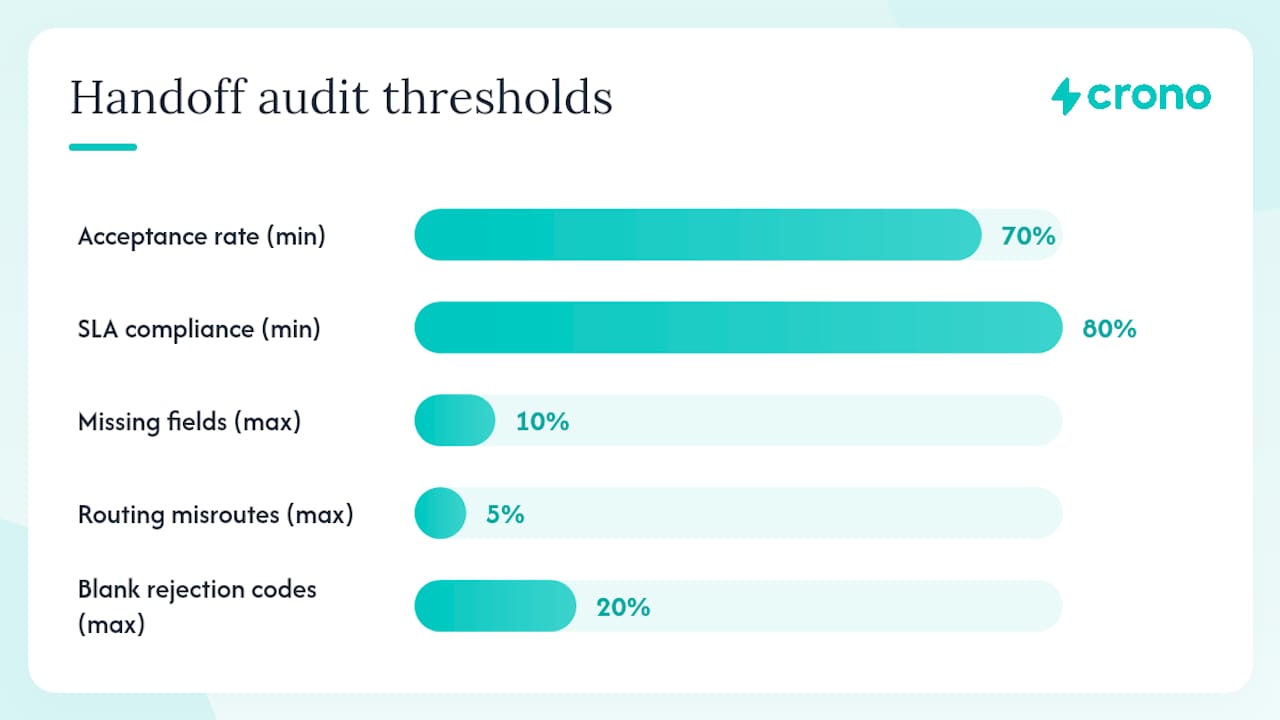
A handoff audit takes one afternoon and usually surfaces two or three fixable problems immediately.
Audit checklist:
- Acceptance rate: What percentage of routed MQLs are accepted as SQLs? Below 70% signals a definition gap.
- SLA compliance: What percentage of accepted SQLs received first contact within the agreed window? Below 80% signals a capacity or notification problem.
- Missing fields: What percentage of MQL records are missing at least one required field? Above 10% signals an enrichment or form gap.
- Routing accuracy: What percentage of leads were routed to the correct rep on first assignment? Misroutes above 5% signal a rules gap.
- Feedback loop activity: Are rejection reason codes populated? If more than 20% are blank or “other,” the loop is broken.
Three sample audit tests:
-
Timed SLA test. Submit a test lead (use an internal email alias) through your primary inbound form at 9:00 AM on a Tuesday. Record the exact time the CRM record is created, the time routing fires, and the time the assigned rep logs first activity. Pass: all three within SLA. Fail: any gap exceeds the agreed window.
-
Data-payload completeness test. Export the last 50 MQL records from your CRM. Count the percentage with all required fields populated. Pass: 90%+ complete. Fail: below 90%, or any required field missing in more than 10% of records.
-
Rejection-reason audit. Export all SQL-rejected records from the last 90 days. Count the percentage with a populated, specific reason code. Pass: 90%+ have a specific code. Fail: more than 10% are blank or “other” without a free-text note.
That pattern points to three simultaneous problems: a definition gap, a broken feedback loop, and a slow-response culture. Fix them in that order.
Prioritized fixes after a failing audit:
- First: Convene a joint criteria alignment session and rewrite MQL/SQL definitions.
- Second: Add required rejection reason codes to the CRM and enforce them with a validation rule.
- Third: Set an SLA timer automation that escalates to the manager if first contact is not logged within the agreed window.
Pro Tip: Run the timed SLA test monthly, not just once. SLA compliance tends to drift as team capacity changes, and a monthly test catches regression before it shows up in win-rate data.
Common fixes to stabilize the handoff, organized by time horizon
Immediate fixes (this week):
- Clarify ownership: document who owns each status transition and make it visible in the CRM.
- Write a one-page MQL/SQL definition and get sign-off from both marketing and sales leadership.
- Add required rejection reason codes with a CRM validation rule that blocks blank submissions.
- Set a visible SLA dashboard so reps and managers can see compliance in real time.
Medium-term fixes (30–90 days):
- Calibrate lead scoring against the last 6 months of closed-won data. Identify which behavioral events actually predicted conversion and weight them accordingly.
- Automate enrichment on lead capture so required fields are populated before routing fires.
- Build a re-nurture workflow for “not ready yet” rejections: tag them, return them to marketing, and trigger a 30-day sequence with a re-qualification check at the end.
- Implement a routing engine if you are using manual assignment. Even native CRM assignment rules beat a spreadsheet.
Long-term fixes (90+ days):
- Build ABM routing logic that identifies named accounts and routes them to dedicated AEs with account-specific context.
- Implement closed-loop analytics: connect CRM opportunity data back to MAP campaign data so marketing can see which campaigns produce closed-won revenue, not just MQLs.
- Run a monthly lead-quality review meeting where marketing and sales ops review MQL→SQL conversion, rejection reasons, and win rates together.
Team rituals that sustain improvement:
- Weekly: Review the SLA compliance dashboard and flag any rep or segment below threshold.
- Monthly: Hold a 30-minute handoff retro: review rejection reasons, recalibrate scoring if needed, and update routing rules for any new segments.
- Quarterly: Revisit MQL/SQL definitions against closed-won data and adjust thresholds.
Measuring impact after each fix: Track MQL→SQL conversion rate, time-to-first-touch, and lead acceptance rate as your primary indicators. Expect meaningful movement within 30 days of implementing definition alignment and SLA enforcement.
How Crono orchestrates reliable handoffs with signal-driven automation
The operational patterns that make handoffs reliable are well understood: auto-enrich on capture, score-based routing triggers, SLA timers, and accept/reject logging inside the CRM. These automation patterns are foundational to preventing lead leakage. Where most teams struggle is connecting those patterns across tools without manual intervention.
Crono’s approach treats the handoff as an orchestration problem. Here is what a signal-driven workflow looks like in practice:
- Auto-enrich on capture: When a lead enters the system, Crono triggers enrichment automatically, filling firmographic and contact fields before any routing decision is made.
- Signal-based prioritization: Leads are scored using a composite of firmographic fit, behavioral engagement, and intent signals. High-score leads with active intent data route immediately to the assigned AE with a priority flag. Mid-score leads enter a nurture queue with a scheduled re-evaluation.
- SLA timer and escalation: The moment a lead is routed, an SLA timer starts. If the rep does not log first activity within the agreed window, Crono escalates to the manager automatically and logs the breach.
- Accept/reject with reason codes: Reps accept or reject directly within the platform. Rejection reasons are required fields, and the data feeds a weekly marketing ops report without any manual export.
For teams running ABM motions, Crono layers expected ACV into the routing decision: enterprise accounts with high intent scores route to senior AEs; mid-market accounts with moderate scores route to the standard queue or a targeted sequence.
Pro Tip: Layer three signal types before making a routing decision: firmographic fit (are they the right company?), behavioral engagement (have they shown interest?), and third-party intent (are they actively researching?). A lead that scores well on all three converts at a materially higher rate than one that scores well on only one. Use that composite score to set priority tiers, not just a binary MQL/non-MQL gate.
For teams looking to go deeper on agentic sales execution and how AI agents can handle enrichment, routing, and follow-up sequencing end to end, Crono’s execution layer connects these steps without requiring manual handoffs between tools.
The handoff is an engineering problem, not a relationship problem
Most advice on the MQL→SQL handoff focuses on getting sales and marketing to “communicate better.” That framing is not wrong, but it is incomplete. Communication improves when the process is unambiguous, not the other way around. When criteria are written down, SLAs are visible, and routing is automated, the number of conversations that need to happen drops sharply. The remaining conversations become productive because they are about calibration, not blame.
The conventional wisdom also underweights speed. Teams spend months debating lead scoring models while their reps are contacting inbound leads four hours after they arrive. The scoring model matters, but a rep calling within 30 minutes with a mediocre score will outperform a perfectly scored lead that sits in a queue until tomorrow morning.
What I see teams consistently underestimate is the feedback loop. That single data point can redirect an entire quarter of marketing spend. The loop is not a nice-to-have; it is the mechanism that makes the whole system self-correcting.
Start with the audit. Run the three tests described above. You will find the leak within an afternoon, and the fix is almost always simpler than the problem looked from the outside.
Sources
Use these sources to validate your next steps and go deeper on specific components of the handoff process.
- Are your marketing and sales teams on the same page
- How to improve Your Marketing to Sales Handoff Process | ClickUp
- What is a Sales Funnel? | Shopify
