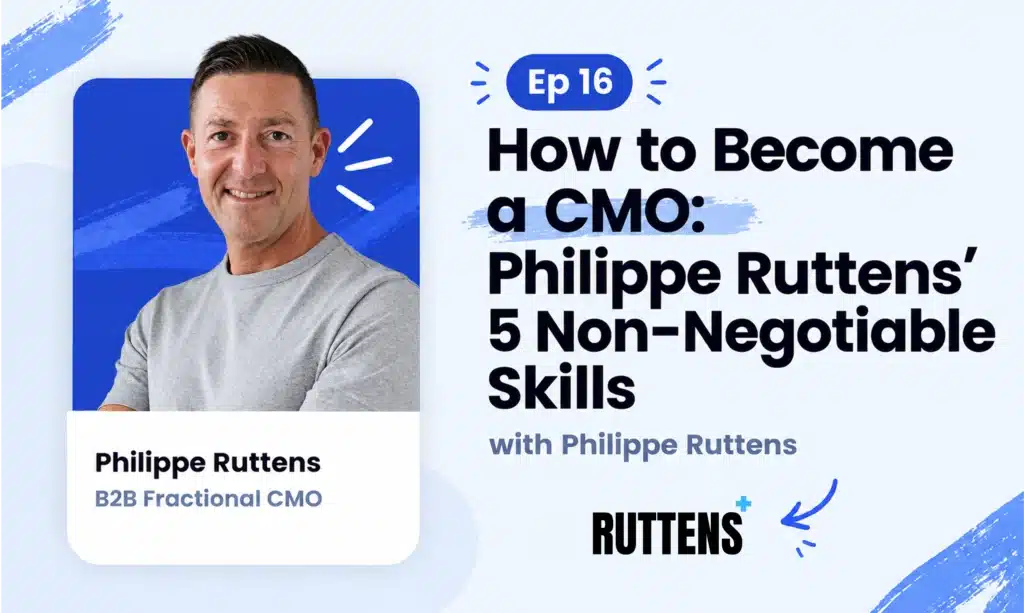
Welcome back to 5 Tips for Wannabe CMOs, our marketing column where we get to know great marketers, their stories and some inspiring tips for the next generation of CMOs.
Most marketers chase a title. Philippe Ruttens chases a number.
In this edition of Crono Talks, we sat down with him to unpack why the “sales-marketing alignment” problem almost never gets fixed with a workshop, and what he’d tell any junior marketer chasing the C-suite in the next 5-7 years. He also shares the one 30-day exercise that closes the gap between marketing and revenue faster than any dashboard ever could.
Philippe Ruttens is a B2B revenue marketing leader with nearly 30 years of experience, most recently as CMO at Tyk. He now works as a fractional CMO and coach, helping SaaS and tech companies turn marketing into a revenue-owning function.
If you’re building toward a CMO seat, or trying to figure out why your pipeline leaks between MQL and closed-won, this one’s for you.
1. Phil, to start simple: how would you personally define a “great CMO” in today’s environment, where sales and marketing are increasingly blended?
A great CMO owns a number, not a function.
Three things separate them from a good marketing director. First, they can say out loud what decision the buyer is actually making – in the buyer’s words, not the product’s. Second, they carry a commercial number, not an activity number: pipeline, win rate, payback. Third, what they build keeps working when they leave the room. If the whole thing runs on the CMO’s personal energy, that’s not marketing leadership, that’s a very expensive campaign manager.
The blending of sales and marketing hasn’t changed the job so much as removed the hiding place. You can no longer hand over a lead and call it done. The great ones treat the full commercial motion – attention, conversation, close, expansion – as one system they are accountable for.
2. You’ve worked closely with sales-driven organizations, what’s the most common disconnect you still see between marketing and sales teams?
It’s almost never a relationship problem, which is why the alignment workshops don’t fix it. It’s an ownership problem at the hand-off.
Marketing measures what it produces. Sales measures what it closes. Nobody owns the gap in between, and the gap is where the revenue leaks. Add two reliable companions: the two teams use different definitions of a qualified lead, and they speak different languages, because marketing writes from the product and sales sells in the words the buyer used on the call.
The fix is unglamorous. One shared pipeline number both teams are judged on. One written definition of a lead, agreed by both, revisited quarterly. And a weekly operating rhythm where both sides look at the same board and name what moved and what didn’t. Thirty minutes a week beats an offsite.
3. Your 5 tips for wannabe CMOs: where should someone start if they dream of reaching your level?
Sit in on deals, listen to calls, carry a target if you can. Marketers who have never felt the end of a quarter make expensive decisions
Twenty real conversations will teach you more than any certification. And do it continuously – customer context goes stale faster than people think
Generalists get hired last and briefed worst. Depth in a sector or a buyer type is what makes your judgement worth paying for.
Not a campaign, a motion: positioning, channel, follow-up, measurement, hand-off. Owning one complete system teaches more than running ten fragments.
The CMO job is judgement under uncertainty, in public. Start making calls, writing down why, and reviewing them honestly
4. If you were mentoring a junior marketer who wants to become a CMO in the next 5–7 years, what 5 skills would you tell them to master first?
- Commercial literacy. Read a P&L. Understand pipeline maths, CAC, payback, retention. If you can’t argue in those terms, you’ll be briefed rather than consulted
- Positioning and messaging. The ability to write the one sentence a buyer recognises as their own problem. It’s the highest-leverage skill in marketing and the most under-practised
- Measurement honesty. Know what your data can prove, and say clearly what it can’t. Credibility with a CEO is built on the second half of that sentence.
- Building teams and hand-offs. Hiring, clear ownership, clean hand-offs between people and systems. Most marketing underperformance is an operating problem, not a talent problem.
- Executive communication. Translate marketing into the language of the board, and influence people who don’t report to you.
5. Finally: if you had to give just one actionable tip to someone aspiring to become a CMO in a sales-led organization, what would it be?
Spend the next 30 days inside sales. Listen to recorded calls, read the lost-deal notes, join the pipeline review and say nothing.
Then rewrite your core messaging using the exact words buyers used, not the words your product team uses. Bring it back to the sales team and ask one question: would you say this on a call? If the answer is no, you have just found the real gap between marketing and revenue, and you found it faster than any dashboard would have shown you.
Not sure where to start?
Start with the Playbook.
Download our free Sales Playbook 2026 and learn how top B2B teams structure their outbound process.
BANT, SPICED & MEDDPICC frameworks
30+ ready-to-use sales templates
2026 outbound & pipeline benchmarks
Don't sell the product. Sell the change the product makes possible.
Build the process before the pipeline.