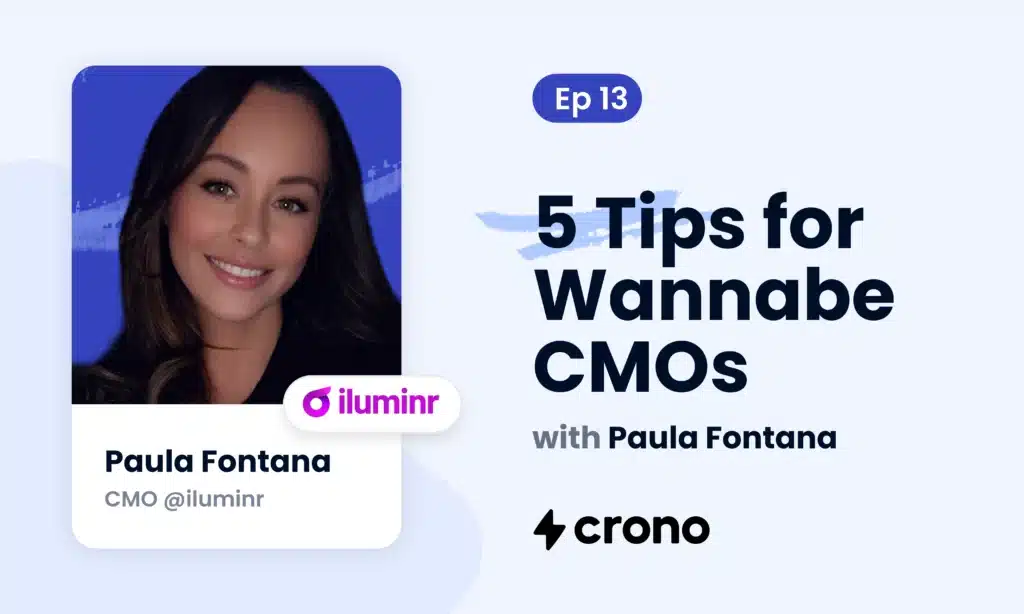
5 Tips for Wannabe CMOs: Paula Fontana on Leading Marketing With Clarity, Influence and Strategic Intent

5 Tips for Wannabe CMOs by Paula Fontana

Welcome back to 5 Tips for Wannabe CMOs, our marketing column where we get to know great marketers, their stories and some inspiring tips for the next generation of CMOs.

Wondering how to become a CMO in B2B SaaS?

The honest answer is: most of the job has nothing to do with marketing. It’s translation, integration, and judgment under pressure.

Paula Fontana has spent her career inside that reality, as a senior marketing leader across early-stage startups and high-growth SaaS companies, as a board director, and now as the founder of Eudai AI, an applied AI advisory firm helping companies perform to their greatest potential.

She’s seen marketing become the place where organizations quietly hand over their unresolved problems, misalignment, uncertainty, capability gaps, and she’s learned to spot the difference between a brand issue and a business one.

Her view of the role? The CMO isn’t the Chief Coloring Officer. They’re the Chief Integration Officer.

In this episode, she shares the five things aspiring marketing leaders actually need to hear before they chase the title.


1. Let’s start with your story.
Your journey has taken you from early-stage startups, to board director and founder of Eudai AI. What has been the project or moment that shaped you most as a CMO?

The moment that shaped me most was the moment I realized that marketing is often the first place organizations put unresolved stuff. 

When the operating environment shifts, a new bet feels risky, the team is facing some big change, growth is choppy, a new product hasn’t gotten the pickup the company anticipated – marketing becomes a kind of pressure valve.

“We need to resposition.”

“We need a new narrative.”

“We need more momentum in market.”

“We need more…”

More – or different – is not always the answer. 

Once I saw the pattern, I stopped asking how to market harder and started asking a different question: what problem is the company actually trying to solve here?

On the surface, it might look like demand or lead flow. Other times, it’s product or implementation. Brand or reputation. Underneath, there’s usually something else going on – misalignment, uncertainty, capability gaps, or unaddressed risk.

That’s when I started to see marketing less as amplification and more as translation.

Customer to company.
Company to customer.
Team to board.
Leadership to team.

That mindset followed me into board work and into founding my own applied AI advisory firm, Eudai AI, where helping companies perform to their greatest potential IS the product. 

2. If you had to give just 5 practical tips to wannabe CMOs to stand out and grow in their role, what would they be?


1. Pay attention to what keeps getting handed to marketing

The fastest way to understand the job of the CMO is to notice what lands on marketing’s desk that isn’t actually marketing.

If you’re asked to: explain unclear strategy, create confidence where there’s no operational backing, align teams that don’t agree – you’re already doing senior-level work.

The step change at this point is deciding when to go with the tide of the organization, when to push back, and when to reframe the problem entirely.

2. Learn to see time as your main constraint

A lot of the benchmarking tends to focus on levers such as budget, how much headcount you need, or the best tools to use to achieve a particular outcome… but the real constraint is time.

Outcomes lag decisions. Momentum decays. Credibility compounds slowly and erodes quickly. You can be right and still be early. 

One of the most valuable skills is learning to see where today’s decisions are drawing from the future versus investing in it – and having the discipline to choose accordingly. 

3. Build a relationship with uncertainty instead of trying to eliminate it

The more senior you get, certainty gets more and more elusive. Often there is no right answer. 

Focus instead on finding ways to test assumptions safely, reduce the number of irreversible decisions the organization is making, and create optionality for the business. 

If you’re uncomfortable sitting in ambiguity, this role will feel heavier than it needs to be.

4. Influence is not persuasion

Early-career marketing teaches you how to persuade.

enior marketing requires you to shape what decisions the organization is making and how it is making them.

That means:

Framing choices before opinions form

Making the tradeoffs visible

Changing what gets discussed altogether

The breadth of the role means you see things others don’t.

That visibility can look political from the outside.

In practice, it’s a responsibility: serving as a watchtower for the board, leadership team, organization, and ultimately, customers and shareholders.

5.Practice letting go of being right

The more senior you get, the less useful it is to be the smartest person in the room. What matters more is whether the organization itself is making better decisions.

And sometimes that means:

Letting a weaker idea run so the organization can learn why it doesn’t work

Holding back a better idea because you know the timing isn’t right

Being directionally right, even if you never get “credit”

If you are lucky, your most impactful legacy will be creating movements that live well outside the bounds of your leadership.

If you need visible wins to feel effective, the role will frustrate you. 

3. What’s one thing about being a CMO that most people wouldn’t expect, or a “myth” you’d like to bust?

The biggest myth is that the CMO is the ‘Chief Coloring Officer’ – the person who makes things look good. 

In reality, the CMO is often the Chief Integration Officer. You are the one person in the C-suite who has this incredible role connecting the dots between what the product does, what the market wants, and how the team acquires (and keeps) happy customers. 

Most people don’t expect how much of the job is actually internal diplomacy, data systems, and organizational design rather than picking out color palettes or great slogans.

4. We all know marketing and sales can sometimes feel like rivals. In your experience, how do you channel that friction into a driver for growth?

The friction never goes away, and I don’t think that’s a bad thing.

Sales optimizes for now. Marketing has to protect later. When those perspectives disagree, it usually means there is something to pay attention to.

What helps:

Shared definitions and shared data

Agreement on time horizons

Using customer behavior – not internal opinion – as the source of truth

When handled well, the tension sharpens focus. When avoided, it turns into politics. A CMO’s job is to design conditions where that organizational friction produces insight.

One last thing: send the elevator back down

As you move closer to senior leadership, you realize how much of your progress came from people who:

  • Opened a door
  • Told you the truth
  • Made space for you when they didn’t have to

Part of growing into the CMO role is doing the same – for your team, your peers, your network, and the younger version of you that’s still figuring it out.


Not sure where to start? Let's talk.

Schedule a session with one of our specialists and get our exclusive Sales Playbook 2026 for free.

In this article

Start your sales revolution

Join 300+ sales teams using Crono and change your sales game.

Picture of Alessandra Bertelli
Alessandra Bertelli
Marketing Specialist

⚡️Bolt - The B2B Sales newsletter by Crono

Subscribe to our newsletter to receive monthly updates and insights on the future of B2B Sales!